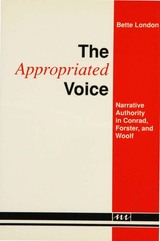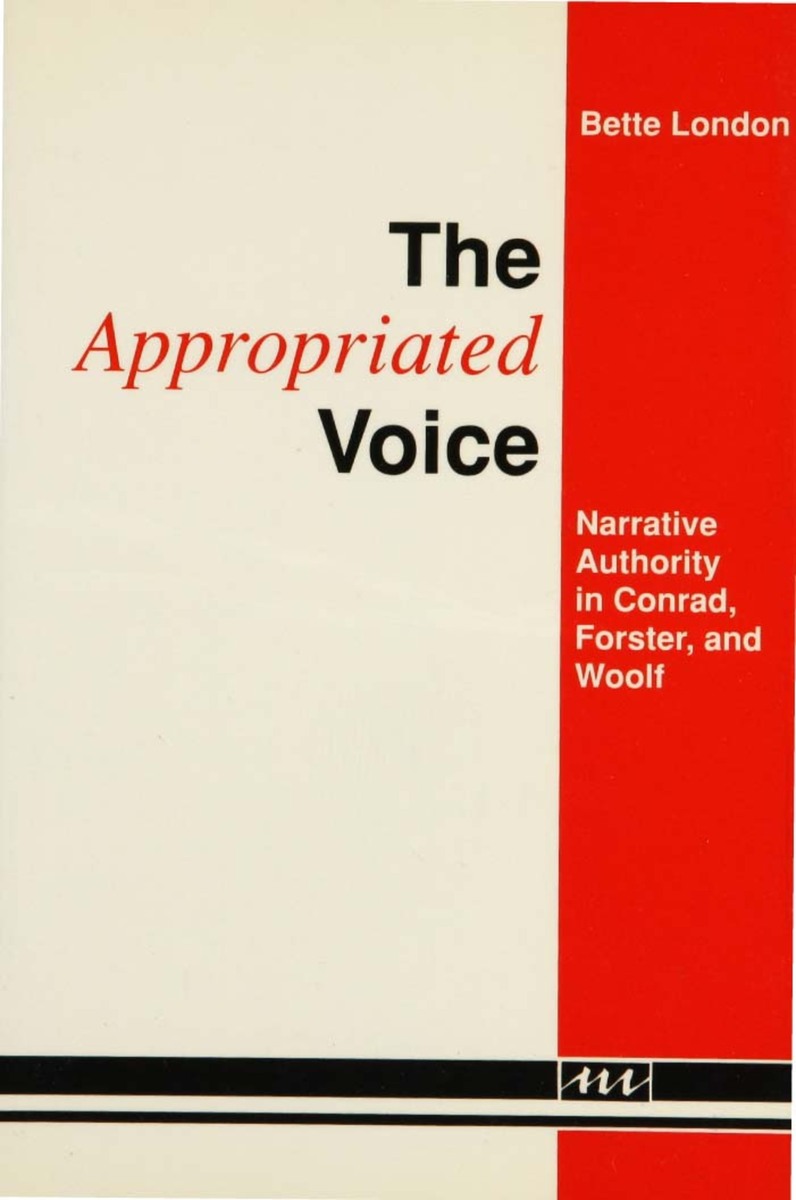
The Appropriated Voice: Narrative Authority in Conrad, Forster, and Woolf
University of Michigan Press, 1990
Cloth: 978-0-472-10160-3 | eISBN: 978-0-472-22494-4 (standard)
Library of Congress Classification PR888.M63L66 1990
Dewey Decimal Classification 823.91209
Cloth: 978-0-472-10160-3 | eISBN: 978-0-472-22494-4 (standard)
Library of Congress Classification PR888.M63L66 1990
Dewey Decimal Classification 823.91209
ABOUT THIS BOOK | AUTHOR BIOGRAPHY | REQUEST ACCESSIBLE FILE
ABOUT THIS BOOK
The Appropriated Voice: Narrative Authority in Conrad, Forster, and Woolf reassesses questions of voice in three central modernist texts: Heart of Darkness, A Passage to India, and To the Lighthouse. Representing voice as the site of a struggle articulated on a number of fronts, Bette London challenges traditional assumptions about voice as a reliable marker of individuality, originality, self-identity, and aesthetic autonomy—assumptions reinforced in the recent reconstructions of modernism in postmodernism’s discourses.Drawing upon narrative theory, cultural criticism, and cultural ethnography, as well as feminist theory, London provides a sophisticated critique of the conventional categories at work in both traditional and revisionist criticism. Her method reveals the narrative and cultural appropriations through which modernism speaks, and produces what might be called modernism’s other ideology: its performance of its own political and aesthetic complicities; its display of its own second-handedness.The book is a contribution to contemporary theoretical debates as well as to the scholarship pertaining to Conrad, Forster, and Woolf.
See other books on: 1882-1941 | English fiction | Modernism (Literature) | Narration (Rhetoric) | Sex role in literature
See other titles from University of Michigan Press