
 A SCHOLARLY BOOK REPOSITORY
Lyric Interventions explores linguistically innovative poetry by contemporary women in North America and Britain whose experiments give rise to fresh feminist readings of the lyric subject. The works discussed by Linda Kinnahan explore the lyric subject in relation to the social: an “I” as a product of social discourse and as a conduit for change.
Contributing to discussions of language-oriented poetries through its focus on women writers and feminist perspectives, this study of lyric experimentation brings attention to the cultural contexts of nation, gender, and race as they significantly shift the terms by which the “experimental” is produced, defined, and understood.
This study focuses upon lyric intervention in distinct but related spheres as they link public and ideological norms of identity. Firstly, lyric innovations with visual and spatial realms of cultural practice and meaning, particularly as they naturalize ideologies of gender and race in North America and the post-colonial legacies of the Caribbean, are investigated in the works of Barbara Guest, Kathleen Fraser, Erica Hunt, and M. Nourbese Philip. Secondly, experimental engagements with nationalist rhetorics of identity, marking the works of Carol Ann Duffy, Denise Riley, Wendy Mulford, and Geraldine Monk, are explored in relation to contemporary evocations of “self” in Britain. And thirdly, in discussions of all of the poets, but particularly accenuated in regard to Guest, Fraser, Riley, Mulford, and Monk, formal experimentation with the lyric “I” is considered through gendered encounters with critical and avant-garde discourses of poetics.
This fresh, energetic study will be of great interest to literary critics and womens studies scholars, as well as poets on both sides of the Atlantic.
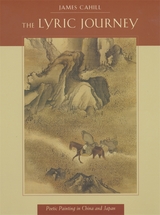
Creating paintings with poetic resonances, sometimes with ties to specific lines of poetry, is a practice that began in China in the eleventh century, the Northern Sung period. James Cahill vividly surveys its first great flowering among artists working in the Southern Sung capital of Hangchou, probably the largest and certainly the richest city on earth in this era. He shows us the revival of poetic painting by late Ming artists working in the prosperous city of Suchou. And we learn how artists in Edo-period Japan, notably the eighteenth-century Nanga masters and the painter and haiku poet Yosa Buson, transformed the style into a uniquely Japanese vehicle of expression.
In all cases, Cahill shows, poetic painting flourished in crowded urban environments; it accompanied an outpouring of poetry celebrating the pastoral, escape from the city, immersion in nature. An ideal of the return to a life close to nature—the “lyric journey”—underlies many of the finest, most moving paintings of China and Japan, and offers a key for understanding them.
Schwarzenbach’s clear, psychologically acute prose makes this novella an evocative narrative, with many intriguing parallels to her own life.
Annemarie Schwarzenbach—journalist, novelist, antifascist, archaeologist, and traveler—has become a European cult figure for bohemian free spirits since the rediscovery of her works in the late 1980s. Lyric Novella is her story of a young man’s obsession with a Berlin variété actress. Despite having his future career mapped out for him in the diplomatic service, the young man begins to question all his family values under Sibylle’s spell. His family, future, and social standing become irrelevant when set against his overriding compulsion to pick her up every night from the theater so they can go for a drive. Bringing the story back to her own life, Schwarzenbach admitted after publication that her hero was in fact a young woman, not a man, leaving little doubt that Lyric Novella is a literary tale of lesbian love during socially and politically turbulent times.
In poet and critic James Longenbach’s title, the word “now” does double duty, evoking both a lyric sense of the present and twentieth-century writers’ assertion of “nowness” as they crafted their poetry in the wake of Modernism. Longenbach examines the fruitfulness of poetic repetition and indecision, of naming and renaming, and of the evolving search for newness in the construction, history, and life of lyrics. Looking to the work of thirteen poets, from Marianne Moore and T. S. Eliot through George Oppen and Jorie Graham to Carl Phillips and Sally Keith, and several musicians, including Virgil Thomson and Patti Smith, he shows how immediacy is constructed through language. Longenbach also considers the life and times of these poets, taking a close look at the syntax and diction of poetry, and offers an original look at the nowness of lyrics.

What does it mean to be a person? One might think of the possession of certain rights, having the capacity for love, or being self-determined. But if words like “person” or “love” seem to carry an internal meaning, where does this meaningfulness come from? Lyric Personhood contends that to be encultured in the modern West is to learn, on top of everything else, an unspoken and mostly felt sense of what it means to be someone, a sense transmitted not only in language but also through encounters with aesthetic form. Through close readings that span nineteenth-century European opera, commercial cinema, and amateur YouTube proposal videos, Dan Wang shows that a “person” has become an aesthetic concept—and not just a legal, moral, political, or philosophical one—in the last two hundred years of Western culture.
It’s hard to let go of the organizing promise of romantic love, the dream of therapeutic “health,” and the aspiration to belong to national culture, Wang argues, because these longings have been shaped by an archive of sentimental and melodramatic works that trains people's expectations for life, genre, and even the knowing promised in theory itself. Tracing a surprisingly continuous imagination of personhood through opera and film aesthetics, Lyric Personhood introduces modes of reading audiovisual works that allow a longer story to be told about the forms that make personhood sensible in the West.
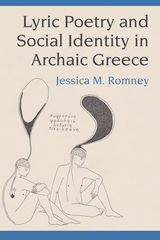
All non-English text and quotes are translated, with the original languages given alongside the translation or in the endnotes.

Pietro Bembo (1470-1547), scholar and critic, was one of the most admired Latinists of his day. After some years at the court of Urbino, where he exchanged Platonic love letters with Lucrezia Borgia, he moved to Rome and served as secretary to Leo X (1513-1520). Later he retired to Padua and a life of letters. He was made a cardinal in 1539. The poems in this volume come from all periods of his life and reflect both his erudition and his wide-ranging friendships. This verse edition is the first time they have been translated into English.
This volume also includes the prose dialogue Etna, an account of Bembo's ascent of Mt. Etna in Sicily during his student days, translated by Betty Radice.
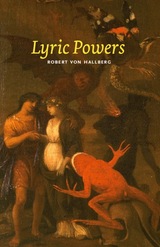
To explain why a reader might prefer one kind of poem to another, von Hallberg analyzes—beyond the political and intellectual significance of poems—the musicality of both lyric poetry and popular song, including that of Tin Pan Alley and doo-wop. He shows that poets have distinctive intellectual resources—not just rhetorical resources—for examining their subjects, and that the power of poetic language to generalize, not particularize, is what justly deserves a critic’s attention.
The first book in more than a decade from this respected critic, Lyric Powers will be celebrated as a genuine event by readers of poetry and literary criticism.
Bringing a provocative perspective to the poetry wars that have divided practitioners and critics for decades, Gillian White argues that the sharp disagreements surrounding contemporary poetics have been shaped by “lyric shame”—an unspoken but pervasive embarrassment over what poetry is, should be, and fails to be.
Favored particularly by modern American poets, lyric poetry has long been considered an expression of the writer’s innermost thoughts and feelings. But by the 1970s the “lyric I” had become persona non grata in literary circles. Poets and critics accused one another of “identifying” with lyric, which increasingly bore the stigma of egotism and political backwardness. In close readings of Elizabeth Bishop, Anne Sexton, Bernadette Mayer, James Tate, and others, White examines the social and critical dynamics by which certain poems become identified as “lyric,” arguing that the term refers less to a specific literary genre than to an abstract way of projecting subjectivity onto poems. Arguments about whether lyric poetry is deserving of praise or censure circle around what White calls “the missing lyric object”: an idealized poem that is nowhere and yet everywhere, and which is the product of reading practices that both the advocates and detractors of lyric impose on poems. Drawing on current trends in both affect and lyric theory, Lyric Shame unsettles the assumptions that inform much contemporary poetry criticism and explains why the emotional, confessional expressivity attributed to American lyric has become so controversial.
Engaging with poets such as Gwendolyn Brooks, H.D., Lorine Niedecker, Alice Notley, and Myung Mi Kim, this book asks: What does lyric mean, and why should it matter to poets and readers? Lyric Trade argues that lyric in the postwar long poem not only registers the ideological contradictions of modernism’s insistence on new forms, but that it also maps spaces for formal reimaginings of the subject.
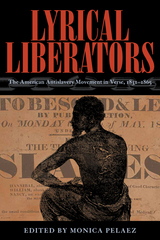
Before Black Lives Matter and Hamilton, there were abolitionist poets, who put pen to paper during an era when speaking out against slavery could mean risking your life. Indeed, William Lloyd Garrison was dragged through the streets by a Boston mob before a planned lecture, and publisher Elijah P. Lovejoy was fatally shot while defending his press from rioters. Since poetry formed a part of the cultural, political, and emotional lives of readers, it held remarkable persuasive power. Yet antislavery poems have been less studied than the activist editorials and novels of the time.
In Lyrical Liberators, Monica Pelaez draws on unprecedented archival research to recover these poems from the periodicals—Garrison’s Liberator, Frederick Douglass’s North Star, and six others—in which they originally appeared. The poems are arranged by theme over thirteen chapters, a number that represents the amendment that finally abolished slavery in 1865. The book collects and annotates works by critically acclaimed writers, commercially successful scribes, and minority voices including those of African Americans and women.
There is no other book like this. Sweeping in scope and passionate in its execution, Lyrical Liberators is indispensable for scholars and teachers of American literature and history, and stands as a testimony to the power of a free press in the face of injustice.
Owens-Murphy surveys a broad array of writers: poets from the lyrical transatlantic tradition, as well as American novelists including Gertrude Stein, Jean Toomer, William Faulkner, Toni Morrison, Louise Erdrich, and Cormac McCarthy. Through a masterful reexamination of canonical works of twentieth-century American fiction through the lens of lyric poetry, she reveals how many elements in these novels can be better understood as poetic and rhetorical figures (metaphysical conceit, polysyndeton, dramatic monologue, apostrophe, and so on) than as narrative ones.
Making fresh contributions to literary theory and American fiction, Lyrical Strategies will fascinate readers and scholars of the American novel, fiction, poetry, and poetics alike.
Cold water is the drink for me / Of all the drinks the best, sir; / Your grog, of whate’er name it be, / I dare not for to taste, sir.
Such a lyric, sung to the tune of “Yankee Doodle,” was typical ammunition in the temperance movement’s battle against alcohol. By the 1830s, Americans drank an average of 9.5 gallons of hard liquor each year. From the 1840s until the beginning of Prohibition, well over one hundred temperance songbooks were published in which inspirational lyrics were set to mostly borrowed tunes in the hope of persuading citizens to put down the bottle.

Hope Glidden’s accessible introduction, along with the notes she and Shapiro provide on specific poems, will increase readers’ enjoyment and illuminate the historical and linguistic issues relating to this wealth of more than 150 lyric poems.
“A marvelous micro-anthology of sixteenth-century French letters. Representing the pinnacle of French Renaissance verse, the poems singled out here are sensitively interpreted in rhymed English versions. . . . There is a pleasant and inspiring craftsmanship in these interpretations.”—Virginia Quarterly Review
"A standard source both for Soviet specialists and for sociologists of science."—American Journal of Sociology
"Joravsky has produced . . . the most detailed and authoritative treatment of Lysenko and his view on genetics."—New York Times Book Review
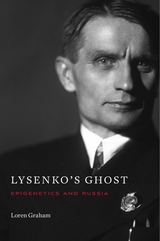
The Soviet agronomist Trofim Lysenko became one of the most notorious figures in twentieth-century science after his genetic theories were discredited decades ago. Yet some scientists, even in the West, now claim that discoveries in the field of epigenetics prove that he was right after all. Seeking to get to the bottom of Lysenko’s rehabilitation in certain Russian scientific circles, Loren Graham reopens the case, granting his theories an impartial hearing to determine whether new developments in molecular biology validate his claims.
In the 1930s Lysenko advanced a “theory of nutrients” to explain plant development, basing his insights on experiments which, he claimed, showed one could manipulate environmental conditions such as temperature to convert a winter wheat variety into a spring variety. He considered the inheritance of acquired characteristics—which he called the “internalization of environmental conditions”—the primary mechanism of heredity. Although his methods were slipshod and his results were never duplicated, his ideas fell on fertile ground during a time of widespread famine in the Soviet Union.
Recently, a hypothesis called epigenetic transgenerational inheritance has suggested that acquired characteristics may indeed occasionally be passed on to offspring. Some biologists dispute the evidence for this hypothesis. Loren Graham examines these arguments, both in Russia and the West, and shows how, in Russia, political currents are particularly significant in affecting the debates.
This is the second volume in the Oratory of Classical Greece series. Planned for publication over several years, the series will present all of the surviving speeches from the late fifth and fourth centuries B.C. in new translations prepared by classical scholars who are at the forefront of the discipline. These translations are especially designed for the needs and interests of today's undergraduates, Greekless scholars in other disciplines, and the general public.
Classical oratory is an invaluable resource for the study of ancient Greek life and culture. The speeches offer evidence on Greek moral views, social and economic conditions, political and social ideology, and other aspects of Athenian culture that have been largely ignored: women and family life, slavery, and religion, to name just a few.
This volume contains all the complete works and eleven of the largest fragments attributed to Lysias, the leading speechwriter of the generation (403-380 B.C.) after the Peloponnesian War, who was also one of the finest and most deceptive storytellers of all time. As a noncitizen resident in Athens, Lysias could take no direct part in politics, but his speeches, written for clients to deliver in court, paint vivid pictures of various private and public disputes: one speaker defends himself on a charge of murdering his wife's lover, while another is accused of having caused the deaths of democratic activists under the short-lived oligarchy of the Thirty (404/3), despite his claim to be protected by the amnesty that accompanied the restoration of democracy in 403.
Attic eloquence.
Lysias (ca. 458–ca. 380 BC), born at Athens, son of a wealthy Syracusan settled in Attica, lived in Piraeus, where with his brother he inherited his father’s shield factory. Being a loyal supporter of democracy, Lysias took the side of the democrats at Athens against the Thirty Tyrants in 404, supplying shields and money. After one political speech in accusation of Eratosthenes (one of the Thirty) in 405, he became at Athens a busy professional speech writer for the law courts. At the Olympic festival of 388 he denounced, with riotous results, the costly display of the embassy sent by Dionysius I of Syracuse and the domination of Sicily by Dionysius.
The surviving speeches of Lysias (about thirty complete out of a very much larger number) are fluent, simple, and graceful in style yet vivid in description. They suggest a passionate partisan who was also a gentle, humorous man. We see in him the art of oratory young and fresh.
Plato, the great philosopher of Athens, was born in 427 BCE. In early manhood an admirer of Socrates, he later founded the famous school of philosophy in the grove Academus. Much else recorded of his life is uncertain; that he left Athens for a time after Socrates' execution is probable; that later he went to Cyrene, Egypt, and Sicily is possible; that he was wealthy is likely; that he was critical of 'advanced' democracy is obvious. He lived to be 80 years old. Linguistic tests including those of computer science still try to establish the order of his extant philosophical dialogues, written in splendid prose and revealing Socrates' mind fused with Plato's thought.
In Laches, Charmides, and Lysis, Socrates and others discuss separate ethical conceptions. Protagoras, Ion, and Meno discuss whether righteousness can be taught. In Gorgias, Socrates is estranged from his city's thought, and his fate is impending. The Apology (not a dialogue), Crito, Euthyphro, and the unforgettable Phaedo relate the trial and death of Socrates and propound the immortality of the soul. In the famous Symposium and Phaedrus, written when Socrates was still alive, we find the origin and meaning of love. Cratylus discusses the nature of language. The great masterpiece in ten books, the Republic, concerns righteousness (and involves education, equality of the sexes, the structure of society, and abolition of slavery). Of the six so-called dialectical dialogues Euthydemus deals with philosophy; metaphysical Parmenides is about general concepts and absolute being; Theaetetus reasons about the theory of knowledge. Of its sequels, Sophist deals with not-being; Politicus with good and bad statesmanship and governments; Philebus with what is good. The Timaeus seeks the origin of the visible universe out of abstract geometrical elements. The unfinished Critias treats of lost Atlantis. Unfinished also is Plato's last work of the twelve books of Laws (Socrates is absent from it), a critical discussion of principles of law which Plato thought the Greeks might accept.
The Loeb Classical Library edition of Plato is in twelve volumes.
Platonic forms of love.
Plato of Athens, who laid the foundations of the Western philosophical tradition and in range and depth ranks among its greatest practitioners, was born to a prosperous and politically active family circa 427 BC. In early life an admirer of Socrates, Plato later founded the first institution of higher learning in the West, the Academy, among whose many notable alumni was Aristotle. Traditionally ascribed to Plato are thirty-five dialogues developing Socrates’ dialectic method and composed with great stylistic virtuosity, together with the Apology and thirteen letters.
The three works in this volume, though written at different stages of Plato’s career, are set toward the end of Socrates’ life (from 416) and explore the relationship between two people known as love (erōs) or friendship (philia). In Lysis, Socrates meets two young men exercising in a wrestling school during a religious festival. In Symposium, Socrates attends a drinking party along with several accomplished friends to celebrate the young tragedian Agathon’s victory in the Lenaia festival of 416: the topic of conversation is love. And in Phaedrus, Socrates and his eponymous interlocutor escape the midsummer heat of the city to the banks of the river Ilissus, where speeches by both on the subject of love lead to a critical discussion of the current state of the theory and practice of rhetoric.
This edition, which replaces the original Loeb editions by Sir Walter R. M. Lamb and by Harold North Fowler, offers text, translation, and annotation that are fully current with modern scholarship.
A perennial classroom and stage favorite as well as the basis of Spike Lee’s Chi-Raq, the play is as relevant today as it was 2,500 years ago. The premise is simplicity itself: to end the Peloponnesian War, women decide to withhold sex from their husbands until the fighting stops.
The play is by turns raucous, bawdy, frantic, and funny. David Mulroy’s exciting new translation retains the original’s verse format, racy jokes, and vibrancy—setting it apart from previous efforts, which are typically reproduced as prose or depart from meaning and meter. His introduction offers a concise summary of Aristophanes’ life and social milieu, including a brief overview of the Peloponnesian War, which took place during the playwright’s lifetime. The appendices include guides on translating meter and Greek pronunciation for aspiring thespians.
This teacher's guide to the intermediate anthology and workbook suggests a variety of classroom communicative activities for both pairs and small groups.
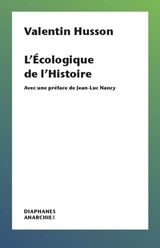
Il y a plaisir à saluer l‘arrivée d’un philosophe tout neuf qui soudain bondit dans le cortège dionysiaque. Plus on est de fous, plus on pense, le proverbe dit vrai et notre temps de misère a plus que besoin de se refaire – s’il se peut – une vigueur spéculative. Il y a plus que du plaisir, une vraie jubilation lorsque le tout neuf philosophe affirme une pensée de la jouissance, de l’abondance et de la dépense au sens de Bataille (ici toujours discrètement mais efficacement présent). Une pensée énergique au sens le plus – oserais-je dire « vitalisant » du terme. L’energeia n’a-t-elle de sens que depuis l’être ? N’y a-t-il pas une autre énergie à penser ? Une énergie non pas de l’être, ni relative à celle extraite de la nature pour des fins productives et économiques, mais une énergie excédentaire, une sorte de « dépense improductive » (Bataille) de la vie ? Une énergie qui serait le luxe biologique du vivant. Ce luxe biologique, Valentin Husson le pense comme – on ne peut plus dire « ontologique » – comme existence en un sens qui se dérobe à Heidegger et à son « sens de l’être » pour affirmer un avoir à être selon lequel l’être se dissipe au-delà de toute consistance tandis que l’avoir à prend toute l’énergie d’une vie en débordante envie d’elle-même. Jean-Luc Nancy

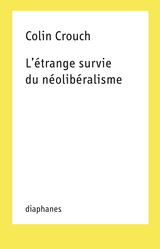
L'Étrange Survie du néolibéralisme s'efforce en effet de révéler comment ce combat s'est soldé par l'avènement de très grandes entreprises, un nouveau pouvoir qui fait désormais pièce à l'État comme aux marchés. Loin de s'apparenter à un aride examen des théories néolibérales, ce texte très accessible cherche à penser le rôle de la « société civile », la seule force, selon l'auteur, en mesure de faire face à la triade formée par le marché, l’État et les conglomérats.
READERS
Browse our collection.
PUBLISHERS
See BiblioVault's publisher services.
STUDENT SERVICES
Files for college accessibility offices.
RECENTLY PUBLISHED





UChicago Accessibility Resources
home | accessibility | search | about | contact us
BiblioVault ® 2001 - 2025
The University of Chicago Press