
 A SCHOLARLY BOOK REPOSITORY
11 start with L start with L
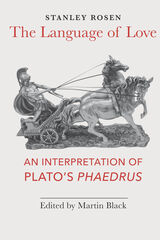
Here Rosen’s argue for the possibility of philosophy or the retrieval of human self-knowledge on the basis of a renewed argument for the partial intelligibility of ordinary experience or, in other words, for the Platonic Ideas. His book on the Symposium was an important contribution to the subsequent sea change in Plato scholarship that returned attention to the dialogue form and to the poetic side of philosophy even in its quarrel with philosophy. That change allowed us search for understanding in the light of the whole, a whole which is otherwise, as Rosen has shown elsewhere, fragmented by the scientism of analytical philosophy or the historicism of “Continental” philosophy.
The Language of Love represents a missing key to Stanley Rosen’s work and, much more significantly, to the rediscovery of philosophy in our time. The title of the book is not merely a play on words. It points to the incommensurability between the constructed or historical nature of language or culture and the pre-discursive apprehension of things that is necessary if speech is to make sense and be understood, as opposed to being mere nonsense.
Among many valuable insights along the way, Rosen unites the dialogue in two parts, treating both eros and rhetoric, showing the linkage between eros and writing, as between myth and analysis. He connects the comic attempt to subject eros to diaeresis in the Phaedrus with the attempt to understand non-being as an eidos in the Sophist. In both cases, the inadequacy of a technical understanding of philosophy returns us to the pre-technical world of ordinary experience.
Rosen’s interpretation is an expression of the Socratic claim that we can’t speak beautifully without knowing the truth and that whatever truth we speak or write is a reflection of the silent invisibility of beauty as the unity of form. However, “Like every good teacher, it does not simply state that link for us to memorize. Instead, we must recollect it.”
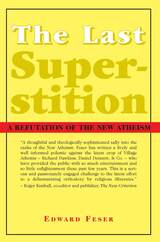
The central contention of the “New Atheism” of Richard Dawkins, Daniel Dennett, Sam Harris, and Christopher Hitchens is that there has for several centuries been a war between science and religion, that religion has been steadily losing that war, and that at this point in human history a completely secular scientific account of the world has been worked out in such thorough and convincing detail that there is no longer any reason why a rational and educated person should find the claims of any religion the least bit worthy of attention.
But as Edward Feser argues inThe Last Superstition, in fact there is not, and never has been, any war between science and religion at all. There has instead been a conflict between two entirely philosophical conceptions of the natural order: on the one hand, the classical “teleological” vision of Plato, Aristotle, Augustine, and Aquinas, on which purpose or goal-directedness is as inherent a feature of the physical world as mass or electric charge; and the modern “mechanical” vision of Descartes, Hobbes, Locke, and Hume, according to which the physical world is comprised of nothing more than purposeless, meaningless particles in motion. As it happens, on the classical teleological picture, the existence of God, the immortality of the soul, and the natural-law conception of morality are rationally unavoidable. Modern atheism and secularism have thus always crucially depended for their rational credentials on the insinuation that the modern, mechanical picture of the world has somehow been established by science. Yet this modern “mechanical” picture has never been established by science, and cannot be, for it is not a scientific theory in the first place but merely a philosophical interpretation of science. Moreover, as Feser shows, the philosophical arguments in its favor given by the early modern philosophers were notable only for being surprisingly weak. The true reasons for its popularity were then, and are now, primarily political: It was a tool by which the intellectual foundations of ecclesiastical authority could be undermined and the way opened toward a new secular and liberal social order oriented toward commerce and technology. So as to further these political ends, it was simply stipulated, by fiat as it were, that no theory inconsistent with the mechanical picture of the world would be allowed to count as “scientific.” As the centuries have worn on and historical memory has dimmed, this act of dogmatic stipulation has falsely come to be remembered as a “discovery.”
However, not only is this modern philosophical picture rationally unfounded, it is demonstrably false. For the “mechanical” conception of the natural world, when worked out consistently, absurdly entails that rationality, and indeed the human mind itself, are illusory. The so-called “scientific worldview” championed by the New Atheists thus inevitably undermines its own rational foundations; and into the bargain (and contrary to the moralistic posturing of the New Atheists) it undermines the foundations of any possible morality as well. By contrast, and as The Last Superstition demonstrates, the classical teleological picture of nature can be seen to find powerful confirmation in developments from contemporary philosophy, biology, and physics; moreover, morality and reason itself cannot possibly be made sense of apart from it. The teleological vision of the ancients and medievals is thereby rationally vindicated – and with it the religious worldview they based upon it.
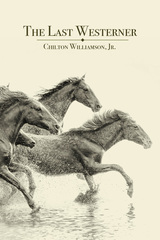
This is a tale of one man's road toward fulfillment that plays out in stages of encounters and abandonment instead of one glorious "last stand" expected in a Western romance. Williamson's story weaves the best elements of several genres and with masterful dialogue he illustrates the landscape of a heart cultivated and ravaged by the challenges that emerge in his path. The majestic setting of the rugged west and its horses is not the main aesthetical context, however. "For [us] women were the whole world and the promise of it, men being hardly more than rivals in love to be challenged and defeated." The Last Westerner is an ode to human happiness embodied in women, and "the kind that comes from a sense of the wholeness, the absolute rightness, of it all." Williamson seems to mean that without women (and horses) no such answers will ever be found. "People without hope don't write books, they say. Neither do men who love women––one woman in particular––lack hope."
Jeb Stuart Ryder, at 51 a retired range detective from Wyoming, meets Jody James, a handsome widowed cowgirl at a horse show in Moab, Utah, where she is exhibiting her prize horse. They begin an idyllic life together until this horse is stolen, and he pledges to pursue the thieves and bring him back to her. Along the way he meets a 16-year-old Navajo boy, John-Wayne Bilagody, who joins the search but with the intention of offering this horse to his own woman. Jeb takes it upon himself to instruct John-Wayne in the proper chivalric attitude a man owes a woman. When they come to the camp of brigada who now possesses the horse, Jeb's world strains to accommodate the existence of Carmen, the beautiful and aristocratic woman who is preparing to lead those men back into Mexico. She has his horse, but his pledge to return it to Jody holds fast. His promise had been a sign of hope, but Jeb at long last arrives at a pass that he knows is the real path to his sunset.
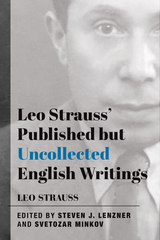
The most complete record of Strauss's thought includes his books together with his other published and unpublished writings and lectures. The achievement of this volume is to present in one collection every piece Strauss chose to publish in English that he did not himself include in a collection or a book. The material is arranged chronologically so as to avoid undue categorization by the editors.
Among the highlights of these works published between 1937 and 1972 are striking formulations not to be found in his books on the relationship between philosophy and society, which is perhaps the most prominent theme in Strauss’s corpus taken as a whole; rare ‘personal’ statements that shed light on his self-understanding as a philosopher; his first writing devoted solely to a classical thinker (“The Spirit of Sparta or the Taste of Xenophon”); his first piece devoted to Plato, “On a New Interpretation of Plato’s Political Philosophy,” his most searching engagement with Jean-Jacques Rousseau; his first treatment of the thought of Niccolò Machiavelli and a wonderful, later treatment of Machiavelli’s relation to ancient writers; and a critical review of a book on Xenophon’s Hellenica.
This complete collection of Strauss’s scattered work in English is invaluable for those interested in the political philosopher, to be sure. But it is also an important contribution to the field in general as well as the history of philosophy.
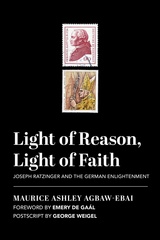
Ratzinger’s extraordinary and sympathetic understanding of the sources of contemporary secularism equipped him to appreciate the gains of the Enlightenment, while still being a fierce critic of the losses humanity has suffered when reason falsely excludes faith. Fr. Agbaw-Ebai’s account reveals Ratzinger, in relation to his various interlocutors, to be the truly “enlightened” one because he demonstrates a truly balanced understanding of the human mind. To be truly rational one must be able to hold to faith and reason both, reason informed by faith in Jesus Christ.
A particular merit of this book is Agbaw-Ebai’s presentation of Ratzinger’s treatment of the German Enlightenment’s greatest contributors: Kant, Nietzche, Hegel and Habermas, among others. In the postscript George Weigel characterizes what this study accomplishes in the larger framework of scholarship. “[Ratzinger’s] position remains too often misunderstood, and sometimes deliberately misinterpreted, throughout the whole Church. And to misunderstand, or misinterpret, Ratzinger is to misunderstand or misinterpret both the modern history of theology and the Second Vatican Council.” Agbaw-Ebai masterfully positions Ratzinger correctly in the history of ideas, and exhibits why Ratzinger will be remembered as one of its main players. Pure rationalists and true believers are equally indebted to him.

What is happening in Medjugorje and why do hundreds of thousands of people visit each year? In June of 1981, the Blessed Virgin Mary, Mother of God, began appearing to six young people with messages above all of peace and conversion. She calls herself the "Queen of Peace," and these apparitions have continued to this day. First coming to the children in the rocky hills outside the small city ravaged by war and Communism, throngs of pilgrims walk the unfriendly trails to the original spot every day of the year and often with bare feet. The miracles and spiritual experiences attributed to this place are impossible to count.
The pilgrimage to Rome is historical and deeply woven into the custom of piety and devotion in the Catholic Church. But for the post-modern world, Medjugorje is the pre-eminent 'destination' for all people seeking to encounter God, especially those who have fallen away or have no religious affiliation. The Jubilee Year will bring many more to Medjugorje and Saverio Gaeta's guidebook provides a necessary service of how to do it and what to do while one is there. The introduction to the English edition is provided by the official chaplain to English-speaking pilgrims, Leon Pereira.
There are over 200 color photographs and graphs.

Saverio Gaeta provides a concise and insightful history of Jubilee celebrations, tracing the custom to biblical norms and following developments up to present day. Jubilees are joyous remembrances of God's consistent paternal intervention in human life, and a time to acknowledge a common orientation toward the encounter with his Son, Jesus Christ, who brings salvation and life in the Trinity.
Living the Jubilee is indispensable for the reader who wishes to embark on a journey of faith, to live as a pilgrim and not tourist in this life. Gaeta inspires everyone to partake of the Jubilee celebrations. He also provides everything a traveler to Rome needs to know to make this trip––public transportation routes, event schedules, how one acquires the Vatican-issued pilgrim card and tickets needed to attend many of these events, plus much more. Even if readers do not make the voyage to Rome, Gaeta's account of the Jubilee in the Catholic Church is a wondrous display of thousands of years of tradition and history that has never lost a sense of joy and gratitude for the God who remains among us. It is a remarkable keepsake and helpful even for Jubilee celebrations in parishes and local communities.
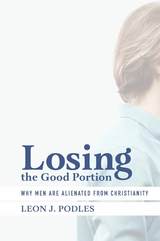
Losing the Good Portion: Why Men Are Alienated from Christianity explores the causes and consequences of the almost millennium-old disparity between the participation of lay men and lay women in the churches of Western Christianity. Podles considers both the anecdotal and statistical evidence for the lack of men: sermons, church rolls, censuses, and sociological analyses.
Podles sees the intellectual roots of lack of men in the Aristotelian understanding of male and female as active and passive, an understanding which has formed all discussion of masculinity and femininity, from Aquinas through Schleiermacher, Barth, and Hans Urs von Balthasar, all of whom saw femininity as more compatible with Christianity than masculinity. Men, according to anthropologists and psychologists, go through a difficult process to attain masculinity and therefore distance themselves from threats to that masculine identity, including Christianity.
Men suspected the clergy was effeminate and sexually irregular. Historians of violence have examined the decline in violence in Europe and the civilizing role of the clergy, a role which further alienated men and led to violent anticlericalism
Podles examines the presentation of Jesus’ masculinity in Scripture and images of Jesus’ masculinity in art, the role of thumos in spirituality, and the various movements that have helped keep men connected to the churches. He makes suggestions for possible outreach to men.
READERS
Browse our collection.
PUBLISHERS
See BiblioVault's publisher services.
STUDENT SERVICES
Files for college accessibility offices.
RECENTLY PUBLISHED





UChicago Accessibility Resources
home | accessibility | search | about | contact us
BiblioVault ® 2001 - 2025
The University of Chicago Press