
 A SCHOLARLY BOOK REPOSITORY
11 start with L start with L
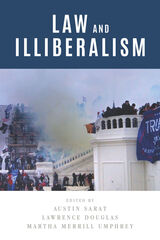
Does the law shield citizens from authoritarian regimes? Are the core beliefs of classical liberalism—namely the rights of all individuals and constraints on state power—still protected by law? Liberalism and its expansion of rights could not exist without the legal system, and unsurprisingly, many scholars have explored the relationship between law and liberalism. However, the study of law and illiberalism is a relatively recent undertaking, a project that takes on urgency in light of the rise of authoritarian powers, among them Donald Trump’s administration, Viktor Orban’s Hungary, Recep Erdogan’s Turkey, and Jair Bolsanoro’s Brazil.
In this volume, six penetrating essays explore the dynamics of the law and illiberal quests for power, examining the anti-liberalism of neoliberalism; the weaponization of “free speech”; the role of the administrative state in current crises of liberal democracy; the broad and unstoppable assault on facts, truth, and reality; and the rise of conspiracism leading up to the Capitol insurrection. In addition to the editors, contributors include Sharon Krause, Elizabeth Anker, Jeremy Kessler, Lee McIntyre, and Nancy Rosenblum.
Left-leaning political parties play an important role as representatives of the poor and disempowered. They once did so by promising protections from the forces of capital and the market’s tendencies to produce inequality. But in the 1990s they gave up on protection, asking voters to adapt to a market-driven world. Meanwhile, new, extreme parties began to promise economic protections of their own—albeit in an angry, anti-immigrant tone.
To better understand today’s strange new political world, Stephanie L. Mudge’s Leftism Reinvented analyzes the history of the Swedish and German Social Democrats, the British Labour Party, and the American Democratic Party. Breaking with an assumption that parties simply respond to forces beyond their control, Mudge argues that left parties’ changing promises expressed the worldviews of different kinds of experts. To understand how left parties speak, we have to understand the people who speak for them.
Leftism Reinvented shows how Keynesian economists came to speak for left parties by the early 1960s. These economists saw their task in terms of discretionary, politically-sensitive economic management. But in the 1980s a new kind of economist, who viewed the advancement of markets as left parties’ main task, came to the fore. Meanwhile, as voters’ loyalties to left parties waned, professional strategists were called upon to “spin” party messages. Ultimately, left parties undermined themselves, leaving a representative vacuum in their wake. Leftism Reinvented raises new questions about the roles and responsibilities of left parties—and their experts—in politics today.
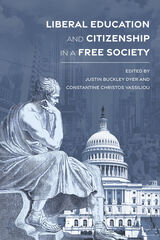
With Liberal Education and Citizenship in a Free Society, a collection of 19 original essays, editors Justin Dyer and Constantine Vassiliou present the work of a diverse group of scholars to assess the value of a liberal arts education in the face of market, technological, cultural, and political forces shaping higher learning today.
How did liberalism, the great political tradition that from the New Deal to the 1960s seemed to dominate American politics, fall from favor so far and so fast? In this history of liberalism since the 1930s, a distinguished historian offers an eloquent account of postwar liberalism, where it came from, where it has gone, and why. The book supplies a crucial chapter in the history of twentieth-century American politics as well as a valuable and clear perspective on the state of our nation's politics today.
Liberalism and Its Discontents moves from a penetrating interpretation of Franklin D. Roosevelt and the New Deal to an analysis of the profound and frequently corrosive economic, social, and cultural changes that have undermined the liberal tradition. The book moves beyond an examination of the internal weaknesses of liberalism and the broad social and economic forces it faced to consider the role of alternative political traditions in liberalism's downfall. What emerges is a picture of a dominant political tradition far less uniform and stable--and far more complex and contested--than has been argued. The author offers as well a masterly assessment of how some of the leading historians of the postwar era explained (or failed to explain) liberalism and other political ideologies in the last half-century. He also makes clear how historical interpretation was itself a reflection of liberal assumptions that began to collapse more quickly and completely than almost any scholar could have imagined a generation ago. As both political history and a critique of that history, Liberalism and Its Discontents, based on extraordinary essays written over the last decade, leads to a new understanding of the shaping of modern America.
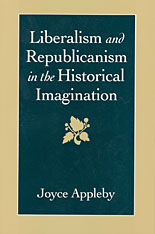
Like dye cast into water, liberal assumptions color everything American, from ideas about human nature to fears about big government. Not the dreaded “L” word of the 1988 presidential campaign, liberalism in its historical context emerged from the modern faith in free inquiry, natural rights, economic liberty, and democratic government. Expressed in the nation-building acts of revolution and constitution-writing, liberalism both structured and limited Americans’ sense of reality for two centuries.
The nation’s scholars were unable to break away from liberalism’s pervasive hold on the American mind until the last generation—when they recovered the lost world of classical republicanism. Ornate, aristocratic, prescriptive, and concerned with the common good, this form of republicanism held sway among the founding fathers before the triumph of liberal thought, with its simple, egalitarian, rational, and individualistic emphasis. The two concepts, as Joyce Appleby shows, posed choices for eighteenth-century thinkers much as they have divided twentieth-century scholars.
Entering one of the liveliest debates in the scholarly world about our ideological roots, Appleby follows the labyrinthine controversies that these two perspectives have generated in their day and in ours. In doing so, she addresses the tensions that remain to be resolved in the democratic societies of the late twentieth century—the complex relations between individual and community, personal liberty and the common good, aspiration and practical wisdom.
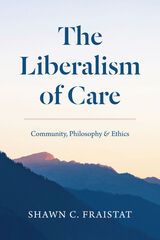
To recover that language, Fraistat turns to three prominent philosophers—Plato, Jean-Jacques Rousseau, and William Godwin—who illuminate the varied ways caring language and caring values have structured core debates in the history of Western political thought about the proper role of government, as well as the rights and responsibilities of citizens. The Liberalism of Care presents a distinctive vision for our liberal politics where political communities and citizens can utilize the ethic and practices of care to face practical challenges.

Liberal societies conventionally treat religion as unique under the law, requiring both special protection (as in guarantees of free worship) and special containment (to keep religion and the state separate). But recently this idea that religion requires a legal exception has come under fire from those who argue that religion is no different from any other conception of the good, and the state should treat all such conceptions according to principles of neutrality and equal liberty. Cécile Laborde agrees with much of this liberal egalitarian critique, but she argues that a simple analogy between the good and religion misrepresents the complex relationships among religion, law, and the state. Religion serves as more than a statement of belief about what is true, or a code of moral and ethical conduct. It also refers to comprehensive ways of life, political theories of justice, modes of voluntary association, and vulnerable collective identities.
Disaggregating religion into its various dimensions, as Laborde does, has two clear advantages. First, it shows greater respect for ethical and social pluralism by ensuring that whatever treatment religion receives from the law, it receives because of features that it shares with nonreligious beliefs, conceptions, and identities. Second, it dispenses with the Western, Christian-inflected conception of religion that liberal political theory relies on, especially in dealing with the issue of separation between religion and state. As a result, Liberalism’s Religion offers a novel answer to the question: Can Western theories of secularism and religion be applied more universally in non-Western societies?

A New York Times Book Review Editors’ Choice
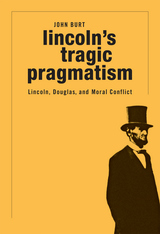
In 1858, challenger Abraham Lincoln debated incumbent Stephen Douglas seven times in the race for a U.S. Senate seat from Illinois. More was at stake than slavery in those debates. In Lincoln’s Tragic Pragmatism, John Burt contends that the very legitimacy of democratic governance was on the line. In a United States stubbornly divided over ethical issues, the overarching question posed by the Lincoln-Douglas debates has not lost its urgency: Can a liberal political system be used to mediate moral disputes? And if it cannot, is violence inevitable?
“John Burt has written a work that every serious student of Lincoln will have to read...Burt refracts Lincoln through the philosophy of Kant, Rawls and contemporary liberal political theory. His is very much a Lincoln for our time.”
—Steven B. Smith, New York Times Book Review
“I'm making space on my overstuffed shelves for Lincoln’s Tragic Pragmatism. This is a book I expect to be picking up and thumbing through for years to come.”
—Jim Cullen, History News Network
“Burt treats the [Lincoln-Douglas] debates as being far more significant than an election contest between two candidates. The debates represent profound statements of political philosophy and speak to the continuing challenges the U.S. faces in resolving divisive moral conflicts.”
—E. C. Sands, Choice
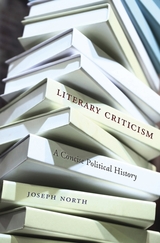
Literary Criticism offers a concise overview of literary studies in the English-speaking world from the early twentieth century to the present. Joseph North steps back from the usual tangle of figures, schools, and movements in order to analyze the intellectual paradigms that underpinned them. The result is a radically new account of the discipline’s development, together with a trenchant argument about where its political future lies.
People in today’s literature departments often assume that their work is politically progressive, especially when compared with the work of early- and mid-twentieth-century critics. North’s view is less cheering. For when understood in relation to the longer arc of the discipline, the current historicist and contextualist mode in literary studies represents a step to the Right. Since the global turn to neoliberalism in the late 1970s, all the major movements within literary studies have been diagnostic rather than interventionist in character: scholars have developed sophisticated techniques for analyzing culture, but they have retreated from systematic attempts to transform it. In this respect, the political potential of current literary scholarship compares poorly with that of earlier critical modes, which, for all their faults, at least had a programmatic commitment to cultural change.
Yet neoliberalism is now in crisis—a crisis that presents opportunities as well as dangers. North argues that the creation of a genuinely interventionist criticism is one of the central tasks facing those on the Left of the discipline today.
READERS
Browse our collection.
PUBLISHERS
See BiblioVault's publisher services.
STUDENT SERVICES
Files for college accessibility offices.
RECENTLY PUBLISHED



UChicago Accessibility Resources
home | accessibility | search | about | contact us
BiblioVault ® 2001 - 2026
The University of Chicago Press