
 A SCHOLARLY BOOK REPOSITORY
5 start with L start with L

A classic, Dantesque political epic from medieval Spain that inspired Cervantes and Góngora, in its first English translation.
Why do the injustices of the past still afflict the present? With this question, Juan de Mena is transported to heaven by a vision in the Dantesque The Labyrinth of Fortune. Composed in 1444 by Mena, a royal chronicler and Latin secretary in the court of Juan II of Castile, El Laberinto de Fortuna became the most important political allegory of medieval Spain. Allegorizing the past, present, and unknowable future through the figure of Providence, the poem reflects on the contentious kingship of Juan II and frames the Reconquest of Moorish territories—the foundational mythos of the emerging nation—as a virtuous, sacred task that would restore justice and the moral order because it fulfills a destiny ordained by God. This is the first English translation of a masterpiece that enriched the Spanish language with a density of learned allusions and a new Latinate humanistic style that deeply influenced subsequent writers such as Miguel Cervantes and Luis de Góngora.
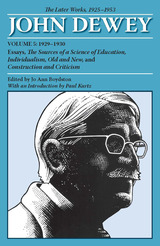
With the exception of The Quest for Certainty (Volume 4) this fifth volume brings together Dewey’s writings for the 1929–1930 period.
During this time Dewey published 4 books and 50 articles on philosophical, educational, political, and social issues. His philosophical essays include “What Humanism Means to Me” and “What I Believe,” both of which express Dewey’s faith in man’s potentialities and intelligence, and a lively Journal of Philosophy exchange with Ernest Nagel, William Ernest Hocking, C. I. Lewis, and F. J. E. Woodbridge. Educational writings include The Sources of a Science of Education. The contents of this volume reflect Dewey’s increasing involvement in social and political problems.

With the untimely death of Edward W. Said in 2003, various academic and public intellectuals worldwide have begun to reassess the writings of this powerful oppositional intellectual. Figures on the neoconservative right have already begun to discredit Said’s work as that of a subversive intent on slandering America’s benign global image and undermining its global authority. On the left, a significant number of oppositional intellectuals are eager to counter this neoconservative vilification, proffering a Said who, in marked opposition to the “anti-humanism” of the great poststructuralist thinkers who were his contemporaries--Jacques Derrida, Jean-Francois Lyotard, Jacques Lacan, Louis Althusser, and Michel Foucault--reaffirms humanism and thus rejects poststructuralist theory.
In this provocative assessment of Edward Said’s lifework, William V. Spanos argues that Said’s lifelong anti-imperialist project is actually a fulfillment of the revolutionary possibilities of poststructuralist theory. Spanos examines Said, his legacy, and the various texts he wrote--including Orientalism,Culture and Imperialism, and Humanism and Democratic Criticism--that are now being considered for their lasting political impact.

“Trenchant and moving.”—Robert Boyers, Los Angeles Times
The inexhaustible man of letters directs his critical gaze at his own profession—teaching.
When we talk about education today, we tend to avoid the rhetoric of “mastery,” with its erotic and inegalitarian overtones. But the charged personal encounter between master and disciple is precisely what interests George Steiner in this book, a sustained reflection on the infinitely complex and subtle interplay of power, trust, and passions in the most profound sorts of pedagogy. Based on Steiner's 2001–2002 Norton Lectures on the art and lore of teaching, Lessons of the Masters evokes a host of exemplary figures, including Socrates and Plato, Virgil and Dante, Heloise and Abelard, Tycho Brahe and Johannes Kepler, Edmund Husserl and Martin Heidegger, along with spiritual leaders from Buddhist and Confucian sages to Jesus and the Baal Shem Tov.
Pivotal in the unfolding of Western culture are Socrates and Jesus, charismatic masters who left no written teachings and founded no schools. In the efforts of their disciples—and in the passion narratives inspired by their deaths—Steiner sees the beginnings of the inward vocabulary, the encoded recognitions of much of our moral, philosophical, and theological idiom. He goes on to consider a diverse array of traditions and disciplines, returning throughout to three underlying themes: the master's power to exploit his student's dependence and vulnerability; the complementary threat of subversion and betrayal of the mentor by his pupil; and the reciprocal exchange of trust and love, of learning and instruction between master and disciple.
Forcefully written and passionately argued, Lessons of the Masters is itself a masterly testament to the high vocation and perilous risks undertaken by true teacher and learner alike.
READERS
Browse our collection.
PUBLISHERS
See BiblioVault's publisher services.
STUDENT SERVICES
Files for college accessibility offices.
RECENTLY PUBLISHED




UChicago Accessibility Resources
home | accessibility | search | about | contact us
BiblioVault ® 2001 - 2025
The University of Chicago Press