
 A SCHOLARLY BOOK REPOSITORY
34 start with L start with L
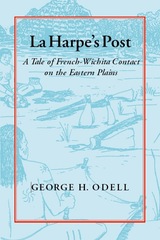
This major contribution to contact period studies points to the Lasley Vore site in modern Oklahoma as the most likely first meeting place of Plains Indians and Europeans more than 300 years ago.
In 1718, Jean-Baptiste Bénard, Sieur de la Harpe, departed St. Malo in Brittany for the New World. La Harpe, a member of the French bourgeoisie, arrived at Dauphin Island on the Gulf coast to take up the entrepreneurial concession provided by the director of the French colony, Jean Baptiste LeMoyne de Bienville. La Harpe's charge was to open a trading post on the Red River just above a Caddoan village not far from present-day Texarkana. Following the establishment of this post, La Harpe ventured farther north to extend his trade market into the region occupied by the Wichita Indians. Here he encountered a Tawakoni village with an estimated 6,000 inhabitants, a number that swelled to 7,000 during the ten-day visit.
Despite years of ethnohistoric and archaeological research, no scholar had successfully established where this important meeting took place. Then in 1988, George Odell and his crew surveyed and excavated an area 13 miles south of Tulsa, along the Arkansas River, that revealed undeniable association of Native American habitation refuse with 18th-century European trade goods.
Odell here presents a full account of the presumed location of the Tawakoni village as revealed through the analysis of excavated materials from nine specialist collaborators. In a strikingly well-written narrative report, employing careful study and innovative analysis supported by appendixes containing the excavation data, Odell combines documentary history and archaeological evidence to pinpoint the probable site of the first European contact with North American Plains Indians.
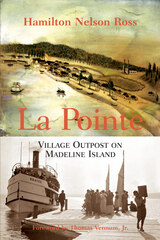
The Wisconsin Historical Society Press has republished a long-out-of-print classic of Wisconsin history, La Pointe: Village Outpost, by Hamilton Nelson Ross (1889-1957). The book, which first appeared in 1960, provides a 300-year history of La Pointe, a community on Madeline Island, one of Lake Superior's Apostle Islands.
With flair, humor, and solid scholarship, Ross tells the story of the region's evolution. Madeline Island served initially as a refuge for the local Ojibway from their enemy the Sioux before the arrival of French explorers in 1659, then an epicenter of the fur-trade era in the eighteenth century, and finally a summer vacation spot for businessmen and industrialists. Today the island attracts thousands of summer tourists who vastly outnumber the 200 or so year-round residents.
Ross first visited Madeline Island from his native Beloit as an eight-year-old, returning again and again over his lifetime to the Ross family cabin in La Pointe. His years of careful study and observation served him well. Ross told the region's story so eloquently that his book helped persuade Congress and the President in 1970 to preserve the islands in perpetuity as the Apostle Islands National Lakeshore.

A major collection of performance works by artist and agitator Anthony Hudson
Lamp Back: Plays and Other Grievances collects nearly a decade of work by Anthony Hudson, a queer Indigenous artist and agitator also known as Portland, Oregon’s premier drag clown, Carla Rossi. Whether fumbling with a lamp in a satirical takedown of land acknowledgments or confronting the history of redface in pop culture, Hudson alternates between Rossi’s cackling “ghost of white privilege” and more earnest, vulnerable confessionals as himself—all with a deep commitment to bitter humor and brutal honesty. In these performance works, a mixed-race Native boy plays a pilgrim in his kindergarten Thanksgiving pageant. A young artist recounts the racism in their favorite musical and the larger American theater system. A drag queen storytime goes disastrously wrong and calls for an exorcism with a plunger. Kate Bredeson’s unflinching introduction speaks to Hudson’s work through a cultural and historical lens and illuminates the importance of his project to filet the American Empire.
Owing to Yucatan’s relative isolation, many assume that the history and economy of the peninsula have evolved in a distinctive way, apart from the central government in Mexico City and insulated from world social and economic factors. The essays in this volume suggest that this has not been the case: the process of development in Yucatan has been linked firmly to national and global forces of change over the past two centuries. The essays are by U.S., Mexican, Canadian, and Belizean social scientists representing both well-established and younger scholars. The result is a perspective on Yucatan’s historical development that is at once international, interdisciplinary, and intergenerational.
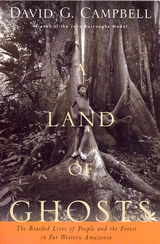
For thirty years David G. Campbell has explored the Amazon, an enchanting terrain of forest and river that is home to the greatest diversity of plants and animals to have ever existed, anywhere at any time, during the four-billion-year history of life on Earth.
With great artistic flair, Campbell describes a journey up the Rio Moa, a remote tributary of the Amazon River, 2,800 miles from its mouth. Here he joins three old friends: Arito, a caiman hunter turned paleontologist; Tarzan, a street urchin brought up in a bordello; and Pimentel, a master canoe pilot. They travel together deep into the rainforest and set up camp in order to survey every woody plant on a two-hectare plot of land with about as many tree species as in all of North America.
Campbell introduces us to two remarkable women, Dona Cabocla, a widow who raised six children on that lonely frontier, and Dona Ausira, a Nokini Native American who is the last speaker of her tribe's ages-old language. These pioneers live in a land whose original inhabitants were wiped out by centuries of disease, slavery, and genocide, taking their traditions and languages with them. He explores the intimate relationship between the extinction of native language and the extirpation of biological diversity. "It's hard for a people to love a place that is not defined in words and thus cannot be understood. And it's easy to give away something for which there are no words, something you never knew existed."
In elegant prose that enchants and entrances, Campbell has written an elegy for the Amazon forest and its peoples-for what has become a land of ghosts.

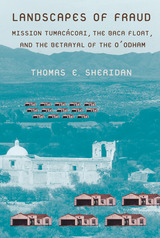
Landscapes of Fraud explores how the penetration of the evolving capitalist world-system created and destroyed communities in the Upper Santa Cruz Valley of Arizona from the late 1600s to the 1970s. Thomas Sheridan has melded history, anthropology, and critical geography to create a penetrating view of greed and power and their lasting effect on those left powerless.
Sheridan first examines how O’odham culture was fragmented by the arrival of the Spanish, telling how autonomous communities moving across landscapes in seasonal rounds were reduced to a mission world of subordination. Sheridan then considers the fate of the Tumacácori grant and Baca Float No. 3, another land grant. He tells the unbroken story of land fraud from Manuel María Gándara’s purchase of the “abandoned” Tumacácori grant at public auction in 1844 through the bankruptcy of the shady real estate developers who had fraudulently promoted housing projects at Rio Rico during the 1960s and ’70s.
As the Upper Santa Cruz Valley underwent a wrenching transition from a landscape of community to a landscape of fraud, the betrayal of the O’odham became complete when land, that most elemental form of human space, was transformed from a communal resource into a commodity bought and sold for its future value. Today, Mission Tumacácori stands as a romantic icon of the past while the landscapes that supported it lay buried under speculative schemes that continue to haunt our history.
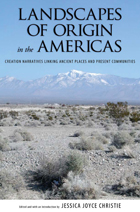
By linking ancient places with present communities, Landscapes of Origin in the Americas explores how cultural landscapes sustain the continuity of origin narratives.
Landscape is a powerful factor in the operation of memory because of the associations narrators make between the local landscape and the events of the stories they tell. Ancestors and mythological events often become fixed in a specific landscape and act as timeless reference points.
In conventional anthropological literature, "landscape" is the term applied to the meaning local people bestow on their cultural and physical surroundings. In this work, the authors explore the cultural and physical landscapes an individual or cultural group has constructed to define the origins or beginnings of that cultural group as revealed through shared or traditional memory. The cultural landscapes of origins in diverse sites throughout the Americas are investigated through multidisciplinary research, not only to reveal the belief system and mythologies but also to place these origin beliefs in context and relationship to each other. In a continual interaction between the past, present, and future, time is subordinate to place, and history, as defined in Western academic terms, does not exist.
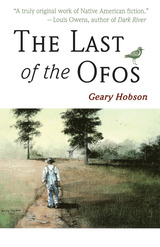
In this subtle but inventive novel, presented as Thomas's memoirs, Geary Hobson offers us a glimpse into a life filled with simple joys and sorrows. In relating his Louisiana childhood, Thomas recalls not just school-learning but being taught Indian ways by the small Ofo community. He tells of his life as a roustabout in the oil fields, of his courtship of the rambunctious Sally Fachette, and of his career as a bootlegger, which landed him in prison. We share Thomas's wartime stint with the Marines—where "for the first time in my life I was treated like a equal"—and his life as a farm laborer and a Hollywood extra portraying warbonneted Cheyennes. Then in his later years, when he truly has become the last of his kind, we find Thomas recruited by an anthropologist from the Smithsonian Institution to preserve his people's culture. In Washington, he is exposed to the vagaries of Indian policy and the emerging Native American movement.
Throughout Thomas's story, readers are introduced to a wide-ranging cast of characters, from the outlaws Bonnie and Clyde to a fellow Marine who is wary of Indians, to an uppity anthropologist who doesn't consider Thomas "expert" enough to handle an Ofo flute. Always poor in material wealth but rich in heritage, Thomas Darko is a Native American Everyman whose identity is shaped by family and homeland. His "autobiography" paints a realistic portrait of an Indian confronting the obstacles in his life and the dilemmas of his age as his story reveals the painful legacy of being the last of one's kind.
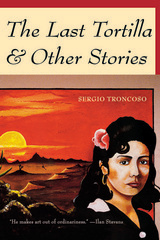
Writing in a straightforward, light-handed style reminiscent of Grace Paley and Raymond Carver, he spins charming tales that reflect his experiences in two worlds. Troncoso's El Paso is a normal town where common people who happen to be Mexican eat, sleep, fall in love, and undergo epiphanies just like everyone else. His tales are coming-of-age stories from the Mexican-American border, stories of the working class, stories of those coping with the trials of growing old in a rapidly changing society. He also explores New York with vignettes of life in the big city, capturing its loneliness and danger.
Beginning with Troncoso's widely acclaimed story "Angie Luna," the tale of a feverish love affair in which a young man rediscovers his Mexican heritage and learns how much love can hurt, these stories delve into the many dimensions of the human condition. We watch boys playing a game that begins innocently but takes a dangerous turn. We see an old Anglo woman befriending her Mexican gardener because both are lonely. We witness a man terrorized in his New York apartment, taking solace in memories of lost love. Two new stories will be welcomed by Troncoso's readers. "My Life in the City" relates a transplanted Texan's yearning for companionship in New York, while "The Last Tortilla" returns to the Southwest to explore family strains after a mother's death—and the secret behind that death. Each reflects an insight about the human heart that has already established the author's work in literary circles.
Troncoso sets aside the polemics about social discomfort sometimes found in contemporary Chicano writing and focuses instead on the moral and intellectual lives of his characters. The twelve stories gathered here form a richly textured tapestry that adds to our understanding of what it is to be human.
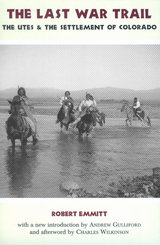
Written with the care and precision of a finely crafted novel, The Last War Trail was nominated for the Pulitzer Prize when it was first published in 1954. Long out of print and now brought back with new rare photographs and illustrations, The Last War Trail will be eagerly read by anyone trying to understand conflicts of the nineteenth century between Native American and encroaching settlers.
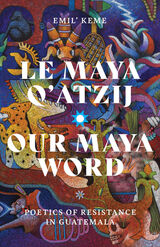
Bringing to the fore the voices of Maya authors and what their poetry tells us about resistance, sovereignty, trauma, and regeneration
In 1954, Guatemala suffered a coup d’etat, resulting in a decades-long civil war. During this period, Indigenous Mayans were subject to displacement, disappearance, and extrajudicial killing. Within the context of the armed conflict and the postwar period in Guatemala, K’iche’ Maya scholar Emil’ Keme identifies three historical phases of Indigenous Maya literary insurgency in which Maya authors use poetry to dignify their distinct cultural, political, gender, sexual, and linguistic identities.
Le Maya Q’atzij / Our Maya Word employs Indigenous and decolonial theoretical frameworks to critically analyze poetic works written by ten contemporary Maya writers from five different Maya nations in Iximulew/Guatemala. Similar to other Maya authors throughout colonial history, these authors and their poetry criticize, in their own creative ways, the continuing colonial assaults to their existence by the nation-state. Throughout, Keme displays the decolonial potentialities and shortcomings proposed by each Maya writer, establishing a new and productive way of understanding Maya living realities and their emancipatory challenges in Iximulew/Guatemala.
This innovative work shows how Indigenous Maya poetics carries out various processes of decolonization and, especially, how Maya literature offers diverse and heterogeneous perspectives about what it means to be Maya in the contemporary world.
In Legacy of the Blue Mountains, author Lynn Galvin asks: What might happen to a group of Apache children, born in present times, yet living as if in the past and marooned in the Sierra Madre mountains of Mexico when their last renegade adult dies? As they attempt to reach their nearest, last known family members, they embark on a journey to a place none of them has ever seen or visited before. Will they be able to remain undetected while following a memorized path laid out in previous centuries that will lead them into the modern world? As the last remaining Apache children confront the challenges of survival in unfamiliar lands, will they endure long enough to reunite with their remaining relatives?
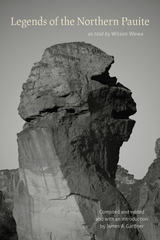
The legends in this volume were recorded, transcribed, reviewed, and edited by Wilson Wewa and James Gardner. Each legend was recorded, then read and edited out loud, to respect the creativity, warmth, and flow of Paiute storytelling. The stories selected for inclusion include familiar characters from native legends, such as Coyote, as well as intriguing characters unique to the Northern Paiute, such as the creature embodied in the Smith Rock pinnacle, now known as Monkey Face, but known to the Paiutes in Central Oregon as Nuwuzoho the Cannibal.
Wewa’s apprenticeship to Northern Paiute culture began when he was about six years old. These legends were passed on to him by his grandmother and other tribal elders. They are now made available to future generations of tribal members, and to students, scholars, and readers interested in Wewa’s fresh and authentic voice. These legends are best read and appreciated as they were told—out loud, shared with others, and delivered with all of the verve, cadence, creativity, and humor of original Paiute storytellers on those clear, cold winter nights in the high desert.
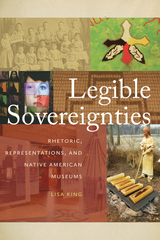
King tracks the exhibit spaces at the Saginaw Chippewa Indian Tribe of Michigan’s Ziibiwing Center, Haskell Indian Nation University’s Cultural Center and Museum, and the Smithsonian’s Washington, DC branch of the National Museum of the American Indian over their first ten years, from their opening until the summer of 2014. Far from formulaic, each site has developed its own rhetorical approaches to reaching its public, revealing multiple challenges and successes in making Native self-representation legible and accessible.
Through documentation and analysis of the inaugural exhibits and recent installations, interviews with curators and staff, and investigation into audience reception of these spaces, Legible Sovereignties argues that there can be no single blanket solution for effective Indigenous self-representation. Instead, Legible Sovereignties demonstrates the nuanced ways in which each site must balance its rhetorical goals and its audience's needs, as well as its material constraints and opportunities, in order to reach its visitors and have Indigenous voices heard.
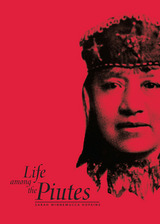
This autobiographical work was written by one of the country's most well-known Native American women, Sarah Winnemucca. She was a Paiute princess and a major figure in the history of Nevada; her tribe still resides primarily in the state. Life Among the Piutes deals with Winnemucca's life and the plight of the Paiute Indians. Life Among the Piutes is Winnemucca's powerful legacy to both white and Paiute cultures. Following the oral tradition of Native American people, she reaches out to readers with a deeply personal appeal for understanding. She also records historical events from a unique perspective. She managed to record the Native American viewpoint of whites settling the West, told in a language that was not her own and by a woman during the time when even white women were not allowed to vote. Sarah Winnemucca dedicated her life to improving the living and social conditions for her people. She gave more than 400 speeches across the United States and Europe to gain support for the Paiutes. She died of tuberculosis in 1891. Life Among the Piutes was originally published in 1883.
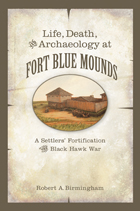
Life, Death, and Archaeology at Fort Blue Mounds is an archaeological detective story illuminating the lives of white settlers in the lead-mining region during the tragic events of the historically important conflict known as the Black Hawk War.
Focusing on the strategically located Fort Blue Mounds in southwestern Wisconsin, Robert A. Birmingham summarizes the 1832 conflict and details the history of the fort, which played a major role not only in U.S. military and militia operations but also in the lives of the white settlers who sought refuge there. Birmingham then transports us to the site decades later, when he and fellow Wisconsin Historical Society archaeologists and dedicated volunteers began their search for the fort. The artifacts they unearthed provide fascinating—and sometimes surprising—insights into the life, material culture, and even the food of the frontier.
Recommended for readers interested in the Black Hawk War, frontier life, Native American history, military history, and archaeology, Life, Death, and Archaeology at Fort Blue Mounds is grounded by a sense of place and the discovery of what a careful examination of our surroundings can tell us about the past.

“Our people are very lucky to be here,” says Albert White Hat Sr. He has lived through a time when Indians were sent to boarding schools and were not permitted to practice their own rituals. Although the Lakota people can practice their beliefs openly once again, things have changed and old ways have been forgotten. As a teacher at Sinte Gleska University in South Dakota, White Hat seeks to preserve the link the Lakota people have with their past. In Life’s Journey—Zuya, White Hat has collected and translated the stories of medicine men, retaining the simplicity of their language so as not to interpret their words through a Western lens. This is Zuya, oral history that is lived and handed down over the generations.
White Hat also shares stories from his own experience. Using anecdotes he shows not only how the Lakota lifestyle has been altered but also how Lakota words have begun to take on new meanings that lack their original connotations and generate a different picture of Lakota philosophy. Language, interwoven with history, tells the people where they came from and who they are. By gathering the traditions and ceremonies in a single volume, with the history of how they evolved, he has secured the meaning of these practices for futre generations. Filled with warmth and humor, Life’s Journey—Zuya is an enjoyable and enlightening read.

More than simply a history of the bow and arrow, The Lightening Stick brings together a broad range of significant people and events, spiritual usages, medicinal treatments, and an unusual array of subject matter related to the weapon itself. Henrietta Stockel conveys a host of information derived from primary documents and provides readers with a fascinating book. Her descriptive storytelling—serious, humorous, and even gory at times—takes the reader from modern uses of bows and arrows (including a previously little-known incident in the atomic city of Los Alamos, New Mexico) to an early era of western history, before guns changed the frontier forever.

Beginning with Chief Justice John Marshall’s foundational opinions in the early nineteenth century and continuing today in the judgments of the Rehnquist Court, Williams shows how undeniably racist language and precedent are still used in Indian law to justify the denial of important rights of property, self-government, and cultural survival to Indians. Building on the insights of Malcolm X, Thurgood Marshall, and Frantz Fanon, Williams argues that racist language has been employed by the courts to legalize a uniquely American form of racial dictatorship over Indian tribes by the U.S. government.
Williams concludes with a revolutionary proposal for reimagining the rights of American Indians in international law, as well as strategies for compelling the current Supreme Court to confront the racist origins of Indian law and for challenging bigoted ways of talking, thinking, and writing about American Indians.
Robert A. Williams Jr. is professor of law and American Indian studies at the James E. Rogers College of Law, University of Arizona. A member of the Lumbee Indian Tribe, he is author of The American Indian in Western Legal Thought: The Discourses of Conquest and coauthor of Federal Indian Law.
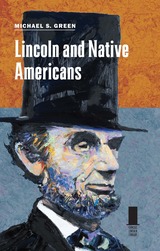
First exploration of Lincoln’s relationship with the Native population in more than four decades
President Abraham Lincoln ordered the largest mass execution of Indigenous people in American history, following the 1862 uprising of hungry Dakota in Minnesota and suspiciously speedy trials. He also issued the largest commutation of executions in American history for the same act. But there is much more to the story of Lincoln’s interactions and involvement, personal and political, with Native Americans, as Michael S. Green shows. His evenhanded assessment explains how Lincoln thought about Native Americans, interacted with them, and was affected by them.
Although ignorant of Native customs, Lincoln revealed none of the hatred or single-minded opposition to Native culture that animated other leaders and some of his own political and military officials. Lincoln did far too little to ease the problems afflicting Indigenous people at the time, but he also expressed more sympathy for their situation than most other politicians of the day. Still, he was not what those who wanted legitimate improvements in the lives of Native Americans would have liked him to be.
At best, Lincoln’s record is mixed. He served in the Black Hawk War against tribes who were combating white encroachment. Later he supported policies that exacerbated the situation. Finally, he led the United States in a war that culminated in expanding white settlement. Although as president, Lincoln paid less attention to Native Americans than he did to African Americans and the Civil War, the Indigenous population received considerably more attention from him than previous historians have revealed.
In addition to focusing on Lincoln’s personal and familial experiences, such as the death of his paternal grandfather at the hands of Indians, Green enhances our understanding of federal policies toward Native Americans before and during the Civil War and how Lincoln’s decisions affected what came after the war. His patronage appointments shaped Indian affairs, and his plans for the West would also have vast consequences. Green weighs Lincoln’s impact on the lives of Native Americans and imagines what might have happened if Lincoln had lived past the war’s end. More than any many other historians, Green delves into Lincoln’s racial views about people of color who were not African American.
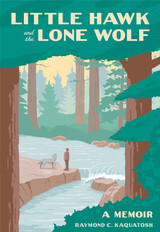
After his father’s death, eight-year-old Ray was sent to an Indian boarding school in Keshena. There he experienced isolation and despair, but also comfort and kindness. Upon his return home, Ray remained a lonely boy in a full house until he met and befriended a lone timber wolf. The unusual bond they formed would last through both their lifetimes. As Ray grew into a young man, he left the reservation more frequently. Yet whenever he returned—from school and work, from service in the Marines, and finally from postwar Wausau with his future wife—the wolf waited.
In this rare first-person narrative of a Menominee Indian’s coming of age, Raymond Kaquatosh shares a story that is wise and irreverent, often funny, and in the end, deeply moving.
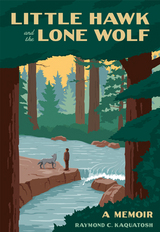
After his father’s death, eight-year-old Ray was sent to an Indian boarding school in Keshena. There he experienced isolation and despair, but also comfort and kindness. Upon his return home, Ray remained a lonely boy in a full house until he met and befriended a lone timber wolf. The unusual bond they formed would last through both their lifetimes. As Ray grew into a young man, he left the reservation more frequently. Yet whenever he returned—from school and work, from service in the Marines, and finally from postwar Wausau with his future wife—the wolf waited.
In this rare first-person narrative of a Menominee Indian’s coming of age, Raymond Kaquatosh shares a story that is wise and irreverent, often funny, and in the end, deeply moving.
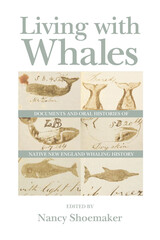
Native Americans along the coasts of southern New England and Long Island have had close ties to whales for thousands of years. They made a living from the sea and saw in the world's largest beings special power and meaning. After English settlement in the early seventeenth century, the region's natural bounty of these creatures drew Natives and colonists alike to develop whale hunting on an industrial scale. By the nineteenth century, New England dominated the world in whaling, and Native Americans contributed substantially to whaleship crews.
In Living with Whales, Nancy Shoemaker reconstructs the history of Native whaling in New England through a diversity of primary documents: explorers' descriptions of their “first encounters,” indentures, deeds, merchants' accounts, Indian overseer reports, crew lists, memoirs, obituaries, and excerpts from journals kept by Native whalemen on their voyages. These materials span the centuries-long rise and fall of the American whalefishery and give insight into the far-reaching impact of whaling on Native North American communities. One chapter even follows a Pequot Native to New Zealand, where many of his Maori descendants still reside today.
Whaling has left behind a legacy of ambivalent emotions. In oral histories included in this volume, descendants of Wampanoag and Shinnecock whalemen reflect on how whales, whaling, and the ocean were vital to the survival of coastal Native communities in the Northeast, but at great cost to human life, family life, whales, and the ocean environment.
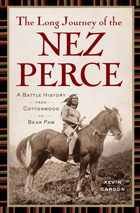
Chiefs Joseph, Looking Glass, White Bird, and Their People Against the United States
In 1877, the U.S. Government opened the Nez Perce lands in Oregon to settlers and ordered the tribe to move to a reservation in Idaho Territory. Although reluctant to leave their homeland, the Nez Perce began the long trek eastward. A small band of young warriors vented their frustration, however, in two days of deadly attacks on settlements along the Salmon River. Realizing that the U.S. response would be overwhelming—particularly in light of Custer’s defeat the year before—the Nez Perce leaders, including Chiefs Joseph, Looking Glass, and White Bird, prepared their people for war. A U.S. Army battalion led by Civil War general Oliver O. Howard along with several other coordinated army units began pursuit in an effort to subdue the Nez Perce and forceably move them to the reservation. The Nez Perce resolved to escape to freedom in Canada. Using their intimate knowledge of the land and their native Appaloosa horses skillfully, the Nez Perce were able to successfully check and elude the much larger American force for more than three months as they wound their way across the Rocky Mountains, through the newly established Yellowstone National Park, and into Montana. The war finally ended when the exhausted Indians—men, women, and children—were surrounded in the Bear Paw Mountains. Looking Glass was shot dead, and at this point, Chief Joseph relinquished and gave his famous address of surrender to General Howard. While most of the Nez Perce ended up on a reservation, the band led by White Bird was able to make their way to Canada and freedom.
The Nez Perce War is one of the most important and emotional campaigns of the Indian Wars. It essentially closed an era in American history, and the amount of time, money, and troops required to subdue the Nez Perce brought the plight of American Indians and the reservation system to the front pages of newspapers around the world. In The Long Journey of the Nez Perce: A Battle History from Cottonwood to Bear Paw, former U.S. Army engineering officer Kevin Carson brings his intimate knowledge of the territory crossed by the Nez Perce along with his skill as a cartographer to reconstruct in detail the battles and skirmishes along the entire route of the conflict.
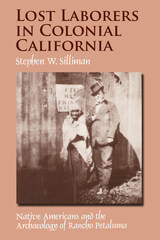
This study focuses on Rancho Petaluma north of San Francisco Bay, a large livestock, agricultural, and manufacturing operation on which several hundred—perhaps as many as two thousand—Native Americans worked as field hands, cowboys, artisans, cooks, and servants. One of the largest ranchos in the region, it was owned from 1834 to 1857 by Mariano Guadalupe Vallejo, one of the most prominent political figures of Mexican California. While historians have studied Vallejo, few have considered the Native Americans he controlled, so we know little of what their lives were like or how they adjusted to the colonial labor regime.
Because Vallejo’s Petaluma Adobe is now a state historic park and one of the most well-protected rancho sites in California, this site offers unparalleled opportunities to investigate nineteenth-century rancho life via archaeology. Using the Vallejo rancho as a case study, Stephen W. Silliman examines this California rancho with a particular eye toward Native American participation. Through the archaeological record—tools and implements, containers, beads, bone and shell artifacts, food remains—he reconstructs the daily practices of Native peoples at Rancho Petaluma and the labor relations that structured indigenous participation in and experience of rancho life. This research enables him to expose the multi-ethnic nature of colonialism, counterbalancing popular misconceptions of Native Americans as either non-participants in the ranchos or passive workers with little to contribute to history.
Lost Laborers in Colonial California draws on archaeological data, material studies, and archival research, and meshes them with theoretical issues of labor, gender, and social practice to examine not only how colonial worlds controlled indigenous peoples and practices but also how Native Americans lived through and often resisted those impositions. The book fills a gap in the regional archaeological and historical literature as it makes a unique contribution to colonial and contact-period studies in the Spanish/Mexican borderlands and beyond.
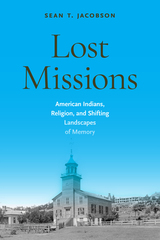
Tracing how shuttered mission schools became contested commemorative landscapes
During the Early Republic and Jacksonian eras, Euro-American colonists and Native nations in the South and Old Northwest established mission schools intended to Christianize Indigenous peoples. In Lost Missions, Sean T. Jacobson recovers the histories and afterlives of these institutions, arguing that they played a far more consequential role in Native–settler relations than scholars have previously acknowledged. Mission schools advanced a spiritual vision of a multiethnic Christian America—one that ultimately collapsed amid the federally sponsored Indian Removal campaigns of the 1830s and 1840s.
Following the closure of these schools, their physical and symbolic landscapes became powerful sites of memory. Euro-American Christians later transformed former missions into commemorative spaces that celebrated “frontier” piety and national expansion. Through monuments, pageantry, and local histories, Protestant and Catholic Americans alike recast missionary labor as a foundational component of American nation-building. In doing so, these narratives framed the Christianization of Native peoples as a benevolent civilizing project, one that implicitly—and sometimes explicitly—sanitized the coercion, dispossession, and violence that accompanied westward expansion and the forced removal of Indigenous nations.
By the late twentieth century, however, these commemorative narratives faded. Suburban development, commercialization, and shifting cultural priorities rendered many mission sites once again “lost,” stripped of the civic meaning they once held. Yet Jacobson shows that these landscapes still speak, especially when viewed from Indigenous perspectives. Reinterpreted through Native histories of endurance and survival, former missions reveal counternarratives of persistence amid profound loss. As tribal nations increasingly engage with these sites today, Lost Missions probes their contested status as places of memory and conscience, illuminating how public history continues to shape and challenge understandings of America’s colonial past.
In these narratives—primary documents written by missionaries and conquistadors—vivid details of these little known Mayan cultures are revealed, answering how and why lowlanders were able to evade Spanish conquest while similar civilizations could not. Fascinating tales of the journey from Europe are included, involving unknown islands, lost pilots, life aboard a galleon fleet, political intrigue, cannibals, and breathtaking natural beauty. In short, these forgotten manuscripts—translations of the papers of the past—provide an unforgettable look at an understudied chapter in the age of exploration.
Lost Shores, Forgotten Peoples will appeal to archaeologists, anthropologists, and historians interested in Central America, the Maya, and the Spanish Conquest.

His writings spanned five decades and have been instrumental across a wide range of academic disciplines. Most importantly, Read devoted a good portion of his research to the meaning of place names in the southeastern United States—especially as they related to Indian word adoption by Europeans.
This volume includes his three Louisiana articles combined: Louisiana: Louisiana Place-Names of Indian Origin (1927), More Indian Place-Names in Louisiana (1928), and Indian Words (1931). Joining Alabama's reprint of Indian Places Names in Alabama and Florida Place Names of Indian Origin and Seminole Personal Names, this volume completes the republication of the southern place name writings of William A. Read.
In May 1725, during a three-year conflict between English colonists and the Eastern Abenaki Nation, a thirty-four-man expedition led by Captain John Lovewell set out to ambush their adversaries, acquire some scalp bounties, and hasten the end of the war. Instead, the Abenakis staged a surprise attack of their own at Pigwacket, Maine, that left more than a third of the New Englanders dead or severely wounded. Although Lovewell himself was slain in the fighting, he emerged a martyred hero, celebrated in popular memory for standing his ground against a superior enemy force.
In this book, Robert E. Cray revisits the clash known as “Lovewell's Fight” and uses it to illuminate the themes of war, death, and memory in early New England. He shows how a military operation plagued from the outset by poor decision-making, and further marred by less-than-heroic battlefield behavior, came to be remembered as early America's version of the Alamo. The government of Massachusetts bestowed payouts, pensions, and land on survivors and widows of the battle, while early chroniclers drafted a master narrative for later generations to emboss. William Henry Longfellow, Nathaniel Hawthorne, and Henry David Thoreau kept the story alive for later generations. Although some nineteenth-century New Englanders disapproved of Lovewell's notoriety as a scalp hunter, it did not prevent the dedication of a monument in his honor at the Fryeburg, Maine, battlesite in 1904.
Even as the actual story of “Lovewell's Fight” receded into obscurity—a bloody skirmish in a largely forgotten war—it remained part of New England lore, one of those rare military encounters in which defeat transcends an opponent's victory to assume the mantle of legend.
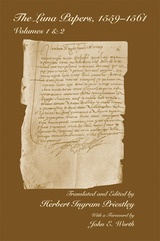
Marks the celebration by the modern city of Pensacola, Florida, of the 450th anniversary of Luna’s fateful colony
The 1559–1561 expedition of Don Tristán de Luna y Arellano to Florida was at the time of Spain’s most ambitious attempt yet to establish a colonial presence in southeastern North America. In June of 159, eleven ships carrying some five hundred soldiers and one thousand additional colonists, including not just Spaniards but also many of Aztec and African descent, sailed north from Veracruz, Mexico, on their way to the bay known then as Ochuse, and later as Pensacola. Finally arriving in mid-August, the colonists quickly sent word of their arrival back to Mexico and unloaded their supplies over the next five weeks, leaving vital food stores onboard the vessels until suitable warehouses could be constructed in the new settlement. When an unexpected hurricane struck on the night of September 19, 1559, however, seven of ten remaining vessels in Luna’s fleet were destroyed, and the expedition was instantaneously converted from a colonial venture to a mission in need of rescue.
Though ultimately doomed to failure by the hurricane that devastated their fleet and food stores, the Luna expedition nonetheless served as an immediate prelude to the successful establishment of a permanent colonial presence at St. Augustine on Florida’s Atlantic coast in 1565, and prefaced the eventual establishment after 1698 of three successive Spanish presidios at the same Pensacola Bay where Luna’s attempt had been made more than a century before.
READERS
Browse our collection.
PUBLISHERS
See BiblioVault's publisher services.
STUDENT SERVICES
Files for college accessibility offices.
RECENTLY PUBLISHED






UChicago Accessibility Resources
home | accessibility | search | about | contact us
BiblioVault ® 2001 - 2026
The University of Chicago Press