
 A SCHOLARLY BOOK REPOSITORY
12 start with L start with L


Leigh Bowery: Performative Costuming and Live Art is a critical exploration of the creative practice, social-historical context, and cultural impact of the late London-based artist Leigh Bowery. The diversity of Bowery’s work and his marginality as an artist who emerged during the 1980s from a subcultural milieu complicated and thwarted his cultural value, hindering his incorporation into art institutions and performance art narratives for some time. Drawing on a variety of disciplines and challenging research contexts, Sofia Vranou seeks to historicize Bowery’s multifaceted body of work and critically situate it within the expanded fields of visual culture and performance studies.
Through close analysis of Bowery’s key looks and non-theatrical performances, the book investigates the implications of his work in dominant histories of performance art and urgent discourses surrounding normativity, representations of illness, and identity politics. Thought-provoking and engaging, it focuses on Bowery’s costuming as a performative strategy that effectively blurs the boundaries between art and life; delves into his aesthetics of freakishness and narcissistic desire, reflects on his involvement with BDSM practices and the performance of extremity, and unpacks the posttranssexual ethos behind his hybrid embodiments and trans-queer visual language.

Leon Bibel, the first biography of this eclectic artist, recounts his life from his birth in Szczebrzeszyn, Poland, in 1913, to his death in New Jersey in 1995. After immigrating to the United States in the 1920s, Bibel came of age during the Great Depression, when New Deal agencies recognized his abilities and supported his artistic endeavors. Working-class artists faced challenges after these programs folded, and Bibel would later spend twenty years as a New Jersey chicken farmer before resurrecting his art career in the 1960s.
Historian Richard Haw shows how Bibel's life was defined by the New Deal, his visionary artwork shaped by the era's commitment to social and economic justice. With reproductions of more than 240 of Bibel's works, most in vivid color, this book reveals how he depicted everything from the trauma of unemployment to the dignity of work, from the horrors of lynching to the pleasures of everyday life.
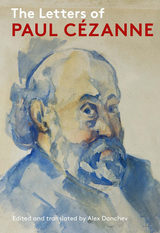
Revered and misunderstood by his peers and lauded by later generations as the father of modern art, Paul Cézanne (1839-1906) has long been a subject of fascination for artists and art lovers, writers, poets, and philosophers. His life was a ceaseless artistic quest, and he channeled much of his wide-ranging intellect and ferocious wit into his letters. Punctuated by exasperated theorizing and philosophical reflection, outbursts of creative ecstasy and melancholic confession, the artist’s correspondence reveals both the heroic and all-toohuman qualities of a man who is indisputably among the pantheon of all-time greats.
This new translation of Cézanne’s letters includes more than twenty that were previously unpublished and reproduces the sketches and caricatures with which Cézanne occasionally illustrated his words. The letters shed light on some of the key artistic relationships of the modern period—about one third of Cézanne’s more than 250 letters are to his boyhood companion Émile Zola, and he communicated extensively with Camille Pissarro and the dealer Ambroise Vollard. The translation is richly annotated with explanatory notes, and, for the first time, the letters are cross-referenced to the current catalogue raisonné. Numerous inaccuracies and archaisms in the previous English edition of the letters are corrected, and many intriguing passages that were unaccountably omitted have been restored. The result is a publishing landmark that ably conveys Cézanne’s intricacy of expression.
Jonathan Flatley’s Like Andy Warhol is a revelatory look at the artist’s likeness-producing practices, not only reflected in his famous Campbell’s soup cans and Marilyn Monroe silkscreens but across Warhol’s whole range of interests including movies, drag queens, boredom, and his sprawling collections. Flatley shows us that Warhol’s art is an illustration of the artist’s own talent for “liking.” He argues that there is in Warhol’s productions a utopian impulse, an attempt to imagine new, queer forms of emotional attachment and affiliation, and to transform the world into a place where these forms find a new home. Like Andy Warhol is not just the best full-length critical study of Warhol in print, it is also an instant classic of queer theory.
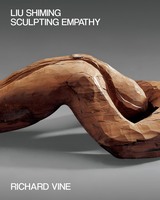
Liu Shiming (1926–2010) is a revered Chinese artist whose works have had a distinct impact on the course of modern Chinese sculpture. Born in Tianjin in 1926, Shiming attended the prestigious Central Academy of Fine Arts (CAFA) in Beijing, where he was part of the first generation of sculptors trained by the People’s Republic of China to study both traditional Chinese art and French modernist principles. Shiming received early recognition for his work, and his student project Measuring Land (1950) was one of the first works exhibited abroad following the establishment of the People’s Republic of China.
Though well respected in China, the sculptor, who died in 2010 at the age of eighty-four, is only now beginning to win the wider recognition he deserves. Meanwhile, contemporary competitors are numberless, most of them Instagram-friendly, while art history tends to focus on towering names and indisputably major movements and events: Braque and Picasso inventing Cubism, Duchamp’s readymades redefining art itself, Warhol’s mind-bending Brillo Boxes, and so on. So why examine an artist in the middle ground? Perhaps, first, because that is where the vast majority of us live, trying to make sense of our lives and grateful for the occasional insight, release, or enrichment that visual art can bring us. Second, because the story of Liu Shiming reveals a great deal about the forces that have shaped postwar art worldwide. He was a man who sought to lead a simple life, dedicated entirely to art, in the midst of China’s epochal, dangerously complex twentieth-century social and political changes.
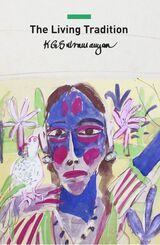
“The fulfillment of a modern Indian artist's wish to be part of a living tradition, i.e. to be individual and innovative, without being an outsider in his own culture, will not come of itself, it calls for concerted effort.”
In Living Tradition, a critical study of modern Indian art as it has evolved through continuous interaction with several traditions—foreign and indigenous—K. G. Subramanyan, one of India's most celebrated artists, offers a theoretical groundwork for that “concerted effort.” In the course of his study, he explores the distinctions between Indian and European traditions, the continuities in India's folk traditions, and the attempts of several thinkers and artists to identify an Indian artistic tradition or to deny it altogether in a quest for personal expression or universality. With over seventy-five illustrations in color complementing Subramanyan's thought-provoking essay, Living Tradition provides readers with a visually engaging exploration of the vibrant tapestry of Indian art.
Subramanyan played a pivotal role in shaping India’s artistic identity after Independence. Mani-da, as he was fondly called, seamlessly blended elements of modernism with folk expression in his works, spanning paintings, murals, sculptures, prints, set designs, and toys. Beyond his visual artistry, his writings have laid a solid foundation for understanding the demands of art on the individual. In the year of his centenary, Seagull is proud to publish his writings in special new editions.
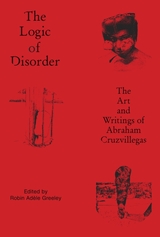
The Logic of Disorder presents for the first time to the English-speaking world the writings of seminal Mexican contemporary artist Abraham Cruzvillegas. Renowned for his sculptures and drawings, Cruzvillegas’s artistic practice ranges from pedagogy to performance. It is through his writings, however, that we can best recognize the impressive depth of knowledge and theoretic clarity of an artist whose work never ceases to impress audiences across the globe.
Each of the texts included in this volume is fully annotated and is accompanied by a number of critical studies by leading curators and scholars, including Claudio Lomnitz of Columbia University and Mark Godfrey from Tate Modern.
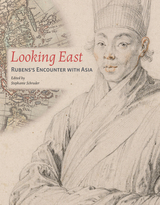
Peter Paul Rubens’s fascinating depiction of a man wearing Korean costume of around 1617, in the collection of the J. Paul Getty Museum, has been considered noteworthy since it was made. Published to accompany an exhibition of Rubens’s Man in Korean Costume at the J. Paul Getty Museum from March 5 to June 9, 2013, Looking East: Rubens’s Encounter with Asia explores the various facets of Rubens’s compelling drawing of this Asian man that appears in later Rubens works. This large drawing was copied in Rubens’s studio during his own time and circulated as a reproductive print in the eighteenth century. Despite the drawing’s renown, however, the reasons why it was made and whether it actually depicts a specific Asian person remain a mystery. The intriguing story that develops involves a shipwreck, an unusual hat, the earliest trade between Europe and Asia, the trafficking of Asian slaves, and the role of Jesuit missionaries in Asia.
The book’s editor, Stephanie Schrader, traces the interpretations and meanings ascribed to this drawing over the centuries. Could Rubens have actually encountered a particular Korean man who sailed to Europe, or did he instead draw a model wearing Asian clothing or simply hear about such a person? What did Europeans really know about Korea during that period, and what might the Jesuits have had to do with the production of this drawing? All of these questions are asked and explored by the book’s contributors, who look at the drawing from various points of view.
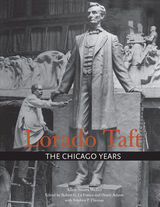
Returning to Chicago from France, Taft established a bustling studio and began a twenty-one-year career as an instructor at the Art Institute, succeeded by three decades as head of the Midway Studios at the University of Chicago. This triumphant era included ephemeral sculpture for the 1893 World's Columbian Exposition; a prolific turn-of-the-century period marked by the gold-medal-winning The Solitude of the Soul; the 1913 Fountain of the Great Lakes; the 1929 Alma Mater at the University of Illinois; and large-scale projects such as his ambitious program for Chicago's Midway with the monumental Fountain of Time. In addition, the book charts Taft's mentoring of women artists, including the so-called White Rabbits at the World's Fair, many of whom went on to achieve artistic success.
Lavishly illustrated with color images of Taft's most celebrated works, Lorado Taft: The Chicago Years completes the first major study of a great American artist.
READERS
Browse our collection.
PUBLISHERS
See BiblioVault's publisher services.
STUDENT SERVICES
Files for college accessibility offices.
RECENTLY PUBLISHED




UChicago Accessibility Resources
home | accessibility | search | about | contact us
BiblioVault ® 2001 - 2025
The University of Chicago Press