logo for Harvard University Press
Labor and Management in a Common Enterprise
Dorothea De Schweinitz
Harvard University Press

front cover of Labwork to Leadership
Labwork to Leadership
A Concise Guide to Thriving in the Science Job You Weren’t Trained For
Jen Heemstra
Harvard University Press, 2025

A roadmap for running a lab—and developing the leadership skills you didn’t know you needed.

As a graduate student and postdoctoral researcher, chemist Jen Heemstra learned how to collect data, write papers, and give talks to other scientists. But when, just a few years into her first job as a principal investigator, conflict broke out in the lab, she realized there was one skill she hadn’t learned: leadership.

Labwork to Leadership is the book that every PI needs. Drawing on her decades of experience—including plenty of trial and error—as well as research from psychology and business management, Heemstra nimbly guides readers through the essentials of scientific leadership. From fostering an inclusive lab environment to setting effective goals and learning to give and receive feedback graciously, she uncovers the curriculum successful PIs must follow to motivate lab members, communicate key values, and inspire confidence.

With candor and humility, Labwork to Leadership demystifies the critical leadership skills that too many universities fail to teach. And it shows how teaching scientists to lead can boost productivity, spur innovation, and, above all, help research teams rediscover the joy of science.

[more]

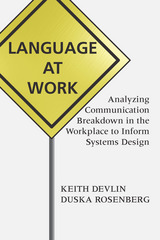
front cover of Language at Work
Language at Work
Analyzing Communication Breakdown in the Workplace to Inform Systems Design
Keith Devlin and Duska Rosenberg
CSLI, 1996
People are very creative in their use of language. This observation was made convincingly by Chomsky in the 1950s and is generally accepted in the scientific communities concerned with the study of language. Computers, on the other hand, are neither creative, flexible, nor adaptable. This is in spite of the fact that their ability to process language is based largely on the grammars developed by linguists and computer scientists. Thus, there is a mismatch between the observed human creativity and our ability as theorists to explain it. Language at Work examines grammars and other descriptions of language by combining the scientific and the practical. The scientific motivation is to unite distinct intellectual traditions, mathematics and descriptive social science, which have tried to provide an adequate explanation of language and its use on their own to no avail. This volume argues that Situation Theory, a theory of information couched in mathematics, has provided a uniform framework for the investigation of the creative aspects of language use. The application of Situation Theory in the study of language use in everyday communication to improve human/computer interaction is explored and espoused.
[more]

front cover of The Last of the Great Observatories
The Last of the Great Observatories
Spitzer and the Era of Faster, Better, Cheaper at NASA
George H. Rieke
University of Arizona Press, 2006
The Spitzer Space Observatory, originally known as the Space Infrared Telescope Facility (SIRTF), is the last of the four “Great Observatories”, which also include the Hubble Space Telescope, the Chandra X-ray Observatory, and the Compton Gamma Ray Observatory. Developed over twenty years and dubbed the “Infrared Hubble", Spitzer was launched in the summer of 2003 and has since contributed significantly to our understanding of the universe.

George Rieke played a key role in Spitzer and now relates the story of how that observatory was built and launched into space. Telling the story of this single mission within the context of NASA space science over two turbulent decades, he describes how, after a tortuous political trail to approval, Spitzer was started at the peak of NASA’s experiment with streamlining and downsizing its mission development process, termed “faster better cheaper.” Up to its official start and even afterward, Spitzer was significant not merely in terms of its scientific value but because it stood at the center of major changes in space science policy and politics. Through interviews with many of the project participants, Rieke reconstructs the political and managerial process by which space missions are conceived, approved, and developed. He reveals that by the time Spitzer had been completed, a number of mission failures had undermined faith in “faster-better-cheaper” and a more conservative approach was imposed. Rieke examines in detail the premises behind “faster better cheaper,” their strengths and weaknesses, and their ultimate impact within the context of NASA’s continuing search for the best way to build future missions.

Rieke’s participant’s perspective takes readers inside Congress and NASA to trace the progress of missions prior to the excitement of the launch, revealing the enormously complex and often disheartening political process that needs to be negotiated. He also shares some of the new observations and discoveries made by Spitzer in just its first year of operation. As the only book devoted to the Spitzer mission, The Last of the Great Observatories is a story at the nexus of politics and science, shedding new light on both spheres as it contemplates the future of mankind’s exploration of the universe.
[more]

logo for American Library Association
Leading and Managing Archives and Records Programs
Bruce W. Dearstyne
American Library Association, 2008

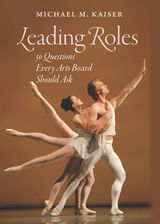
front cover of Leading Roles
Leading Roles
50 Questions Every Arts Board Should Ask
Michael M. Kaiser
Brandeis University Press, 2010
Not-for-profit arts organizations struggled to survive the recent economic recession. In this increasingly hardscrabble environment, it is absolutely imperative that the boards of these organizations function as energetically, creatively, and efficiently as possible. Michael M. Kaiser’s personal history with boards of arts organizations began when he served on the board of the Washington Opera (now the Washington National Opera) in 1983. Today, in his capacity as president of the John F. Kennedy Center for the Performing Arts, Kaiser recently completed a 50-state, 69-city Arts in Crisis tour. Board issues came up repeatedly as central to the success or failure of the organization. Drawing on these and many other conversations, nationally and internationally, Kaiser’s book offers members of boards and staffs the information they need to create the healthy atmosphere necessary to thriving arts organizations. Organized in a clear, readable, question-and-answer format, Leading Roles covers every aspect of board participation in the life of the organization, including mission and governance; fundraising and marketing responsibilities; the relationship of the board to the artistic director, executive director, and staff; and its responsibilities for planning and budgeting. Kaiser addresses boards in crisis, international boards, and boards of arts organizations of color. Throughout, he emphasizes the importance of transparency and clarity in the board’s dealings with its own members and those of the arts community of which it is a part, showing how anything less results in contentiousness that can immobilize an arts organization, or even tear it apart.
[more]

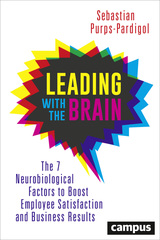
front cover of Leading with the Brain
Leading with the Brain
The 7 Neurobiological Factors to Boost Employee Satisfaction and Business Results
Sebastian Purps-Pardigol
Campus Verlag, 2016
How do business leaders inspire their employees so deeply that employees strive to surpass their own best work, helping managers and their staff to achieve mutual success? Sebastian Purps-Pardigol has figured it out—and the answer starts with the brain. Based on insights from neuroscience, psychology, and behavioral economics, as well as one hundred and fifty interviews with employees and CEOs, he has devised a new, innovative approach to the meaning of leadership today and what it takes to make businesses unbeatable.

In Leading with the Brain, Purps-Pardigol presents seven factors all business leaders should keep in mind to not only make their workforce feel more satisfied, but also to increase the overall health and well-being of their staff. Drawing on real-life examples of businesses that succeed by managing according to scientific findings, Purps-Pardigol shows that by leading in a people-oriented, humane way, managers can release their employees’ hidden energies to the benefit of all.

[more]

front cover of Lean Product Development
Lean Product Development
A manager's guide
Colin Mynott
The Institution of Engineering and Technology, 2012
Lean product development (LPD) is the application of lean principles to product development, aiming to develop new or improved products that are successful in the market. It is a cross-functional activity that seeks to uncover product knowledge hidden within the end-to-end production flow, typically in the hand-over points between functional units. LPD deals with the complete process from gathering and generating ideas, through assessing potential success, to developing concepts, evaluating them to create a best concept, detailing the product, testing/developing it and handing over to the manufacture. LPD is performed against a background of continuously assessing and reducing risk of market failure.
[more]

front cover of Legacies of Space and Intangible Heritage
Legacies of Space and Intangible Heritage
Archaeology, Ethnohistory, and the Politics of Cultural Continuity in the Americas
Fernando Armstrong-Fumero
University Press of Colorado, 2017

Legacies of Space and Intangible Heritage is an interdisciplinary exploration of the intersections between the study and management of physical sites and the reproduction of intangible cultural legacies. The volume provides nine case studies that explore different ways in which place is mediated by social, political, and ecological processes that have deep historical roots and that continue to affect the politics of heritage management.

Spaces of human habitation are both historical records of the past and key elements in reproducing the knowledge and values that define lives in the present. Practices, knowledge, and skills that communities recognize as part of their culture—and that a range of legal statutes define as protected intangible heritages—are threatened by increased migration, the displacement of indigenous peoples, and limits on access to culturally or historically significant sites. This volume addresses how different physical environments contribute to the reproduction of cultural forms even in the wake of these processes of displacement and change. Case studies from North and South America reveal a pattern of abandonment and reestablishment of settlements and show how collective memory drives people back to culturally meaningful sites.

This tendency for communities to return to the sites that shaped their collective histories, along with the growing importance granted to intangible heritage, challenges archaeologists and other heritage workers to find new ways of incorporating the cultural legacies that link societies to place into the work of research and stewardship. By examining the politics of cultural continuity through the lenses of archaeology and ethnohistory, Legacies of Space and Intangible Heritage demonstrates this complex relationship between a people’s heritage and the landscape that affects the making of "place."

Contributors: Rani Alexander, Hannah Becker, Minette Church, Bonnie Clark, Chip Colwell, Winifred Creamer, Emiliana Cruz, T. J. Ferguson, Julio Hoil Gutierrez, Jonathan Haas, Saul Hedquist, Maren Hopkins, Stuart B. Koyiyumptewa, Christine Kray, Henry Marcelo Castillo, Anna Roosevelt, Jason Yaeger, Keiko Yoneda
[more]

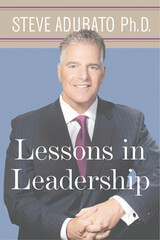
front cover of Lessons in Leadership
Lessons in Leadership
Steve Adubato, PhD
Rutgers University Press, 2016
In this practical guide, Emmy Award-winning public broadcasting anchor Steve Adubato teaches readers to be self-aware, empathetic, and more effective leaders at work and at home. His powerful case studies spotlighting dozens of leaders—from Pope Francis to New Jersey governor Chris Christie—are complemented by concrete tips and tools based in real-life scenarios. With Lessons in Leadership, readers can learn to steer others through difficult economic times, to mentor rising leaders, to provide straight talk to underperforming employees, and even how to lead a company through a significant change. 
[more]

logo for American Library Association
The Librarian as Information Consultant
Sarah Anne Murphy
American Library Association, 2011

logo for American Library Association
Library Technology Buying Strategies
Marshall Breeding
American Library Association, 2016


Send via email Share on Facebook Share on Twitter