
 A SCHOLARLY BOOK REPOSITORY
101 books about Naval and 4
start with L
101 books about Naval and 4
101 books about Naval
4 start with L start with L
4 start with L start with L

Landing Platform Dock Intrepid
Jantinus Mulder
Amsterdam University Press, 2024
One of a two-ship class assault ships commissioned in 1967. Incorporating a large docking well aft, which could accommodate up to four medium landing craft, while four 30 troop light landing craft could be loaded on davits each side of the superstructure. The large flight deck aft could operate up to six helicopters. Both ships operated with the Falkland Task Force in 1982.
[more]
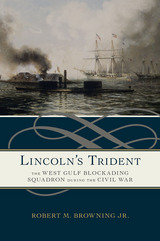
Lincoln's Trident
The West Gulf Blockading Squadron during the Civil War
Robert M. Browning Jr.
University of Alabama Press, 2014
In Lincoln’s Trident, Coast Guard historian Robert M. Browning Jr. continues his magisterial series about the Union’s naval blockade of the Confederacy during the American Civil War. Established by the Navy Department in 1862, the West Gulf Blockading Squadron operated from St. Andrews Bay (Panama City), Florida to the Rio Grande River. As with the Navy’s blockade squadrons operating in the Atlantic, the mission of the West Gulf Blockading Squadron was to cripple the South’s economy by halting imports and disrupting cotton exports, the South’s main source of hard currency. The blockade also limited transportation within the South and participated in combined operations with Union land forces.
The history of the squadron comprises myriad parts and players, deployed in a variety of missions across the thousand-mile-wide Western Theater. From disorganized beginnings, the squadron’s leaders and sailors had to overcome setbacks, unfulfilled expectations, and lost opportunities. Browning masterfully captures the many variables that influenced the strategic choices of Navy commanders as they both doggedly pursued unchanging long-term goals as well as improvised and reacted to short-term opportunities.
Notable among its leaders was David Glasgow Farragut, believed by many to be America’s greatest naval hero, who led the squadron through most of the war and the climactic Battle of Mobile Bay. Under his legendary leadership, the squadron not only sealed Confederate sea ports, but also made feints and thrusts up the Mississippi River as far north as Vicksburg, Mississippi.
Knowing the Navy’s role in isolating the Confederate economy and preventing the movement of troops and supplies within the South is crucial to understanding of the outcomes of the Civil War, as well as the importance of naval power in military conflicts. With thirty-five maps and illustrations, Lincoln’s Trident expounds upon an essential part of the Civil War as well as naval and American history.
The history of the squadron comprises myriad parts and players, deployed in a variety of missions across the thousand-mile-wide Western Theater. From disorganized beginnings, the squadron’s leaders and sailors had to overcome setbacks, unfulfilled expectations, and lost opportunities. Browning masterfully captures the many variables that influenced the strategic choices of Navy commanders as they both doggedly pursued unchanging long-term goals as well as improvised and reacted to short-term opportunities.
Notable among its leaders was David Glasgow Farragut, believed by many to be America’s greatest naval hero, who led the squadron through most of the war and the climactic Battle of Mobile Bay. Under his legendary leadership, the squadron not only sealed Confederate sea ports, but also made feints and thrusts up the Mississippi River as far north as Vicksburg, Mississippi.
Knowing the Navy’s role in isolating the Confederate economy and preventing the movement of troops and supplies within the South is crucial to understanding of the outcomes of the Civil War, as well as the importance of naval power in military conflicts. With thirty-five maps and illustrations, Lincoln’s Trident expounds upon an essential part of the Civil War as well as naval and American history.
[more]
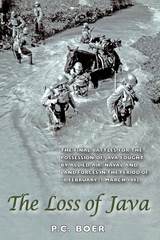
The Loss of Java
The Final Battles for the Possession of Java Fought by Allied Air, Naval and Land Forces in the Period of 18 February - 7 March 1942
P.C. Boer
National University of Singapore Press, 2011
The Loss of Java explains in detail the air, sea and land battles between the Allied and Japanese armed forces during the battle for Java that followed the evacuation of southern Sumatra in February 1942. Little has been written about the allied air campaign, or about why Dutch forces fought just one major land battle with the Japanese, the Battle of the Tjiater Pass, in the later stages of the struggle.
P.C. Boer considers whether the assessment of Major General Van Oyen that deploying the Allied air forces might prevent Japanese invasion of Java was realistic, and whether reliance on air power limited the capacity of land and naval forces to repel Japan's advances. The generally accepted idea is that the Allies were ineffective in their fight against the Japanese invaders but in fact the Japanese suffered serious losses. Boer's study shows that Dutch strategy grew out of a carefully-devised plan of defense, and that the battle for Java comprised not one (the Battle of the Java Sea) but four major engagements. However, Japanese commanders at various levels consciously took steps that exposed their forces to great risk but succeeded in putting the Allies under great pressure. In the end the Royal Netherlands East Indies Army (KNIL) and the allied forces capitulated on 8 March 1942.
This book is a translation of Het Verlies Van Java: Een kwestie van Air Power. De eindstrijd om Nederlands-Indie van de geallieerde lucht-, zee- en landstrijdkrschten in de periode van 18 februari t/m 7 maart 1942 (Amsterdam: Bataafsche Leeuw BV for the Koninklijke Militaire Academie, 2006).
P.C. Boer considers whether the assessment of Major General Van Oyen that deploying the Allied air forces might prevent Japanese invasion of Java was realistic, and whether reliance on air power limited the capacity of land and naval forces to repel Japan's advances. The generally accepted idea is that the Allies were ineffective in their fight against the Japanese invaders but in fact the Japanese suffered serious losses. Boer's study shows that Dutch strategy grew out of a carefully-devised plan of defense, and that the battle for Java comprised not one (the Battle of the Java Sea) but four major engagements. However, Japanese commanders at various levels consciously took steps that exposed their forces to great risk but succeeded in putting the Allies under great pressure. In the end the Royal Netherlands East Indies Army (KNIL) and the allied forces capitulated on 8 March 1942.
This book is a translation of Het Verlies Van Java: Een kwestie van Air Power. De eindstrijd om Nederlands-Indie van de geallieerde lucht-, zee- en landstrijdkrschten in de periode van 18 februari t/m 7 maart 1942 (Amsterdam: Bataafsche Leeuw BV for the Koninklijke Militaire Academie, 2006).
[more]
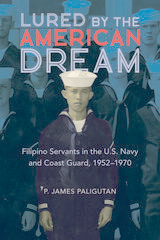
Lured by the American Dream
Filipino Servants in the U.S. Navy and Coast Guard, 1952-1970
P. James Paligutan
University of Illinois Press, 2022
Starting in 1952, the United States Navy and Coast Guard actively recruited Filipino men to serve as stewards--domestic servants for officers. Oral histories and detailed archival research inform P. James Paligutan's story of the critical role played by Filipino sailors in putting an end to race-based military policies. Constrained by systemic exploitation, Filipino stewards responded with direct complaints to flag officers and chaplains, rating transfer requests that flooded the bureaucracy, and refusals to work. Their actions had a decisive impact on seagoing military’s elimination of the antiquated steward position. Paligutan looks at these Filipino sailors as agents of change while examining the military system through the lens of white supremacy, racist perceptions of Asian males, and the motives of Filipinos who joined the armed forces of the power that had colonized their nation.
Insightful and dramatic, Lured by the American Dream is the untold story of how Filipino servicepersons overcame tradition and hierarchy in their quest for dignity.
[more]
READERS
Browse our collection.
PUBLISHERS
See BiblioVault's publisher services.
STUDENT SERVICES
Files for college accessibility offices.
RECENTLY PUBLISHED






UChicago Accessibility Resources
home | accessibility | search | about | contact us
BiblioVault ® 2001 - 2025
The University of Chicago Press