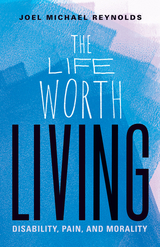
front cover of The Life Worth Living
The Life Worth Living
Disability, Pain, and Morality
Joel Michael Reynolds
University of Minnesota Press, 2022

A philosophical challenge to the ableist conflation of disability and pain

More than 2,000 years ago, Aristotle said: “let there be a law that no deformed child shall live.” This idea is alive and well today. During the past century, Supreme Court Justice Oliver Wendell Holmes Jr. argued that the United States can forcibly sterilize intellectually disabled women and philosopher Peter Singer argued for the right of parents to euthanize certain cognitively disabled infants. The Life Worth Living explores how and why such arguments persist by investigating the exclusion of and discrimination against disabled people across the history of Western moral philosophy.

Joel Michael Reynolds argues that this history demonstrates a fundamental mischaracterization of the meaning of disability, thanks to the conflation of lived experiences of disability with those of pain and suffering. Building on decades of activism and scholarship in the field, Reynolds shows how longstanding views of disability are misguided and unjust, and he lays out a vision of what an anti-ableist moral future requires.

The Life Worth Living is the first sustained examination of disability through the lens of the history of moral philosophy and phenomenology, and it demonstrates how lived experiences of disability demand a far richer account of human flourishing, embodiment, community, and politics in philosophical inquiry and beyond.

Accessibility features: Retail e-book files for this title are screen-reader friendly with images accompanied by short alt text and/or extended descriptions.


[more]

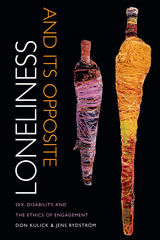
front cover of Loneliness and Its Opposite
Loneliness and Its Opposite
Sex, Disability, and the Ethics of Engagement
Don Kulick and Jens Rydström
Duke University Press, 2015
Few people these days would oppose making the public realm of space, social services and jobs accessible to women and men with disabilities. But what about access to the private realm of desire and sexuality? How can one also facilitate access to that, in ways that respect the integrity of disabled adults, and also of those people who work with and care for them?

Loneliness and Its Opposite documents how two countries generally imagined to be progressive engage with these questions in very different ways. Denmark and Sweden are both liberal welfare states, but they diverge dramatically when it comes to sexuality and disability. In Denmark, the erotic lives of people with disabilities are acknowledged and facilitated. In Sweden, they are denied and blocked. Why do these differences exist, and how do both facilitation and hindrance play out in practice?

Loneliness and Its Opposite charts complex boundaries between private and public, love and sex, work and intimacy, and affection and abuse. It shows how providing disabled adults with access to sexual lives is not just crucial for a life with dignity. It is an issue of fundamental social justice with far reaching consequences for everyone.
[more]


Send via email Share on Facebook Share on Twitter