
 A SCHOLARLY BOOK REPOSITORY
6 start with L start with L


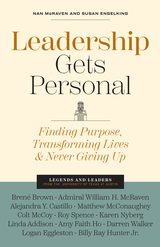
How the University of Texas shaped twelve people who changed the world.
College is a time for personal growth. But any Biology 101 student knows that growth (personal or otherwise) requires the right environment. Collecting the revealing and deeply personal stories of twelve UT alumni who became leaders in their fields, Leadership Gets Personal honors the transformative impact of the Forty Acres on those who learn and grow there.
Matthew McConaughey, Academy Award-winning actor and #1 New York Times best-selling author, was destined for law school, but with the encouragement of his UT community, he realized he was a born storyteller. Brené Brown, author of the #1 New York Times bestseller Dare to Lead, struggled for years before finding her purpose in the Social Work Department. Dr. Amy Ho knew she wanted to change the American health care system, and at UT she gained the confidence and skills to make a difference. Astronaut Karen Nyberg was a shy kid; her UT graduate studies propelled her to space. And Darren Walker would go on to become president of the Ford Foundation, taking inspiration from the financial aid counselors who made sure he got the education he yearned for. For these and other outstanding alumni profiled here, the road was often rocky. Through perseverance, humility, and collaboration, they learned not only to exercise leadership but to live it.
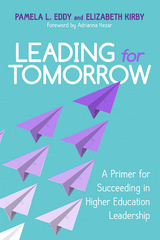
Using an engaging case study approach, Leading for Tomorrow provides readers with real-world examples that will help them reflect on their own management and communication styles. It also shows newly minted administrators how they can follow best practices while still developing a style of leadership that is authentic and uniquely their own.
The book’s case studies offer practical solutions for how to deal with emerging trends and persistent problems in the field of higher education, from decreasing state funding to political controversies on campus. Leading for Tomorrow gives readers the tools they need to get the best out of their team, manage conflicts, support student success, and instill a campus culture of innovation that will meet tomorrow’s challenges.

Lobbying for Higher Education is about how the major higher education associations and the constituent American colleges and universities try to influence federal policy, especially congressional policy. In clear prose Cook explains how the higher education community organizes itself in Washington, how it lobbies, and how its major interest groups are perceived both by their own members and by public officials. The book focuses on the crucial development in 1995-1996 of a new lobbying paradigm, which included the greater use of campus-based resources and ad hoc coalitions. The most engrossing part of its story is higher education's creative response to the policy turmoil and disruption of the status quo that resulted from the shift in congressional party control.
The author, Constance Cook, uses sources unique to this project: over 1,500 survey responses from college and university presidents (a 62% return rate) and nearly 150 interviews with institutional and association leaders. Fortuitously, the 1994 electoral upheaval provided her with an opportunity to capture, analyze, and interpret the responses of her subjects in a period of unusually sweeping change.
Lobbying for Higher Education is a timely book with an interesting and important story at its core.

The 1950s through the early 1970s are widely seen as American academia’s golden age, when universities—well-funded and viewed as essential for national security, economic growth, and social mobility—embraced an egalitarian mission. Swelling in size, schools attracted new types of students and professors, including radicals who challenged their institutions’ calcified traditions. But that halcyon moment soon came to a painful and confusing end, with consequences that still afflict the halls of ivy. In The Lost Promise, Ellen Schrecker—our foremost historian of both the McCarthy era and the modern American university—delivers a far-reaching examination of how and why it happened.
Schrecker illuminates how US universities’ explosive growth intersected with the turmoil of the 1960s, fomenting an unprecedented crisis where dissent over racial inequality and the Vietnam War erupted into direct action. Torn by internal power struggles and demonized by conservative voices, higher education never fully recovered, resulting in decades of underfunding and today’s woefully inequitable system. As Schrecker’s magisterial history makes blazingly clear, the complex blend of troubles that disrupted the university in that pivotal period haunts the ivory tower to this day.
READERS
Browse our collection.
PUBLISHERS
See BiblioVault's publisher services.
STUDENT SERVICES
Files for college accessibility offices.
RECENTLY PUBLISHED




UChicago Accessibility Resources
home | accessibility | search | about | contact us
BiblioVault ® 2001 - 2025
The University of Chicago Press