
 A SCHOLARLY BOOK REPOSITORY
Winner of the 2020 Outstanding Book Award Presented by the Public and Nonprofit Section of the National Academy of Management
Winner of the 2019 Louis Brownlow Book Award from the National Academy of Public Administration
Through in-depth case studies of federal programs and controversial legislation, the authors show that administrative burdens are the nuts-and-bolts of policy design. Regarding controversial issues such as voter enfranchisement or abortion rights, lawmakers often use administrative burdens to limit access to rights or services they oppose. For instance, legislators have implemented administrative burdens such as complicated registration requirements and strict voter-identification laws to suppress turnout of African American voters. Similarly, the right to an abortion is legally protected, but many states require women seeking abortions to comply with burdens such as mandatory waiting periods, ultrasounds, and scripted counseling. As Herd and Moynihan demonstrate, administrative burdens often disproportionately affect the disadvantaged who lack the resources to deal with the financial and psychological costs of navigating these obstacles.
However, policymakers have sometimes reduced administrative burdens or shifted them away from citizens and onto the government. One example is Social Security, which early administrators of the program implemented in the 1930s with the goal of minimizing burdens for beneficiaries. As a result, the take-up rate is about 100 percent because the Social Security Administration keeps track of peoples’ earnings for them, automatically calculates benefits and eligibility, and simply requires an easy online enrollment or visiting one of 1,200 field offices. Making more programs and public services operate this efficiently, the authors argue, requires adoption of a nonpartisan, evidence-based metric for determining when and how to institute administrative burdens, with a bias toward reducing them. By ensuring that the public’s interaction with government is no more onerous than it need be, policymakers and administrators can reduce inequality, boost civic engagement, and build an efficient state that works for all citizens.
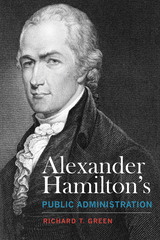
American public administration inherited from Alexander Hamilton a distinct republican framework through which we derive many of our modern governing standards and practices. His administrative theory flowed from his republican vision, prescribing not only the how of administration but also what should be done and why. Administration and policy merged seamlessly in his mind, each conditioning the other. His Anti-Federalist detractors clearly saw this and fought his vision tooth and nail.
That conflict endures to this day because Americans still have not settled on just one vision of the American republic. That is why, Richard Green argues, Hamilton is a pivotal figure in our current reckoning. If we want to more fully understand ourselves and our ways of governing today, we must start by understanding Hamilton, and we cannot do that without exploring his administrative theory and practice in depth.
Alexander Hamilton’s Public Administration considers Hamilton both as a founder of the American republic, steeped in the currents of political philosophy and science of his day, and as its chief administrative theorist and craftsman, deeply involved in establishing the early institutions and policies that would bring his interpretation of the written Constitution to life. Accordingly, this book addresses the complex mix of classical and modern ideas that informed his vision of a modern commercial and administrative republic; the administrative ideas, institutions, and practices that flowed from that vision; and the substantive policies he deemed essential to its realization. Green’s analysis grows out of an immersion in Hamilton’s extant papers, including reports, letters, pamphlets, and essays. Readers will find a comprehensive explanation of his theoretical contributions and a richly detailed account of his ideas and practices in historical context.
The essays raise such issues as the education of civil servants, the changes necessitated by crises, the growth of social sciences in governmental concerns, and primarily, the role of public administrators in America. Each author is a distinguished expert in his own right, and each essay can stand alone as a remarkable insight into the changing world of public administration within American society. Frederick Mosher’s expertise and supervision shapes this work into a remarkable and holistic perspective on public administration over time.
An updated classic of public administration
This fresh publication of James W. Fesler’s classic, Area and Administration is a powerful work of intellectual history. Richly illustrating how the Great Depression and World War II shaped the thinking of scholars who helped build modern American government.
It is also an authoritative work of powerful insight. The challenges of linking the center with the front lines, or securing vertical and horizonal coordination, and of connecting area and function, have only become more important in twenty-first century government. Fesler’s path-breaking book provides an extraordinarily useful foundation for grappling with issues that have become even more important for governance.

Public administration has evolved into an extraordinarily complex form of governance employing traditional bureaucracy, quasi-government public organizations, and collaborative networks of nongovernmental organizations. Analyzing and improving government performance—a matter of increasing concern to citizens, elected officials, and managers of the organizations themselves—has in turn become a much more fraught undertaking. Understanding the new complexities calls for new research approaches.
The Art of Governance presents a fresh palette of research based on a new framework of governance that was first developed by coeditor Laurence E. Lynn, Jr., with Carolyn J. Heinrich, and Carolyn J. Hill in their book, Improving Governance: A New Logic for Empirical Research. That book identified how the relationships among citizens, legislatures, executive and organizational structures, and stakeholders interact, in order to better diagnose and solve problems in public management.
This volume takes that relational concept into new realms of conceptualization and application as it links alternative institutional and administrative structures to program performance in different policy areas and levels of government. Collectively, the contributors begin to paint a new picture of how management matters throughout the policy process. They illuminate how, at different levels of an organization, leadership and management vary—and explore both the significance of structural systems and the importance of alternative organizational forms for the implementation of public policies.
The Art of Governance shows that effective governance is much more complex than paint-by-number. But if the variety of forms and models of governance are analyzed using advanced theories, models, methods, and data, important lessons can be applied that can lead us to more successful institutions.
Legislative member organizations (LMOs)—such as caucuses in the U.S. Congress and intergroups in the European Parliament—exist in lawmaking bodies around the world. Unlike parties and committees, LMOs play no obvious, predefined role in the legislative process. They provide legislators with opportunities to establish social networks with colleagues who share common interests. In turn, such networks offer valuable opportunities for the efficient exchange of policy-relevant—and sometimes otherwise unattainable—information between legislative offices. Building on classic insights from the study of social networks, the authors provide a comparative overview of LMOs across advanced, liberal democracies. In two nuanced case studies of LMOs in the European Parliament and the U.S. Congress, the authors rely on a mix of social network analysis, sophisticated statistical methods, and careful qualitative analysis of a large number of in-depth interviews.
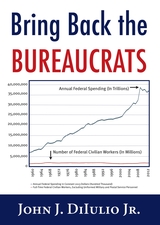
In Bring Back the Bureaucrats, John J. DiIulio Jr., one of America’s most respected political scientists and an adviser to presidents in both parties, summons the facts and statistics to show us how America’s big government works and why reforms that include adding a million more people to the federal workforce by 2035 might help to slow government’s growth while improving its performance.
Starting from the underreported reality that the size of the federal workforce hasn’t increased since the early 1960s, even though the federal budget has skyrocketed. The number of federal programs has ballooned; Bring Back the Bureaucrats tells us what our elected leaders won’t: there are not enough federal workers to work for our democracy effectively.
DiIulio reveals that the government in America is Leviathan by Proxy, a grotesque form of debt-financed big government that guarantees terrible government. Washington relies on state and local governments, for-profit firms, and nonprofit organizations to implement federal policies and programs. Big-city mayors, defense industry contractors, nonprofit executives, and other national proxies lobby incessantly for more federal spending. This proxy system chokes on chores such as cleaning up toxic waste sites, caring for hospitalized veterans, collecting taxes, handling plutonium, and policing more than $100 billion annually in “improper payments.” The lack of competent, well-trained federal civil servants resulted in the failed federal response to Hurricane Katrina and the troubled launch of Obamacare’s “health exchanges.”
Bring Back the Bureaucrats is further distinguished by the presence of E. J. Dionne Jr. and Charles Murray, two of the most astute voices from the political left and right, respectively, who offer their candid responses to DiIulio at the end of the book.
Whereas Weber contends that the administration of all modern nation-states would eventually converge in one form characterized by rationality and legal authority, Silberman argues that the process of bureaucratic rationalization took, in fact, two courses. One path is characterized by permeable organizational boundaries and the allocation of information by "professionals." The other features well-defined boundaries and the allocation of information by organizational rules. Through case studies of France, Japan, the United States, and Great Britain, Silberman demonstrates that this divergence stems from differences in leadership structure and in levels of uncertainty about leadership succession in the nineteenth century.
Silberman concludes that the rise of bureacratic rationality was primarily a response to political problems rather than social and economic concerns. Cages of Reason demonstrates how rationalization can have occurred over a wide range of cultures at various levels of economic development. It will be of considerable interest to readers in a number of disciplines: political science, sociology, history, and public administration.
"Silberman has produced an invaluable, densely packed work that those with deep knowledge of public administrative development will find extremely rewarding." —David H. Rosenbloom, American Political Science Review
"An erudite, incisive, and vibrant book, the product of intensive study and careful reflection. Given its innovative theoretical framework and the wealth of historical materials contained in it, this study will generate debate and stimulate research in sociology, political science, and organizational theory. It is undoubtedly the best book on the comparative evolution of the modern state published in the last decade."—Mauro F. Guillen, Contemporary Sociology
Replete with practical advice for anyone considering a career in federal, state, or local government, Caught between the Dog and the Fireplug, or How to Survive Public Service conveys what life is really like in a public service job. The book is written as a series of lively, entertaining letters of advice from a sympathetic uncle to a niece or nephew embarking on a government career.
Kenneth Ashworth draws on more than forty years of public sector experience to provide advice on the daily challenges that future public servants can expect to face: working with politicians, bureaucracy, and the press; dealing with unpleasant and difficult people; leading supervisors as well as subordinates; and maintaining high ethical standards. Ashworth relates anecdotes from his jobs in Texas, California, and Washington, D.C., that illustrate with humor and wit fundamental concepts of public administration.
Be prepared, says Ashworth, to encounter all sorts of unexpected situations, from the hostile to the bizarre, from the intimidating to the outrageous. He shows that in the confrontational world of public policymaking and program implementation, a successful career demands disciplined, informed thought, intellectual and personal growth, and broad reading. He demonstrates how, despite the inevitable inefficiencies of a democratic society, those working to shape policy in large organizations can nonetheless effect significant change-and even have fun along the way.
The book will interest students and teachers of public administration, public affairs, policy development, leadership, or higher education administration. Ashworth's advice will also appeal to anyone who has ever been caught in a tight spot while working in government service.
Citizen Power portal (https://thecitizenscampaign.org/register/).
Collaborating to Manage captures the basic ideas and approaches to public management in an era where government must partner with external organizations as well as other agencies to work together to solve difficult public problems. In this primer, Robert Agranoff examines current and emergent approaches and techniques in intergovernmental grants and regulation management, purchase-of-service contracting, networking, public/nonprofit partnerships and other lateral arrangements in the context of the changing public agency. As he steers the reader through various ways of coping with such organizational richness, Agranoff offers a deeper look at public management in an era of shared public program responsibility within governance.
Geared toward professionals working with the new bureaucracy and for students who will pursue careers in the public or non-profit sectors, Collaborating to Manage is a student-friendly book that contains many examples of real-world practices, lessons from successful cases, and summaries of key principles for collaborative public management.
Whether the goal is building a local park or developing disaster response models, collaborative governance is changing the way public agencies at the local, regional, and national levels are working with each other and with key partners in the nonprofit and private sectors. While the academic literature has spawned numerous case studies and context- or policy-specific models for collaboration, the growth of these innovative collaborative governance systems has outpaced the scholarship needed to define it.
Collaborative Governance Regimes breaks new conceptual and practical ground by presenting an integrative framework for working across boundaries to solve shared problems, a typology for understanding variations among collaborative governance regimes, and an approach for assessing both process and productivity performance. This book draws on diverse literatures and uses rich case illustrations to inform scholars and practitioners about collaborative governance regimes and to provide guidance for designing, managing, and studying such endeavors in the future.
Collaborative Governance Regimes will be of special interest to scholars and researchers in public administration, public policy, and political science who want a framework for theory building, yet the book is also accessible enough for students and practitioners.
Governments worldwide struggle to remove policy deadlocks and enact much-needed reforms in organizational structure and public services. In this book, Jacob Torfing explores collaborative innovation as a way for public and private stakeholders to break the impasse. These network-based collaborations promise to multiply the skills, ideas, energy, and resources between government and its partners across agency boundaries and in the nonprofit and private sectors.
Torfing draws on his own pioneering work in Europe as well as examples from the United States and Australia to construct a cross-disciplinary framework for studying collaborative innovation. His analysis explores its complex and interactive processes as he looks at how drivers and barriers may enhance or impede the collaborative approach. He also reflects on the roles institutional design, public management, and governance reform play in spurring collaboration for public sector innovation. The result is a theoretically and empirically informed book that carefully demonstrates how multi-actor collaboration can enhance public innovation in the face of fiscal constraint, the proliferation of wicked problems, and the presence of unsatisfied social needs.
Today’s public managers not only have to function as leaders within their agencies, they must also establish and coordinate multi-organizational networks of other public agencies, private contractors, and the public. This important transformation has been the subject of an explosion of research in recent years. The Collaborative Public Manager brings together original contributions by some of today’s top public management and public policy scholars who address cutting-edge issues that affect government managers worldwide. State-of-the-art empirical research reveals why and how public managers collaborate and how they motivate others to do the same. Examining tough issues such as organizational design and performance, resource sharing, and contracting, the contributors draw lessons from real-life situations as they provide tools to meet the challenges of managing conflict within interorganizational, interpersonal networks. This book pushes scholars, students, and professionals to rethink what they know about collaborative public management—and to strive harder to achieve its full potential.
While the field of public management has become increasingly international, research and policy recommendations that work for one country often do not work for another. Why, for example, is managerial networking important in the United States, moderately effective in the United Kingdom, and of little consequence in the Netherlands? Comparative Public Management argues that scholars must find a better way to account for political, environmental, and organizational contexts to build a more general model of public management. The volume editors propose a framework in which context influences the types of managerial actions that can be used effectively in public organizations.
After introducing the innovative framework, the book offers seven empirical chapters—cases from seven countries and a range of policy areas (health, education, taxation, and local governance)—that show how management affects performance in different contexts. Following these empirical tests, the book examines themes that emerge across cases and seeks to set an agenda for future research. Intended for students and scholars of public administration and public policy, this book will be the first to provide a comprehensive comparative assessment of management’s impact on organizational performance.
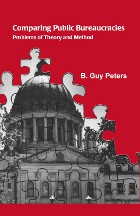
The comparative study of public policy once promised to make major contributions to our understanding of government. Much of that promise now appears unfulfilled. What accounts for this decline in intellectual fortunes and change in intellectual fashion? Comparing Public Bureaucracies seeks to understand why. One of the principal answers is that there is no readily accepted and dependent variable that would allow comparative public administration to conform to the usual canons of social research. In contrast, comparative public policy has a ready-made dependent variable in public expenditure.
Peters discusses four possible dependent variables for comparative public administration. The first is personnel—the number and type of people who work for government. Second, the number and type of organizations that form government can suggest a great deal about the structure of government. Third, the behavior of members is obviously important for understanding what actually happens in government—such as the extents to which bureaucracies approximate the budget-maximizing behavior posited by economists. Ginally, the relative power of civil servants in the policymaking process is a major factor in institutional politics in contemporary industrial societies.
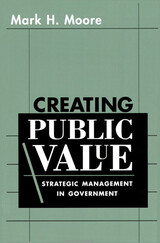
A seminal figure in the field of public management, Mark H. Moore presents his summation of fifteen years of research, observation, and teaching about what public sector executives should do to improve the performance of public enterprises. Useful for both practicing public executives and those who teach them, this book explicates some of the richest of several hundred cases used at Harvard’s Kennedy School of Government and illuminates their broader lessons for government managers. Moore addresses four questions that have long bedeviled public administration: What should citizens and their representatives expect and demand from public executives? What sources can public managers consult to learn what is valuable for them to produce? How should public managers cope with inconsistent and fickle political mandates? How can public managers find room to innovate?
Moore’s answers respond to the well-understood difficulties of managing public enterprises in modern society by recommending specific, concrete changes in the practices of individual public managers: how they envision what is valuable to produce, how they engage their political overseers, and how they deliver services and fulfill obligations to clients. Following Moore’s cases, we witness dilemmas faced by a cross-section of public managers: William Ruckelshaus and the Environmental Protection Agency; Jerome Miller and the Department of Youth Services; Miles Mahoney and the Park Plaza Redevelopment Project; David Sencer and the swine flu scare; Lee Brown and the Houston Police Department; Harry Spence and the Boston Housing Authority. Their work, together with Moore’s analysis, reveals how public managers can achieve their true goal of producing public value.
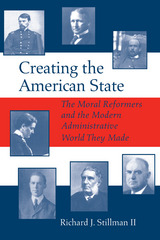
In this illuminating and provocative study, Stillman provides a new understanding of the foundation of the American state.
Whether renewing a driver's license, traveling on an airplane, or just watching in fascination as a robot probes Mars, we all participate in the everyday workings of the modern administrative state. As Stillman demonstrates in this study, however, we have not, until now, fully investigated or appreciated this administrative stateÕs origins or its evolution into the entity that so affects our lives today.
Stillman reveals that this modern enterprise emerged from a complex foundation of ideas and ideals rather than as a result of a simple, rational plan or cataclysmic event, as previously contended. In fact, he finds that the basis for our current administrative state lies in the lives of the seven individuals who, during the late 19th and early 20th centuries, invented its various elements.
Stillman also finds that although they lived at different times, these seven founders-George William Curtis, Charles Francis Adams, Jr., Emory Upton, Jane Addams, Frederick W. Taylor, Richard Childs, and Louis Brownlow-had much in common: all were products of intensely Protestant, small-town America, and all were motivated by strong moral idealism. Indeed, Stillman finds that state making in the United States has been a continuation of the Protestant goal to "protest and purify."
Some names are more recognizable than others, but all, through remarkable moral fervor and exceptional leadership skills, invented the administrative practices and procedures so familiar today.
Today, the work of government often involves coordination at the federal, state, and local levels as well as with contractors and citizens’ groups. This process of governance across levels of government, jurisdictions, and types of actors is called intergovernmental relations, and intergovernmental management (IGM) is the way work is administered in this increasingly complex system. Leading authority Robert Agranoff reintroduces intergovernmental management for twenty-first-century governance to a new generation of scholars, students, and practitioners.
Agranoff examines IGM in the United States from four thematic perspectives: law and politics, jurisdictional interdependency, multisector partners, and networks and networking. Common wisdom holds that government has “hollowed out” despite this present era of contracting and networked governance, but he argues that effective intergovernmental management has never been more necessary or important. He concludes by offering six next steps for intergovernmental management.
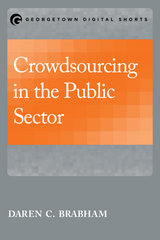
Crowdsourcing is a term that was coined in 2006 to describe how the commercial sector was beginning to outsource problems or tasks to the public through an open call for solutions over the internet or social media. Crowdsourcing works to generate new ideas or develop innovative solutions to problems by drawing on the wisdom of the many rather than the few. US local government experimented with rudimentary crowdsourcing strategies as early as 1989, but in the last few years local, state, and federal government have increasingly turned to crowdsourcing to enhance citizen participation in problem solving, setting priorities, and decision making. While crowdsourcing in the public sector holds much promise and is part of a larger movement toward more citizen participation in democratic government, many challenges, especially legal and ethical issues, need to be addressed to successfully adapt it for use in the public sector.
Daren C. Brabham has been at the forefront of the academic study of crowdsourcing. This book includes extensive interviews with public and private sector managers who have used crowdsourcing. Brabham concludes with a list of the top ten best practices for public managers.
The ancient Greek statesman is a familiar figure in the Western political tradition. Less well known is the administrator who ran the state but who was himself a slave. Challenging the modern belief that democracy and bondage are incompatible, Paulin Ismard directs our attention to the cradle of Western democracy, ancient Athens, where the functioning of civic government depended crucially on highly skilled experts who were literally public servants—slaves owned by the city-state rather than by private citizens.
Known as dēmosioi, these public slaves filled a variety of important roles in Athenian society. They were court clerks, archivists, administrators, accountants, and policemen. Many possessed knowledge and skills beyond the attainments of average citizens, and they enjoyed privileges, such as the right to own property, that were denied to private slaves. In effect, dēmosioi were Western civilization’s first civil servants—though they carried out their duties in a condition of bound servitude.
Ismard detects a radical split between politics and administrative government at the heart of Athenian democracy. The city-state’s managerial caste freed citizens from the day-to-day responsibilities of running the state. By the same token, these public servants were unable to participate in the democratic process because they lacked the rights of full citizenship. By rendering the state’s administrators politically invisible, Athens warded off the specter of a government capable of turning against the citizens’ will. In a real sense, Ismard shows, Athenian citizens put the success of their democratic experiment in the hands of slaves.
An in-depth look at life in the “smart” city
Technology has fundamentally transformed urban life. But today’s “smart” cities look little like what experts had predicted. Aaron Shapiro shows us the true face of the revolution in urban technology, taking the reader on a tour of today’s smart city. Along the way, he develops a new lens for interpreting urban technologies—logistical governance—to critique an urban future based on extraction and rationalization.
Through ethnographic research, journalistic interviews, and his own hands-on experience, Shapiro helps us peer through cracks in the smart city’s facade. He investigates the true price New Yorkers pay for “free,” ad-funded WiFi, finding that it ultimately serves the ends of commercial media. He also builds on his experience as a bike courier for a food delivery startup to examine how promises of “flexible employment” in the gig economy in fact pave the way for strict managerial control. And he turns his eye toward hot-button debates around police violence and new patrol technologies, asking whether algorithms are really the answer to reforming our cities’ ongoing crises of criminal justice.
Through these gripping accounts of the new technological urbanism, Design, Control, Predict makes vital contributions to conversations around data privacy and algorithmic governance. Shapiro brings much-needed empirical research to a field that has often relied on “10,000-foot views.” Timely, important, and expertly researched, Design, Control, Predict doesn’t just help us comprehend urbanism today—it advances strategies for critiquing and resisting a dystopian future that can seem inevitable.
Reports of scandal and corruption have led to the downfall of numerous political leaders in Latin America in recent years. What conditions have developed that allow for the exposure of wrongdoing and the accountability of leaders? Enforcing the Rule of Law examines how elected officials in Latin American democracies have come under scrutiny from new forms of political control, and how these social accountability mechanisms have been successful in counteracting corruption and the limitations of established institutions.
This volume reveals how legal claims, media interventions, civic organizations, citizen committees, electoral observation panels, and other watchdog groups have become effective tools for monitoring political authorities. Their actions have been instrumental in exposing government crime, bringing new issues to the public agenda, and influencing or even reversing policy decisions.
Enforcing the Rule of Law presents compelling accounts of the emergence of civic action movements and their increasing political influence in Latin America, and sheds new light on the state of democracy in the region.
Serving the public interest with integrity requires a moral perspective that can rise above the day-to-day pressures of the job. This book integrates Western philosophy’s most significant ethical theories and merges them with public administration theory to provide public administrators with an explicit moral foundation for ethical decision making.
Ethics in the Public Service reviews moral thought through the ages, from Plato to Rorty, and makes the philosophies of the more difficult thinkers accessible to both students and practitioners. Unifying seemingly disparate ethical positions, including those of Aristotle, Kant, and Mill, the authors defend the idea of objective moral truth and critique subjectivist views, refuting postmodernism and ethical relativism. Using their integrated objective approach, they tackle such dichotomies in public administration theory as bureaucracy vs. democracy, and they also examine a case study in an administrative setting.
Offering a better understanding of moral dilemmas rather than a formula, this book presents scholars and practitioners with a framework that is both objective and flexible, theoretical and practical. This original synthesis provides a comprehensive basis for administrative thought and action.
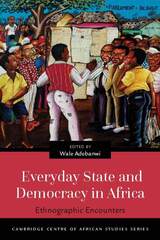
Bottom-up case studies, drawn from the perspective of ordinary Africans’ experiences with state bureaucracies, structures, and services, reveal how citizens and states define each other.
This volume examines contemporary citizens’ everyday encounters with the state and democratic processes in Africa. The contributions reveal the intricate and complex ways in which quotidian activities and experiences—from getting an identification card (genuine or fake) to sourcing black-market commodities to dealing with unreliable waste collection—both (re)produce and (re)constitute the state and democracy. This approach from below lends gravity to the mundane and recognizes the value of conceiving state governance not in terms of its stated promises and aspirations but rather in accordance with how people experience it.
Both new and established scholars based in Africa, Europe, and North America cover a wide range of examples from across the continent, including
- bureaucratic machinery in South Sudan, Nigeria, and Kenya
- infrastructure and shortages in Chad and Nigeria
- disciplinarity, subjectivity, and violence in Rwanda, South Africa, and Nigeria
- the social life of democracy in the Congo, Cameroon, and Mozambique
- education, welfare, and health in Ethiopia, the Democratic Republic of Congo, and Burkina Faso
Everyday State and Democracy in Africa demonstrates that ordinary citizens’ encounters with state agencies and institutions define the meanings, discourses, practices, and significance of democratic life, as well its distressing realities.
Contributors:
- Daniel Agbiboa
- Victoria Bernal
- Jean Comaroff
- John L. Comaroff
- E. Fouksman
- Fred Ikanda
- Lori Leonard
- Rose Løvgren
- Ferenc Dávid Markó
- Ebenezer Obadare
- Rogers Orock
- Justin Pearce
- Katrien Pype
- Edoardo Quaretta
- Jennifer Riggan
- Helle Samuelsen
- Nicholas Rush Smith
- Eric Trovalla
- Ulrika Trovalla
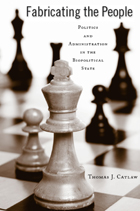
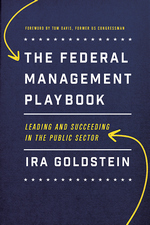
Stories of government management failures often make the headlines, but quietly much gets done as well. What makes the difference? Ira Goldstein offers wisdom about how to lead and succeed in the federal realm, even during periods when the political climate is intensely negative, based on his decades of experience as a senior executive at two major government consulting firms and as a member of the US federal government's Senior Executive Service.
The Federal Management Playbook coaches the importance of always keeping four key concepts in mind when planning for success: goals, stakeholders, resources, and time frames. Its chapters address how to effectively motivate government employees, pick the right technologies, communicate and negotiate with powerful stakeholders, manage risks, get value from contractors, foster innovation, and more. Goldstein makes lessons easy to apply by breaking each chapter’s plans into three strategic phases: create an offensive strategy, execute your plan effectively, and play a smart defense. Additional tips describe how career civil servants and political appointees can get the most from one another, advise consultants on providing value to government, and help everyone better manage ever-present oversight.
The Federal Management Playbook is a must-read for anyone working in the government realm and for students who aspire to public service.
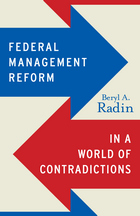
Proposals for reform have dotted the federal management landscape in the United States for more than 50 years. Yet these efforts by public management professionals have frequently failed to produce lasting results. In her new book, Federal Management Reform in a World of Contradictions, renowned public administration scholar Beryl A. Radin reveals what may lie behind the failure of so many efforts at government management reform.
To spur new thinking about this problem, Radin examines three basic sets of contradictions between the strategies of the reformers and the reality of the US federal system: contradictions in the shared powers structure, contradictions in values, and contradictions between politics and administration. She then explores six types of reform efforts and the core beliefs that guided them. The six reform areas are contracting out, personnel policy, agency reorganization, budgeting, federalism policies and procedures, and performance management. The book shows how too often these prescriptions for reform have tried to apply techniques from the private sector or a parliamentary system that do not transfer well to the structure of the US federal system and its democratic and political traditions.
Mindful of the ineffectiveness of a “one-size-fits–all” approach, Radin does not propose a single path for reform, but calls instead for a truly honest assessment of past efforts as today’s reformers design a new conceptual and strategic roadmap for the future.

It provides a full account of trade union history and activism across the public sector worldwide. Examining the major political events of the 20th century, the book shows what challenges they presented to the PSI and its major unions. It shows how the public sector responded to the two World Wars, the rise of fascism, the Cold war, and the independence struggles in the former colonies.
It also provides a comprehensive account of the evolution of public service provision, from public health to policing, water, pensions, security and culture. It includes many examples of how the recent liberalization and privatization of public services has failed to secure efficiency and equity.
Viewed alternately as an obstacle to justice, an impediment to efficient government, and a tool by which some groups gain benefits and privileges at the expense of others, public administration threatens to become the whipping boy of American government. In this innovative look at the nation's bureaucracy, Michael W. Spicer revisits the values of the Constitution in order to reconcile the administrative state to its many critics.
Drawing on political and social philosophy, Spicer argues that there is a fundamental philosophical conflict over the role of reason in society between writers in public administration and the designers of the American Constitution. This examination of worldviews illuminates the problem that American government faces in trying to ground a legitimate public administration in the Constitution. Defending and developing the Founders' idea that political power, whatever its source, must be checked, he critically examines existing ideas about the role of public administration in American governance and offers an alternative vision of public administration more in line with the Founders' constitutional design. This book will provide fresh insights for anyone interested in the role of public administration in the United States today.

A once-in-a-generation event held every twenty years, the Minnowbrook conference brings together the top scholars in public administration and public management to reflect on the state of the field and its future. This unique volume brings together a group of distinguished authors—both seasoned and new—for a rare critical examination of the field of public administration yesterday, today, and tomorrow.
The book begins by examining the ideas of previous Minnowbrook conferences, such as relevance and change, which are reflective of the 1960s and 1980s. It then moves beyond old Minnowbrook concepts to focus on public administration challenges of the future: globalism, twenty-first century collaborative governance, the role of information technology in governance, deliberative democracy and public participation, the organization of the future, and teaching the next generation of leaders. The book ends by coming full circle to examine the current challenge of remaining relevant. There is no other book like this—nor is there ever likely to be another—in print. Simply put, the ideas, concepts, and spirit of Minnowbrook are one-of-a-kind. This book captures the soul of public administration past, present, and future, and is a must-read for anyone serious about the theory and practice of public administration.
With Good Enough for Government Work, Lerman uses surveys, experiments, and public opinion data to argue persuasively that the reputation of government is itself an impediment to government’s ability to achieve the common good. In addition to improving its efficiency and effectiveness, government therefore has an equally critical task: countering the belief that the public sector is mired in incompetence. Lerman takes readers through the main challenges. Negative perceptions are highly resistant to change, she shows, because we tend to perceive the world in a way that confirms our negative stereotypes of government—even in the face of new information. Those who hold particularly negative perceptions also begin to “opt out” in favor of private alternatives, such as sending their children to private schools, living in gated communities, and refusing to participate in public health insurance programs. When sufficient numbers of people opt out of public services, the result can be a decline in the objective quality of public provision. In this way, citizens’ beliefs about government can quickly become a self-fulfilling prophecy, with consequences for all. Lerman concludes with practical solutions for how the government might improve its reputation and roll back current efforts to eliminate or privatize even some of the most critical public services.
Drawing on recent advances in the social sciences, this volume shows how rigorous, theory-based empirical research can help improve the management of public policies and programs—and how better governance can lead to better performance.
These original essays demonstrate how better data and improved statistical techniques have allowed researchers to construct more complex models of governance processes and thereby assess the effects of many variables on policy and program outcomes. They present useful research results that illuminate such issues as automatic grade advancement in public schools, management of federally-funded job-training programs, reducing welfare caseloads, and management of welfare-to-work programs.
Illustrating a range of theoretical and methodological possibilities, this book shows how more sophisticated research in public management can help improve government performance.
With the rush of calamitous events in recent years—the September 11 terror attacks, the Iraq imbroglio, and hurricanes Katrina and Rita—Americans feel themselves to be living in dark times. Trust in one another and in the government is at low ebb. People in public service face profound challenges to the meaning and efficacy of their work. Where can a public servant turn for a public philosophy to sustain practice?
Inspired by Hannah Arendt and several other philosophers, Governance in Dark Times is the first book to explore the philosophical and value underpinnings needed to guide public servants in these times. Featuring down-to-earth discussions of such issues as terrorism, torture, and homeland security, it suggests ways for people in government to think more deeply, judge more wisely, and act more meaningfully. Camilla Stivers argues that the most urgent requirement in dark times is re-kindling what Arendt called "the light of the public," and offers practical steps for public servants to create spaces for citizen dialogue and engagement in public life. Ideas like "governance of the common ground" and "public service as social hope" will spark discussion and encourage renewed dedication to the work of governing.
Grounded in the author's more than thirty years of teaching and administrative practice, Governance in Dark Times urges public servants in clear, jargon-free prose to reflect, to understand the world we live in, and to act responsibly, both individually and with fellow citizens.
The federal government is having increasing difficulty faithfully executing the laws, which is what Alexander Hamilton called “the true test” of a good government. This book diagnoses the symptoms, explains their general causes, and proposes ways to improve the effectiveness of the federal government. Employing Hamilton’s seven measures of an energetic federal service, Paul Light shows how the government is wanting in each measure.
After assessing the federal report card, Light offers a comprehensive agenda for reform, including new laws limiting the number of political appointees, reducing the layers of government management, reducing the size of government as its Baby Boom employees retire, revitalizing the federal career, and reducing the heavy outsourcing of federal work. Although there are many ways to fix each of the seven problems with government, only a comprehensive agenda will bring the kind of reform needed to reverse the overall erosion of the capacity to faithfully execute all the laws.
With The Great Broadening, Bryan D. Jones, Sean M. Theriault, and Michelle Whyman examine in detail the causes, internal dynamics, and consequences of this extended burst of activity. They argue that the broadening of government responsibilities into new policy areas such as health care, civil rights, and gender issues and the increasing depth of existing government programs explain many of the changes in America politics since the 1970s. Increasing government attention to particular issues was motivated by activist groups. In turn, the beneficiaries of the government policies that resulted became supporters of the government’s activity, leading to the broad acceptance of its role. This broadening and deepening of government, however, produced a reaction as groups critical of its activities organized to resist and roll back its growth.
Policymakers and public managers around the world have become preoccupied with the question of how their goals can be achieved in a way that rebuilds public confidence in government. Yet because public policies and programs increasingly are being administered through a complicated web of jurisdictions, agencies, and public-private partnerships, evaluating their effectiveness is more difficult than in the past. Though social scientists possess insightful theories and powerful methods for conducting empirical research on governance and public management, their work is too often fragmented and irrelevant to the specific tasks faced by legislators, administrators, and managers.
Proposing a framework for research based on the premise that any particular governance arrangement is embedded in a wider social, fiscal, and political context, Laurence E. Lynn Jr., Carolyn J. Heinrich, and Carolyn J. Hill argue that theory-based empirical research, when well conceived and executed, can be a primary source of fundamental, durable knowledge about governance and policy management. Focusing on complex human services such as public assistance, child protection, and public education, they construct an integrative, multilevel "logic of governance," that can help researchers increase the sophistication, power, and relevance of their work.
Scholars of public administration have historically too often been disdainful towards politics in the field, viewing political activities and interests as opportunities for corruption, mismanagement, and skewed priorities. Supporters of this anti-political stance have become even more strident in recent years, many of them advancing scientific models for the study and practice of public administration and governance.

"Colbert has long been celebrated as Louis XIV's minister of finance, trade, and industry. More recently, he has been viewed as his minister of culture and propaganda. In this lively and persuasive book, Jake Soll has given us a third Colbert, the information manager."
---Peter Burke, University of Cambridge
"Jacob Soll gives us a road map drawn from the French state under Colbert. With a stunning attention to detail Colbert used knowledge in the service of enhancing
royal power. Jacob Soll's scholarship is impeccable and his story long
overdue and compelling."
---Margaret Jacob, University of California, Los Angeles
"Nowadays we all know that information is the key to power, and that the masters of information rule the world. Jacob Soll teaches us that Jean-Baptiste Colbert had grasped this principle three and a half centuries ago, and used it to construct a new kind of state. This imaginative, erudite, and powerfully written book re-creates the history of libraries and archives in early modern Europe, and ties them in a novel and convincing way to the new statecraft of Europe's absolute monarchs."
---Anthony Grafton, Princeton University
"Brilliantly researched, superbly told, and timely, Soll's story is crucial for the history of the modern state."
---Keith Baker, Stanford University
When Louis XIV asked his minister Jean-Baptiste Colbert---the man who was to oversee the building of Versailles and the Royal Academy of Sciences, as well as the navy, the Paris police force, and French industry---to build a large-scale administrative government, Colbert created an unprecedented information system for political power. In The Information Master, Jacob Soll shows how the legacy of Colbert's encyclopedic tradition lies at the very center of the rise of the modern state and was a precursor to industrial intelligence and Internet search engines.
Soll's innovative look at Colbert's rise to power argues that his practice of collecting knowledge originated from techniques of church scholarship and from Renaissance Italy, where merchants recognized the power to be gained from merging scholarship, finance, and library science. With his connection of interdisciplinary approaches---regarding accounting, state administration, archives, libraries, merchant techniques, ecclesiastical culture, policing, and humanist pedagogy---Soll has written an innovative book that will redefine not only the history of the reign of Louis XIV and information science but also the study of political and economic history.
Jacob Soll is Associate Professor of History at Rutgers University and the author of Publishing The Prince: History, Reading, and the Birth of Political Criticism (University of Michigan Press, 2005), and winner of the 2005 Jacques Barzun Prize from the American Philosophical Society and a 2009 Guggenheim Fellowship. Soll edited a special issue of Journal of the History of Ideas titled "The Uses of Historical Evidence in Early Modern Europe"; has cofounded the online journal Republics of Letters; and is editor, along with Anthony Grafton and Ann Blair, of the series Cultures of Knowledge in the Early Modern World.
Since their publication in 1957, Downs's seminal ideas -- tweedledum and tweedledee politics and the "rationality" of political ignorance and nonparticipation on the part of voters--have shaped an ongoing debate about how politics actually work. The debate pits a public-choice model inspired by microeconomic precepts against a traditional textbook model that presumes a responsible, informed, and civic-minded citizenry and a set of elected officials motivated by concern for the public interest and policy convictions.
The essays comprising Information, Participation, and Choice, by leading political scientists and economists, provide both a summary of Downs's key theoretical insights and an empirical examination of how well models inspired by Downs accurately describe U.S. political competition for Congress and the presidency.
Bernard Grofman is Professor of Political Science and Social Psychology, University of California, Irvine.
Institutions and Economic Performance explores the question of why income per capita varies so greatly across countries. Even taking into account disparities in resources, including physical and human capital, large economic discrepancies remain across countries. Why are some societies but not others able to encourage investments in places, people, and productivity?
The answer, the book argues, lies to a large extent in institutional differences across societies. Such institutions are wide-ranging and include formal constitutional arrangements, the role of economic and political elites, informal institutions that promote investment and knowledge transfer, and others. Two core themes run through the contributors’ essays. First, what constraints do institutions place on the power of the executive to prevent it from extorting the investments and effort of other people and institutions? Second, when are productive institutions self-enforcing?
Institutions and Economic Performance is unique in its melding of economics, political science, history, and sociology to address its central question.
Coping with the practical problems of bureaucracy is hampered by the limited self-conception and the constricted mindsets of mainstream public administration thinking. Modernist public administration theory, although valuable and capable of producing ever more remarkable results, is limiting as an explanatory and catalytic force in resolving fundamental problems about the nature, size, scope, and functioning of public bureaucracy and in transforming public bureaucracy into a more positive force.
This original study specifies a reflexive language paradigm for public administration thinking and shows how a postmodern perspective permits a revolution in the character of thinking about public bureaucracy. The author considers imagination, deconstruction, deterritorialization, and alterity. Farmer's work emphasizes the need for an expansion in the character and scope of public administration's disciplinary concerns and shows clearly how the study and practice of public administration can be reinvigorated.
The real work of many governments is done not in stately domed capitols but by a network of federal and state officials working with local governments and nongovernmental organizations to address issues that cross governmental boundaries. Managing within Networks analyzes the structure, operations, and achievements of these public management networks that are trying to solve intractable problems at the field level.
It examines such areas as transportation, economic and rural development, communications systems and data management, water conservation, wastewater management, watershed conservation, and services for persons with developmental disabilities. Robert Agranoff draws a number of innovative conclusions about what these networks do and how they do it from data compiled on fourteen public management networks in Indiana, Iowa, Kentucky, Nebraska, and Ohio.
Agranoff identifies four different types of networks based on their purposes and observes the differences between network management and traditional management structures and leadership. He notes how knowledge is managed and value added within intergovernmental networks. This volume is useful for students, scholars, and practitioners of public management.
Observers have been predicting the demise of China’s political system since Mao Zedong’s death over thirty years ago. The Chinese Communist state, however, seems to have become increasingly adept at responding to challenges ranging from leadership succession and popular unrest to administrative reorganization, legal institutionalization, and global economic integration. What political techniques and procedures have Chinese policymakers employed to manage the unsettling impact of the fastest sustained economic expansion in world history?
As the authors of these essays demonstrate, China’s political system allows for more diverse and flexible input than would be predicted from its formal structures. Many contemporary methods of governance have their roots in techniques of policy generation and implementation dating to the revolution and early PRC—techniques that emphasize continual experimentation. China’s long revolution had given rise to this guerrilla-style decisionmaking as a way of dealing creatively with pervasive uncertainty. Thus, even in a post-revolutionary PRC, the invisible hand of Chairman Mao—tamed, tweaked, and transformed—plays an important role in China’s adaptive governance.

involved in real-world managing are not always willing to reveal the intricacies of their
everyday muddles. Barbara Czarniawska argues that in order to understand these uncharted
territories, we need to gather local and concrete stories about organizational life and subject
them to abstract and metaphorical interpretation.
Using a narrative approach unique to organizational studies, Czarniawska employs literary
devices to uncover the hidden workings of organizations. She applies cultural metaphors to
public administration in Sweden to demonstrate, for example, how the dynamics of a
screenplay can illuminate the budget disputes of an organization. She shows how the
interpretive description of organizational worlds works as a distinct genre of social analysis,
and her investigations ultimately disclose the paradoxical nature of organizational life: we follow
routines in order to change, and decentralize in order to control. By confronting such
paradoxes, we bring crisis to existing institutions and enable them to change.
Cost-benefit analysis (CBA) has been an important policy tool of government since the 1980s, when the Reagan administration ordered that all major new regulations be subjected to a rigorous test of whether their projected benefits would outweigh their costs. Not surprisingly, CBA has been criticized by many who claim that it neglects, especially on the benefit side, important values that are hard to measure.
In this book, the authors reconceptualize cost-benefit analysis, arguing that its objective should be overall well-being rather than economic efficiency. They show why the link between preferences and well-being is more complicated than economists have thought. Satisfying a person's preference for some outcome is welfare-enhancing only if he or she is self-interested and well-informed. Also, cost-benefit analysis is not a super-procedure but simply a way to identify welfare-maximizing policies. A separate kind of analysis is required to weigh rights and equal treatment.
This book not only places cost-benefit analysis on a firmer theoretical foundation, but also has many practical implications for how government agencies should undertake cost-benefit studies.
This book is generally about public administration and particularly about new public administration, a product of the turbulent late 1960s and the 1970s.
In recent years, Western bureaucracies have continued to expand, but are citizens better served? In this volume, sixteen contributors analyze the problems of government organization, both in individual cases and in a broader comparative context.
Contributors: Joel D. Aberbach; Peter Aucoin; Richard A. Chapman; Michael G. Hansen; Peter Hennessy; Brian W. Hogwood; Mohammad Mohabbat Kahn; Ulrich Klöti; Charles H. Levine; Johan P. Olsen; Bert A. Rockman; Richard Rose; Norman C. Thomas; John Warhurst; and the editors.
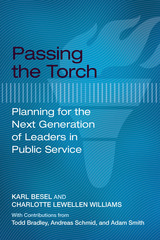
Public-service executives, both elected and appointed within the public and nonprofit sectors, are retiring at record levels, and the number of Americans reaching age sixty-five annually will continue to rise over the next decade and is expected to surpass four million in 2020. Finding qualified, motivated leaders to fill vital public-service positions will challenge the public and nonprofit sectors.
Unfortunately, recent studies show that few proactive steps are being taken by public-service organizations to plan for the next generation. Passing the Torch: Planning for the Next Generation of Public-Service Leaders provides an outline for those who will be facing and managing these looming changes.
In this valuable guide, the factors that influence selection of a career in public service are explored through the authors’ years of experience as leaders in public-service organizations and through interviews with other public-service professionals. Passing the Torch will be essential for leaders of nonprofit organizations, university faculty, researchers in the field of nonprofit management, and students in nonprofit management courses.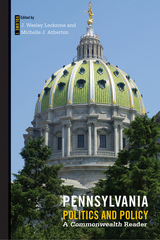
The activities of state governments have always been important in the American federal system. However, recent partisan gridlock in Washington, DC has placed states at the forefront of policymaking as the national government maintains the status quo. Pennsylvania Politics and Policy, Volume 1 is designed to showcase current issues of interest to Pennsylvanians. This reader contains updated chapters from recent issues of Commonwealth: A Journal of Pennsylvania Politics and Policy on education, health care, public finance, tax policy, environmental policy, alcohol policy and more. Each chapter is supplemented by forums with arguments in support of or opposed to contested elements of state policy, discussion questions, and suggestions for further reading.
In addition, Pennsylvania Politics and Policy, Volume 1 includes a comprehensive guide to researching state government and policy online. It is designed as a text or supplement for college or advanced high school classes in American government, state and local politics, public policy, and public administration.
Contributors include: David G. Argall, Tom Baldino, Michele Deegan, Michael Dimino, George Hale, Rachel L. Hampton , Paula Duda Holoviak Jon Hopcraft, Vera Krekanova, Maureen W. McClure, Barry G. Rabe, Marguerite Roza, Lanethea Mathews Shultz, Jennie Sweet-Cushman, Amanda Warco, and the editors.
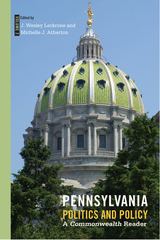
Designed to showcase current issues of interest, Pennsylvania Politics and Policy, Volume 2 isthe second reader consisting of updated chapters from recent issues of Commonwealth: A Journal of Pennsylvania Politics and Policy. The editors and contributors to this volume focus on government institutions, election laws, the judiciary, government finance and budgeting, the opioid crisis, childcare, property taxes, environmental policy, demographics, and more. Each chapter is supplemented by discussion questions, suggestions for further reading, and forums with arguments in support of or opposed to contested elements of state policy.
In addition, Pennsylvania Politics and Policy, Volume 2 includes a detailed guide to researching state government and policy online, as well as a comprehensive chapter on the structure of Pennsylvania government. It is designed as a text or supplement for college or advanced high school classes in American government, state and local politics, public policy, and public administration.
Contributors include: John Arway, Jenna Becker Kane, Jeffrey Carroll, Bob Dick, Ashley Harden, Stefanie I. Kasparek, Vera Krekanova, Maureen W. McClure, John F. McDonald, Josh Shapiro, Marc Stier, Jennie Sweet-Cushman, James Vike, and the editors.
Although merit system selection and management of public personnel is thought of as the standard for good governance, public employees frequently are appointed by political officials rather than being members of a career civil service. In fact, there has been an increase in the level of patronage appointments and politicization of public administration over the past several decades as political leaders attempt to impose their control over the public bureaucracy. Although widespread, patronage appointments in the public sector are particularly important in Latin America, where there is a tradition of extensive patronage. The Politics of Patronage Appointments in Latin American Central Administrations seeks to understand the motivations of patrons when they make appointments, the roles appointees play, the skills required to play these roles, and what accounts for different modalities of patronage. It moves beyond the conventional condemnation of patronage to examine the multiple uses of political appointments, which can be crucial for obtaining the services of highly qualified individuals who otherwise might not be willing to work in the public sector.

Lindenfeld argues that these sciences of state developed a technique of deliberation on practical issues such as tax policy and welfare, that serves as a model for contemporary administrations.

The authors support their pragmatic approach with evidence drawn from in-depth analyses of education, transportation, and health care policies. In each policy area, initiatives such as school choice, deregulation of airlines and other carriers, and the promotion of managed care have introduced or enlarged the role of market forces with the aim of eliminating bureaucratic inefficiency. But in each case, the authors show, reality proved to be much more complex than market models predicted. This complexity has resulted in a political cycle—strikingly consistent across policy spheres—that culminates in public interventions to sustain markets while protecting citizens from their undesirable effects. Situating these case studies in the context of more than two hundred years of debate about the role of markets in society, Brown and Jacobs call for a renewed focus on public-private partnerships that recognize and respect each sector’s vital—and fundamentally complementary—role.
In this critical examination of public administration's pervasive vision of a powerful state, Spicer thoughtfully reconsiders the relationship between activities of governance and concepts of the state.
Woodrow Wilson argued for a state led by a powerful government, guided by science and enlightened experts, for the accomplishment of a set of collective purposes—in other words, a purposive state. Michael Spicer contends that though Wilson and those who followed him have not typically explored questions of political and constitutional theory in their writing, a clear and strong vision of the state has emerged in their work nonetheless.
Building upon the work of Dwight Waldo and others who have sought to explore and reveal the political theory behind the seemingly neutral language of administration, Spicer explores the roots—both historical and philosophical—of the purposive state. He considers the administrative experience of 18th-century Prussia and its relationship to the vision of the purposive state, and examines the ways this idea has been expressed in the 20th century. He then looks at the practical problems such a vision creates for public policy in a fragmented postmodern political culture. Finally, Spicer explores an alternative view of public administration—one based on a civil association model appropriate to our constitutional traditions and contemporary culture.
Is public administration an art or a science? This question of whether the field is driven by values or facts will never be definitively answered due to a lack of consensus among scholars. The resulting divide has produced many heated debates; however, in this pioneering volume, Norma Riccucci embraces the diversity of research methods rather than suggesting that there is one best way to conduct research in public administration.
Public Administration examines the intellectual origins and identity of the discipline of public administration, its diverse research traditions, and how public administration research is conducted today. The book’s intended purpose is to engage reasonable-minded public administration scholars and professionals in a dialogue on the importance of heterogeneity in epistemic traditions, and to deepen the field’s understanding and acceptance of its epistemological scope. This important book will provide a necessary overview of the discipline for graduate students and scholars.
In The Public Good and the Brazilian State, Anne G. Hanley assembles an economic history of public revenues as they developed in nineteenth-century Brazil. Specifically, Hanley investigates the financial life of the municipality—a district comparable to the county in the United States—to understand how the local state organized and prioritized the provision of public services, what revenues paid for those services, and what happened when the revenues collected failed to satisfy local needs. Through detailed analyses of municipal ordinances, mayoral reports, citizen complaints, and financial documents, Hanley sheds light on the evolution of public finance and its effect on the early economic development of Brazilian society. This deeply researched book offers valuable insights for anyone seeking to better understand how municipal finance informs histories of inequality and underdevelopment.
Leading scholars present the most complete, as well as the most advanced, treatment of public management reform and innovation available
The subject of reform in the public sector is not new; indeed, its latest rubric, reinventing government, has become good politics. Still, as the contributors ask in this volume, is good politics necessarily good government?Given the growing desire to reinvent government, there are hard questions to be asked: Is the private sector market model suitable and effective when applied to reforming public and governmental organizations? What are the major political forces affecting reform efforts in public management? How is public management reform accomplished in a constitutional democratic government? How do the values of responsiveness, professionalism, and managerial excellence shape current public management reforms? In this volume, editors H. George Frederickson and Jocelyn M. Johnston bring together scholars with a shared interest in empirical research to confront head-on the toughest questions public managers face in their efforts to meet the demands of reform and innovation.
Throughout the book, the authors consider the bureaucratic resistance that results when downsizing and reinvention are undertaken simultaneously, the dilemma public managers face when elected executives set a reform agenda that runs counter to the law, and the mistaken belief that improved management can remedy flawed policy.
---Bryn Mawr Classical Review
A solution to inequalities wherever we look—in health care, secure retirement, education—is as close as the public library. Or the post office, community pool, or local elementary school. Public options—reasonably priced government-provided services that coexist with private options—are all around us, ready to increase opportunity, expand freedom, and reawaken civic engagement if we will only let them.
Whenever you go to your local public library, send mail via the post office, or visit Yosemite, you are taking advantage of a longstanding American tradition: the public option. Some of the most useful and beloved institutions in American life are public options—yet they are seldom celebrated as such. These government-supported opportunities coexist peaceably alongside private options, ensuring equal access and expanding opportunity for all.
Ganesh Sitaraman and Anne Alstott challenge decades of received wisdom about the proper role of government and consider the vast improvements that could come from the expansion of public options. Far from illustrating the impossibility of effective government services, as their critics claim, public options hold the potential to transform American civic life, offering a wealth of solutions to seemingly intractable problems, from housing shortages to the escalating cost of health care.
Imagine a low-cost, high-quality public option for child care. Or an extension of the excellent Thrift Savings Plan for federal employees to all Americans. Or every person having access to an account at the Federal Reserve Bank, with no fees and no minimums. From broadband internet to higher education, The Public Option reveals smart new ways to meet pressing public needs while spurring healthy competition. More effective than vouchers or tax credits, public options could offer us all fairer choices and greater security.
Public policy advocates routinely assert that “research has shown” a particular policy to be desirable. But how reliable is the analysis in the research they invoke? And how does that analysis affect the way policy is made, on issues ranging from vaccination to minimum wage to FDA drug approval? Charles Manski argues here that current policy is based on untrustworthy analysis. By failing to account for uncertainty in an unpredictable world, policy analysis misleads policy makers with expressions of certitude. Public Policy in an Uncertain World critiques the status quo and offers an innovation to improve how policy research is conducted and how policy makers use research.
Consumers of policy analysis, whether civil servants, journalists, or concerned citizens, need to understand research methodology well enough to properly assess reported findings. In the current model, policy researchers base their predictions on strong assumptions. But as Manski demonstrates, strong assumptions lead to less credible predictions than weaker ones. His alternative approach takes account of uncertainty and thereby moves policy analysis away from incredible certitude and toward honest portrayal of partial knowledge. Manski describes analysis of research on such topics as the effect of the death penalty on homicide, of unemployment insurance on job-seeking, and of preschooling on high school graduation. And he uses other real-world scenarios to illustrate the course he recommends, in which policy makers form reasonable decisions based on partial knowledge of outcomes, and journalists evaluate research claims more closely, with a skeptical eye toward expressions of certitude.
Governments and nonprofits exist to create public value. Yet what does that mean in theory and practice?
This new volume brings together key experts in the field to offer unique, wide-ranging answers. From the United States, Europe, and Australia, the contributors focus on the creation, meaning, measurement, and assessment of public value in a world where government, nonprofit organizations, business, and citizens all have roles in the public sphere. In so doing, they demonstrate the intimate link between ideas of public value and public values and the ways scholars theorize and measure them. They also add to ongoing debates over what public value might mean, the nature of the most important public values, and how we can practically apply these values. The collection concludes with an extensive research and practice agenda conceived to further the field and mainstream its ideas.
Aimed at scholars, students, and stakeholders ranging from business and government to nonprofits and activist groups, Public Value and Public Administration is an essential blueprint for those interested in creating public value to advance the common good.
Economic individualism and market-based values dominate today's policymaking and public management circles—often at the expense of the common good. In his new book, Barry Bozeman demonstrates the continuing need for public interest theory in government. Public Values and Public Interest offers a direct theoretical challenge to the "utility of economic individualism," the prevailing political theory in the western world.
The book's arguments are steeped in a practical and practicable theory that advances public interest as a viable and important measure in any analysis of policy or public administration. According to Bozeman, public interest theory offers a dynamic and flexible approach that easily adapts to changing situations and balances today's market-driven attitudes with the concepts of common good advocated by Aristotle, Saint Thomas Aquinas, John Locke, and John Dewey.
In constructing the case for adopting a new governmental paradigm based on what he terms "managing publicness," Bozeman demonstrates why economic indices alone fail to adequately value social choice in many cases. He explores the implications of privatization of a wide array of governmental services—among them Social Security, defense, prisons, and water supplies. Bozeman constructs analyses from both perspectives in an extended study of genetically modified crops to compare the policy outcomes using different core values and questions the public value of engaging in the practice solely for the sake of cheaper food.
Thoughtful, challenging, and timely, Public Values and Public Interest shows how the quest for fairness can once again play a full part in public policy debates and public administration.
Mark H. Moore’s now classic Creating Public Value offered advice to public managers about how to create public value. But that book left a key question unresolved: how could one recognize (in an accounting sense) when public value had been created? Here, Moore closes the gap by setting forth a philosophy of performance measurement that will help public managers name, observe, and sometimes count the value they produce, whether in education, public health, safety, crime prevention, housing, or other areas. Blending case studies with theory, he argues that private sector models built on customer satisfaction and the bottom line cannot be transferred to government agencies. The Public Value Account (PVA), which Moore develops as an alternative, outlines the values that citizens want to see produced by, and reflected in, agency operations. These include the achievement of collectively defined missions, the fairness with which agencies operate, and the satisfaction of clients and other stake-holders.
But strategic public managers also have to imagine and execute strategies that sustain or increase the value they create into the future. To help public managers with that task, Moore offers a Public Value Scorecard that focuses on the actions necessary to build legitimacy and support for the envisioned value, and on the innovations that have to be made in existing operational capacity.
Using his scorecard, Moore evaluates the real-world management strategies of such former public managers as D.C. Mayor Anthony Williams, NYPD Commissioner William Bratton, and Commissioner of the Minnesota Department of Revenue John James.
“In this classic, Gaus writes perceptively of the ‘ecology’ of public administration and its relationship to the rise of the administrative state. He recounts how crises and changes in people, place, physical technology, social technology, and philosophy in the first half of the 20th century led citizens repeatedly to look to government for relief. Politicians, in turn, created or expanded the powers of public agencies.” —Journal of Management History
The prevailing notion that the best government is achieved through principles of management and business practices is hardly new—it echoes the early twentieth-century "gospel of efficiency" challenged by Dwight Waldo in 1948 in his pathbreaking book, The Administrative State. Asking, "Efficiency for what?", Waldo warned that public administrative efficiency must be backed by a framework of consciously held democratic values.
Revisiting Waldo's Administrative State brings together a group of distinguished authors who critically explore public administration's big ideas and issues and question whether contemporary efforts to "reinvent government," promote privatization, and develop new public management approaches constitute a coherent political theory capable of meeting the complex challenges of governing in a democracy. Taking Waldo's book as a starting point, the authors revisit and update his key concepts and consider their applicability for today.
The book follows Waldo's conceptual structure, first probing the material and ideological background of modern public administration, problems of political philosophy, and finally particular challenges inherent in contemporary administrative reform. It concludes with a look ahead to "wicked" policy problems—such as terrorism, global warming, and ecological threats—whose scope is so global and complex that they will defy any existing administrative structures and values. Calling for a return to conscious consideration of democratic accountability, fairness, justice, and transparency in government, the book's conclusion assesses the future direction of public administrative thought.
This book can stand alone as a commentary on reconciling democratic values and governance today or as a companion when reading Waldo's classic volume.
Government “of the people, by the people, for the people” expresses an ideal that resonates in all democracies. Yet poll after poll reveals deep distrust of institutions that seem to have left “the people” out of the governing equation. Government bureaucracies that are supposed to solve critical problems on their own are a troublesome outgrowth of the professionalization of public life in the industrial age. They are especially ill-suited to confronting today’s complex challenges.
Offering a far-reaching program for innovation, Smart Citizens, Smarter State suggests that public decisionmaking could be more effective and legitimate if government were smarter—if our institutions knew how to use technology to leverage citizens’ expertise. Just as individuals use only part of their brainpower to solve most problems, governing institutions make far too little use of the skills and experience of those inside and outside of government with scientific credentials, practical skills, and ground-level street smarts. New tools—what Beth Simone Noveck calls technologies of expertise—are making it possible to match the supply of citizen expertise to the demand for it in government.
Drawing on a wide range of academic disciplines and practical examples from her work as an adviser to governments on institutional innovation, Noveck explores how to create more open and collaborative institutions. In so doing, she puts forward a profound new vision for participatory democracy rooted not in the paltry act of occasional voting or the serendipity of crowdsourcing but in people’s knowledge and know-how.
State Work begins with an ethnographic account of Harney’s work as a midlevel manager within an Ontario government initiative charged with leading the province’s efforts to combat racism. Through readings of material such as The X-Files and Law & Order, Harney then reviews how popular images of the state and government labor are formed within American culture and how these ideas shape everyday life. He highlights the mutually dependent roles played in state work by the citizenry and civil servants. Using as case studies Al Gore’s National Partnership for Reinventing Government and a community-policing project in New York City, Harney also critiques public management literature and performance measurement theories. He concludes his study with a look at the motivations of state workers.
The State You See uncovers a racial gap in the way the American government appears in people’s lives. It makes it clear that public policy changes over the last fifty years have driven all Americans to distrust the government that they see in their lives, even though Americans of different races are not seeing the same kind of government.
For white people, these policy changes have involved a rising number of generous benefits submerged within America’s tax code, which taken together cost the government more than Social Security and Medicare combined. Political attention focused on this has helped make welfare and taxes more visible representations of government for white Americans. As a result, white people are left with the misperception that government does nothing for them, apart from take their tax money to spend on welfare. Distrust of government is the result. For people of color, distrust is also rampant but for different reasons. Over the last fifty years, America has witnessed increasingly overbearing policing and swelling incarceration numbers. These changes have disproportionately impacted communities of color, helping to make the criminal legal system a unique visible manifestation of government in these communities.
While distrust of government emerges in both cases, these different roots lead to different consequences. White people are mobilized into politics by their distrust, feeling that they must speak up in order to reclaim their misspent tax dollars. In contrast, people of color are pushed away from government due to a belief that engaging in American elections will yield the same kind of unresponsiveness and violence that comes from interactions with the police. The result is a perpetuation of the same kind of racial inequality that has always been present in American democracy. The State You See is essential reading for anyone interested in understanding how the American government engages in subtle forms of discrimination and how it continues to uphold racial inequality in the present day.
Derek A. Epp argues that some agencies can indeed do that and that instability is at least partially a function of poor institutional design. While it is inherently more challenging to maintain stability around complex problems like immigration or climate change, the deliberative process itself can affect the degree of stability around an issue. Epp looks at whether agencies follow a deliberative model for decision making, in which policies are developed by means of debate among a small group of policymakers, or a collective model, in which the opinions of many people are aggregated, as with the stock market. He argues that, in many instances, the collective model produces more informed and stable policy outcomes that can be adapted more readily to new information and changing public priorities.

In this well-informed yet anxious age, public administrators have constructed vast cisterns that collect and interpret a meteoric shower of facts. Akhlaque Haque demonstrates that this pervasive use and increasing dependence on information technology (IT) enables sophisticated and well-intentioned public services that nevertheless risk deforming public policy decision-making and sees a contradiction inherent in a public that seeks services that require a level of data collection that in turn triggers fears of a tyrannical police state.
The author posits that IT’s potential as a tool for human development depends on how civil servants and citizens actively engage in identifying desired outcomes, map IT solutions to those outcomes, and routinize the applications of those solutions. This leads to his call for the development of entrepreneurs who generate innovative solutions to critical human needs and problems. In his powerful summary, he recaps possible answers to the question: What is the best way a public institution can apply technology to improving the human condition?
Engrossing, challenging, and timely, Surveillance, Transparency, and Democracy is essential reading for both policy makers as well as the great majority of readers and citizens engaged in contemporary arguments about the role of government, public health and security, individual privacy, data collection, and surveillance.
Government has become a refuge, and a relic, of America’s crumbling middle-class economy. As the public and private worlds of work have veered in different directions, the gaps between them are warping government work in unintended ways.
Three decades of economic turbulence have rendered American workplaces more demanding and less secure, more rewarding for high-end workers and punishing for workers without advanced skills. This workplace revolution, however, has largely bypassed government. Public employees—representing roughly one-sixth of the total workforce—still work under the conditions of dampened risk and constrained opportunity that marked most of the economy during the middle-class boom following World War II.
The divergent paths of public and private employment have intensified a long-standing pattern: elite workers spurn public jobs, while less skilled workers cling to government work as a refuge from a harsh private economy. The first trend creates a chronic talent deficit in the public sector. The second trend makes the government workplace rigid and resistant to change. And both contribute to shortfalls in public-sector performance.
The Warping of Government Work documents government’s isolation from the rest of the American economy and arrays the stark choices we confront for narrowing, or accommodating, the divide between public and private work.
This study of the critical role of ethics and moral responsibility in the field of public administration, Michael M. Harmon and O. C. McSwite posit that administrative ethics, as presently conceived and practiced, is largely a failure, incapable of delivering on its original promise of effectively regulating official conduct in order to promote the public interest. They argue that administrative ethics is compromised at its very foundations by two core assumptions: that human beings act rationally and that language is capable of conveying clear, stable, and unambiguous principles of ethical conduct.
The result is the illusion that values, principles, and rules of ethical conduct can be specified in workably clear ways, in particular, through their formalization in official codes of ethics; that people are capable of comprehending and responding to them as they are intended; and that the rewards and punishments attached to them will be effective in structuring daily behavior.
In a series of essays that draw on both fiction and film, as well as the disciplines of pragmatism, organizational theory, psychoanalysis, structural linguistics, and economics, Harmon and McSwite make their case for human relationship as the proper foundation of administrative ethics. “Exercising responsible ethical practice requires attaining a special kind of relationship with other people. Relationship is how the pure freedom that resides in the human psyche—for ethical choice, creativity, or original action of any type—can be brought into the structured world of human social relations without damaging or destroying it.” Furthermore, they make the case for dropping the term “ethics” in favor of the term “responsibility,” as “responsibility accentuates the social [relational] nature of moral action.”

READERS
Browse our collection.
PUBLISHERS
See BiblioVault's publisher services.
STUDENT SERVICES
Files for college accessibility offices.
RECENTLY PUBLISHED





UChicago Accessibility Resources
home | accessibility | search | about | contact us
BiblioVault ® 2001 - 2024
The University of Chicago Press