
 A SCHOLARLY BOOK REPOSITORY
23 start with M start with M

Mentally ill people turned out of institutions, crack-cocaine use on the rise, more poverty, public housing a shambles: as attempts to explain homelessness multiply so do the homeless—and we still don’t know why. The first full-scale economic analysis of homelessness, Making Room provides answers quite unlike those offered so far by sociologists and pundits. It is a story about markets, not about the bad habits or pathology of individuals.
One perplexing fact is that, though homelessness in the past occurred during economic depressions, the current wave started in the 1980s, a time of relative prosperity. As Brendan O’Flaherty points out, this trend has been accompanied by others just as unexpected: rising rents for poor people and continued housing abandonment. These are among the many disconcerting facts that O’Flaherty collected and analyzed in order to account for the new homelessness. Focused on six cities (New York, Newark, Chicago, Toronto, London, and Hamburg), his studies also document the differing rates of homelessness in North America and Europe, and from one city to the next, as well as interesting changes in the composition of homeless populations. For the first time, too, a scholarly observer makes a useful distinction between the homeless people we encounter on the streets every day and those “officially” counted as homeless.
O’Flaherty shows that the conflicting observations begin to make sense when we see the new homelessness as a response to changes in the housing market, linked to a widening gap in the incomes of rich and poor. The resulting shrinkage in the size of the middle class has meant fewer hand-me-downs for the poor and higher rents for the low-quality housing that is available. O’Flaherty’s tightly argued theory, along with the wealth of new data he introduces, will put the study of homelessness on an entirely new plane. No future student or policymaker will be able to ignore the economic factors presented so convincingly in this plainspoken book.
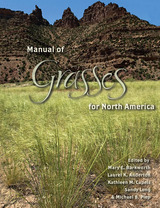
The Manual of Grasses for North America is designed as a successor to the classic volume by Hitchcock and Chase. It reflects current taxonomic thought and includes keys, illustrations, and distribution maps for the nearly 900 native and 400 introduced species that have been found in North America north of Mexico. In addition, it presents keys and illustrations for several species that are known only in cultivation or are of major agricultural significance, either as progenitors of bread wheat and corn or as a major threat to North American agriculture because of their ability to hybridize with crop species. The Manual is a major reference work for grasses that will retain its value for many years.

A prolific writer and versatile social critic, Canadian novelist and poet Margaret Atwood has recently published Bluebeard’s Egg (short stories), Interlunar (poetry), and The Handmaid’s Tale a critically acclaimed best-selling novel.
This international collection of essays evaluates the complete body of her work—both the acclaimed fiction and the innovative poetry. The critics represented here—American, Australian, and Canadian—address Atwood’s handling of such themes as feminism, ecology, the gothic novel, and the political relationship between Canada and the United States.
The essays on Atwood’s novels introduce the general reader to her development as a writer, as she matures from a basically subjective, poetic vision, seen in Surfacing and The Edible Woman, to an increasingly engaged, political stance, exemplified by The Handmaid’s Tale. Other essays examine Atwood’s poetry, from her transformation of the Homeric model to her criticisms of the United States’ relationship with Canada. The last two critical essays offer a unique view of Atwood through an investigation of her use of the concept of shamanism and through a presentation of eight of her vivid watercolors.
The volume ends with Atwood presenting her own views in an interview with Jan Garden Castro and in a conversation between Atwood and students at the University of Tampa, Florida.

In 2005 Kate Jackson ventured into the remote swamp forests of the northern Congo to collect reptiles and amphibians. Her camping equipment was rudimentary, her knowledge of Congolese customs even more so. She knew how to string a net and set a pitfall trap, but she never imagined the physical and cultural difficulties that awaited her.
Culled from the mud-spattered pages of her journals, Mean and Lowly Things reads like a fast-paced adventure story. It is Jackson’s unvarnished account of her research on the front lines of the global biodiversity crisis—coping with interminable delays in obtaining permits, learning to outrun advancing army ants, subsisting on a diet of Spam and manioc, and ultimately falling in love with the strangely beautiful flooded forest.
The reptile fauna of the Republic of Congo was all but undescribed, and Jackson’s mission was to carry out the most basic study of the amphibians and reptiles of the swamp forest: to create a simple list of the species that exist there—a crucial first step toward efforts to protect them. When the snakes evaded her carefully set traps, Jackson enlisted people from the villages to bring her specimens. She trained her guide to tag frogs and skinks and to fix them in formalin. As her expensive camera rusted and her Western soap melted, Jackson learned what it took to swim with the snakes—and that there’s a right way and a wrong way to get a baby cobra out of a bottle.

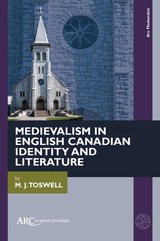
Canada has a deep layer of medievalism embedded in its architecture, governance structures, and sociocultural bedrock. This volume distinguishes between Canadian medievalism and its closest neighbours, British and American medievalism, and argues that the ignored or unnoticed medievalism of English Canada derives from its foundation by United Empire Loyalists escaping to the north in the late eighteenth century.
The book considers particular literary and cultural expressions of medievalism—including Gothic architecture, heraldry, ice hockey, and Samuel de Champlain’s lost astrolabe; and the work of Guy Gavriel Kay, Earle Birney, Robertson Davies, Louise Penny, Alice Munro, Margaret Atwood, and George Longmore—arguing that medievalism remains a potent force in Canadian national identity.
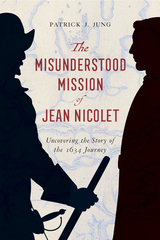
In more recent decades, historians have pieced together a story that is not only more likely but more complicated and interesting. Patrick Jung synthesizes the research about Nicolet and his superior Samuel de Champlain, whose diplomatic goals in the region are crucial to understanding this much misunderstood journey across the Great Lakes. Additionally, historical details about Franco-Indian relations and the search for the Northwest Passage provide a framework for understanding Nicolet’s famed mission.

Fiddlers, step dancers, storytellers, traditional singers, and folklorists staged Montreal’s first veillée in 1919. All that was missing, announced one of the organizers, was a magic carpet to transport the audience into the countryside and a kiss of forgetfulness to erase the woes of modern life.
Laura Risk tells the story of the veillées and explores how these commercial performances of idealized rural life became part of Quebec’s cultural heritage. Her in-depth examinations of key performances and recordings follow traditional music and dance from the stage onto radio, records and other audio media, and television. Throughout, Risk documents how veillées redefined folklore in twentieth-century Quebec and illuminates how their distinctive framing of traditional musicians and repertoire impacts the performance and reception of the music to the present day.
Astute and evocative, Music and the Staged Veillée in Quebec reveals the music, dancing, call-and-response songs, and extramusical associations winding through century-long conversations about nation, culture, and identity in Quebec.
READERS
Browse our collection.
PUBLISHERS
See BiblioVault's publisher services.
STUDENT SERVICES
Files for college accessibility offices.
RECENTLY PUBLISHED





UChicago Accessibility Resources
home | accessibility | search | about | contact us
BiblioVault ® 2001 - 2025
The University of Chicago Press