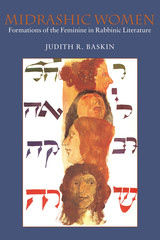
front cover of Midrashic Women
Midrashic Women
Formations of the Feminine in Rabbinic Literature
Judith R. Baskin
Brandeis University Press, 2002
While most gender-based analyses of rabbinic Judaism concentrate on the status of women in the halakhah (the rabbinic legal tradition), Judith R. Baskin turns her attention to the construction of women in the aggadic midrash, a collection of expansions of the biblical text, rabbinic ruminations, and homiletical discourses that constitutes the non-legal component of rabbinic literature. Examining rabbinic convictions of female alterity, competing narratives of creation, and justifications of female disadvantages, as well as aggadic understandings of the ideal wife, the dilemma of infertility, and women among women and as individuals, she shows that rabbinic Judaism, a tradition formed by men for a male community, deeply valued the essential contributions of wives and mothers while also consciously constructing women as other and lesser than men. Recent feminist scholarship has illuminated many aspects of the significance of gender in biblical and halakhic texts but there has been little previous study of how aggadic literature portrays females and the feminine. Such representations, Baskin argues, often offer a more nuanced and complex view of women and their actual lives than the rigorous proscriptions of legal discourse.

[more]

front cover of A Model for the Christian Life
A Model for the Christian Life
Hilary of Poitier's Commentary on the Psalms
Paul C. Burns
Catholic University of America Press, 2012
In this examination of Hilary's treatise, Paul C. Burns discusses the intended audience of Hilary's text and the use of the Psalms by Christians in the fourth century. He identifies Hilary's distinctive perspectives; his dependence on Origen; his Latin theological and exegetical tradition; and the creative directions of Hilary's thought.
[more]

front cover of The Mussar Torah Commentary
The Mussar Torah Commentary
A Spiritual Path to Living a Meaningful and Ethical Life
Rabbi Barry H. Block
Central Conference of American Rabbis, 2020

This Mussar-based commentary is a vital resource for Torah study, offering a thoughtful analysis of each of the 54 weekly parashot. Each essay in this anthology brings a parashah into juxtaposition with one of the Mussar middot (character traits as described within the Jewish school of ethics called Mussar), thereby providing an applied lens of Mussar teachings that helps us to delve deeper into our tradition with increased mindfulness and intention.


[more]


Send via email Share on Facebook Share on Twitter