
 A SCHOLARLY BOOK REPOSITORY
18 start with M start with M

In this follow up to his book, The Rule of Racialization—which considered the way class structure is formed in the U.S.—Steve Martinot now examines how the structures of racialization reside at the core of all social, cultural, and political institutions in the U.S. In The Machinery of Whiteness, Martinot examines how race and racism are produced in the United States, analyzing the politics of racialization, and the preponderance of racial segregation and racial deprivation that have kept the U.S. a white dominated society throughout its history. Martinot dedicates this work to expunging white supremacy from the earth.
The Machinery of Whiteness investigates how “whiteness” came to be as foundational to the process that then produced the modern concept of race. Martinot addresses the instrumentalization of women as a necessary step in its formation, furthering the debates regarding the relationships of race and gender. And he addresses U.S. international interventionism, the anti-immigrant movements, and white racist populism to describe the political forms that white supremacy takes.
Martinot puts these together to analyze the underlying cultural structures of racialization that have driven and conditioned the resurgence of white supremacy and white entitlement in the wake of the Civil Rights movements. This book is a call to transform the cultural structures of the U.S. to make justice and democracy, which depend on inclusion and not segregation, possible.
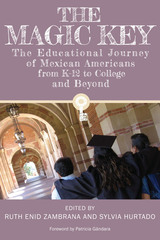
Mexican Americans comprise the largest subgroup of Latina/os, and their path to education can be a difficult one. Yet just as this group is often marginalized, so are their stories, and relatively few studies have chronicled the educational trajectory of Mexican American men and women. In this interdisciplinary collection, editors Zambrana and Hurtado have brought together research studies that reveal new ways to understand how and why members of this subgroup have succeeded and how the facilitators of success in higher education have changed or remained the same.
The Magic Key’s four sections explain the context of Mexican American higher education issues, provide conceptual understandings, explore contemporary college experiences, and offer implications for educational policy and future practices. Using historical and contemporary data as well as new conceptual apparatuses, the authors in this collection create a comparative, nuanced approach that brings Mexican Americans’ lived experiences into the dominant discourse of social science and education. This diverse set of studies presents both quantitative and qualitative data by gender to examine trends of generations of Mexican American college students, provides information on perceptions of welcoming university climates, and proffers insights on emergent issues in the field of higher education for this population. Professors and students across disciplines will find this volume indispensable for its insights on the Mexican American educational experience, both past and present.
With essays devoted to theories of racial domination, comparative global racisms, and transnational white identity, the geographical reach of the volume is significant and broad. Dalton Conley writes on “How I Learned to Be White.” Allan Bérubé discusses the intersection of gay identity and whiteness, and Mab Segrest describes the spiritual price white people pay for living in a system of white supremacy. Other pieces examine the utility of whiteness as a critical term for social analysis and contextualize different attempts at antiracist activism. In a razor-sharp introduction, the editors not only raise provocative questions about the intellectual, social, and political goals of those interested in the study of whiteness but assess several of the topic’s major recurrent themes: the visibility of whiteness (or the lack thereof); the “emptiness” of whiteness as a category of identification; and conceptions of whiteness as a structural privilege, a harbinger of violence, or an institutionalization of European imperialism.
Contributors. William Aal, Allan Bérubé, Birgit Brander Rasmussen, Dalton Conley, Troy Duster, Ruth Frankenberg, John Hartigan Jr., Eric Klinenberg, Eric Lott, Irene J. Nexica, Michael Omi, Jasbir Kaur Puar, Mab Segrest, Vron Ware, Howard Winant, Matt Wray
An unprecedented account of social stratification within the US legal profession.
How do race, class, gender, and law school status condition the career trajectories of lawyers? And how do professionals then navigate these parameters?
The Making of Lawyers’ Careers provides an unprecedented account of the last two decades of the legal profession in the US, offering a data-backed look at the structure of the profession and the inequalities that early-career lawyers face across race, gender, and class distinctions. Starting in 2000, the authors collected over 10,000 survey responses from more than 5,000 lawyers, following these lawyers through the first twenty years of their careers. They also interviewed more than two hundred lawyers and drew insights from their individual stories, contextualizing data with theory and close attention to the features of a market-driven legal profession.
Their findings show that lawyers’ careers both reflect and reproduce inequalities within society writ large. They also reveal how individuals exercise agency despite these constraints.

Viewing the search for “coming to terms with the past” as a form of politics, John Torpey argues that there are major differences between reparations for the living victims of past wrongdoing and reparations for the descendants of such victims. More fundamentally, he argues that claims for reparations comprise a relatively novel kind of politics that involves a quest for symbolic recognition and material compensation for those seeking them—through the idiom of the past rather than the present. This reissue is the first paperback edition and contains a new preface by the author.

A revealing portrait of Judge James E. Horton Jr., whose quiet moral courage reshaped one of the most explosive legal battles in American history.
A Man Visited by History illuminates what author Steven P. Brown calls the “last major Scottsboro trials–related subject to have eluded careful study”: the life of Judge James E. Horton Jr., the white Alabama Eighth Circuit judge who set aside an all-white jury’s guilty verdict and death sentence in the second trial of African American defendant Haywood Patterson. Of the three trial judges and more than one hundred jurors who considered the cases of the Scottsboro defendants, Horton was the only one to find that the evidence against them was virtually nonexistent. Horton was then removed from further involvement with the cases and, despite being on the fast track to political prominence before the 1933 retrial of the Scottsboro defendants, was defeated for reelection as circuit judge in 1934. His ruling in the Patterson case impacted the Scottsboro defendants’ lives and continues to affect their legacies today.
Brown researched largely untapped resources that, for the first time, illuminate who Horton was before the Scottsboro trials, what he faced presiding over Patterson’s case, the factors that led him to overturn the jury’s verdict, and his later life raising award-winning cattle. What emerges is a remarkably consistent picture of a man who, Brown argues, for more than ninety years, sought nothing more than to do what he thought was right. Historians of the South, the early twentieth century, the law, and race relations as well as general readers will find this intimate account of the judge in the infamous trials to be riveting and instructive.
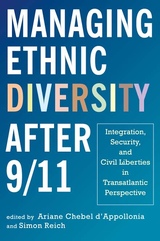
Managing Ethnic Diversity after 9/11 compares these two strategies and considers that both may have engendered greater radicalization--and a greater chance of home-grown terrorism. Essays address how transatlantic countries, including the United Kingdom, the United States, France, Germany, Spain, Italy, and the Netherlands have integrated ethnic minorities, especially Arabs and Muslims, since 9/11. Discussing the "securitization of integration," contributors argue that the neglect of civil integration has challenged the rights of these minorities and has made greater security more remote.
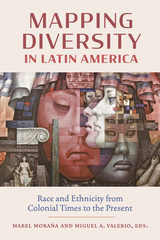
Taking an interdisciplinary approach to understanding issues of collective identity, otherness, alterity, and the like, Mapping Diversity in Latin America sheds light on histories that have been traditionally overlooked in texts on race in Latin America, such as the rich history of diasporic Asian, Syrian Lebanese, and Jewish communities, and the more recent emergence of Latinx populations in the United States. The book includes a critical examination of fundamental concepts such as mestizaje, mulataje, creolization, negritud, and blanquitud, as well as critical and theoretical approaches to the study of these issues in postcolonial societies.

In Martin Heidegger Saved My Life, Grant Farred combines autobiography with philosophical rumination to offer this unusual meditation on American racism. In the fall of 2013 while raking leaves outside his home, Farred experienced a racist encounter: a white woman stopped to ask him, “Would you like another job?” Farred responded, “Only if you can match my Cornell faculty salary.” The moment, however, stuck with him. The black man had gravitated to, of all people, Martin Heidegger, specifically Heidegger’s pronouncement, “Only when man speaks, does he think—and not the other way around,” in order to unpack this encounter.
In this essay, Farred grapples with why it is that Heidegger—well known as a Nazi—resonates so deeply with him during this encounter instead of other, more predictable figures such as Malcolm X, W. E. B. DuBois, or Frantz Fanon.
Forerunners is a thought-in-process series of breakthrough digital works. Written between fresh ideas and finished books, Forerunners draws on scholarly work initiated in notable blogs, social media, conference plenaries, journal articles, and the synergy of academic exchange. This is gray literature publishing: where intense thinking, change, and speculation take place in scholarship.
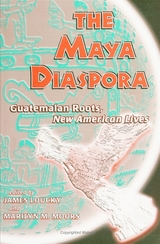
This widespread poverty was endemic throughout northwestern Guatemala, where 80 percent of Maya children were chronically malnourished, and forced wide-scale migration to the Pacific coast. The self-help aid that flowed into the area in the 1960s and 1970s raised hopes for justice and equity that were brutally suppressed by Guatemala's military government. This military reprisal led to a massive diaspora of Maya throughout Canada, the United States, Mexico, and Central America.
This collection describes that process and the results. The chapters show the dangers and problems of the migratory/refugee process and the range of creative cultural adaptations that the Maya have developed. It provides the first comparative view of the formation and transformation of this new and expanding transnational population, presented from the standpoint of the migrants themselves as well as from a societal and international perspective. Together, the chapters furnish ethnographically grounded perspectives on the dynamic implications of uprooting and resettlement, social and psychological adjustment, long-term prospects for continued links to migration history from Guatemala, and the development of a sense of co-ethnicity with other indigenous people of Maya descent. As the Maya struggle to find their place in a more global society, their stories of quiet courage epitomize those of many other ethnic groups, migrants, and refugees today.
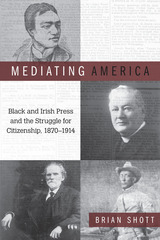
Until recently, print media was the dominant force in American culture. The power of the paper was especially true in minority communities. African Americans and European immigrants vigorously embraced the print newsweekly as a forum to move public opinion, cohere group identity, and establish American belonging.
Mediating America explores the life and work of T. Thomas Fortune and J. Samuel Stemons as well as Rev. Peter C. Yorke and Patrick Ford—respectively two African American and two Irish American editor/activists in the late nineteenth and early twentieth centuries. Historian Brian Shott shows how each of these “race men” (the parlance of the time) understood and advocated for his group’s interests through their newspapers. Yet the author also explains how the newspaper medium itself—through illustrations, cartoons, and photographs; advertisements and page layout; and more—could constrain editors’ efforts to guide debates over race, religion, and citizenship during a tumultuous time of social unrest and imperial expansion.
Black and Irish journalists used newspapers to recover and reinvigorate racial identities. As Shott proves, minority print culture was a powerful force in defining American nationhood.


The Melting Pot and the Altar was first published in 1981. Minnesota Archive Editions uses digital technology to make long-unavailable books once again accessible, and are published unaltered from the original University of Minnesota Press editions.
Recent studies of assimilation in nineteenth-century America have focused on the ways in which immigrant groups maintained separate identities rather than on their absorption in American society. In The Melting Pot and the Altar Richard M. Bernard puts to test the theory of the melting pot. He concludes that although cultural and structural pluralism deserves attention so does interaction between the host society and the immigrants
Through extensive quantitative analysis of census reports and marriage records Bernard studies the pattern of intergroup marriage - the ultimate test of assimilation - during a period of massive migration to this country. His research on eleven immigrant groups and the native-born population in Wisconsin suggests that there was considerable intergroup mixing. Moreover, once allowance is made for differing times of arrival, immigration generations, and rural or urban residences, the assimilative patterns of Western and Eastern European groups were remarkably similar. An examination of several factors, such as occupation, age, location, and birthplace of parents, shows that certain demographic and social characteristics rather than any particular ethnic identification increased the likelihood that an individual would marry outside his or her group.
The Melting Pot and the Altar is the first multiple variable analysis of marital assimilation in an entire state whose immigration patterns is similar to that of the nation. Both historians and sociologist will find this work of interest as an example of quantitative methodology and for its new evidence on an important subject.

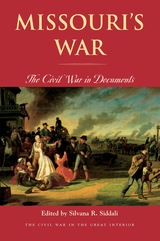
Winner of a 2011 “Distinguished Achievement in Literature” award, Missouri Humanities Council
Civil War Missouri stood at the crossroads of America. As the most Southern-leaning state in the Middle West, Missouri faced a unique dilemma. The state formed the gateway between east and west, as well as one of the borders between the two contending armies. Moreover, because Missouri was the only slave state in the Great Interior, the conflicts that were tearing the nation apart were also starkly evident within the state. Deep divisions between Southern and Union supporters, as well as guerrilla violence on the western border, created a terrible situation for civilians who lived through the attacks of bushwhackers and Jayhawkers.
The documents collected in Missouri's War reveal what factors motivated Missourians to remain loyal to the Union or to fight for the Confederacy, how they coped with their internal divisions and conflicts, and how they experienced the end of slavery in the state. Private letters, diary entries, song lyrics, official Union and Confederate army reports, newspaper editorials, and sermons illuminate the war within and across Missouri's borders.
Missouri's War also highlights the experience of free and enslaved African Americans before the war, as enlisted Union soldiers, and in their effort to gain rights after the end of the war. Although the collection focuses primarily on the war years, several documents highlight both the national sectional conflict that led to the outbreak of violence and the effort to reunite the conflicting forces in Missouri after the war.
READERS
Browse our collection.
PUBLISHERS
See BiblioVault's publisher services.
STUDENT SERVICES
Files for college accessibility offices.
RECENTLY PUBLISHED






UChicago Accessibility Resources
home | accessibility | search | about | contact us
BiblioVault ® 2001 - 2026
The University of Chicago Press