
 A SCHOLARLY BOOK REPOSITORY
14 start with M start with M
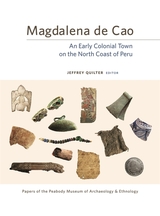
During the early Colonial Period in the Americas, as an ancient way of life ended and the modern world began, indigenous peoples and European invaders confronted, resisted, and compromised with one another. Yet archaeological investigations of this complex era are rare. Magdalena de Cao is an exception: the first in-depth and heavily illustrated examination of what life was like at one culturally mixed town and church complex during the early Colonial Period in Peru.
The field research reported in this volume took place at the site of Magdalena de Cao Viejo, a town on the edge of the Pacific Ocean whose 150-year lifespan ran from the Late Renaissance to the Age of Enlightenment. For a decade, an interdisciplinary team of researchers conducted archaeological and historical research in Peru, Spain, and the United States. Their analysis of documentary sources and recovered artifacts—including metals, textiles, beads, and fragmentary paper documents—opens new doors to understanding daily life in Magdalena de Cao during a turbulent time. Touching on themes of colonialism, cultural hybridity, resistance, and assimilation, Magdalena de Cao provides a comprehensive overview of the project itself and a rich body of data that will be of interest to researchers for years to come.
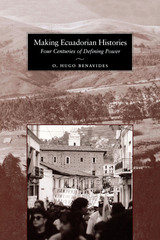
In Ecuador, as in all countries, archaeology and history play fundamental roles in defining national identity. Connecting with the prehistoric and historic pasts gives the modern state legitimacy and power. But the state is not the only actor that lays claim to the country's archaeological patrimony, nor is its official history the only version of the story. Indigenous peoples are increasingly drawing on the past to claim their rights and standing in the modern Ecuadorian state, while the press tries to present a "neutral" version of history that will satisfy its various publics.
This pathfinding book investigates how archaeological knowledge is used for both maintaining and contesting nation-building and state-hegemony in Ecuador. Specifically, Hugo Benavides analyzes how the pre-Hispanic site of Cochasquí has become a source of competing narratives of Native American, Spanish, and Ecuadorian occupations, which serve the differing needs of the nation-state and different national populations at large. He also analyzes the Indian movement itself and the recent controversy over the final resting place for the traditional monolith of San Biritute. Offering a more nuanced view of the production of history than previous studies, Benavides demonstrates how both official and resistance narratives are constantly reproduced and embodied within the nation-state's dominant discourses.
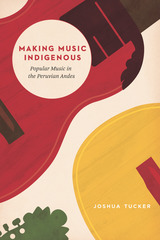
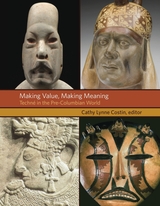
Making Value, Making Meaning: Techné in the Pre-Columbian World adopts the concept of techné as an analytic tool useful for understanding how the production process created value and meaning for social valuables and public monuments in complex societies in pre-Columbian Mesoamerica and the Andes. In doing so, the archaeologists and art historians contributing to this volume add to the study of ancient artisans and craftsmanship through the exploration of how technology, the organization of production, artisan identity, and the deployment of esoteric knowledge factored into the creation of symbolically and politically charged material culture.
The wide-ranging case studies in this volume demonstrate that the concept of techné—thorough and masterful knowledge of a specific field deployed to create things with social utility—is a powerful one for understanding the political economy of craft production and the role of objects in social life and how their creation and use helps to generate their social, political, and spiritual power.
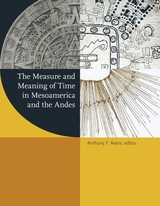
Westerners think of time as a measure of duration, a metric quantity that is continuous, homogeneous, unchangeable, and never ending—a reality that lies outside of human existence. How did the people of Mesoamerica and the Andes, isolated as they were from the rest of the world, conceive of their histories? How and why did they time their rituals? What knowledge can we acquire about their time from studying the material record they have left behind?
This volume brings together specialists in anthropology, archaeology, art history, astronomy, and the history of science to contemplate concrete and abstract temporal concepts gleaned from the Central Mexicans, Mayans, and Andeans. Contributors first address how people reckon and register time; they compare the western linear, progressive way of knowing time with the largely cyclic notions of temporality derived from the Americas, and they dissect, explain, and explore the origins of the complex dynastic and ritual calendars of the Maya, Inca, and Aztecs. They subsequently consider how people sense time and its moral dimensions. Time becomes an inescapable feature of the process of perception, an entity that occupies a succession of moments rather than the knife-edge present ingrained in our Western minds.
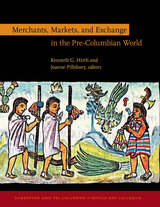
Winner, Senior Book Prize, American Ethnological Society
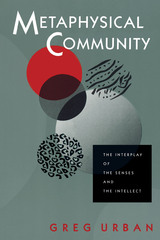
Starting with the post-structuralist idea that truth systems are lodged in discourse, and that discourse varies from society to society, Greg Urban seeks to discover the nature and extent of that variation. His journey to an Amerindian society in which dreams are more prominent than everyday aspects of the sensible world leads him to radically reformulate one of the main problematics of Western thought: the relationship between our sensations of the world and the understandings we form of them.
Metaphysical Community proposes that this dichotomy comes from the interplay between two sides of discourse-its intelligible side as a carrier of meanings, and its sensible side as thing-in-the-world that must be replicated. This insight leads to the heart of the book-the exploration of the uneasy tension that binds experience and understanding, phenomena and noumena.
Urban challenges basic assumptions that underlie social and cultural anthropology and much of the social sciences and humanities. His provocative insights will be of interest to all those concerned with anthropology, cultural studies, literary criticism, the sociology and politics of culture, and philosophy.
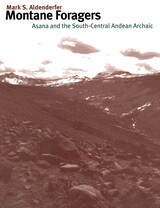
Aldenderfer's investigation forms a methodological and theoretical tour de force that elucidates elevational stress—what it takes for humans to adjust and survive at high altitudes. In a masterful integration of mountain biology and ecology, he emphasizes the nature of hunter-gatherer adaptations to high-mountain environments. He carefully documents the cultural history of Asana, the first stratified, open-air site discovered in the highlands of the south-central Andes. He establishes a number of major occurrences at this revolutionary site, including the origins of plant and animal domestication and transitions to food production, the growth and packing of forager populations, and the advent of some form of complexity and social hierarchy.
The rich and diversified archaeological record recovered at Asana—which spans from 10,000 to 3,500 years ago—includes the earliest houses as well as public and ceremonial buildings in the central cordillera. Built, used, and abandoned over many millennia, the Asana structures completely transform our understanding of the antiquity and development of native American architecture. Aldenderfer's detailed archaeological case study of high-elevation foraging adaptation, his description of this extreme environment as a viable human habitat, and his theoretical model of montane foraging create a new understanding of the lifeways of foraging peoples worldwide.

At once approachable and informative, The Monumental Andes tells the history of the lofty mountains and civilizations that characterize the Central Andes. The book explores many interconnected aspects of ancient Andean life, including climate, topography, agricultural methods, natural hazards, the construction of monumental structures, the creation of sophisticated art objects, and the plant-based hallucinogens and narcotics used in religious rituals. From earthquake-resistant structures to shrines on the tops of active volcanoes, ancient Andeans left behind relics that amaze and inspire today.

Anthropologist Sandhya Krittika Narayanan begins with these challenges, and asks: What does it mean to be a Quechua or Aymara speaker in Puno today? What does it mean to be an Indigenous ethnic Quechua or Aymara individual?
Mother Tongues of the High Andes opens with these questions, exploring what Quechua and Aymara languages and identities mean for Indigenous puneños as they navigate their past and present. Narayanan argues that understanding inter-Indigenous linguistic and social differences involves examining Indigenous gender roles, responsibilities, and linguistic practices, particularly those of Indigenous puneña women. She shows how these practices have contributed to the maintenance of Indigenous multilingualism and continuity in local modes of understanding Indigenous identity and difference.
Even as ideologies around Indigenous identity and linguistic practices shift due to global discourses on Indigenous ethnic identity and nationalism, Indigenous women continue to play a crucial role, promoting new ways to speak and think about Quechua and Aymara linguistic differences, making the Indigenous roots and histories of Puno recognizable to a global audience. Through a comprehensive ethnographic exploration of gender, language, and Indigenous difference, Narayanan shows how the linguistic and social practices of Indigenous puneña women both contest and reaffirm competing visions of Quechua and Aymara linguistic identity and authority.
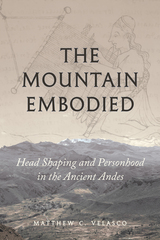
A study of the ancient practice of Andean head shaping and its cultural connotations.
In the late sixteenth century, Spanish conquerors in Peru’s Colca Valley encountered the Collaguas and Cavanas, Indigenous people who undertook a striking form of body modification: Collaguas bound the heads of infants and children so that their skulls grew narrow and elongated, and Cavanas so that their skulls became wide and squat. Head shaping resulted in craniums that resembled two specific mountains associated with the groups. For Europeans, shaped skulls immediately and durably became a marker of territorialized ethnic difference.
The Mountain Embodied offers a more nuanced story. Having studied hundreds of samples of human remains, bioarchaeologist Matthew Velasco argues that reducing head shape to a mere ethnic marker is a colonial invention. Instead, the social significance of head shaping was protean and intersected with other structures of difference, such as gender, kinship, and status, influencing experience within the community. Head shaping, then, was one factor in the construction of a locally embedded kind of subjectivity. An outsider could deduce group identity from head shape, but for practitioners, head shaping reflected something else: nothing less than personhood itself.
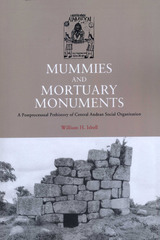
Since prehistoric times, Andean societies have been organized around the ayllu, a grouping of real or ceremonial kinspeople who share labor, resources, and ritual obligations. Many Andean scholars believe that the ayllu is as ancient as Andean culture itself, possibly dating back as far as 6000 B.C., and that it arose to alleviate the hardships of farming in the mountainous Andean environment.
In this boldly revisionist book, however, William Isbell persuasively argues that the ayllu developed during the latter half of the Early Intermediate Period (around A.D. 200) as a means of resistance to the process of state formation. Drawing on archaeological evidence, as well as records of Inca life taken from the chroniclers, Isbell asserts that prehistoric ayllus were organized around the veneration of deceased ancestors, whose mummified bodies were housed in open sepulchers, or challups, where they could be visited by descendants seeking approval and favors. By charting the temporal and spatial distribution of chullpa ruins, Isbell offers a convincing new explanation of where, when, and why the ayllu developed.
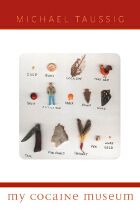
Combining natural history with political history in a filmic, montage style, Taussig deploys the show-and-tell modality of a museum to engage with the inner life of heat, rain, stone, and swamp, no less than with the life of gold and cocaine.
This effort to find a poetry of words becoming things is brought to a head by the explosive qualities of those sublime fetishes of evil beauty, gold and cocaine. At its core, Taussig's museum is about the lure of forbidden things, charged substances that transgress moral codes, the distinctions we use to make sense of the world, and above all the conventional way we write stories.
READERS
Browse our collection.
PUBLISHERS
See BiblioVault's publisher services.
STUDENT SERVICES
Files for college accessibility offices.
RECENTLY PUBLISHED



UChicago Accessibility Resources
home | accessibility | search | about | contact us
BiblioVault ® 2001 - 2025
The University of Chicago Press