logo for University of Chicago Press
MacArthur's Japanese Constitution
Kyoko Inoue
University of Chicago Press, 1991
The Japanese constitution as revised by General MacArthur in 1946, while generally regarded to be an outstanding basis for a liberal democracy, is at the same time widely considered to be—in its Japanese form—an document which is alien and incompatible with Japanese culture. Using both linguistics and historical data, Kyoto Inoue argues that despite the inclusion of alien concepts and ideas, this constitution is nonetheless fundamentally a Japanese document that can stand on its own.

"This is an important book. . . . This is the most significant work on postwar Japanese constitutional history to appear in the West. It is highly instructive about the century-long process of cultural conflict in the evolution of government and society in modern Japan."—Thomas W. Burkman, Monumenta Nipponica
[more]

front cover of Machinic Eros
Machinic Eros
Writings on Japan
Félix Guattari
University of Minnesota Press, 2015

The French philosopher Félix Guattari frequently visited Japan during the 1980s and organized exchanges between French and Japanese artists and intellectuals. His immersion into the “machinic eros” of Japanese culture put him into contact with media theorists such as Tetsuo Kogawa and activists within the mini-FM community (Radio Home Run), documentary filmmakers (Mitsuo Sato), photographers (Keiichi Tahara), novelists (Kobo Abe), internationally recognized architects (Shin Takamatsu), and dancers (Min Tanaka). From pachinko parlors to high-rise highways, alongside corporate suits and among alt-culture comrades, Guattari put himself into the thick of Japanese becomings during a period in which the bubble economy continued to mutate. This collection of essays, interviews, and longer meditations shows a radical thinker exploring the architectural environment of Japan’s “machinic eros.”
[more]

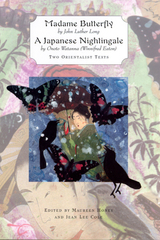
front cover of 'Madame Butterfly' and 'A Japanese Nightingale'
'Madame Butterfly' and 'A Japanese Nightingale'
Two Orientalist Texts
Cole, Jean Lee
Rutgers University Press, 2002
Madame Butterfly (1898) and A Japanese Nightingale (1901) both appeared at the height of American fascination with Japanese culture. These two novellas are paired here together for the first time to show how they defined and redefined contemporary misconceptions of the "Orient." This is the first reprinting of A Japanese Nightingale since its 1901 appearance, when it propelled Winnifred Eaton (using the pseudonym Onoto Watanna) to fame. John Luther Long's Madame Butterfly introduced American readers to the figure of the tragic geisha who falls in love with, and is then rejected by, a dashing American man; the opera Puccini based upon this work continues to enthrall audiences worldwide. Although Long emphasized the insensitivity of Westerners in their dealings with Asian people, the ever-faithful Cho-Cho-San typified Asian subservience and Western dominance. A Japanese Nightingale takes Long's revision several steps further. Eaton's heroine is powerful in her own right and is loved on her own terms. A Japanese Nightingale is also significant for its hidden personal nature. Although Eaton's pen name implied she was Japanese, she was, in fact, of Chinese descent. Living in a society that was virulently anti-Chinese, she used a Japanese screen for her own problematic identity, and A Japanese Nightingale tells us as much about the author's struggle to embrace her Asian heritage as it does about the stereotypes she contests.
[more]

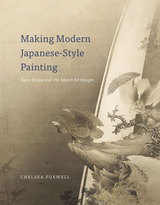
front cover of Making Modern Japanese-Style Painting
Making Modern Japanese-Style Painting
Kano Hogai and the Search for Images
Chelsea Foxwell
University of Chicago Press, 2015
The Western discovery of Japanese paintings at nineteenth-century world’s fairs and export shops catapulted Japanese art to new levels of international popularity. With that popularity, however, came criticism, as Western writers began to lament a perceived end to pure Japanese art and a rise in westernized cultural hybrids. The Japanese response: nihonga, a traditional style of painting that reframed existing techniques to distinguish them from Western artistic conventions. Making Modern Japanese-Style Painting explores the visual characteristics and social functions of nihonga and traces its relationship to the past, its viewers, and emerging notions of the modern Japanese state.

Chelsea Foxwell sheds light on interlinked trends in Japanese nationalist discourse, government art policy, American and European commentary on Japanese art, and the demands of export. The seminal artist Kano Hogai (1828–88) is one telling example: originally a painter for the shogun, his art eventually evolved into novel, eerie images meant to satisfy both Japanese and Western audiences. Rather than simply absorbing Western approaches, nihonga as practiced by Hogai and others broke with pre-Meiji painting even as it worked to neutralize the rupture.

By arguing that fundamental changes to audience expectations led to the emergence of nihonga—a traditional interpretation of Japanese art for a contemporary, international market—Making Modern Japanese-Style Painting offers a fresh look at an important aspect of Japan’s development into a modern nation.
[more]

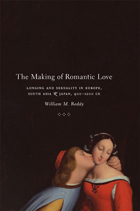
front cover of The Making of Romantic Love
The Making of Romantic Love
Longing and Sexuality in Europe, South Asia, and Japan, 900-1200 CE
William M. Reddy
University of Chicago Press, 2012
In the twelfth century, the Catholic Church attempted a thoroughgoing reform of marriage and sexual behavior aimed at eradicating sexual desire from Christian lives. Seeking a refuge from the very serious condemnations of the Church and relying on a courtly culture that was already preoccupied with honor and secrecy, European poets, romance writers, and lovers devised a vision of love as something quite different from desire.  Romantic love was thus born as a movement of covert resistance.
 
In The Making of Romantic Love: Longing and Sexuality in Europe, South Asia, and Japan, William M. Reddy illuminates the birth of a cultural movement that managed to regulate selfish desire and render it innocent—or innocent enough. Reddy strikes out from this historical moment on an international exploration of love, contrasting the medieval development of romantic love in Europe with contemporaneous eastern traditions in Bengal and Orissa, and in Heian Japan from 900-1200 CE, where one finds no trace of an opposition between love and desire. In this comparative framework, Reddy tells an appealing tale about the rise and fall of various practices of longing, underscoring the uniqueness of the European concept of sexual desire.
[more]

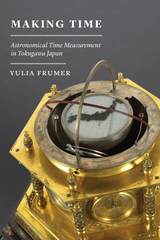
front cover of Making Time
Making Time
Astronomical Time Measurement in Tokugawa Japan
Yulia Frumer
University of Chicago Press, 2017
What is time made of? We might balk at such a question, and reply that time is not made of anything—it is an abstract and universal phenomenon. In Making Time, Yulia Frumer upends this assumption, using changes in the conceptualization of time in Japan to show that humans perceive time as constructed and concrete.

In the mid-sixteenth century, when the first mechanical clocks arrived in Japan from Europe, the Japanese found them interesting but useless, because they failed to display time in units that changed their length with the seasons, as was customary in Japan at the time. In 1873, however, the Japanese government adopted the Western equal-hour system as well as Western clocks. Given that Japan carried out this reform during a period of rapid industrial development, it would be easy to assume that time consciousness is inherent to the equal-hour system and a modern lifestyle, but Making Time suggests that punctuality and time-consciousness are equally possible in a society regulated by a variable-hour system, arguing that this reform occurred because the equal-hour system better reflected a new conception of time — as abstract and universal—which had been developed in Japan by a narrow circle of astronomers, who began seeing time differently as a result of their measurement and calculation practices. Over the course of a few short decades this new way of conceptualizing time spread, gradually becoming the only recognized way of treating time.   
 
[more]

front cover of Managing
Managing "Modernity"
Work, Community, and Authority in Late-Industrializing Japan and Russia
Rudra Sil
University of Michigan Press, 2002
In Managing "Modernity," Rudra Sil examines how institution-builders respond to the competing influences of institutional models and inherited social legacies as they attempt to generate and sustain authority in late-industrializing societies. Through a historical and comparative study of large-scale enterprises in Japan and Russia, the book examines the impact of different institution-building strategies on managerial authority, invoking the experience of postwar Japan to highlight the benefits of a syncretic approach that selectively integrates adaptable features of borrowed institutions with portable norms inherited from preexisting communities.
Managing "Modernity" engages a variety of intellectual perspectives in the social sciences. The theoretical approach represents a conscious effort to overcome the contentious debates in political science and sociology among proponents of historical institutionalism, cultural analysis, and rational-choice theory. The substantive argument draws on, and partially integrates, concepts and findings from comparative politics, economic sociology, industrial relations, organization theory, business management, and the political economy of Japan and Russia.
In light of ongoing debates over the significance and impact of "globalization," the eclectic and integrative approach in Managing "Modernity" offers a fresh and provocative contribution that will interest scholars and graduate students across a variety of disciplines and subfields. It offers compelling insights to anyone generally concerned with the social forces that facilitate or hinder the diffusion of ideas and institutions across national boundaries.
Rudra Sil is Janice and Julian Bers Assistant Professor in the Social Sciences, Department of Political Science, University of Pennsylvania.
[more]

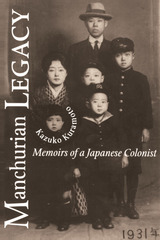
front cover of Manchurian Legacy
Manchurian Legacy
Memoirs of a Japanese Colonist
Kazuko Kuramoto
Michigan State University Press, 1999

Kazuko Kuramoto was born and raised in Dairen, Manchuria, in 1927, at the peak of Japanese expansionism in Asia. Dairen and the neighboring Port Arthur were important colonial outposts on the Liaotung Peninsula; the train lines established by Russia and taken over by the Japanese, ended there. When Kuramoto's grandfather arrived in Dairen as a member of the Japanese police force shortly after the end of the Russo-Japanese War in 1905, the family's belief in Japanese supremacy and its "divine" mission to "save" Asia from Western imperialists was firmly in place. As a third-generation colonist, the seventeen-year-old Kuramoto readily joined the Red Cross Nurse Corps in 1944 to aid in the war effort and in her country's sacred cause. A year later, her family listened to the emperor's radio broadcast ". . . we shall have to endure the unendurable, to suffer the insufferable." Japan surrendered unconditionally. 
     Manchurian Legacy is the story of the family's life in Dairen, their survival as a forgotten people during the battle to reclaim Manchuria waged by Russia, Nationalist China, and Communist China, and their subsequent repatriation to a devastated Japan. Kuramoto describes a culture based on the unthinking oppression of the colonized by the colonizer. And, because Manchuria was, in essence, a Japanese frontier, her family lived a freer and more luxurious life than they would have in Japan—one relatively unscathed by the war until after the surrender.  
     As a commentator Kuramoto explores her culture both from the inside, subjectively, and from the outside, objectively. Her memoirs describe her coming of age in a colonial society, her family's experiences in war-torn Manchuria, and her "homecoming" to Japan—where she had never been—just as Japan is engaged in its own cultural upheaval.
[more]

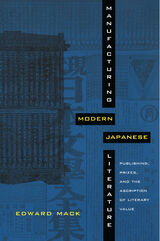
front cover of Manufacturing Modern Japanese Literature
Manufacturing Modern Japanese Literature
Publishing, Prizes, and the Ascription of Literary Value
Edward Mack
Duke University Press, 2010
Emphasizing how modes of book production, promotion, and consumption shape ideas of literary value, Edward Mack examines the role of Japan’s publishing industry in defining modern Japanese literature. In the late nineteenth century and early twentieth, as cultural and economic power consolidated in Tokyo, the city’s literary and publishing elites came to dominate the dissemination and preservation of Japanese literature. As Mack explains, they conferred cultural value on particular works by creating prizes and multivolume anthologies that signaled literary merit. One such anthology, the Complete Works of Contemporary Japanese Literature (published between 1926 and 1931), provided many readers with their first experience of selected texts designated as modern Japanese literature. The low price of one yen per volume allowed the series to reach hundreds of thousands of readers. An early prize for modern Japanese literature, the annual Akutagawa Prize, first awarded in 1935, became the country’s highest-profile literary award. Mack chronicles the history of book production and consumption in Japan, showing how advances in technology, the expansion of a market for literary commodities, and the development of an extensive reading community enabled phenomena such as the Complete Works of Contemporary Japanese Literature and the Akutagawa Prize to manufacture the very concept of modern Japanese literature.
[more]

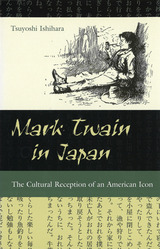
front cover of Mark Twain in Japan
Mark Twain in Japan
The Cultural Reception of an American Icon
Tsuyoshi, Ishihara
University of Missouri Press, 2005

Best known for his sharp wit and his portrayals of life along the banks of the Mississippi River, Mark Twain is indeed an American icon, and many scholars have examined how he and his work are perceived in the United States. In Mark Twain in Japan, however, Tsuyoshi Ishihara explores how Twain’s uniquely American work is viewed in a completely different culture.
Mark Twain in Japan addresses three principal areas. First, the author considers Japanese translations of Twain’s books, which have been overlooked by scholars but which have had a significant impact on the formation of the public image of Twain and his works in Japan. Second, he discusses the ways in which traditional and contemporary Japanese culture have transformed Twain’s originals and shaped Japanese adaptations. Finally, he uses the example of Twain in Japan as a vehicle to delve into the complexity of American cultural influences on other countries, challenging the simplistic one-way model of “cultural imperialism.” Ishihara builds on the recent work of other researchers who have examined such models of American cultural imperialism and found them wanting. The reality is that other countries sometimes show their autonomy by transforming, distorting, and rejecting aspects of American culture, and Ishihara explains how this is no less true in the case of Twain.
Featuring a wealth of information on how the Japanese have regarded Twain over time, this book offers both a history lesson on Japanese-American relations and a thorough analysis of the “Japanization” of Mark Twain, as Ishihara adds his voice to the growing international chorus of scholars who emphasize the global localization of American culture. While the book will naturally be of interest to Twain scholars, it also will appeal to other groups, particularly those interested in popular culture, Japanese culture, juvenile literature, film, animation, and globalization of American culture.
[more]

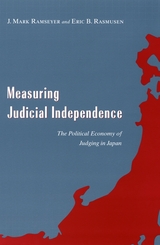
front cover of Measuring Judicial Independence
Measuring Judicial Independence
The Political Economy of Judging in Japan
J. Mark Ramseyer and Eric B. Rasmusen
University of Chicago Press, 2003
The role of the U.S. Supreme Court in the aftermath of the 2000 presidential election raised questions in the minds of many Americans about the relationships between judges and political influence; the following years saw equally heated debates over the appropriate role of political ideology in selecting federal judges. Legal scholars have always debated these questions—asking, in effect, how much judicial systems operate on merit and principle and how much they are shaped by politics.

The Japanese Constitution, like many others, requires that all judges be "independent in the exercise of their conscience and bound only by this Constitution and its laws." Consistent with this requirement, Japanese courts have long enjoyed a reputation for vigilant independence—an idea challenged only occasionally, and most often anecdotally. But in this book, J. Mark Ramseyer and Eric B. Rasmusen use the latest statistical techniques to examine whether that reputation always holds up to scrutiny—whether, and to what extent, the careers of lower court judges can be manipulated to political advantage.

On the basis of careful econometric analysis of career data for hundreds of judges, Ramseyer and Rasmusen find that Japanese politics do influence judicial careers, discreetly and indirectly: judges who decide politically charged cases in ways favored by the ruling party enjoy better careers after their decisions than might otherwise be expected, while dissenting judges are more likely to find their careers hampered by assignments to less desirable positions.

Ramseyer and Rasmusen's sophisticated yet accessible analysis has much to offer anyone interested in either judicial independence or the application of econometric techniques in the social sciences.
[more]

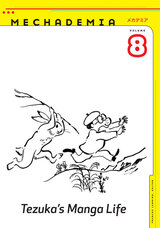
front cover of Mechademia 8
Mechademia 8
Tezuka’s Manga Life
Frenchy Lunning
University of Minnesota Press, 2013

Known as the “Walt Disney of Japan” it is no surprise that Tezuka Osamu is still the best-known manga creator to Western fans. Current scholarship has uncovered the profound complexity and ambiguity not only of his work but of the man, the artist, and his life—dismantling his position as the god of manga.

Contributors to this volume of Mechademia—a series devoted to creative and critical work on anime, manga, and the fan arts—analyze Tezuka and his complicated approaches toward life and nonlife on earth, as well as his effect on the lives of other manga artists. Using essays and reprints of Japanese manga on Tezuka, this book questions his influence and attitudes toward the nonhuman, evolutionary theory, the aesthetic lineage of contemporary manga, incipient feminism in the reinscription of the nonhuman feminine, the sexual politics of manga bodies, the origins of the moe culture, and the styles of didacticism revealing the digressions of insects and classical modes, among others.

The authors offer varying perspectives on the historical transformations in production, distribution, and reception that gradually integrated and differentiated an overlapping series of markets and readerships in the postwar era. Divided into four sections that explore different “lives”—“Nonhuman Life,” “Media Life,” “A Life in Manga,” and “Everyday Life”—Mechademia 8 serves as a prehistory of the impersonal politics of the present while tracing Tezuka’s legacy.

Contributors: Akatsuka Fujio; Anno Moyoko; Linda H. Chance, U of Pennsylvania; Jonathan Clements; Hideaki Fujiki, Nagoya U; Patrick W. Galbraith; Verina Gfader, U of Huddersfield; Alicia Gibson; G. Clinton Godart, USC; Yorimitsu Hashimoto, Osaka U; Ryan Holmberg; Hikari Hori, Columbia U; Mary A. Knighton, College of William and Mary; Thomas Lamarre, McGill U; Christine L. Marran, U of Minnesota; Natsume Fusanosuke, Gakushuin U, Tokyo; Ōtsuka Eiji, Kobe Design U; Baryon Tensor Posadas; Renato Rivera Rusca, Meiji U; Frederik L. Schodt; Marc Steinberg, Concordia U; Tezuka Osamu; Toshiya Ueno, Wako U, Tokyo; Matthew Young.
[more]

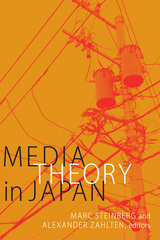
front cover of Media Theory in Japan
Media Theory in Japan
Marc Steinberg and Alexander Zahlten, editors
Duke University Press, 2017
Providing an overview of Japanese media theory from the 1910s to the present, this volume introduces English-language readers to Japan's rich body of theoretical and conceptual work on media for the first time. The essays address a wide range of topics, including the work of foundational Japanese thinkers; Japanese theories of mediation and the philosophy of media; the connections between early Japanese television and consumer culture; and architecture's intersection with communications theory. Tracing the theoretical frameworks and paradigms that stem from Japan's media ecology, the contributors decenter Eurocentric media theory and demonstrate the value of the Japanese context to reassessing the parameters and definition of media theory itself. Taken together, these interdisciplinary essays expand media theory to encompass philosophy, feminist critique, literary theory, marketing discourse, and art; provide a counterbalance to the persisting universalist impulse of media studies; and emphasize the need to consider media theory situationally.
 
Contributors. Yuriko Furuhata, Aaron Gerow, Mark Hansen, Marilyn Ivy, Takeshi Kadobayashi, Keisuke Kitano, Akihiro Kitada, Thomas Looser, Anne McKnight, Ryoko Misono, Akira Mizuta Lippit, Miryam Sas, Fabian Schäfer, Marc Steinberg, Tomiko Yoda, Alexander Zahlten
[more]

front cover of Meiji Graves in Happy Valley
Meiji Graves in Happy Valley
Stories of Early Japanese Residents in Hong Kong
Yoshiko Nakano and Georgina Challen
Hong Kong University Press, 2024
Stories of Meiji-era Japanese residents and their final resting place in Hong Kong.

The Hong Kong Cemetery in Happy Valley is home to over 470 graves connected to the city’s Japanese population. Most of these graves belong to individuals who died during the Meiji era (1868–1912), a remarkable period of modernization and opening up of Japan that saw thousands of its inhabitants travel to other parts of the world to study, work, and settle. Who were these people? What were they doing in Hong Kong? And why were unbaptized Japanese buried in what was called at one time the "Protestant Cemetery"?

Hong Kong’s Meiji-era Japanese community was one of two halves. Company executives sat atop the social ladder and karayuki-san, or prostitutes, occupied the lower echelons, with tradespeople and professionals somewhere in between. By revealing the personal journeys of these mostly forgotten Japanese, the authors aim to add to transnational perspectives on Hong Kong and Japan during the late nineteenth and early twentieth centuries, as well as increase recognition of this fragmented community’s place in the development of this diverse city.
[more]

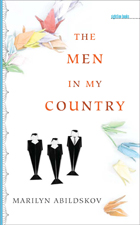
front cover of The Men in My Country
The Men in My Country
Marilyn Abildskov
University of Iowa Press, 2004
In the early 1990s, at the watershed age of thirty, Marilyn Abildskov decided she needed to start over. She accepted an offer to move from Utah to Matsumoto, Japan, to teach English to junior high school students. “All I knew is that I had to get away and when I stared at my name on the Japanese contract, the squiggles of katakana, my name typed in English sturdily beneath, I liked how it looked. As if it—as if I—were translated, transformed, emerging now as someone new.”

The Men in My Country is the story of an American woman living and loving in Japan. Satisfied at first to observe her exotic surroundings, the woman falls in love with the place, with the light, with the curve of a river, with the smell of bonfires during obon, with blue and white porcelain dishes, with pencil boxes, and with small origami birds. Later, struggling for a deeper connection—“I wanted the country under my skin”—Abildskov meets the three men who will be part of her transformation and the one man with whom she will fall deeply in love.

A travel memoir offering an artful depiction of a very real place, The Men in My Country also covers the terrain of a complex emotional journey, tracing a geography of the heart, showing how we move to be moved, how in losing ourselves in a foreign place we can become dangerously—and gloriously—undone.
[more]

logo for University of Minnesota Press
Militarized Currents
Toward a Decolonized Future in Asia and the Pacific
Setsu Shigematsu
University of Minnesota Press, 2010
Foregrounding indigenous and feminist scholarship, this collection analyzes militarization as an extension of colonialism from the late twentieth to the twenty-first century in Asia and the Pacific. The contributors theorize the effects of militarization across former and current territories of Japan and the United States, such as Guam, Okinawa, the Marshall Islands, the Philippines, and Korea, demonstrating that the relationship between militarization and colonial subordination—and their gendered and racialized processes—shapes and produces bodies of memory, knowledge, and resistance.
 
Contributors: Walden Bello, U of the Philippines; Michael Lujan Bevacqua, U of Guam; Patti Duncan, Oregon State U; Vernadette Vicuña Gonzalez, U of Hawai‘i, M noa; Insook Kwon, Myongji U; Laurel A. Monnig, U of Illinois, Urbana–Champaign; Katharine H. S. Moon, Wellesley College; Jon Kamakawiwo‘ole Osorio, U of Hawai‘i, M noa; Naoki Sakai, Cornell U; Fumika Sato, Hitotsubashi U; Theresa Cenidoza Suarez, California State U, San Marcos; Teresia K. Teaiwa, Victoria U, Wellington; Wesley Iwao Ueunten, San Francisco State U.
[more]

front cover of Mixed-Member Electoral Systems in Constitutional Context
Mixed-Member Electoral Systems in Constitutional Context
Taiwan, Japan, and Beyond
Edited by Nathan F. Batto, Chi Huang, Alexander C. Tan, and Gary W. Cox
University of Michigan Press, 2016
Reformers have promoted mixed-member electoral systems as the “best of both worlds.” In this volume, internationally recognized political scientists evaluate the ways in which the introduction of a mixed-member electoral system affects the configuration of political parties. The contributors examine several political phenomena, including cabinet post allocation, nominations, preelectoral coalitions, split-ticket voting, and the size of party systems and faction systems. Significantly, they also consider various ways in which the constitutional system—especially whether the head of government is elected directly or indirectly—can modify the incentives created by the electoral system.  

The findings presented here demonstrate that the success of electoral reform depends not only on the specification of new electoral rules per se but also on the political context—and especially the constitutional framework—within which such rules are embedded.
[more]

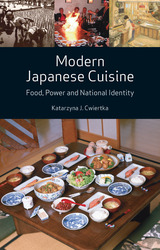
front cover of Modern Japanese Cuisine
Modern Japanese Cuisine
Food, Power and National Identity
Katarzyna J. Cwiertka
Reaktion Books, 2015
Over the past two decades, the popularity of Japanese food in the West has increased immeasurably—a major contribution to the evolution of Western eating habits. But Japanese cuisine itself has changed significantly since pre-modern times, and the food we eat at trendy Japanese restaurants, from tempura to sashimi, is vastly different from earlier Japanese fare. Modern Japanese Cuisine examines the origins of Japanese food from the late nineteenth century to unabashedly adulterated American favorites like today’s California roll.

Katarzyna J. Cwiertka demonstrates that key shifts in the Japanese diet were, in many cases, a consequence of modern imperialism. Exploring reforms in military catering and home cooking, wartime food management and the rise of urban gastronomy, Cwiertka shows how Japan’s numerous regional cuisines were eventually replaced by a set of foods and practices with which the majority of Japanese today ardently identify.

The result of over a decade of research, Modern Japanese Cuisine is a fascinating look at the historical roots of some of the world’s best cooking and will provide appetizing reading for scholars of Japanese culture and foodies alike.
[more]

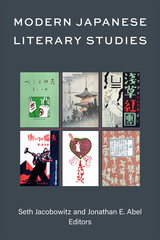
front cover of Modern Japanese Literary Studies
Modern Japanese Literary Studies
Seth Jacobowitz and Jonathan E. Abel, Editors
University of Michigan Press, 2026
Explores new directions in modern Japanese literature
[more]

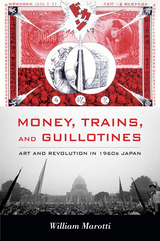
front cover of Money, Trains, and Guillotines
Money, Trains, and Guillotines
Art and Revolution in 1960s Japan
William Marotti
Duke University Press, 2013
During the 1960s a group of young artists in Japan challenged official forms of politics and daily life through interventionist art practices. William Marotti situates this phenomenon in the historical and political contexts of Japan after the Second World War and the international activism of the 1960s. The Japanese government renewed its Cold War partnership with the United States in 1960, defeating protests against a new security treaty through parliamentary action and the use of riot police. Afterward, the government promoted a depoliticized everyday world of high growth and consumption, creating a sanitized national image to present in the Tokyo Olympics of 1964. Artists were first to challenge this new political mythology. Marotti examines their political art, and the state's aggressive response to it. He reveals the challenge mounted in projects such as Akasegawa Genpei's 1,000-yen prints, a group performance on the busy Yamanote train line, and a plan for a giant guillotine in the Imperial Plaza. Focusing on the annual Yomiuri Indépendant exhibition, he demonstrates how artists came together in a playful but powerful critical art, triggering judicial and police response. Money, Trains, and Guillotines expands our understanding of the role of art in the international 1960s, and of the dynamics of art and policing in Japan.
[more]

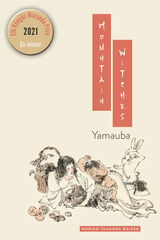
front cover of Mountain Witches
Mountain Witches
Yamauba
Noriko T. Reider
Utah State University Press, 2021
Mountain Witches is a comprehensive guide to the complex figure of yamauba—female yōkai often translated as mountain witches, who are commonly described as tall, enigmatic women with long hair, piercing eyes, and large mouths that open from ear to ear and who live in the mountains—and the evolution of their roles and significance in Japanese culture and society from the premodern era to the present. In recent years yamauba have attracted much attention among scholars of women’s literature as women unconstrained by conformative norms or social expectations, but this is the first book to demonstrate how these figures contribute to folklore, Japanese studies, cultural studies, and gender studies.
 
Situating the yamauba within the construct of yōkai and archetypes, Noriko T. Reider investigates the yamauba attributes through the examination of narratives including folktales, literary works, legends, modern fiction, manga, and anime. She traces the lineage of a yamauba image from the seventh-century text Kojiki to the streets of Shibuya, Tokyo, and explores its emergence as well as its various, often conflicting, characteristics. Reider also examines the adaptation and re-creation of the prototype in diverse media such as modern fiction, film, manga, anime, and fashion in relation to the changing status of women in Japanese society.
 
Offering a comprehensive overview of the development of the yamauba as a literary and mythic trope, Mountain Witches is a study of an archetype that endures in Japanese media and folklore. It will be valuable to students, scholars, and the general reader interested in folklore, Japanese literature, demonology, history, anthropology, cultural studies, gender studies, and the visual and performing arts.
 
[more]

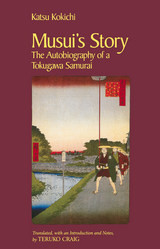
front cover of Musui's Story
Musui's Story
The Autobiography of a Tokugawa Samurai
Kokichi Katsu; Translated by Teruko Craig
University of Arizona Press, 1988
A series of picaresque adventures set against the backdrop of a Japan still closed off from the rest of the world, Musui's Story recounts the escapades of samurai Katsu Kokichi. As it depicts Katsu stealing, brawling, indulging in the pleasure quarters, and getting the better of authorities, it also provides a refreshing perspective on Japanese society, customs, economy, and human relationships.

From childhood, Katsu was given to mischief. He ran away from home, once at thirteen, making his way as a beggar on the great trunk road between Edo and Kyoto, and again at twenty, posing as the emissary of a feudal lord. He eventually married and had children but never obtained official preferment and was forced to supplement a meager stipend by dealing in swords, selling protection to shopkeepers, and generally using his muscle and wits.

Katsu's descriptions of loyalty and kindness, greed and deception, vanity and superstition offer an intimate view of daily life in nineteenth-century Japan unavailable in standard history books. Musui's Story will delight not only students of Japan's past but also general readers who will be entranced by Katsu's candor and boundless zest for life.
[more]

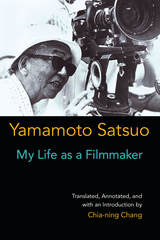
front cover of My Life as a Filmmaker
My Life as a Filmmaker
Yamamoto Satsuo; Translated, Annotated, and with an Introduction by Chia-ning Chang
University of Michigan Press, 2017
In his posthumous autobiography, Watakushi no eiga jinsei (1984), Yamamoto reflects on his career and legacy: beginning in the prewar days as an assistant director in a well-established film company under the master Naruse Mikio, to his wide-ranging experiences as a filmmaker, including his participation in the tumultuous Toho Labor Upheaval soon after Japan’s defeat in World War II and his struggles as an independent filmmaker in the 1950s and 1960s before returning to work within the mainstream industry.  In the process, he established himself as one of the most prominent and socially engaged film artists in postwar Japan.  Imbued with vibrant social realism and astute political commentary, his filmic genres ranged widely from melodramas, period films from the Tokugawa era, samurai action jidaigeki, social satires, and antiwar films. Providing serious insights into and trenchant critique of the moral corruption in Japanese politics, academe, industry, and society, Yamamoto at the same time produced highly successful films that offered drama and entertainment for Japanese and international moviegoers.  His considerable artistic distinction, strong social and political consciousness, and filmic versatility have earned him a unique and distinguished position among Japan’s world-class film directors.
 
In addition to detailed annotations of the autobiography, translator Chia-ning Chang offers a comprehensive introduction to the career and the significance of Yamamoto and his works in the context of Japanese film history.  It contextualizes Yamamoto’s life and works in the historical and cultural zeitgeist of prewar, wartime, and postwar Japan before scrutinizing the unique qualities of his narrative voice and social conscience as a film artist.

[more]


Send via email Share on Facebook Share on Twitter