
 A SCHOLARLY BOOK REPOSITORY
15 start with M start with M

Contributors include Paulo Drino (University of Manchester), Cynthia Sanborn (Centro de Investigaciones, Universidad del Pacifico, Lima), Carlos Monge (Participacion Ciudadana, Lima), Fernando Rospigliosi (Instituto de Estudios Peruanos, Lima), Pedro Franck (Departamento de Economia, Universidad Catolica, Lima), Fernando Eguren (Centro Peruano de Ciencias Sociales, Lima), Rosemary Thorp (Queen Elizabeth House/St Antony's College, Oxford), Eduardo Dargent (University of Texas,Austin), Coletta Youngers (Washington Office on Latin America,Washington D.C.), Francisco Durand (University of Texas, San Antonio), Jose Tavara (Departamento de Economia, Universidad Catolica, Lima, and OSIPTEL), and Richard Webb (Instituto Cuanto and Central Bank of Peru).

“In Malambo . . . the Rimac proudly rubs elbows with the freedmen, the cimarrons, and smuggled slaves. . . It runs united to the other subterranean springs underneath Blanket Street, Weavers Lane, and under Jewish Street . . . and Swordmaker’s Lanes.”
The Rimac shapes the narrative of this compelling historical novel that probes the brutal clash of ethnicity, religion, and class in sixteenth- and seventeenth-century Peru. Set against the backdrop of Spanish colonialism and the Spanish Inquisition in the “New World,” Malambo peels back the layers of Peru’s society to focus on the subtle connections among indigenous peoples— Africans, Jews, Christians, and others—whose cultural fusion pervades Latin American history and culture.
At the heart of the novel is Tomason, an African artist living along the Rimac who paints religious murals for the church and his colonial masters. The intermingling of his Yoruba heritage with his life in a Spanish colony transforms him into a griot figure who unearths the deeper truths of his painful and complex experience by sharing it. Other memorable characters’ stories intertwine with Tomason’s tale, developing a narrative that powerfully reflects on the themes of dislocation and enslavement.
Malambo is an unforgettable work that explores the origins of the Afro-Hispanic experience and offers a profound meditation on the forces of history.
The stories in Marayrasu stage fantastical, mysterious encounters that belie the characters’ often harsh economic and political realities as they seek belonging in modern Peru through art, music, and relationships. Depicted in poetic prose, these characters are loners, orphans, and outcasts experiencing quiet, tender encounters with other people and animals, the creative arts, and the land they find themselves depending on. Living vibrantly within these stories, the leviathan of Inca lore considers its own form, a young boy moves to a mining town and gets involved with a local union leader’s fight for worker rights while feeling the powerful pull of a large mountain overlooking the town, and a Persian cat captures the attention of a family down on its luck. Amy Olen’s translation smoothly captures Rivera Martínez’s impressive stories, offering a unique lens into the region at the heart of this canonical author’s inimitable work.
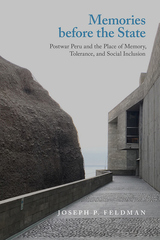
Memories before the State examines the discussions and debates surrounding the creation of the Place of Memory, Tolerance, and Social Inclusion (LUM), a national museum in Peru that memorializes the country’s internal armed conflict of the 1980s and 1990s. Emerging from a German donation that the Peruvian government initially rejected, the Lima-based museum project experienced delays, leadership changes, and limited institutional support as planners and staff devised strategies that aligned the LUM with a new class of globalized memorial museums and responded to political realities of the country’s postwar landscape. The book analyzes forms of authority that emerge as an official institution seeks to incorporate and manage diverse perspectives on recent violence.
In November 1532, a group of 168 Spaniards seized the Inca emperor Atahuallpa in the town of Cajamarca, in the northern Peruvian highlands. Their act, quickly taken as a symbol of the conquest of a vast empire, brought them unprecedented rewards in gold and silver; it made them celebrities, gave them first choice of positions of honor and power in the new Peru of the Spaniards, and opened up the possibility of a splendid life at home in Spain, if they so desired. Thus they became men of consequence, at the epicenter of a swift and irrevocable transformation of the Andean region. Yet before that memorable day in Cajamarca they had been quite unexceptional, a reasonable sampling of Spaniards on expeditions all over the Indies at the time of the great conquests.
The Men of Cajamarca is perhaps the fullest treatment yet published of any group of early Spaniards in America. Part I examines general types, characteristics, and processes visible in the group as representative Spanish immigrants, central to the establishment of a Spanish presence in the New World’s richest land. The intention is to contribute to a changing image of the Spanish conqueror, a man motivated more by pragmatic self-interest than by any love of adventure, capable and versatile as often as illiterate and rough. Aiming at permanence more than new landfalls, these men created the governmental units and settlement distribution of much of Spanish America and set lasting patterns for a new society.
Part II contains the men’s individual biographies, ranging from a few lines for the most obscure to many pages of analysis for the best-documented figures. The author traces the lives of the men to their beginnings in Spain and follows their careers after the episode in Cajamarca.
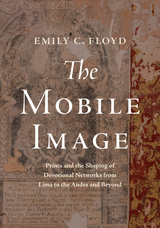
A study of the production and movement of prints in colonial South America.
Printed images have had a central place in art-historical studies of colonial Spanish America, but scholars have typically focused on imported prints, designed and produced in Europe. The Mobile Image focuses instead on works printed in colonial Lima, generating there a distinctive print culture that served local and regional needs, while also appealing to European print consumers.
Inexpensive, easily transportable, and numerous, Lima’s prints traversed the varied geographies of the Viceroyalty of Peru both as loose sheets and within the protective covers of printed books. In the process, limeño devotional prints encouraged the development of shared regional imaginaries about the sacred Andean landscape, a space marked by miracle-working Virgins, potential saints, and powerful images of Christ. These same prints traveled abroad, where they promoted iconographies developed in Lima and influenced European conceptions of the Andes. Simultaneously, the visual language of limeño prints often challenges conventional approaches to interpreting colonial depictions of race. In analyzing limeño prints, and the identities of their makers, patrons, and consumers, The Mobile Image demonstrates that race is harder to recognize in colonial images than we might think. Unearthing hundreds of forgotten prints, Emily C. Floyd provides a fresh resource for interpreting colonial artworks, troubling established understandings of their aesthetics, and compelling us to reexamine colonial South American material cultures.
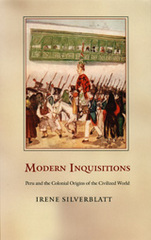
Drawing on extensive research in Peruvian and Spanish archives, Silverblatt uses church records, evangelizing sermons, and missionary guides to explore how the emerging modern world was built, experienced, and understood by colonists, native peoples, and Inquisition officials: Early missionaries preached about world history and about the races and nations that inhabited the globe; Inquisitors, able bureaucrats, defined who was a legitimate Spaniard as they executed heretics for “reasons of state”; the “stained blood” of Indians, blacks, and descendants of Jews and Moors was said to cause their deficient character; and native Peruvians began to call themselves Indian.
In dialogue with Arendt and other theorists of modernity, Silverblatt shows that the modern world’s underside is tied to its origins in colonialism and to its capacity to rationalize violence. Modern Inquisitions forces the reader to confront the idea that the Inquisition was not only a product of the modern world of the sixteenth and seventeenth centuries, but party to the creation of the civilized world we know today.
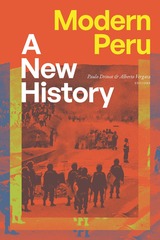
Contributors. Eduardo Dargent, Paulo Drinot, Cynthia McClintock, José Luis Rénique, Natalia Sobrevilla Perea, Alberto Vergara, Charles Walker
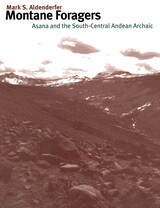
Aldenderfer's investigation forms a methodological and theoretical tour de force that elucidates elevational stress—what it takes for humans to adjust and survive at high altitudes. In a masterful integration of mountain biology and ecology, he emphasizes the nature of hunter-gatherer adaptations to high-mountain environments. He carefully documents the cultural history of Asana, the first stratified, open-air site discovered in the highlands of the south-central Andes. He establishes a number of major occurrences at this revolutionary site, including the origins of plant and animal domestication and transitions to food production, the growth and packing of forager populations, and the advent of some form of complexity and social hierarchy.
The rich and diversified archaeological record recovered at Asana—which spans from 10,000 to 3,500 years ago—includes the earliest houses as well as public and ceremonial buildings in the central cordillera. Built, used, and abandoned over many millennia, the Asana structures completely transform our understanding of the antiquity and development of native American architecture. Aldenderfer's detailed archaeological case study of high-elevation foraging adaptation, his description of this extreme environment as a viable human habitat, and his theoretical model of montane foraging create a new understanding of the lifeways of foraging peoples worldwide.

At once approachable and informative, The Monumental Andes tells the history of the lofty mountains and civilizations that characterize the Central Andes. The book explores many interconnected aspects of ancient Andean life, including climate, topography, agricultural methods, natural hazards, the construction of monumental structures, the creation of sophisticated art objects, and the plant-based hallucinogens and narcotics used in religious rituals. From earthquake-resistant structures to shrines on the tops of active volcanoes, ancient Andeans left behind relics that amaze and inspire today.

Moral electricity—a term coined by American transcendentalists in the 1850s to describe the force of nature that was literacy and education in shaping a greater society. This concept wasn't strictly an American idea, of course, and Ronald Briggs introduces us to one of the greatest examples of this power: the literary scene in Lima, Peru, in the nineteenth century.
As Briggs notes in the introduction to The Moral Electricity of Print, "the ideological glue that holds the American hemisphere together is a hope for the New World as a grand educational project combined with an anxiety about the baleful influence of a politically and morally decadent Old World that dominated literary output through its powerful publishing interests." The very nature of living as a writer and participating in the literary salons of Lima was, by definition, a revolutionary act that gave voice to the formerly colonized and now liberated people. In the actions of this literary community, as men and women worked toward the same educational goals, we see the birth of a truly independent Latin American literature.

Anthropologist Sandhya Krittika Narayanan begins with these challenges, and asks: What does it mean to be a Quechua or Aymara speaker in Puno today? What does it mean to be an Indigenous ethnic Quechua or Aymara individual?
Mother Tongues of the High Andes opens with these questions, exploring what Quechua and Aymara languages and identities mean for Indigenous puneños as they navigate their past and present. Narayanan argues that understanding inter-Indigenous linguistic and social differences involves examining Indigenous gender roles, responsibilities, and linguistic practices, particularly those of Indigenous puneña women. She shows how these practices have contributed to the maintenance of Indigenous multilingualism and continuity in local modes of understanding Indigenous identity and difference.
Even as ideologies around Indigenous identity and linguistic practices shift due to global discourses on Indigenous ethnic identity and nationalism, Indigenous women continue to play a crucial role, promoting new ways to speak and think about Quechua and Aymara linguistic differences, making the Indigenous roots and histories of Puno recognizable to a global audience. Through a comprehensive ethnographic exploration of gender, language, and Indigenous difference, Narayanan shows how the linguistic and social practices of Indigenous puneña women both contest and reaffirm competing visions of Quechua and Aymara linguistic identity and authority.
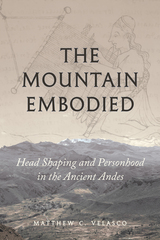
A study of the ancient practice of Andean head shaping and its cultural connotations.
In the late sixteenth century, Spanish conquerors in Peru’s Colca Valley encountered the Collaguas and Cavanas, Indigenous people who undertook a striking form of body modification: Collaguas bound the heads of infants and children so that their skulls grew narrow and elongated, and Cavanas so that their skulls became wide and squat. Head shaping resulted in craniums that resembled two specific mountains associated with the groups. For Europeans, shaped skulls immediately and durably became a marker of territorialized ethnic difference.
The Mountain Embodied offers a more nuanced story. Having studied hundreds of samples of human remains, bioarchaeologist Matthew Velasco argues that reducing head shape to a mere ethnic marker is a colonial invention. Instead, the social significance of head shaping was protean and intersected with other structures of difference, such as gender, kinship, and status, influencing experience within the community. Head shaping, then, was one factor in the construction of a locally embedded kind of subjectivity. An outsider could deduce group identity from head shape, but for practitioners, head shaping reflected something else: nothing less than personhood itself.
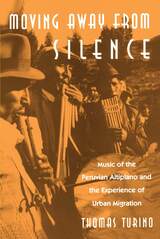
Turino's ethnography is the first large-scale study to concentrate on the pervasive effects of migration on Andean people and their music. Turino uses the musical traditions of Conima, Peru as a unifying thread, tracing them through the varying lives of Conimeos in different locales. He reveals how music both sustains and creates meaning for a people struggling amid the dramatic social upheavals of contemporary Peru.
Moving Away from Silence contains detailed interpretations based on comparative field research of Conimeo musical performance, rehearsals, composition, and festivals in the highlands and Lima. The volume will be of great importance to students of Latin American music and culture as well as ethnomusicological and ethnographic theory and method.
READERS
Browse our collection.
PUBLISHERS
See BiblioVault's publisher services.
STUDENT SERVICES
Files for college accessibility offices.
RECENTLY PUBLISHED



UChicago Accessibility Resources
home | accessibility | search | about | contact us
BiblioVault ® 2001 - 2026
The University of Chicago Press