
 A SCHOLARLY BOOK REPOSITORY
37 start with M start with M

For the majority of his life, Aleksandrov lived, wrote, and fought as a man, and was recognized as such by most of his contemporaries. This contradicts the dominant position in especially Western feminist scholarship, which understands “Durova” either as a woman so patriotic that she dressed as a man to fight Russia’s wars or as a woman so frustrated by gender restrictions that she dramatically sought to cast them aside. Averbach makes the contrary case that we should take Aleksandrov at his word and accept his transition as genuine. Doing so allows for fresh interpretations of both his autobiographical writings and his works of fiction, interpretations that Averbach deftly shows have salience not just for a single man’s life but also for how we understand masculinity, imperialism, and nationalism in nineteenth-century Russia more broadly.

Offering a fundamental reinterpretation of the emergence of the Soviet state, Peter Holquist situates the Bolshevik Revolution within the continuum of mobilization and violence that began with World War I and extended through Russia's civil war. In so doing, Holquist provides a new genealogy for Bolshevik political practices, one that places them clearly among Russian and European wartime measures. From this perspective, the Russian Revolution was no radical rupture with the past, but rather the fulcrum point in a continent-wide era of crisis and violence that began in 1914.
While Tsarist and Revolutionary governments implemented policies for total mobilization common to other warring powers, they did so in a supercharged and concentrated form. Holquist highlights how the distinctive contours of Russian political life set its experience in these years apart from other wartime societies. In pursuit of revolution, statesmen carried over crisis-created measures into political life and then incorporated them into the postwar political structure. Focusing on three particular policies--state management of food; the employment of official violence for political ends; and state surveillance--Holquist demonstrates the interplay of state policy and local implementation, and its impact on the lives of ordinary citizens. Making War, Forging Revolution casts a new light on Russia's revolution and boldly inserts it into the larger story of the Great War and twentieth-century European history.
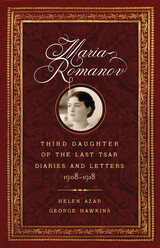
In the twilight of the nineteenth century, a third daughter was born to Tsar Nicholas II and his wife Alexandra. Grand Duchess Maria Nikolaevna—known to her family and friends simply as “Mashka”—grew into an empathetic, down-to-earth girl, unaffected by her imperial status. Often overshadowed by her two older sisters, Olga and Tatiana, and later, her brother Alexei and younger sister Anastasia, Maria ultimately proved to have a uniquely strong and solid personality.
In Maria Romanov: Third Daughter of the Last Tsar, Diaries and Letters, 1908–1918, by translator and researcher Helen Azar with George Hawkins, Mashka’s voice is heard again through her intimate writings, presented for the first time in English. The Grand Duchess was much more than a pretty princess wearing white dresses in hundreds of faded sepia photographs; Maria’s surviving diaries and letters offer a fascinating insight into the private life of a loving family—from festivals and faith, to Rasputin and the coming Revolution; it is clear why this middle child ultimately became a pillar of strength and hope for them all. Maria’s gentle character belied her incredible courage, which emerged in the darkest hours of her brief life. “The incarnation of modesty elevated by suffering,” as Maria was described during the last weeks of her life, she was able to maintain her kindness and optimism, even in the midst of violence and degradation.
On a stuffy summer night in 1918, only a few weeks after her nineteenth birthday, Maria was murdered along with the rest of her family in a cellar of a house chosen for this “special purpose.” Two sets of charred remains, confirmed to be Maria’s and her brother Alexei’s, were not discovered until almost ninety years later, separately from those of the other victims of the massacre. As the authors relate, it is still unknown if these remains will ever be allowed to be laid to rest.
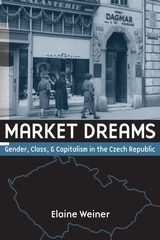
Drawing on a rich trove of focus group data, interviews, and textual sources, Elaine Weiner's Market Dreams powerfully captures the varied responses of female managers and factory workers in the Czech Republic to their country's transition from socialism to capitalism. Her work, rooted in sociology and comparative feminism, is an important advance for the literature on women in Eastern Europe.
"Market Dreams is a conceptually-sophisticated and empirically-rich account of how the discourses and practices of the free market penetrated the hearts and minds of everyday Czech citizens. Weiner's provocative analysis takes readers inside the worlds of female factory workers to expose the discontinuities between their radiant market dreams and their everyday realities--and juxtaposes them to the continuities experienced by female managers. In the process, it challenges many of our ideas about post/socialism, marketization, and gender and reveals the enduring power of stories in shaping social identities and actions."
---Lynne Haney, Associate Professor of Sociology, New York University
"Through interviews and a careful analysis of newspaper articles written in the first decade after the collapse of state socialism, Weiner explores the complicated interconnections between personal stories and the emerging neoliberal metanarrative of the free market in the Czech Republic after 1989. Her book transcends many of the dichotomies with which researchers of post-state socialism have been struggling: 'East' vs. 'West,' losers and winners, emancipation vs. oppression, etc., and thus makes a truly novel contribution to our understanding of women's lives after state socialism."
---Éva Fodor, Assistant Professor of Gender Studies, Central European University
"Weiner's rich and innovative study of female Czech managers and workers exemplifies the importance of narrative analysis for understanding why gender and class have not (yet) reconfigured the sense of postcommunism's alternatives. This is critical reading for feminists, class analysts, and students of postcommunist social change."
---Michael Kennedy, Director, Center for European Studies, University of Michigan
Elaine Weiner is Assistant Professor of Sociology at McGill University. Visit the author's website at: www.mcgill.ca/sociology/faculty/weiner/.
Cover Credit: Frank Scherschel/Time & Life Pictures/Getty Images

The Market-Planned Economy of Yugoslavia was first published in 1966. Minnesota Archive Editions uses digital technology to make long-unavailable books once again accessible, and are published unaltered from the original University of Minnesota Press editions.
The Yugoslavian economic system, combining, as it does, elements of Marxist socialism with many aspects of free enterprise, represents a challenging experiment which is being closely watched by students of economic and political theory. The system has attracted serious attention in the emerging nations of Asia and Africa and, more recently, in the Soviet Union itself. Though they retain socialist, state-centered goals, the Yugoslavs have introduced a great deal of decentralization and individual incentive and have allowed production to be largely regulated by the demand of a relatively free market instead of by predetermined quotas and plans.
Professor Pejovich describes and analyzes this economic system, as it affects both the overall economy and the individual firm. He then provides a theoretical analysis in which he points out implications for economic theory and for the theory of socialism as well as the practical significance of the Yugoslavian experiment. The stud makes an important contribution in combining the economic theory of socialism formulated in the pioneering work of Oskar Lange with the theory of economic development if Joseph Schumpeter, whose concepts are discussed by Dr. Pejovich in an appendix.
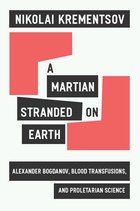
Much like Vladimir Lenin, his onetime rival for the leadership of the Bolshevik party during its formative years, Alexander Bogdanov (1873–1928) was a visionary. In two science fiction novels set on Mars, Bogdanov imagined a future in which the workers of the world, liberated from capitalist exploitation, create a “physiological collective” that rejuvenates and unites its members through regular blood exchanges. But Bogdanov was not merely a dreamer. He worked tirelessly to popularize and realize his vision, founding the first research institute devoted to the science of blood transfusion.
In A Martian Stranded on Earth, the first broad-based book on Bogdanov in English, Nikolai Krementsov examines Bogdanov’s roles as revolutionary, novelist, and scientist, presenting his protagonist as a coherent thinker who pursued his ideas in a wide range of venues. Through the lens of Bogdanov’s involvement with blood studies on one hand, and of his fictional and philosophical writings on the other, Krementsov offers a nuanced analysis of the interactions between scientific ideas and societal values.
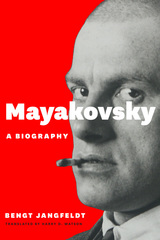
With Mayakovsky, Bengt Jangfeldt offers the first comprehensive biography of Mayakovsky, revealing a troubled man who was more dreamer than revolutionary, more political romantic than hardened Communist. Jangfeldt sets Mayakovsky’s life and works against the dramatic turbulence of his times, from the aesthetic innovations of the pre-revolutionary avant-garde to the rigidity of Socialist Realism and the destruction of World War I to the violence—and hope—of the Russian Revolution, through the tightening grip of Stalinist terror and the growing disillusion with Russian communism that eventually led the poet to take his life.
Through it all is threaded Mayakovsky’s celebrated love affair with Lili Brik and the moving relationship with Lili’s husband, Osip, along with a brilliant depiction of the larger circle of writers and artists around Mayakovsky, including Maxim Gorky, Viktor Shklovsky, Alexander Rodchenko, and Roman Jakobson. The result is a literary life viewed in the round, enabling us to understand the personal and historical furies that drove Mayakovsky and generated his still-startling poetry.
Illustrated throughout with rare images of key characters and locations, Mayakovsky is a major step in the revitalization of a crucial figure of the twentieth-century avant-garde.

Written by an interdisciplinary group of experts, this edited collection addresses the mutual influence among disparate spheres of public life that enabled the media “Wild West” of the first post-Soviet decade. As a joint platform, the volume and the associated Multimedia Sourcebook of the Russian 1990s present the decade’s media cultures in a manner that reflects their historical interconnectedness and relationship to the global present.
Edited by Maya Vinokour with contributions from Bradley Gorski, Courtney Doucette, Fabrizio Fenghi, Rita Safariants, Daniil Leiderman, Thomas Keenan, and Pavel Khazanov.

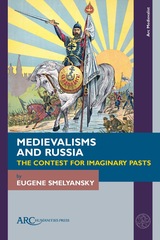
This new monograph is devoted to a detailed exploration of the ways in which the medieval past has been wielded to propagandic effect in Imperial, Soviet, and post-Soviet Russia.
From politicians’ speeches to popular culture, from Orthodox Christianity to neo-paganism, the medieval Russian past remains crucial in constructing national identity, mobilizing society during times of crisis, and providing alternative models of communal belonging. Frequent appeals to a medieval Slavic past, its heroes and myths, have provided—and continue to provide—a particularly powerful tool for animating imperialist and populist sentiments.
This study explores persuasive—and pervasive—recourse to tropes concerned with the Middle Ages in Imperial, Soviet, and post-Soviet Russia, seeking to explain why an often romanticized medieval past remains potent in Russian politics, society, and culture today.
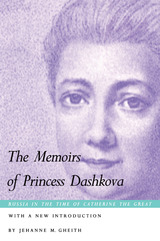
Originally written in French, first published in English, and long out of print, Dashkova’s Memoirs tell the story of a woman who at age eighteen played an important role in the coup that brought Catherine the Great to the throne. The relationship between these two women, often tense, is a central theme throughout this story. Dashkova, occupying the highly unusual position of both stateswoman and mother, also reveals her own path between the demands and limitations of the "private" and "public" spheres of her society. She provides a view of the expectations of Russian aristocratic women, the possibilities available to them, and the ways in which gender roles were conceived in the eighteenth century.
With a new introduction by Jehanne M Gheith, The Memoirs of Princess Dashkova will renew interest in the life of a fascinating woman for students of Russian history, women’s studies, and eighteenth-century studies. It will be a significant text for those engaged in the cross-cultural study of the traditions of women’s autobiographical writing.
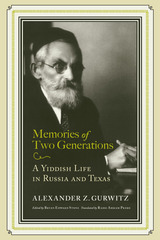
In 1910, at the age of fifty-one, Alexander Ziskind Gurwitz made the bold decision to emigrate with his wife and four children from southeastern Ukraine in Tsarist Russia to begin a new life in Texas. In 1935, in his seventies, Gurwitz composed a retrospective autobiography, Memories of Two Generations, that recounts his personal story both of the rich history of the lost Jewish world of Eastern Europe and of the rambunctious development of frontier Jewish communities in the United States.
In both Europe and America, Gurwitz inhabited an almost exclusively Jewish world. As a boy, he studied in traditional yeshivas and earned a living as a Hebrew language teacher and kosher butcher. Widely travelled, Gurwitz recalls with wit and insight daily life in European shtetls, providing perceptive and informative comments about Jewish religion, history, politics, and social customs. Among the book’s most notable features is his first-hand, insider’s account of the yearly Jewish holiday cycle as it was observed in the nineteenth century, described as he experienced it as a child.
Gurwitz’s account of his arrival in Texas forms a cornerstone record of the Galveston Immigration Movement; this memoir represents the only complete narrative of that migration from an immigrant’s point of view. Gurwitz’s descriptions about the development of a thriving Orthodox community in San Antonio provide an important and unique primary source about a facet of American Jewish life that is not widely known.
Gurwitz wrote his memoir in his preferred Yiddish, and this translation into English by Rabbi Amram Prero captures the lyrical style of the original. Scholar and author Bryan Edward Stone’s special introduction and illuminating footnotes round out a superb edition that offers much to experts and general readers alike.

This account of historical politics in Ukraine, framed in a broader European context, shows how social, political, and cultural groups have used and misused the past from the final years of the Soviet Union to 2020. Georgiy Kasianov details practices relating to history and memory by a variety of actors, including state institutions, non-governmental organizations, political parties, historians, and local governments. He identifies the main political purposes of these practices in the construction of nation and identity, struggles for power, warfare, and international relations.
Kasianov considers the Ukrainian case in the context of a global increase in the politics of history and memory, with particular emphasis on a distinctive East-European variety. He pays special attention to the use and abuse of history in relations between Ukraine, Russia, and Poland.
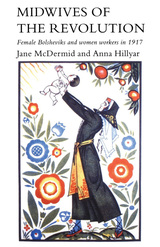
The Bolshevik seizure of power in 1917 and the ensuing communist regime have often been portrayed as a man’s revolution, with women as bystanders or even victims. Midwives of the Revolution examines the powerful contribution made by women to the overthrow of tsarism in 1917 and their importance in the formative years of communism in Russia.
Focusing on the masses as well as the high-ranking intelligentsia, Midwives of the Revolution is the first sustained analysis of female involvement in the revolutionary era of Russian history. The authors investigate the role of Bolshevik women and the various forms their participation took. Drawing on the experiences of representative individuals, the authors discuss the important relationship between Bolshevik women and the workers in the turbulent months of 1917.
The authors demonstrate that women were an integral part of the revolutionary process and challenge assumptions that they served merely to ignite an essentially masculine revolt. By placing women center stage, without exaggerating their roles, this study enriches our understanding of a momentous event in twentieth-century history.

One of the most powerful poets of his generation consolidates his reputation as an exceptionally forthright and astringent critic in this book that analyzes the relationship between English-language literature, especially poetry, and nineteenth and twentieth-century politics. Tom Paulin's criticism stays on track, always responsive to a work's characteristic genius and sensitive to its social setting.
Each of these essays—on poets ranging from Robert Southey and Christina Rossetti to Philip Larkin, from John Clare to Elizabeth Bishop and Ted Hughes, with a few excursions into the poetry of Eastern Europe for contrast—is informed by a love for poetry and a lively attention to detail. At every turn, Paulin demonstrates the intricate connection between the private imagination and society at large, simultaneously illuminating the kinship between the literature of the past and of the present. He also relates the poetry to themes of nationhood and to ideas about orality, speech rhythms, and vernacular background. Minotaur exemplifies the sort of general, accessible criticism of the arts that will interest a wide range of readers.
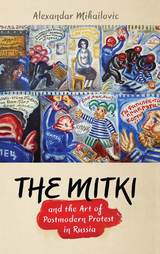
More broadly, Alexandar Mihailovic shows, the Mitki pioneered a form of political protest art that has since become a centerpiece of activism in post-Soviet Russia, most visibly today in groups such as Pussy Riot. He draws on extensive interviews with members of the collective and illuminates their critique of the authoritarian state, militarism, and social strictures from the Brezhnev years to the present.
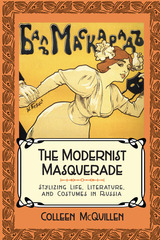
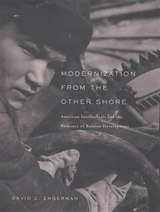
From the late nineteenth century to the eve of World War II, America's experts on Russia watched as Russia and the Soviet Union embarked on a course of rapid industrialization. Captivated by the idea of modernization, diplomats, journalists, and scholars across the political spectrum rationalized the enormous human cost of this path to progress. In a fascinating examination of this crucial era, David Engerman underscores the key role economic development played in America's understanding of Russia and explores its profound effects on U.S. policy.
American intellectuals from George Kennan to Samuel Harper to Calvin Hoover understood Russian events in terms of national character. Many of them used stereotypes of Russian passivity, backwardness, and fatalism to explain the need for--and the costs of--Soviet economic development. These costs included devastating famines that left millions starving while the government still exported grain.
This book is a stellar example of the new international history that seamlessly blends cultural and intellectual currents with policymaking and foreign relations. It offers valuable insights into the role of cultural differences and the shaping of economic policy for developing nations even today.
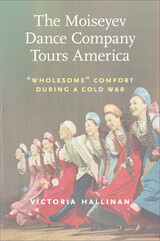
During the Cold War, dancers and musicians from the United States and the USSR were drawn into the battle for hearts and minds, crossing the Iron Curtain to prove their artistic and ideological prowess. After the passage of the Lacy-Zarubin Agreement, direct cultural exchange between the two superpowers opened up, and the Moiseyev Dance Company arrived in the United States in 1958. The first Soviet cultural representatives to tour America, this folk-dance troupe’s repertoire included dances from territories controlled or influenced by the USSR, including Uzbekistan, Crimea, and Poland.
Drawing on contemporary personal and published accounts, Victoria Hallinan explores why the dancers garnered overwhelming acclaim during their multicity tour and Ed Sullivan Show appearance. The “boy-meets-girl” love stories of the dances, and their idealized view of multiple Soviet cultures living together in harmony, presented a comforting image of post–World War II gender norms and race relations for audiences. Americans saw the dancers—their supposed enemies—as humans rather than agents of communist contagion.
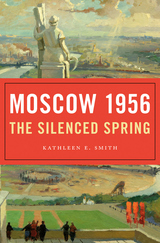
Joseph Stalin had been dead for three years when his successor, Nikita Khrushchev, stunned a closed gathering of Communist officials with a litany of his predecessor’s abuses. Meant to clear the way for reform from above, Khrushchev’s “Secret Speech” of February 25, 1956, shattered the myth of Stalin’s infallibility. In a bid to rejuvenate the Party, Khrushchev had his report read out loud to members across the Soviet Union that spring. However, its message sparked popular demands for more information and greater freedom to debate.
Moscow 1956: The Silenced Spring brings this first brief season of thaw into fresh focus. Drawing on newly declassified Russian archives, Kathleen Smith offers a month-by-month reconstruction of events as the official process of de-Stalinization unfolded and political and cultural experimentation flourished. Smith looks at writers, students, scientists, former gulag prisoners, and free-thinkers who took Khrushchev’s promise of liberalization seriously, testing the limits of a more open Soviet system.
But when anti-Stalin sentiment morphed into calls for democratic reform and eventually erupted in dissent within the Soviet bloc—notably in the Hungarian uprising—the Party balked and attacked critics. Yet Khrushchev had irreversibly opened his compatriots’ eyes to the flaws of monopolistic rule. Citizens took the Secret Speech as inspiration and permission to opine on how to restore justice and build a better society, and the new crackdown only reinforced their discontent. The events of 1956 set in motion a cycle of reform and retrenchment that would recur until the Soviet Union’s collapse in 1991.
Once the hub of the tsarist state, later Brezhnev's "model Communist city"--home of the Kremlin, Red Square, and St. Basil's Cathedral--Moscow is for many the quintessence of everything Russian. Timothy Colton's sweeping biography of this city at the center of Soviet life reveals what such a position has meant to Moscow and ultimately to Russia itself.
Linchpin of the Soviet system and exemplar of its ideology, Moscow was nonetheless instrumental in the Soviet Union's demise. It was in this metropolis of nine million people that Boris Yeltsin, during two frustrating years as the city's party boss, began his move away from Communist orthodoxy. Colton charts the general course of events that led to this move, tracing the political and social developments that have given the city its modern character. He shows how the monolith of Soviet power broke down in the process of metropolitan governance, where the constraints of censorship and party oversight could not keep up with proliferating points of view, haphazard integration, and recurrent deviation from approved rules and goals. Everything that goes into making a city--from town planning, housing, and retail services to environmental and architectural concerns--figures in Colton's account of what makes Moscow unique. He shows us how these aspects of the city's organization, and the actions of leaders and elite groups within them, coordinated or conflicted with the overall power structure and policy imperatives of the Soviet Union. Against this background, Colton explores the growth of the anti-Communist revolution in Moscow politics, as well as fledgling attempts to establish democratic institutions and a market economy.
As it answers persistent questions about Soviet political history, this lavishly illustrated volume may also point the way to understanding Russia's future.
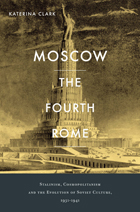
In the early sixteenth century, the monk Filofei proclaimed Moscow the “Third Rome.” By the 1930s, intellectuals and artists all over the world thought of Moscow as a mecca of secular enlightenment. In Moscow, the Fourth Rome, Katerina Clark shows how Soviet officials and intellectuals, in seeking to capture the imagination of leftist and anti-fascist intellectuals throughout the world, sought to establish their capital as the cosmopolitan center of a post-Christian confederation and to rebuild it to become a beacon for the rest of the world.
Clark provides an interpretative cultural history of the city during the crucial 1930s, the decade of the Great Purge. She draws on the work of intellectuals such as Sergei Eisenstein, Sergei Tretiakov, Mikhail Koltsov, and Ilya Ehrenburg to shed light on the singular Zeitgeist of that most Stalinist of periods. In her account, the decade emerges as an important moment in the prehistory of key concepts in literary and cultural studies today—transnationalism, cosmopolitanism, and world literature. By bringing to light neglected antecedents, she provides a new polemical and political context for understanding canonical works of writers such as Brecht, Benjamin, Lukacs, and Bakhtin.
Moscow, the Fourth Rome breaches the intellectual iron curtain that has circumscribed cultural histories of Stalinist Russia, by broadening the framework to include considerable interaction with Western intellectuals and trends. Its integration of the understudied international dimension into the interpretation of Soviet culture remedies misunderstandings of the world-historical significance of Moscow under Stalin.
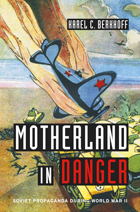
Much of the story about the Soviet Union’s victory over Nazi Germany has yet to be told. In Motherland in Danger, Karel Berkhoff addresses one of the most neglected questions facing historians of the Second World War: how did the Soviet leadership sell the campaign against the Germans to the people on the home front?
For Stalin, the obstacles were manifold. Repelling the German invasion would require a mobilization so large that it would test the limits of the Soviet state. Could the USSR marshal the manpower necessary to face the threat? How could the authorities overcome inadequate infrastructure and supplies? Might Stalin’s regime fail to survive a sustained conflict with the Germans?
Motherland in Danger takes us inside the Stalinist state to witness, from up close, its propaganda machine. Using sources in many languages, including memoirs and documents of the Soviet censor, Berkhoff explores how the Soviet media reflected—and distorted—every aspect of the war, from the successes and blunders on the front lines to the institution of forced labor on farm fields and factory floors. He also details the media’s handling of Nazi atrocities and the Holocaust, as well as its stinting treatment of the Allies, particularly the United States, the UK, and Poland. Berkhoff demonstrates not only that propaganda was critical to the Soviet war effort but also that it has colored perceptions of the war to the present day, both inside and outside of Russia.

In fourteen chapters and an updated introduction, European and North American specialists examine the recent evolution of Islamic expression and practice in these former Communist regions, as well as its political significance within officially atheistic regimes. Representing a wide range of disciplines and perspectives, the authors detail how the modern ethno-religious situation developed and matured in hostile circumstances, the degree of latitude the local Muslims achieved in religious expression, and what prospect the future seemed to offer just before the breakup of the Soviet Union and the Federal Republic of Yugoslavia. Overall, the book provides a thorough analysis of the coincidence and tension between ethnic and religious identity in two countries officially devoted to the separation of ethnic groups in domestic cultural arrangements but not in the social or political realm.
Contributors. Edward Allworth, Hans Bräker, Marie Broxup, Georg Brunner, Bert G. Fragner, Uwe Halbach, Wolfgang Höpken, Andreas Kappeler, Edward J. Lazzerini, Richard Lorenz, Alexandre Popovi´c, Sabrina Petra Ramet, Azade-Ayse Rorlich, Gerhard Simon, Tadeusz Swietochowski
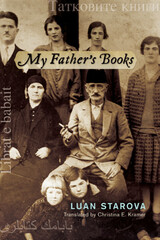
In My Father’s Books, the first volume in Luan Starova’s multivolume Balkan Saga, he explores themes of history, displacement, and identity under three turbulent regimes—Ottoman, Fascist, and Stalinist—in the twentieth century. Weaving a story from the threads of his parents’ lives from 1926 to 1976, he offers a child’s-eye view of personal relationships in shifting political landscapes and an elegiac reminder of the enduring power of books to sustain a literate culture.
Through lyrical waves of memory, Starova reveals his family’s overlapping religious, linguistic, national, and cultural histories. His father left Constantinople as the Ottoman Empire collapsed, and the young family fled from Albania to Yugoslav Macedonia when Luan was a boy. His parents, cosmopolitan and well-traveled in their youth, and steeped in the cultures of both Orient and Occident, find themselves raising their children in yet another stagnant and repressive state. Against this backdrop, Starova remembers the protected spaces of his childhood—his mother’s walled garden, his father’s library, the cupboard holding the rarest and most precious of his father’s books. Preserving a lost heritage, these books also open up a world that seems wide, deep, and boundless.
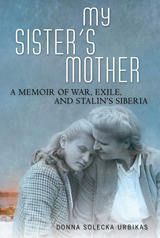
In 1940, Janina Ślarzynska and her five-year-old daughter Mira were taken by Soviet secret police (NKVD) from their small family farm in eastern Poland and sent to Siberia with hundreds of thousands of others. So began their odyssey of hunger, disease, cunning survival, desperate escape across a continent, and new love amidst terrible circumstances.
But in the 1950s, baby boomer Donna yearns for a “normal” American family while Janina and Mira are haunted by the past. In this unforgettable memoir, Donna recounts her family history and her own survivor’s story, finally understanding the damaged mother who had saved her sister.
Finalist, Best Traditional Non-Fiction Book, Chicago Writers Association
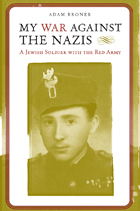
A poignant account of the perils and fortunes of an indomitable survivor of violence in Eastern Europe during World War II.
In 1939, to escape Nazi occupation, 14-year-old Adam Broner and his older brother Sam left their home and family in Lodz, Poland, and made their way to the Soviet Union. Adam enlisted in the Red Army to join the fight against the Nazis but was sent to work in a Siberian coal mine instead when his nationality was discovered. After a bold and daring escape from Siberia, Broner reached the Soviet Polish Kosciuszko Army, joined the struggle against the Nazis, participated in the liberation of Poland, and rode victorious into Berlin in 1945. He later learned that his parents, siblings (except Sam), and all other close relatives had perished during the war.
Broner rebuilt his life, established a family, returned to Moscow for a degree in economics, and then went back to Poland, where he accepted a job in the Polish central planning agency. Eventually fed up with the growing anti-Semitism of the Communist government there, the author emigrated to the United States in 1969. He earned a doctorate from Princeton University and served as an economic adviser to New Jersey governors and the state legislature. In retirement, Broner learned portrait painting and reproduced the likenesses of his parents and siblings from memory, which are presented along with their biographies in this book.
In recounting his struggle for survival during some of the most dramatic upheavals of the 20th century— the Great Depression, Nazism, World War II, and the spread of Communism in Central Europe— Broner reveals a life dedicated to the ultimate goal of freedom, which he achieved through a combination of arduous effort and fortunate circumstance.

A keen observer of culture, Czech writer Vladimír Macura (1945–99) devoted a lifetime to illuminating the myths that defined his nation. The Mystifications of a Nation, the first book-length translation of Macura’s work in English, offers essays deftly analyzing a variety of cultural phenomena that originate, Macura argues, in the “big bang” of the nineteenth-century Czech National Revival, with its celebration of a uniquely Czech identity.
In reflections on two centuries of Czech history, he ponders the symbolism in daily life. Bridges, for example—once a force of civilization connecting diverse peoples—became a sign of destruction in World War I. Turning to the Soviet and post-Soviet eras, Macura probes a range of richly symbolic practices, from the naming of the Prague metro system, to the mass gymnastic displays of the Communist period, to post–Velvet Revolution preoccupations with the national anthem. In “The Potato Bug,” he muses on one of the stranger moments in the Cold War—the claim that the United States was deliberately dropping insects from airplanes to wreak havoc on the crops of Czechoslovakia.
While attending to the distinctively Czech elements of such phenomena, Macura reveals the larger patterns of Soviet-brand socialism. “We were its cocreators,” he declares, “and its analysis touches us as a scalpel turned on its own body.” Writing with erudition, irony, and wit, Macura turns the scalpel on the authoritarian state around him, demythologizing its mythology.
READERS
Browse our collection.
PUBLISHERS
See BiblioVault's publisher services.
STUDENT SERVICES
Files for college accessibility offices.
RECENTLY PUBLISHED


UChicago Accessibility Resources
home | accessibility | search | about | contact us
BiblioVault ® 2001 - 2025
The University of Chicago Press