
 A SCHOLARLY BOOK REPOSITORY
16 start with M start with M
How a culture of violence legitimized lynching among ordinary people
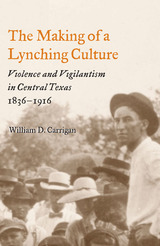
On May 15, 1916, a crowd of fifteen thousand witnessed the lynching of an eighteen-year-old black farm worker named Jesse Washington. Most central Texans of the time failed to call for the punishment of the mob’s leaders. In The Making of a Lynching Culture, now in paperback, William D. Carrigan seeks to explain not how a fiendish mob could lynch one man but how a culture of violence that nourished this practice could form and endure for so long among ordinary people.
Beginning with the 1836 independence of Texas, The Making of a Lynching Culture reexamines traditional explanations of lynching, including the role of the frontier, economic tensions, and political conflicts. Using a voluminous body of court records, newspaper accounts, oral histories, and other sources, Carrigan shows how notions of justice and historical memory were shaped to glorify violence and foster a culture that legitimized lynching.
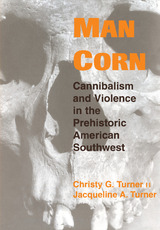
Until quite recently, Southwest prehistory studies have largely missed or ignored evidence of violent competition. Christy and Jacqueline Turner’s study of prehistoric violence, homicide, and cannibalism explodes the myth that the Anasazi and other Southwest Indians were simple, peaceful farmers. Using detailed osteological analyses and other lines of evidence the Turners show that warfare, violence, and their concomitant horrors were as common in the ancient Southwest as anywhere else in the world.
The special feature of this massively documented study is its multi-regional assessment of episodic human bones assemblages (scattered floor deposits or charnel pits) by taphonomic analysis, which considers what happens to bones from the time of death to the time of recovery. During the past thirty years, the authors and other analysts have identified a minimal perimortem taphonomic signature of burning, pot polishing, anvil abrasions, bone breakage, cut marks, and missing vertebrae that closely match the signatures of animal butchering and is frequently associated with additional evidence of violence. More than seventy-five archaeological sited containing several hundred individuals are carefully examined for the cannibalism signature. Because this signature has not been reported for any sites north of Mexico, other than those in the Southwest, the authors also present detailed comparisons with Mesoamerican skeletal collections where human sacrifice and cannibalism were known to have been practiced. The authors review several hypotheses for Southwest cannibalism: starvation, social pathology, and institutionalized violence and cannibalism. In the latter case, they present evidence for a potential Mexican connection and demonstrate that most of the known cannibalized series are located temporally and spatially near Chaco great houses.

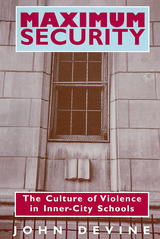
Based on years of frontline experience in New York's inner-city schools, Maximum Security demonstrates that such policing strategies are not only ineffectual, they divorce students and teachers from their ethical and behavioral responsibilities. Exploring the culture of violence from within, John Devine argues that the security system, with its uniformed officers and invasive high-tech surveillance, has assumed presumptive authority over students' bodies and behavior, negating the traditional roles of teachers as guardians and agents of moral instruction. The teacher is reduced to an information bureaucrat, a purveyor of technical knowledge, while the student's physical well-being and ethical actions are left to the suspect scrutiny of electronic devices and security specialists with no pedagogical mission, training, or interest. The result is not a security system at all, but an insidious institutional disengagement from the caring supervision of the student body.
With uncompromising honesty, Devine provides a powerful portrayal of an educational system in crisis and bold new insight into the malignant culture of school violence.
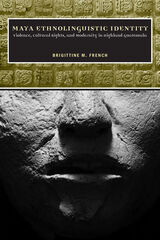
French shows, with useful examples, how constructions of language and collective identity are in fact strategies undertaken to serve the goals of institutions (including the government, the military, the educational system, and the church) and social actors (including linguists, scholars, and activists). But by incorporating in-depth fieldwork with groups that speak Kaqchikel and K’iche’ along with analyses of Spanish-language discourses, Maya Ethnolinguistic Identity also shows how some individuals in urban, bilingual Indian communities have disrupted the essentializing projects of multiculturalism. And by focusing on ideologies of language, the author is able to explicitly link linguistic forms and functions with larger issues of consciousness, gender politics, social positions, and the forging of hegemonic power relations.
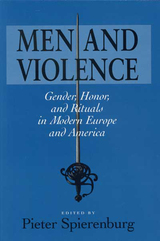
The essays focus on the United States and western Europe from the seventeenth to the twentieth centuries. The contributors are Ute Frevert, Steven Hughes, Robert Nye, Daniele Boschi, Amy Sophia Greenberg, Martin J. Wiener, Stephen Kantrowitz, and Terence Finnegan. Men and Violence will be welcomed and widely used by a broad range of scholars and students.
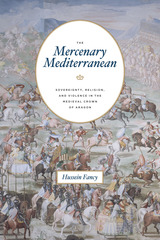
They were not the first or only Muslim soldiers to do so. Over the course of the thirteenth and fourteenth centuries, the Christian kings of Aragon recruited thousands of foreign Muslim soldiers to serve in their armies and as members of their royal courts. Based on extensive research in Arabic, Latin, and Romance sources, The Mercenary Mediterranean explores this little-known and misunderstood history. Far from marking the triumph of toleration, Hussein Fancy argues, the alliance of Christian kings and Muslim soldiers depended on and reproduced ideas of religious difference. Their shared history represents a unique opportunity to reconsider the relation of medieval religion to politics, and to demonstrate how modern assumptions about this relationship have impeded our understanding of both past and present.

Mixed Realism is about how we interact with media. Timothy J. Welsh shows how videogames, like novels, both promise and trouble experiences of “immersion.” His innovative methodology offers a new understanding of the expanding role of virtuality in contemporary life.
Today’s wired culture is a mixed reality, conducted as exchanges between virtual and material contexts. We make balance transfers at an ATM, update Facebook timelines, and squeeze in sessions of Angry Birds on the subway. However, the “virtual” is still frequently figured as imaginary, as opposed to “real.” The vision of 1990s writers of a future that would pit virtual reality against actual reality has never materialized, yet it continues to haunt cultural criticism. Our ongoing anxiety about immersive media now surrounds videogames, especially “shooter games,” and manifests as a fear that gamers might not know the difference between the virtual world and the real world.
As Welsh notes, this is the paradox of real virtuality. We understand that the media-generated virtualities that fill our lives are not what they represent. But what are they if they are not real? Do they have presence, significance, or influence exceeding their material presence and the user processes that invoke them? What relationships do they establish through and beyond our interactions with them?
Mixed Realism brims with fresh analyses of literary works such as Truman Capote’s In Cold Blood and Mark Z. Danielewski’s House of Leaves, along with sustained readings of controversial videogames such as Super Columbine Massacre and Call of Duty: Modern Warfare 2. Continually connecting the dots between surprising groupings of texts and thinkers, from David Foster Wallace to the cult-classic videogame Eternal Darkness and from Cormac McCarthy to Grand Theft Auto, it offers a fresh perspective on both digital games and contemporary literature.

---Kenneth Ledford, Case Western Reserve University
Far too many poor Black communities struggle with gun violence and homicide. The result has been the unnatural contortion of Black families and the inter-generational perpetuation of social chaos and untimely death. Young people are repeatedly ripped away from life by violence, while many men are locked away in prisons. In neighborhoods like those of Wilmington, Delaware, residents routinely face the pressures of violence, death, and incarceration. Murder Town, USA is thus a timely ethnography with an innovative structure: the authors helped organize fifteen residents formerly involved with the streets and/or the criminal justice system to document the relationship between structural opportunity and experiences with violence in Wilmington's Eastside and Southbridge neighborhoods.
Earlier scholars offered rich cultural analysis of violence in low-income Black communities, and yet this literature has mostly conceptualized violence through frameworks of personal responsibility or individual accountability. And even if acknowledging the pressure of structural inequality, most earlier researchers describe violence as the ultimate result of some moral failing, a propensity for crime, and the notion of helplessness. Instead, in Murder Town USA, Payne, Hitchens, and Chamber, along with their collaborative team of street ethnographers, instead offer a radical re-conceptualization of violence in low-income Black communities by describing the penchant for violence and involvement in crime overall to be a logical, "resilient" response to the perverse context of structural inequality.
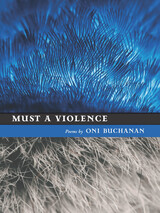
In sounding out the problem of how to respond to violence and to the betrayal and domestication of that which is wild, this book counters with aesthetic violence and disruption of its own, opening the self to the unexpected powers of the senses and to encounters between "wildness" and "domestication" within the self. Though never easy, this openness creates the possibility for an all-enveloping love that touches and joins all animals, both nonhuman and human.
READERS
Browse our collection.
PUBLISHERS
See BiblioVault's publisher services.
STUDENT SERVICES
Files for college accessibility offices.
RECENTLY PUBLISHED





UChicago Accessibility Resources
home | accessibility | search | about | contact us
BiblioVault ® 2001 - 2025
The University of Chicago Press