
 A SCHOLARLY BOOK REPOSITORY
18 start with N start with N
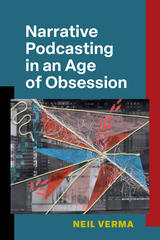
Narrative Podcasting in an Age of Obsession is the first book to look back on this prodigious body of material and attempt to make sense of it from a structural, historical, and analytic point of view. Focusing on more than 350 podcasts and other audio works released between Serial and the COVID pandemic, the book explores why so many of these podcasts seem “obsessed with obsession,” why they focus not only on informing listeners but also dramatizing the labor that goes into it, and why fiction podcasts work so hard to prove they are a brand new form, even as they revive features of radio from decades gone by. This work also examines the industry's reckoning with its own implication in systemic racism, misogyny, and other forms of discrimination. Employing innovative new critical techniques for close listening—including pitch tracking software and spectrograms—Narrative Podcasting in an Age of Obsession makes a major contribution to podcast studies and media studies more broadly.
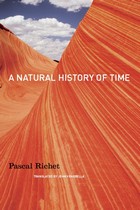
The quest to pinpoint the age of the Earth is nearly as old as humanity itself. For most of history, people trusted mythology or religion to provide the answer, even though nature abounds with clues to the past of the Earth and the stars. In A Natural History of Time, geophysicist Pascal Richet tells the fascinating story of how scientists and philosophers examined those clues and from them built a chronological scale that has made it possible to reconstruct the history of nature itself.
Richet begins his story with mythological traditions, which were heavily influenced by the seasons and almost uniformly viewed time cyclically. The linear history promulgated by Judaism, with its story of creation, was an exception, and it was that tradition that drove early Christian attempts to date the Earth. For instance, in 169 CE, the bishop of Antioch, for instance declared that the world had been in existence for “5,698 years and the odd months and days.”
Until the mid-eighteenth century, such natural timescales derived from biblical chronologies prevailed, but, Richet demonstrates, with the Scientific Revolution geological and astronomical evidence for much longer timescales began to accumulate. Fossils and the developing science of geology provided compelling evidence for periods of millions and millions of years—a scale that even scientists had difficulty grasping. By the end of the twentieth century, new tools such as radiometric dating had demonstrated that the solar system is four and a half billion years old, and the universe itself about twice that, though controversial questions remain.
The quest for time is a story of ingenuity and determination, and like a geologist, Pascal Richet carefully peels back the strata of that history, giving us a chance to marvel at each layer and truly appreciate how far our knowledge—and our planet—have come.

The rapid growth of the American environmental movement in recent decades obscures the fact that long before the first Earth Day and the passage of the Endangered Species Act, naturalists and concerned citizens recognized—and worried about—the problem of human-caused extinction.
As Mark V. Barrow reveals in Nature’s Ghosts, the threat of species loss has haunted Americans since the early days of the republic. From Thomas Jefferson’s day—when the fossil remains of such fantastic lost animals as the mastodon and the woolly mammoth were first reconstructed—through the pioneering conservation efforts of early naturalists like John James Audubon and John Muir, Barrow shows how Americans came to understand that it was not only possible for entire species to die out, but that humans themselves could be responsible for their extinction. With the destruction of the passenger pigeon and the precipitous decline of the bison, professional scientists and wildlife enthusiasts alike began to understand that even very common species were not safe from the juggernaut of modern, industrial society. That realization spawned public education and legislative campaigns that laid the foundation for the modern environmental movement and the preservation of such iconic creatures as the bald eagle, the California condor, and the whooping crane.
A sweeping, beautifully illustrated historical narrative that unites the fascinating stories of endangered animals and the dedicated individuals who have studied and struggled to protect them, Nature’s Ghosts offers an unprecedented view of what we’ve lost—and a stark reminder of the hard work of preservation still ahead.

The naval leader has taken centre stage in traditional naval histories. However, while the historical narrative has been fairly consistent the development of various navies has been accompanied by assumptions, challenges and competing visions of the social characteristics of naval leaders and of their function. Whilst leadership has been a constant theme in historical studies, it has not been scrutinised as a phenomenon in its own right. This book examines the critical period in Europe between 1700 -1850, when political, economic and cultural shifts were bringing about a new understanding of the individual and of society. Bringing together context with a focus on naval leadership as a phenomenon is at the heart of this book, a unique collaborative venture between British, French and Spanish scholars. As globalisation develops in the twenty-first century the significance of navies looks set to increase. This volume of essays aims to place naval leadership in its historical context.
An electronic version of this book is freely available, thanks to the support of libraries working with Knowledge Unlatched. KU is a collaborative initiative designed to make high quality books Open Access for the public good. The Open Access ISBN for this book is 978-1-911534-76-1. More information about the initiative and details about KU’s Open Access programme can be found at www.knowledgeunlatched.org
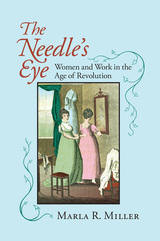
In this book, Marla R. Miller illuminates the significance of women's work in the clothing trades of the early Republic. Drawing on diaries, letters, reminiscences, ledgers, and material culture, she explores the contours of working women's lives in rural New England, offering a nuanced view of their varied ranks and roles—skilled and unskilled, black and white, artisanal and laboring—as producers and consumers, clients and craftswomen, employers and employees. By plumbing hierarchies of power and skill, Miller explains how needlework shaped and reflected the circumstances of real women's lives, at once drawing them together and setting them apart.
The heart of the book brings into focus the entwined experiences of six women who lived in and around Hadley, Massachusetts, a thriving agricultural village nestled in a bend in the Connecticut River about halfway between the Connecticut and Vermont borders. Miller's examination of their distinct yet overlapping worlds reveals the myriad ways that the circumstances of everyday lives positioned women in relationship to one another, enlarging and limiting opportunities and shaping the trajectories of days, years, and lifetimes in ways both large and small. The Needle's Eye reveals not only how these women thought about their work, but how they thought about their world.
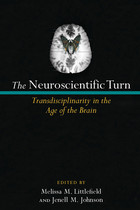
The Neuroscientific Turnbrings together 19 scholars from a variety of fields to reflect on the promises of and challenges facing emergent "neurodisciplines" such as neuroethics, neuroeconomics, and neurohistory. In the aftermath of the Decade of the Brain, neuroscience has become one of the hottest topics of study---not only for scientists but also, increasingly, for scholars from the humanities and social sciences. While the popular press has simultaneously lauded and loathed the coming "neurorevolution," the academy has yet to voice any collective speculations about whether there is any coherence to this neuroscientific turn; what this turn will and should produce; and what implications it has for inter- or transdisciplinary inquiry.
Melissa M. Littlefield and Jenell M. Johnson provide an initial framework for this most recent of "turns" by bringing together 14 original essays by scholars from the humanities, social sciences, and neurosciences. The resulting collection will appeal to neuroscientists curious about their colleagues' interest in their work; scholars and students both in established neurodisciplines and in disciplines such as sociology or English wondering about how to apply neuroscience findings to their home disciplines; and to science, technology, and society scholars and students interested in the roles of interdisciplinarity and transdisciplinarity in the construction of knowledge.
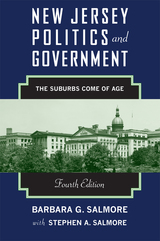
Offering a comprehensive overview of New Jersey politics and government, chapters cover the state’s political history; campaigns and elections; interest groups; the constitution; the development of government institutions; relationships with neighboring states, the federal government, and its own municipalities and counties; tax and spending policies; education; and quality of life issues.

Before news organizations began putting their content online, people got the news in print or on TV and almost always outside of the workplace. But nowadays, most of us keep an eye on the headlines from our desks at work, and we have become accustomed to instant access to a growing supply of constantly updated stories on the Web. This change in the amount of news available as well as how we consume it has been coupled with an unexpected development in editorial labor: rival news organizations can now keep tabs on the competition and imitate them, resulting in a decrease in the diversity of the news. Peeking inside the newsrooms where journalists create stories and the work settings where the public reads them, Pablo J. Boczkowski reveals why journalists contribute to the growing similarity of news—even though they dislike it—and why consumers acquiesce to a media system they find increasingly dissatisfying.
Comparing and contrasting two newspapers in Buenos Aires with similar developments in the United States, News at Work offers an enlightening perspective on living in a world with more information but less news.
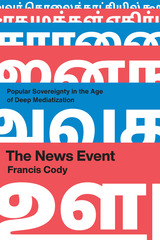
Not merely the act of representing events with words or images, a “news event” is the reciprocal relationship between the events being reported in the news and the event of the news coverage itself. In The News Event, Francis Cody focuses on how imaginaries of popular sovereignty have been remade through the production and experience of such events. Political sovereignty is thoroughly mediated by the production of news, and subjects invested in the idea of democracy are remarkably reflexive about the role of publicly circulating images and texts in the very constitution of their subjectivity. The law comes to stand as both a limit and positive condition in this process of event making, where acts of legal and extralegal repression of publication can also become the stuff of news about news makers. When the subjects of news inhabit multiple participant roles in the unfolding of public events, when the very technologies of recording and circulating events themselves become news, the act of representing a political event becomes difficult to disentangle from that of participating in it. This, Cody argues, is the crisis of contemporary news making: the news can no longer claim exteriority to the world on which it reports.
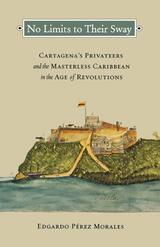
Most of Cartagena's privateers were people of color and descendants of slaves who benefited from the relative freedom and flexibility of life at sea, but also faced kidnapping, enslavement, and brutality. Many came from Haiti and Guadeloupe; some had been directly involved in the Haitian Revolution. While their manpower proved crucial in the early Anti-Spanish struggles, Afro-Caribbean privateers were also perceived as a threat, suspected of holding questionable loyalties, disorderly tendencies, and too strong a commitment to political and social privileges for people of color. Based on handwritten and printed sources in Spanish, English, and French, this book tells the story of Cartagena's multinational and multicultural seafarers, revealing the Trans-Atlantic and maritime dimensions of South American independence.

Winner of the 2016 Eliza Atkins Gleason Book Award and the 2016 Lillian Smith Book Award
Americans tend to imagine their public libraries as time-honored advocates of equitable access to information for all. Through much of the twentieth century, however, many black Americans were denied access to public libraries or allowed admittance only to separate and smaller buildings and collections. While scholars have examined and continue to uncover the history of school segregation, there has been much less research published on the segregation of public libraries in the Jim Crow South. In fact, much of the writing on public library history has failed to note these racial exclusions.
In Not Free, Not for All, Cheryl Knott traces the establishment, growth, and eventual demise of separate public libraries for African Americans in the South, disrupting the popular image of the American public library as historically welcoming readers from all walks of life. Using institutional records, contemporaneous newspaper and magazine articles, and other primary sources together with scholarly work in the fields of print culture and civil rights history, Knott reconstructs a complex story involving both animosity and cooperation among whites and blacks who valued what libraries had to offer. African American library advocates, staff, and users emerge as the creators of their own separate collections and services with both symbolic and material importance, even as they worked toward dismantling those very institutions during the era of desegregation.
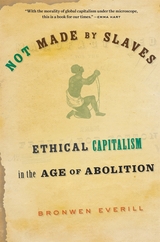
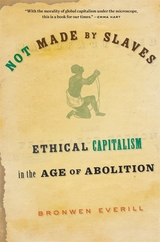
How abolitionist businesses marshaled intense moral outrage over slavery to shape a new ethics of international commerce.
“East India Sugar Not Made By Slaves.” With these words on a sugar bowl, consumers of the early nineteenth century declared their power to change the global economy. Bronwen Everill examines how abolitionists from Europe to the United States to West Africa used new ideas of supply and demand, consumer credit, and branding to shape an argument for ethical capitalism.
Everill focuses on the everyday economy of the Atlantic world. Antislavery affected business operations, as companies in West Africa, including the British firm Macaulay & Babington and the American partnership of Brown & Ives, developed new tactics in order to make “legitimate” commerce pay. Everill explores how the dilemmas of conducting ethical commerce reshaped the larger moral discourse surrounding production and consumption, influencing how slavery and freedom came to be defined in the market economy. But ethical commerce was not without its ironies; the search for supplies of goods “not made by slaves”—including East India sugar—expanded the reach of colonial empires in the relentless pursuit of cheap but “free” labor.
Not Made by Slaves illuminates the early years of global consumer society, while placing the politics of antislavery firmly in the history of capitalism. It is also a stark reminder that the struggle to ensure fair trade and labor conditions continues.
“Impressive…[Readers] will be rewarded with greater understanding of historical developments that changed the relationship between consumers and producers in a global economy in ways that reverberate to this day.”
—Wall Street Journal
“Everill repositions West Africa as central to the broader Atlantic story of 18th and 19th century economic morality, its relationship with commercial ethics, and the expansion of capitalism.”
—Financial Times
“Offers a penetrating new perspective on abolition in the British Empire by spotlighting a particular cast of characters: the commercial abolitionists in West Africa who fashioned a consumer-focused, business-friendly antislavery ethics. These figures sought to prove the moral and economic superiority of non-slave labor while profiting from the transition away from slavery…Impressive.”
—Jacobin
“East India Sugar Not Made By Slaves.” With these words inscribed on a sugar bowl, nineteenth-century consumers were reminded of their power to change the global economy. Determined to strike at the heart of the slave trade, abolitionist businesses throughout the Atlantic used new ideas of supply and demand, consumer credit, and branding to make the case for ethical capitalism.
Consumers became the moral compass of capitalism as companies in West Africa, including Macaulay & Babington and Brown & Ives, developed clever new tactics to make “legitimate” commerce pay. Yet ethical trade was not without its problems. The search for goods “not made by slaves” unwittingly expanded the reach of colonial enterprises in the relentless pursuit of cheap labor. Not Made by Slaves captures the moral dilemmas roiling the early years of global consumer society and is a stark reminder of the unintended consequences of relying on consumer self-interest to transform global capitalism.

Scholars have long been fascinated by the creative struggles with genre manifested throughout Dostoevsky’s career. In The Novel in the Age of Disintegration, Kate Holland brings historical context to bear, showing that Dostoevsky wanted to use the form of the novel as a means of depicting disintegration brought on by various crises in Russian society in the 1860s. This required him to reinvent the genre. At the same time he sought to infuse his novels with the capacity to inspire belief in social and spiritual reintegration, so he returned to some older conventions of a society that was already becoming outmoded.
In thoughtful readings of Demons, The Adolescent, A Writer’s Diary, and The Brothers Karamazov, Holland delineates Dostoevsky’s struggle to adapt a genre to the reality of the present, with all its upheavals, while maintaining a utopian vision of Russia’s future mission.
READERS
Browse our collection.
PUBLISHERS
See BiblioVault's publisher services.
STUDENT SERVICES
Files for college accessibility offices.
RECENTLY PUBLISHED




UChicago Accessibility Resources
home | accessibility | search | about | contact us
BiblioVault ® 2001 - 2026
The University of Chicago Press