
 A SCHOLARLY BOOK REPOSITORY
23 start with N start with N
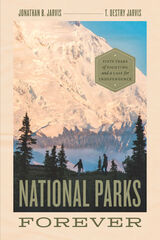
The US National Parks, what environmentalist and historian Wallace Stegner called America’s “best idea,” are under siege. Since 1972, partisan political appointees in the Department of the Interior have offered two conflicting views of the National Park Service (NPS): one vision emphasizes preservation and science-based decision-making, and another prioritizes economic benefits and privatization. These politically driven shifts represent a pernicious, existential threat to the very future of our parks.
For the past fifty years, brothers Jonathan B. and T. Destry Jarvis have worked both within and outside NPS as leaders and advocates. National Parks Forever interweaves their two voices to show how our parks must be protected from those who would open them to economic exploitation, while still allowing generations to explore and learn in them. Their history also details how Congress and administration appointees have used budget and staffing cuts to sabotage NPS’s ability to manage the parks and even threatened their existence. Drawing on their experience, Jarvis and Jarvis make a bold and compelling proposal: that it is time for NPS to be removed from the Department of the Interior and made an independent agency, similar to the Smithsonian Institution, giving NPS leaders the ability to manage park resources and plan our parks’ protection, priorities, and future.

This is an auto-narrated audiobook edition of this book.
Two leaders of the National Park Service provide a front-row seat to the disastrous impact of partisan politics over the past fifty years—and offer a bold vision for the parks’ future.
The US National Parks, what environmentalist and historian Wallace Stegner called America’s “best idea,” are under siege. Since 1972, partisan political appointees in the Department of the Interior have offered two conflicting views of the National Park Service (NPS): one vision emphasizes preservation and science-based decision-making, and another prioritizes economic benefits and privatization. These politically driven shifts represent a pernicious, existential threat to the very future of our parks.
For the past fifty years, brothers Jonathan B. and T. Destry Jarvis have worked both within and outside NPS as leaders and advocates. National Parks Forever interweaves their two voices to show how our parks must be protected from those who would open them to economic exploitation, while still allowing generations to explore and learn in them. Their history also details how Congress and administration appointees have used budget and staffing cuts to sabotage NPS’s ability to manage the parks and even threatened their existence. Drawing on their experience, Jarvis and Jarvis make a bold and compelling proposal: that it is time for NPS to be removed from the Department of the Interior and made an independent agency, similar to the Smithsonian Institution, giving NPS leaders the ability to manage park resources and plan our parks’ protection, priorities, and future.
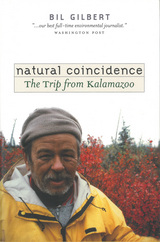
Natural Coincidence collects some of Bil Gilbert's finest writing, covering a diverse range of subjects that include investigations of the biology of Tasmanian devils, the lives and loves of snapping turtles, and an appreciation of the intelligence of crows. Perfectly suiting this eclectic choice of angles is Gilbert's unique writing style, a blend of unprepossessing erudition, wit, and honesty that has been compared to Aldo Leopold's Sand County Almanac.
The collection opens with a memoir of a childhood Christmas in western Michigan, before Gilbert's fascination with the natural world drew him to more exotic locales like Tasmania, Alaska, Nova Scotia, and Manhattan to write about such topics as the javelina, bigfoot, buffalo, and ringtails.
"More than 50 years ago," writes Gilbert, "without a clear notion about why or where I was going, I set off on a trip from Kalamazoo, Michigan. I am still traveling toward an unknown destination. But along the way, much more for reasons of good luck than thoughtful planning, I have met many wonderful beings and happenings. The essays appearing in Natural Coincidence represent an attempt to describe some of these wonders. I like to think, or at least pretend, that the inspiration for and theme of this book is gratitude."
World history is often referred to as the story of human conflict. Those struggles that are seen as our history must now include the uncontrolled violence that humanity perpetrates upon the earth, and the uncontrollable menace to human life posed by the earth in reaction to this violence. Just as a social contract once brought order to human relations, Serres believes that we must now sign a "natural contract" with the earth to bring balance and reciprocity to our relations with the planet that gives us life. Our survival depends on the extent to which humans join together and act globally, on an earth now conceived as an entity.
Tracing the ancient beginnings of modernity, Serres examines the origins and possibilities of a natural contract through an extended meditation on the contractual foundations of law and science. By invoking a nonhuman, physical world, Serres asserts, science frees us from the oppressive confines of a purely social existence, but threatens to become a totalitarian order in its own right. The new legislator of the natural contract must bring science and law into balance.
Serres ends his meditation by retelling the story of the natural contract as a series of parables. He sees humanity as a spacecraft that with the help of science and technology has cast off from familiar moorings. In place of the ties that modernity and analytic reason have severed, we find a network of relations both stranger and stronger than any we once knew, binding us to one another and to the world. The philosopher's harrowing and joyous task, Serres tells us, is that of comprehending and experiencing the bonds of violence and love that unite us in our spacewalk to the spaceship Mother Earth.
"Wise, rich and poetic . . . not simply a philosophical study of the Environment, or an ecological questioning of Philosophy . . . Nature is acknowledged as an inside force which breaks [the philosopher's] discourse, and opens it up to a vigilant poetic meditation."--Substance: A Review of Theory and Literary Criticism
As public funding for conservation efforts grows ever scarcer and the private sector is brimming with ideas about how its role—along with its profits— can grow, market forces have found their way into environmental management to a degree unimaginable only a few years ago. Ecotourism, payment for environmental services (PES), and new conservation finance instruments such as species banking, carbon trading, and biodiversity derivatives are only some of the market mechanisms that have sprung into being. This is “Nature™ Inc.”: a fast-growing frontier of networks, activities, knowledge, and regulations that are rapidly changing the relations between people and nature on both global and local scales.
Nature™ Inc. brings together cutting-edge research by respected scholars from around the world to analyze how “neoliberal conservation” is reshaping human–nature relations that have been fashioned over two centuries of capitalist development. Contributors synthesize and add to a growing body of academic literature that cuts across the disciplinary boundaries of geography, sociology, anthropology, political science, and development studies to critically interrogate the increasing emphasis on neoliberal market-based mechanisms in environmental conservation. They all grapple with one overriding question: can capitalist market mechanisms resolve the environmental problems they have helped create?
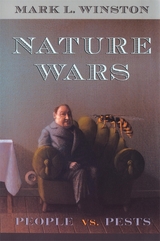
On our side, a vast arsenal of chemical pesticides. On their side? They don't have a side, the pests who must do nature's bidding. This is our war, and should we win it, ours would be a sorry planet. With disturbing news from the front, Nature Wars sounds the alarm against our dangerous tactics for controlling the pests that are an annoying but integral part of our world.
Thirty years after Silent Spring woke us to the devastation wrought by DDT, chemical pesticides are as pervasive as ever, deployed at a rate of 4 pounds a year for every man, woman, and child in this country. This ongoing commitment to pesticides, Mark Winston argues, reflects our sense of place in nature: embattled, beleaguered, driven to aggression. His book, as sensible as it is wise, seeks to change this mindset, to show how a more measured and discriminating approach to pests, one based on management rather than eradication, might serve us and the natural world far better than our ill-fated all-out war.
Winston backs up this approach with a full battery of case studies that take us from lawns and kitchens to farms and orchards, from insects and weeds to rats and coyotes. Here we see the complex political, biological, economic, social, and personal interactions that lie behind each pest management decision. Against this background Winston considers diverse instances of past pest management that reveal a consistent pattern of mistakes and problems--and lead to realistic, workable proposals for reducing pesticide use.
A compelling book about ethics and choices, Nature Wars shows us the difference between protecting ourselves from real pests and poisoning ourselves and the planet. It turns us from our war on nature to our task as stewards of the environment.
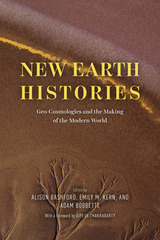
This book brings the history of the geosciences and world cosmologies together, exploring many traditions, including Chinese, Pacific, Islamic, South and Southeast Asian conceptions of the earth’s origin and makeup. Together the chapters ask: How have different ideas about the sacred, animate, and earthly changed modern environmental sciences? How have different world traditions understood human and geological origins? How does the inclusion of multiple cosmologies change the meaning of the Anthropocene and the global climate crisis? By carefully examining these questions, New Earth Histories sets an ambitious agenda for how we think about the earth.
The chapters consider debates about the age and structure of the earth, how humans and earth systems interact, and how empire has been conceived in multiple traditions. The methods the authors deploy are diverse—from cultural history and visual and material studies to ethnography, geography, and Indigenous studies—and the effect is to highlight how earth knowledge emerged from historically specific situations. New Earth Histories provides both a framework for studying science at a global scale and fascinating examples to educate as well as inspire future work. Essential reading for students and scholars of earth science history, environmental humanities, history of science and religion, and science and empire.
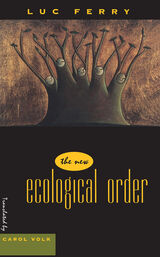
Traditional ecological movements, or "democratic ecology," seek to protect the environment of human societies; they are pragmatic and reformist. But another movement has become the refuge both of nostalgic counterrevolutionaries and of leftist illusions. This is "deep ecology." Its followers go beyond practical critiques of human greed and waste: they call into question the very possibility of human coexistence with nature. The human species is no longer at the center of the world, but subject to a new god called Nature. For these purists, man can only soil the harmony of the universe. In order to secure natural equilibrium, the only solution is to grant rights to animals, to trees, and to rocks.
Ferry launches his critique by examining early European legal cases concerning the status and rights of animals, including a few notorious cases where animals were brought to trial, found guilty, and publicly hanged. He then demonstrates that German Romanticism embraced certain key ideas of the deep ecology movement concerning the protection of animals and the environment. Later adopted by the Nazis, many of these ideas point to a profoundly antihumanistic component of deep ecology that is compatible with totalitarianism.
Ferry shows how deep ecology casts aside all the gains of human autonomy since the Enlightenment. He deciphers the philosophical and political assumptions of a movement that threatens to infantalize human society by preying on the fear of the authority of a new theological-political order. Far from denying our "duty in relation to nature," The New Ecological Order offers a bracing caution—against the dangers of environmental claims and, more important, against the threat to democracy contained in the deep ecology doctrine when pushed to its extreme.
"A book of intellectual power, full of insights, invention, and not without temerity, from one of the best political philosophers today."—Le Figaro
"Few books have analyzed in depth this phenomenon of the ecological movement as the most recent book by Luc Ferry has done. . . . It is a book that absolutely must be read."—Le Point
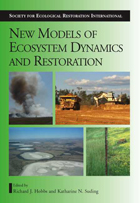
Conceptual models based on alternative stable states and restoration thresholds can help inform restoration efforts. New Models for Ecosystem Dynamics and Restoration brings together leading experts from around the world to explore how conceptual models of ecosystem dynamics can be applied to the recovery of degraded systems and how recent advances in our understanding of ecosystem and landscape dynamics can be translated into conceptual and practical frameworks for restoration.
In the first part of the book, background chapters present and discuss the basic concepts and models and explore the implications of new scientific research on restoration practice. The second part considers the dynamics and restoration of different ecosystems, ranging from arid lands to grasslands, woodlands, and savannahs, to forests and wetlands, to production landscapes. A summary chapter by the editors discusses the implications of theory and practice of the ideas described in preceding chapters.
New Models for Ecosystem Dynamics and Restoration aims to widen the scope and increase the application of threshold models by critiquing their application in a wide range of ecosystem types. It will also help scientists and restorationists correctly diagnose ecosystem damage, identify restoration thresholds, and develop corrective methodologies that can overcome such thresholds.
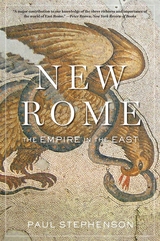
A comprehensive new history of the Eastern Roman Empire based on the science of the human past.
As modern empires rise and fall, ancient Rome becomes ever more significant. We yearn for Rome’s power but fear Rome’s ruin—will we turn out like the Romans, we wonder, or can we escape their fate? That question has obsessed centuries of historians and leaders, who have explored diverse political, religious, and economic forces to explain Roman decline. Yet the decisive factor remains elusive.
In New Rome, Paul Stephenson looks beyond traditional texts and well-known artifacts to offer a novel, scientifically minded interpretation of antiquity’s end. It turns out that the descent of Rome is inscribed not only in parchments but also in ice cores and DNA. From these and other sources, we learn that pollution and pandemics influenced the fate of Constantinople and the Eastern Roman Empire. During its final five centuries, the empire in the east survived devastation by natural disasters, the degradation of the human environment, and pathogens previously unknown to the empire’s densely populated, unsanitary cities. Despite the Plague of Justinian, regular “barbarian” invasions, a war with Persia, and the rise of Islam, the empire endured as a political entity. However, Greco-Roman civilization, a world of interconnected cities that had shared a common material culture for a millennium, did not.
Politics, war, and religious strife drove the transformation of Eastern Rome, but they do not tell the whole story. Braiding the political history of the empire together with its urban, material, environmental, and epidemiological history, New Rome offers the most comprehensive explanation to date of the Eastern Empire’s transformation into Byzantium.
A Times of London Book of the Year
Longlisted for the Runciman Award
“The most compelling fusion yet of narrative history with the recent findings of environmental research and scientific data. It will change the way we understand key events and transformations in the Eastern Empire.”—Anthony Kaldellis, author of Romanland
“[A] major contribution…Brings the world of New Rome alive with exceptional learning and a magnificent openness to modern scientific methods that breathe life into conventional narratives of political and social history.”—Peter Brown, New York Review of Books
“A sweeping survey of the disintegration of the western Roman empire and the emergence of Byzantium…This impressive chronicle offers an eye-opening perspective on a period of dramatic change.”—Publishers Weekly
Long before Rome fell to the Ostrogoths in 476 AD, a new city had risen to take its place as the beating heart of the empire, the glittering Constantinople, known as New Rome. In this strikingly original account of the collapse of the Western Roman Empire and emergence of Byzantium, Paul Stephenson offers a new interpretation of the forces that coalesced—dynastic, religious, climactic—to shift the center of power to the east. His novel, scientifically minded interpretation of antiquity's end presents evidence found not only in parchments and personalities, but also in ice cores and DNA.
From 395 to 700 AD, the empire in the east was subjected to a series of invasions and pandemics, confronting natural disasters and outbreaks in pathogens previously unknown to the empire’s densely populated, unsanitary cities. Politics, war, and religious strife sparked by the rise of Islam drove the transformation of Eastern Rome, but they do not tell the whole story. Deftly braiding the political history of the empire together with its material, environmental, and epidemiological history, New Rome offers a surprising new explanation of why Rome fell and how the Eastern Empire became Byzantium.
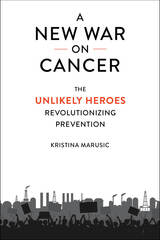
That was the question that motivated Kristina Marusic’s revelatory inquiry into cancer prevention. In searching for answers, she met remarkable doctors, scientists, and advocates who are upending our understanding of cancer and how to fight it. They recognize that we will never reduce cancer rates without ridding our lives of the chemicals that increasingly trigger this deadly disease.
Most never imagined this role for themselves. One scientist grew up without seeing examples of Indian-American women in the field, yet went on to make shocking discoveries about racial disparities in cancer risk. Another leader knew her calling was children’s health, but realized only later in her career that kids can be harmed by invisible pollutants at their daycares. Others uncovered surprising links between cancer and the everyday items that fill our homes and offices.
For these individuals, the fight has become personal. And it certainly is personal for Berry, a young woman whose battle with breast cancer is woven throughout these pages. Might Berry have dodged cancer had she not grown up in Oil City, Pennsylvania, in the shadow of refineries? There is no way to know for sure. But she is certain that, even with the best treatment available, her life was changed irrevocably by her diagnosis. Marusic shows that, collectively, we have the power to prevent many cases like Berry’s. The war on cancer is winnable—if we revolutionize the way we fight.

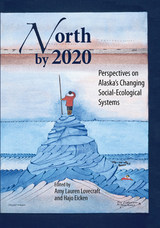
Originating from a series of workshops held at the Alaska Forum of the Fourth International Polar Year, this interdisciplinary volume addresses a host of current concerns regarding the ecology and rapid transformation of the arctic. Concentrating on the most important linked social-ecological systems, including fresh water, marine resources, and oil and gas development, this volume explores opportunities for sustainable development from a variety of perspectives, among them social sciences, natural and applied sciences, and the arts. Individual chapters highlight expressions of climate change in dance, music, and film, as well as from an indigenous knowledge–based perspective.
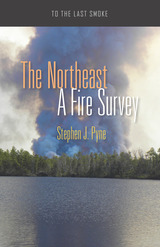
The Northeast has its roster of great fires, beginning with dark days in the late 18th century, followed by a chronicle of conflagrations continuing as late as 1903 and 1908, with a shocking after-tremor in 1947. It hosted the nation’s first forestry schools. It organized the first interstate (and international) fire compact. And it was the Northeast that pioneered the transition to the true Big Burn—industrial combustion—as America went from burning living landscapes to burning lithic ones.
In this new book in the To the Last Smoke series, renowned fire expert Stephen J. Pyne narrates this history and explains how fire is returning to a place not usually thought of in America’s fire scene. He examines what changes in climate and land use mean for wildfire, what fire ecology means for cultural landscapes, and what experiments are underway to reintroduce fire to habitats that need it. The region’s great fires have gone; its influence on the national scene has not.
The Northeast: A Fire Survey samples the historic and contemporary significance of the region and explains how it fits into a national cartography and narrative of fire.
Included in this volume:
How the region shaped America’s understanding and policy toward fire
How fire fits into the region today and what that means for the country overall
What changes in climate, land use, and institutions may mean for northeastern fire, both wild and tame

The Northeast's Changing Forest reviews the history and conditions of the forest in the nine northeastern states. This diverse region stretches from the shores of Lake Erie to Passamaquoddy Bay and from Cape May, New Jersey to northern Maine. The forests range from the dune forest of the New Jersey beaches to subalpine forests in the White Mountains and the Adirondacks. Heavily cleared for agriculture in the nineteenth century, the region's forests have increased in area since 1909 by an amount equal to the entire forest area of Maine, which is 17 million acres.
The region's forests can be thought of as five "forests," each playing a distinct economic role. In the Industrial Forest, the growing and harvesting of industrial wood is the primary use, accompanied by substantial use for hunting, fishing, snowmobiling, and wilderness canoeing. In the Suburban Forest, the general emphasis on "green backdrop" roles belies the importance of casual recreation, firewood cutting, and industrial wood uses. In the Rural Forest of the region's farming and thinly settled rural areas, traditional forest uses continue. In the Recreational Forest, heavily developed areas for skiing, lakeside camps and resorts, and coastal developments set the tone. Finally, in the Wild Forest, preservation of nature is dominant.
After generations when few aside from the landowner and technical communities paid the forests much attention, they have now become focal points for policy conflicts. Proposals for large additions to the Adirondack Park's Forever Wild lands, for creating a Maine Woods National Park, and for eliminating all timber harvesting on the region's National Forests are prominent examples. The legislatures of every state in the region deal annually with issues of forest taxation, forest practices regulation, public ownership, and land uses affecting forests. The Northeast's Changing Forest gives readers an historic, geographic, and ecological background for understanding the condition of the forests of the Northeast and the outlook for their future.
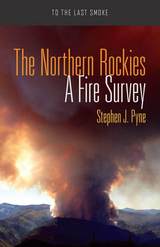
The Northern Rockies remain one of three major hearths for America’s fire culture. They hold a major fire laboratory, an equipment development center, an aerial fire depot, and a social engagement with fire—even a literature. Missoula is to fire in the big backcountry what Tallahassee is to prescribed burning and what Southern California is to urban-wildland hybrids. On its margins, Boise hosts the National Interagency Fire Center. In this structured collection of essays on the region, Stephen J. Pyne explores what makes the Northern Rockies distinctive and what sets it apart from other regions of the country. Surprisingly, perhaps, the story is equally one of big bureaucracies and of generations that encounter the region’s majestic landscapes through flame.
The Northern Rockies is part of a multivolume series describing the nation’s fire scene region by region. The volumes in To the Last Smoke also cover Florida, the Northern Rockies, the Great Plains, the Southwest, and several other critical fire regions. The series serves as an important punctuation point to Pyne’s 50-year career with wildland fire—both as a firefighter and a fire scholar. These unique surveys of regional pyrogeography are Pyne’s way of “keeping with it to the end,” encompassing the directive from his rookie season to stay with every fire “to the last smoke.”
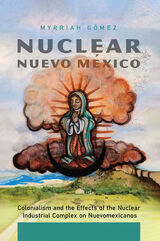
Contrary to previous works that suppress Nuevomexicana/o presence throughout U.S. nuclear history, Nuclear Nuevo México focuses on recovering the voices and stories that have been lost or ignored in the telling of this history. By recuperating these narratives, Myrriah Gómez tells a new story of New Mexico, one in which the nuclear history is not separate from the collective colonial history of Nuevo México but instead demonstrates how earlier eras of settler colonialism laid the foundation for nuclear colonialism in New Mexico.
Gómez examines the experiences of Nuevomexicanas/os who have been impacted by the nuclear industrial complex, both the weapons industry and the commercial industry. Gómez argues that Los Alamos was created as a racist project that targeted poor and working-class Nuevomexicana/o farming families, along with their Pueblo neighbors, to create a nuclear empire. The resulting imperialism has left a legacy of disease and distress throughout New Mexico that continues today.
READERS
Browse our collection.
PUBLISHERS
See BiblioVault's publisher services.
STUDENT SERVICES
Files for college accessibility offices.
RECENTLY PUBLISHED





UChicago Accessibility Resources
home | accessibility | search | about | contact us
BiblioVault ® 2001 - 2026
The University of Chicago Press