
 A SCHOLARLY BOOK REPOSITORY
22 start with N start with N
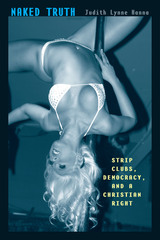
Across America, strip clubs have come under attack by a politically aggressive segment of the Christian Right. Using plausible-sounding but factually untrue arguments about the harmful effects of strip clubs on their communities, the Christian Right has stoked public outrage and incited local and state governments to impose onerous restrictions on the clubs with the intent of dismantling the exotic dance industry. But an even larger agenda is at work, according to Judith Lynne Hanna. In Naked Truth, she builds a convincing case that the attack on exotic dance is part of the activist Christian Right’s “grand design” to supplant constitutional democracy in America with a Bible-based theocracy.
Hanna takes readers onstage, backstage, and into the community and courts to reveal the conflicts, charges, and realities that are playing out at the intersection of erotic fantasy, religion, politics, and law. She explains why exotic dance is a legitimate form of artistic communication and debunks the many myths and untruths that the Christian Right uses to fight strip clubs. Hanna also demonstrates that while the fight happens at the local level, it is part of a national campaign to regulate sexuality and punish those who do not adhere to Scripture-based moral values. Ultimately, she argues, the naked truth is that the separation of church and state is under siege and our civil liberties—free speech, women’s rights, and free enterprise—are at stake.
Lucy Ann Lobdell’s (1829–1912) extraordinary life was shaped by personal strife and the hardships of survival in upstate New York. Struggling with an abusive, alcoholic husband, a young child, ailing parents, and financial strain, Lucy did what was necessary to support her family. In a rural world defined by hunting, farming, and lumbering, she dressed, labored, and lived in a traditional masculine manner. Her prowess as a rifle shot and fiddle player were known locally, but because of her unconventional, androgynous lifestyle, she became a target of public gossip and ridicule. Educated and eloquent, Lucy penned and published, Lucy Ann Lobdell, the Female Hunter of Delaware and Sullivan Counties, N.Y., in 1855. The narrative provides a unique look at the persecution of a woman whose only “offense” was disregard for contemporary societal norms.
After her husband was killed during the Civil War, she received a widow’s pension. Ostracized and eventually hospitalized in 1880—gender laws of the time imprisoned indigent men, but sent women to mental hospitals—she underwent torturous experimental treatment until she confessed to a self-serving doctor that she was “a man in all that the name implies.” Whether Lucy was a lesbian, cross dresser, or transgender, we don’t know from the historical record, but as Lisa Macchia Ohliger demonstrates in The Narrative of Lucy Ann Lobdell: A Woman’s Case for Equality, Lucy did embody the nascent women’s rights movement. At the same time, and not far from where Lucy lived and went to school, Amelia Bloomer was advocating the right for women to wear pants and was publishing the feminist newspaper, The Lily, while Susan B. Anthony was pushing for land rights and equal pay for women. All of these issues are found in Lucy’s autobiographical account, fully reproduced in this volume. Lucy’s life is an illustration of the historical significance and destructive power of gender in society, and her narrative bears painful witness to the clash between taboo and survival.
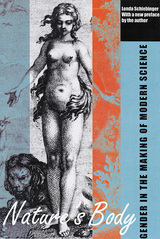
Eighteenth-century natural historians created a peculiar, and peculiarly durable, vision of nature—one that embodied the sexual and racial tensions of that era. When plants were found to reproduce sexually, eighteenth-century botanists ascribed to them passionate relations, polyandrous marriages, and suicidal incest, and accounts of steamy plant sex began to infiltrate the botanical literature of the day. Naturalists also turned their attention to the great apes just becoming known to eighteenth-century Europeans, clothing the females in silk vestments and training them to sip tea with the modest demeanor of English matrons, while imagining the males of the species fully capable of ravishing women.
Written with humor and meticulous detail, Nature’s Body draws on these and other examples to uncover the ways in which assumptions about gender, sex, and race have shaped scientific explanations of nature. Schiebinger offers a rich cultural history of science and a timely and passionate argument that science must be restructured in order to get it right.
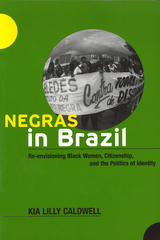
In Negras in Brazil, Kia Lilly Caldwell examines the life experiences of Afro-Brazilian women whose stories have until now been largely untold. This pathbreaking study analyzes the links between race and gender and broader processes of social, economic, and political exclusion. Drawing on ethnographic research with social movement organizations and thirty-five life history interviews, Caldwell explores the everyday struggles Afro-Brazilian women face in their efforts to achieve equal rights and full citizenship. She also shows how the black women's movement, which has emerged in recent decades, has sought to challenge racial and gender discrimination in Brazil. While proposing a broader view of citizenship that includes domains such as popular culture and the body, Negras in Brazil highlights the continuing relevance of identity politics for members of racially marginalized communities. Providing new insights into black women's social activism and a gendered perspective on Brazilian racial dynamics, this book will be of interest to students and scholars of Latin American Studies, African diaspora studies, women's studies, politics, and cultural anthropology.
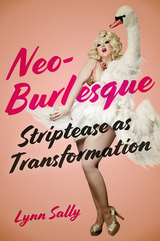
Performance studies scholar and acclaimed burlesque artist Lynn Sally offers an inside look at the history, culture, and philosophy of New York’s neo-burlesque scene. Revealing how twenty-first century neo-burlesque is in constant dialogue with the classic burlesque of the nineteenth and twentieth centuries, she considers how today’s performers use camp to comment on preconceived notions of femininity. She also explores how the striptease performer directs the audience’s gaze, putting on layers of meaning while taking off layers of clothing.
Through detailed profiles of iconic neo-burlesque performers such as Dita Von Teese, Dirty Martini, Julie Atlas Muz, and World Famous *BOB*, this book makes the case for understanding neo-burlesque as a new sexual revolution. Yet it also examines the broader community of “Pro-Am” performers who use neo-burlesque as a liberating vehicle for self-expression. Raising important questions about what feminism looks like, Neo-Burlesque celebrates a revolutionary performing art and participatory culture whose acts have political reverberations, both onstage and off.

The neoliberal self, far from being a stable marker of urban, liberal, millennial Indian identity, is replete with contradictions and oppositions. This study of the unstable neoliberal identity lays bare the sense of precarity and inherent inequality that neoliberal regimes confer upon their subjects.
This analysis draws upon theories of feminist media studies, popular culture analyses, and film studies to critique mainstream Hindi cinema texts produced in the last two decades. Rele Sathe also examines a variety of peripheral subjects and texts, including the film star, the urban space, web series, YouTube videos, and social media content.


In No More Separate Spheres! both established and new scholars look at the changing categories of analysis—from seventies feminism to nineties postcolonialism—that have shaped this discussion. In her introduction, Cathy N. Davidson assesses the state of criticism with regard to the separate spheres debate, and sets a constructive and often provocative tone for the rest of the volume. While one essay provides an overview of the multiple fronts on which the post-separate spheres model of criticism has been engaged, others offer perspectives that either support of directly confront and critique this model. Rather than seeking to establish yet another critical formula based on the opposition of binary terms, this special issue of American Literature will help move the debate to the next level.
Contributors. José F. Aranda, Lauren Berlant, Lawrence Buell, Judith Fetterley, Amy Kaplan, You-me Park, Marjorie Pryse, Gail Wald

A respected group of contributors from diverse generations and backgrounds argue for new chronologies, more inclusive conceptualizations of feminist agendas and participants, and fuller engagements with contestations around particular issues and practices. Race, class, and sexuality are explored within histories of women's rights and feminism as well as the cultural and intellectual currents and social and political priorities that marked movements for women's advancement and liberation. These essays question whether the concept of waves surging and receding can fully capture the complexities of U.S. feminisms and suggest models for reimagining these histories from radio waves to hip-hop.
The chapters in No Slam Dunk show that is this not simply a story of an “unfinished revolution.” Rather, they contend, it is simplistic optimism to assume that we are currently nearing the conclusion of a story of linear progress that ends with a certain future of equality and justice. This book provides important theoretical and empirical insights into the contemporary world of sports to help explain the unevenness of social change and how, despite significant progress, gender equality in sports has been “No Slam Dunk.”
Contemporary French writing on the Maghreb—that part of Africa above the Sahara—is truly postmodern in scope, the rich product of multifaceted histories promoting the blending of two worlds, two identities, two cultures, and two languages.
Nomadic Voices of Exile demonstrates how that postmodern sentiment has altered perceptions concerning Maghrebian feminine identity since the end of the French-colonial era. The authors discussed here, both those who reside in the Maghreb and those who have had to seek asylum in France, find themselves at the intersection of French and North African viewpoints, exposing a complicated world that must be negotiated and redefined.
In looking at the authors whose writings extend beyond a gender-based dialogue to include such issues as race, politics, religion, and history, Valérie Orlando explores the rich and changing landscape of the literature and the culture, addresses the stereotypes that have defined the past, and navigates the space of the exiled, a space previously at the peripheries of Western discourse.
Nomadic Voices of Exile will be useful to a variety of classrooms—women’s studies, Middle East studies, Francophone literature, Third World women writers—and to anyone interested in postcolonial and postmodern theory and philosophy and the history of the Maghreb through literature.
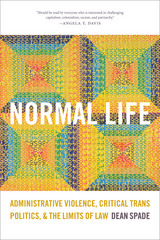
Wait—what's wrong with rights? It is usually assumed that trans and gender nonconforming people should follow the civil rights and "equality" strategies of lesbian and gay rights organizations by agitating for legal reforms that would ostensibly guarantee nondiscrimination and equal protection under the law. This approach assumes that the best way to address the poverty and criminalization that plague trans populations is to gain legal recognition and inclusion in the state's institutions. But is this strategy effective?
In Normal Life Dean Spade presents revelatory critiques of the legal equality framework for social change, and points to examples of transformative grassroots trans activism that is raising demands that go beyond traditional civil rights reforms. Spade explodes assumptions about what legal rights can do for marginalized populations, and describes transformative resistance processes and formations that address the root causes of harm and violence.
In the new afterword to this revised and expanded edition, Spade notes the rapid mainstreaming of trans politics and finds that his predictions that gaining legal recognition will fail to benefit trans populations are coming to fruition. Spade examines recent efforts by the Obama administration and trans equality advocates to "pinkwash" state violence by articulating the US military and prison systems as sites for trans inclusion reforms. In the context of recent increased mainstream visibility of trans people and trans politics, Spade continues to advocate for the dismantling of systems of state violence that shorten the lives of trans people. Now more than ever, Normal Life is an urgent call for justice and trans liberation, and the radical transformations it will require.
Wait—what's wrong with rights? It is usually assumed that trans and gender nonconforming people should follow the civil rights and “equality” strategies of lesbian and gay rights organizations by agitating for legal reforms that would ostensibly guarantee equal access, nondiscrimination, and equal protection under the law. This approach assumes that the best way to address the poverty and criminalization that plague trans populations is to get recognized by law and included in the state's institutions. But does changing what the law says about a targeted and marginalized population bring material relief? And what if many of the problems that shorten trans people's lives stem from the ordinary, banal ways that gender norm categories are administered by virtually every state and private institution?
In Normal Life Dean Spade presents revelatory critiques of the legal equality framework for social change and points to examples of transformative grassroots trans activism that is raising demands that go beyond traditional civil rights reforms. Spade explodes the assumptions about what legal rights can do for marginalized populations and describes transformative resistance processes and formations that address the root causes of harm and violence. Setting forth a politic that goes beyond the quest for mere legal inclusion, Normal Life is an urgent call for justice and trans liberation, and the radical transformations it will require.

A Times Higher Education Book of the Week
A virulent strain of antifeminism is thriving online that treats women’s empowerment as a mortal threat to men and to the integrity of Western civilization. Its proponents cite ancient Greek and Latin texts to support their claims—from Ovid’s Ars Amatoria to Seneca and Marcus Aurelius—arguing that they articulate a model of masculinity that sustained generations but is now under siege. Not All Dead White Men reveals that some of the most controversial and consequential debates about the legacy of the ancients are raging not in universities but online.
“A chilling account of trolling, misogyny, racism, and bad history proliferated online by the Alt-Right… Zuckerberg makes a persuasive case for why we need a new, more critical, and less comfortable relationship between the ancient and modern worlds in this important and very timely book.”
—Emily Wilson, translator of The Odyssey
“Explores how ideas about Ancient Greece and Rome are used and misused by antifeminist thinkers today.”
—Time
“Zuckerberg presciently analyzes these communities’…embrace of stoicism as a self-help tool to gain confidence, jobs, and girlfriends. Their adoration of men like Marcus Aurelius, Epictetus, and Ovid…is founded in a limited and distorted interpretation of ancient philosophy…lending heft and authority to sexism and abuse.”
—The Nation
“Traces the application—and misapplication—of classical authors and texts in online communities that see feminism as a threat.”
—Bitch Media
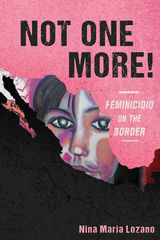
Finding theories of new materialism inadequate to explain the feminicidios, Lozano critiques and extends this approach—advancing instead a new theoretical framework, border materialism, to argue that capitalist systems of neoliberalism and free trade are directly correlated to the killing of women on the US–Mexico border. Through the author’s fifteen-plus years of on-the-ground fieldwork, readers are presented with firsthand accounts, testimonies, and new social movement strategies from family members and activists attempting to stop these gendered crimes.
By offering concrete case studies—including analysis of maquiladoras/factories and free trade zones, public monuments and murals memorializing the victims, rastreos/searches by family members for victims’ DNA remains, and testimony from Mothers, family members, and activists—Not One More! lays bare the socioeconomic and geopolitical forces at work in the killing of women in Juárez.
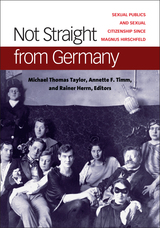
Two visual sourcebooks and catalog essays on an exhibition of contemporary artists’ responses to the Hirschfeld historical materials interrogate the modes of visual representation that Hirschfeld employed by re-imagining the public visibility of his institute from a contemporary perspective. The archival material includes stunning, never-before-published images from Hirschfeld’s institute that challenge many received ideas, while the scholarly and art catalog essays explore collaboration and dialogue as methods of research and activism that resonate beyond the academy to pressing issues of public concern.
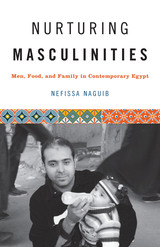
Two structuring concepts have predominated in discussions concerning how Middle Eastern men enact their identity culturally: domination and patriarchy. Nurturing Masculinities dispels the illusion that Arab men can be adequately represented when we speak of them only in these terms. By bringing male perspectives into food studies, which typically focus on the roles of women in the production and distribution of food, Nefissa Naguib demonstrates how men interact with food, in both political and domestic spheres, and how these interactions reflect important notions of masculinity in modern Egypt.
In this classic ethnography, narratives about men from a broad range of educational backgrounds, age groups, and social classes capture a holistic representation of masculine identity and food in modern Egypt on familial, local, and national levels. These narratives encompass a broad range of issues and experiences, including explorations of traditions surrounding food culture; displays of caregiving and love when men recollect the taste, feel, and fragrance of food as they discuss their desires to feed their families well and often; and the role that men, working to ensure the equitable distribution of food, played during the Islamist movement of the Muslim Brotherhood in 2011. At the core of Nurturing Masculinities is the idea that food is a powerful marker of manhood, fatherhood, and family structure in contemporary Egypt, and by better understanding these foodways, we can better understand contemporary Egyptian society as a whole.
READERS
Browse our collection.
PUBLISHERS
See BiblioVault's publisher services.
STUDENT SERVICES
Files for college accessibility offices.
RECENTLY PUBLISHED




UChicago Accessibility Resources
home | accessibility | search | about | contact us
BiblioVault ® 2001 - 2025
The University of Chicago Press