
 A SCHOLARLY BOOK REPOSITORY
37 start with N start with N

Focusing primarily on a group of Dominican nuns in Strasbourg, Germany, Amy Leonard's Nails in the Wall outlines the century-long battle between these nuns and the Protestant city council. With savvy strategies that employed charm, wealth, and political and social connections, the nuns were able to sustain their Catholic practices. Leonard's in-depth archival research uncovers letters about and records of the nuns' struggle to maintain their religious beliefs and way of life in the face of Protestant reforms. She tells the story of how they worked privately to keep Catholicism alive-continuing to pray in Latin, smuggling in priests to celebrate Mass, and secretly professing scores of novices to ensure the continued survival of their convents. This fascinating and heartening study shows that, far from passively allowing the Protestants to dismantle their belief system, the women of the Strasbourg convents were active participants in the battle over their vocation and independence.
Offering a nuanced analysis of how publicity was constructed through radio programming, print media, popular song, and film, Currid examines how German citizens developed an emotional investment in the nation and other forms of collectivity that were tied to the sonic experience. Reading in detail popular genres of music—the Schlager (or “hit”), so-called gypsy music, and jazz—he offers a complex view of how they played a part in the creation of German culture.
A National Acoustics contributes to a new understanding of what constitutes the public sphere. In doing so, it illustrates the contradictions between Germany’s social and cultural histories and how the technologies of recording not only were vital to the emergence of a national imaginary but also exposed the fault lines in the contested terrain of mass communication.
Brian Currid is an independent scholar who lives in Berlin.
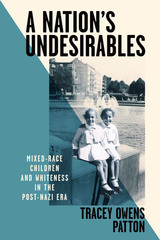
An innovative investigation of the entangled histories of race, transnational adoption, and post-Nazi Germany.
In a moving blend of family history and cutting-edge scholarship, Tracey Owens Patton’s A Nation’s Undesirables synthesizes work in rhetorical postmemory studies, critical adoption studies, Afrofuturism, and more to tell the story of her mother and aunt, Lore and Lilli. Two of thousands of children born to white German women and Black American men after World War II, the twins moved to the United States at age seven, where their mother renounced her parental rights and put them into the adoption system. They did not see her again for fifty-two years.Patton takes up the twins’ story and their reckoning with their mixed-race, Black German identity to disrupt standard narratives around World War II, Black experiences in Germany, and race and adoption. Combining family interviews, historical artifacts, and autoethnographic reflection, Patton composes a new narrative of women and Black German children in the postwar era. In examining the systemic racism of Germany’s efforts to move children like Lore and Lilli out of the country—and the suppression of German women’s bodily autonomy—Patton amplifies the once unacknowledged identities of these Black German children to broaden our understanding of citizenship, racism, and sexism after World War II.
Focusing on the Cold War years, thismonograph examines the processes, problems, and policies through which the Federal Republic of Germany was formed and admitted into the North Atlantic Treaty Organization (NATO). The author compares the situation of Weimar Germany during its short-lived postwar decade with that of the Federal Republic by applying geopolitical concepts and theory, illustrating Germany’s territorial uniqueness and how that special aspect of its place on the European continent in?uenced the nation’s diplomacy in both eras.
During the late 1940s and the 1950s, the problem presented by Germany to the other NATO allies was how to secure and maintain the Federal Republic’s allegiance to the anticommunist alliance without eliminating the country’s desire to be reunited with its Soviet-dominated eastern section. How both NATO and Germany managed to maintain themselves in a state of dynamic equilibrium throughout the era of the Cold War illustrates the concept of international organization called “cooptation,” which Lyman helped to de?ne and expand.
The epilogue explores the larger issues that the case study illuminates: global space, national territorialization, collective identity, and ethnocentrism. Considering the current con?ict in the Balkans as it relates to the new Germany and the role of NATO, this far-reaching book is especially relevant with its suggestions for a basic supranational sociology.
What was life like under the Third Reich? What went on between parents and children? What were the prevailing attitudes about sex, morality, religion? How did workers perceive the effects of the New Order in the workplace? What were the cultural currents—in art, music, science, education, drama, and on the radio?
Professor Mosse’s extensive analysis of Nazi culture—groundbreaking upon its original publication in 1966—is now offered to readers of a new generation. Selections from newspapers, novellas, plays, and diaries as well as the public pronouncements of Nazi leaders, churchmen, and professors describe National Socialism in practice and explore what it meant for the average German.
By recapturing the texture of culture and thought under the Third Reich, Mosse’s work still resonates today—as a document of everyday life in one of history’s darkest eras and as a living memory that reminds us never to forget.
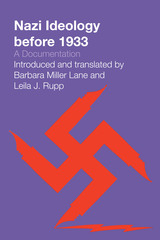
This volume brings together a hitherto scattered and inaccessible body of material crucial to the understanding of the evolution of Nazi political thought. Before the publication of this volume, scholars had virtually ignored the extensive writings and programs published by leading Nazi ideologues before 1933. Barbara Miller Lane and Leila J. Rupp have collected the political writings of Nazi theorists—Dietrich Eckart, Alfred Rosenberg, Gottfried Feder, Joseph Goebbels, Gregor and Otto Strasser, Heinrich Himmler, and Richard Walther Darré—during the period before the National Socialists came to power. The Strassers are given considerable space because of their great intellectual importance within the party before 1933. In commentary by the editors, the significance of each Nazi theorist is weighed and evaluated at each stage of the history of the party.
Lane and Rupp conclude that Nazi ideology, before 1933 at least, was not a consistent whole but a doctrine in the process of rapid development to which new ideas were continually introduced. By the time the Nazis came to power, however, a group of interrelated assertions and official promises had been made to party followers and to the public. Hitler and the Third Reich had to accommodate this ideology, even when not implementing it. Hitler’s role in the development of Nazi ideology, interpreted here as a very permissive one, is thoroughly assessed. His own writings, however, have been omitted since they are readily available elsewhere.
The twenty-eight documents included in this book illustrate themes and phases in Nazi ideology which are discussed in the introduction and the detailed prefatory notes. Long selections, as often as possible full-length, are provided to allow the reader to follow the arguments. Each selection is accompanied by an introductory note and annotations which clarify its relationship to other works of the author and other writings of the period. Also included are original translations of the “Twenty-Five Points” and a number of little-known official party statements.
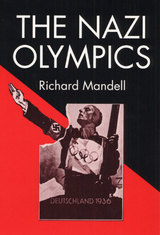

The 1936 Olympic Games played a key role in the development of both Hitler’s Third Reich and international sporting competition. The Nazi Olympics gathers essays by modern scholars from prominent participating countries and lays out the issues--sporting as well as political--surrounding the involvement of individual nations.
The volume opens with an analysis of Germany’s preparations for the Games and the attempts by the Nazi regime to allay the international concerns about Hitler’s racist ideals and expansionist ambitions. Essays follow on the United States, Great Britain, and France--top-tier Olympian nations with misgivings about participation--as well as Germany's future Axis partners Italy and Japan. Other contributions examine the issues involved for Finland, Sweden, Norway, Denmark, and the Netherlands. Throughout, the authors reveal the high political stakes surrounding the Games and how the Nazi Olympics distilled critical geopolitical issues of the time into a spectacle of sport.
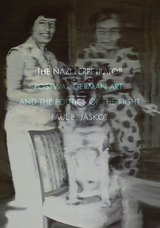
Who was responsible for the crimes of the Nazis? Party leaders and members? Rank-and-file soldiers and bureaucrats? Ordinary Germans? This question looms over German disputes about the past like few others. It also looms over the art and architecture of postwar Germany in ways that have been surprisingly neglected. In The Nazi Perpetrator, Paul B. Jaskot fundamentally reevaluates pivotal developments in postwar German art and architecture against the backdrop of contentious contemporary debates over the Nazi past and the difficulty of determining who was or was not a Nazi perpetrator.
Like their fellow Germans, postwar artists and architects grappled with the Nazi past and the problem of defining the Nazi perpetrator—a problem that was thoroughly entangled with contemporary conservative politics and the explosive issue of former Nazis living in postwar Germany. Beginning with the formative connection between Nazi politics and art during the 1930s, The Nazi Perpetrator traces the dilemma of identifying the perpetrator across the entire postwar period. Jaskot examines key works and episodes from West Germany and, after 1989, reunified Germany, showing how the changing perception of the perpetrator deeply impacted art and architecture, even in cases where artworks and buildings seem to have no obvious relation to the Nazi past. The book also reinterprets important periods in the careers of such major figures as Gerhard Richter, Anselm Kiefer, and Daniel Libeskind.
Combining political history with a close analysis of specific works, The Nazi Perpetrator powerfully demonstrates that the ongoing influence of Nazi Germany after 1945 is much more central to understanding a wide range of modern German art and architecture than cultural historians have previously recognized.
A revolutionary new approach to the place of Nazi ideology in twentieth-century thought
Psychoanalysis was a symptom of everything the Nazis reviled: an intellectual assault on Kultur largely perpetrated by Jews. It was also, as this remarkable work shows, an inescapable symptom of modernity, practiced, transformed, and perpetuated by and within the Nazi regime. A sweeping, magisterial work by one of the most incisive and interesting scholars of modern philosophy, theory, and culture, Nazi Psychoanalysis studies the breadth of this phenomenon in order to clarify and deepen our understanding not only of psychoanalysis but of the twentieth century.
Tracing the intersections of psychoanalysis and Nazism, Laurence A. Rickels discovers startling conjunctions and continuities in writers as diverse as Adler and Adorno, Kafka and Goethe, Lacan, H. Rider Haggard, and Heidegger, and in works as different as Der Golem, Civilization and Its Discontents, Frankenstein, Faust, and Brave New World. In a richly allusive style, he writes of psychoanalysis in multifarious incarnations, of the concept and actual history of "insurance," of propaganda in theory and practice, of psychological warfare, Walt Disney, and the Frankfurt School debates—a dizzying tour of the twentieth century that helps us see how the "corridor wars" that arise in the course of theoretical, clinical, social, political, and cultural attempts to describe the human psyche are related to the world wars of the century in an intimate and infinitely complicated manner. Though some have used its appropriation by the Nazis to brand psychoanalysis with the political odium of fascism, Rickels instead finds an uncanny convergence—one that suggests far-reaching possibilities for both psychoanalysis and psychoanalytic criticism. His work, with its enormous intellectual and historical span, makes a persuasive argument that no element of modernity—not psychoanalysis any more than Marxism or deconstruction, cultural revolutions or technological advances-can be adequately understood without a thorough consideration of its Nazi component.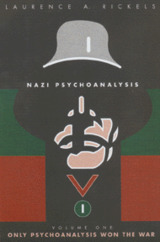
A revolutionary new approach to the place of Nazi ideology in twentieth-century thought
Psychoanalysis was a symptom of everything the Nazis reviled: an intellectual assault on Kultur largely perpetrated by Jews. It was also, as this remarkable work shows, an inescapable symptom of modernity, practiced, transformed, and perpetuated by and within the Nazi regime. A sweeping, magisterial work by one of the most incisive and interesting scholars of modern philosophy, theory, and culture, Nazi Psychoanalysis studies the breadth of this phenomenon in order to clarify and deepen our understanding not only of psychoanalysis but of the twentieth century.
Tracing the intersections of psychoanalysis and Nazism, Laurence A. Rickels discovers startling conjunctions and continuities in writers as diverse as Adler and Adorno, Kafka and Goethe, Lacan, H. Rider Haggard, and Heidegger; and in works as different as Der Golem, Civilization and Its Discontents,Frankenstein, Faust, and Brave New World. In a richly allusive style, he writes of psychoanalysis in multifarious incarnations, of the concept and actual history of "insurance," of propaganda in theory and practice, of psychological warfare, Walt Disney, and the Frankfurt School debates—a dizzying tour of the twentieth century that helps us see how the "corridor wars" that arise in the course of theoretical, clinical, social, political, and cultural attempts to describe the human psyche are related to the world wars of the century in an intimate and infinitely complicated manner. Though some have used its appropriation by the Nazis to brand psychoanalysis with the political odium of fascism, Rickels instead finds an uncanny convergence—one that suggests far-reaching possibilities for both psychoanalysis and psychoanalytic criticism. His work, with its enormous intellectual and historical span, makes a persuasive argument that no element of modernity—not psychoanalysis any more than Marxism or deconstruction, cultural revolutions or technological advances—can be adequately understood without a thorough consideration of its Nazi component.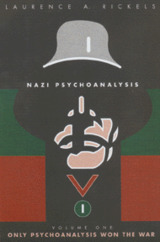
A revolutionary new approach to the place of Nazi ideology in twentieth-century thought
Psychoanalysis was a symptom of everything the Nazis reviled: an intellectual assault on Kultur largely perpetrated by Jews. It was also, as this remarkable work shows, an inescapable symptom of modernity, practiced, transformed, and perpetuated by and within the Nazi regime. A sweeping, magisterial work by one of the most incisive and interesting scholars of modern philosophy, theory, and culture, Nazi Psychoanalysis studies the breadth of this phenomenon in order to clarify and deepen our understanding not only of psychoanalysis but of the twentieth century.
Tracing the intersections of psychoanalysis and Nazism, Laurence A. Rickels discovers startling conjunctions and continuities in writers as diverse as Adler and Adorno, Kafka and Goethe, Lacan, H. Rider Haggard, and Heidegger; and in works as different as Der Golem, Civilization and Its Discontents, Frankenstein, Faust, and Brave New World. In a richly allusive style, he writes of psychoanalysis in multifarious incarnations, of the concept and actual history of "insurance," of propaganda in theory and practice, of psychological warfare, Walt Disney, and the Frankfurt School debates—a dizzying tour of the twentieth century that helps us see how the "corridor wars" that arise in the course of theoretical, clinical, social, political, and cultural attempts to describe the human psyche are related to the world wars of the century in an intimate and infinitely complicated manner. Though some have used its appropriation by the Nazis to brand psychoanalysis with the political odium of fascism, Rickels instead finds an uncanny convergence-one that suggests far-reaching possibilities for both psychoanalysis and psychoanalytic criticism. His work, with its enormous intellectual and historical span, makes a persuasive argument that no element of modernity—not psychoanalysis any more than Marxism or deconstruction, cultural revolutions or technological advances—can be adequately understood without a thorough consideration of its Nazi component.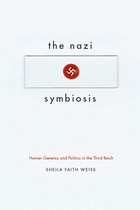
The Faustian bargain—in which an individual or group collaborates with an evil entity in order to obtain knowledge, power, or material gain—is perhaps best exemplified by the alliance between world-renowned human geneticists and the Nazi state. Under the swastika, German scientists descended into the moral abyss, perpetrating heinous medical crimes at Auschwitz and at euthanasia hospitals. But why did biomedical researchers accept such a bargain?
The Nazi Symbiosis offers a nuanced account of the myriad ways human heredity and Nazi politics reinforced each other before and during the Third Reich. Exploring the ethical and professional consequences for the scientists involved as well as the political ramifications for Nazi racial policies, Sheila Faith Weiss places genetics and eugenics in their larger international context. In questioning whether the motives that propelled German geneticists were different from the compromises that researchers from other countries and eras face, Weiss extends her argument into our modern moment, as we confront the promises and perils of genomic medicine today.


Charts the global resonance of the image of Nefertiti over the past century.
From the moment that the bust of Nefertiti was uncovered after over 3,000 years and shown at its first exhibition in Berlin in 1924, it rapidly became an iconic image. Today, the silhouette alone of this powerful Ancient Egyptian queen is recognized and admired around the world.
In Nefertiti: The Making of a Global Icon, historian Sebastian Conrad tracks the full story of the world’s embrace and appropriation of this famous visage. Starting with the discovery of the bust and Germany’s claims to its possession, Conrad shows how it became a contested object, tracing Egypt’s efforts to call for its restitution from 1924 to the present. He also canvasses the uses to which Nefertiti’s image has been put and the causes with which it has been associated: for cosmetic ads and beauty clinics; by advocates for European unity; by drag queens and the queer community; by National Socialists; by nationalists in Egypt and Bengal; by Afro-Brazilian communities; and by important Black figures from Elijah Muhammad to Beyoncé. Against a global backdrop, Conrad showcases the stunning object’s fame and the often-controversial issues and debates in which it has been embroiled. He also argues that the story of Nefertiti’s trajectory offers insights into the changing shape of globalization from the era of imperialism to the present.
This accessible, deeply researched book reveals both how much is at stake in the life of objects and how Nefertiti’s arresting likeness continues to challenge us today.

"This is a fascinating local story with major implications for studies of nationalism and regional identities throughout Europe more generally."
---Dennis Sweeney, University of Alberta
"James Bjork has produced a finely crafted, insightful, indeed, pathbreaking study of the interplay between religious and national identity in late nineteenth-century Central Europe."
---Anthony Steinhoff, University of Tennessee at Chattanooga
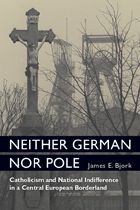
Neither German nor Pole examines how the inhabitants of one of Europe's most densely populated industrial districts managed to defy clear-cut national categorization, even in the heyday of nationalizing pressures at the turn of the twentieth century. As James E. Bjork argues, the "civic national" project of turning inhabitants of Upper Silesia into Germans and the "ethnic national" project of awakening them as Poles both enjoyed successes, but these often canceled one another out, exacerbating rather than eliminating doubts about people's national allegiances. In this deadlock, it was a different kind of identification---religion---that provided both the ideological framework and the social space for Upper Silesia to navigate between German and Polish orientations. A fine-grained, microhistorical study of how confessional politics and the daily rhythms of bilingual Roman Catholic religious practice subverted national identification, Neither German nor Pole moves beyond local history to address broad questions about the relationship between nationalism, religion, and modernity.
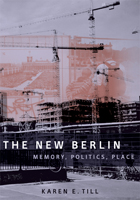
“The New Berlin is a notable contribution to human geography and to the interdisciplinary literature on social memory and place making. Till’s methods and scholarship have provided the conceptual groundwork for the exploration and development of place making, social memory, and spatial haunting through the particular practices and politics of the new Berlin. Her readable style is marked by a narrative economy in which every word and sentence serves the larger purposes of the book. I recommend this book to anyone—student, scholar, or practitioner—who is interested in the social dynamics of memory formation and place making.” —The Professional Geographer
“This book is a well-written ‘first-hand’ account, though it also thoroughly covers academic literature, contemporary news accounts, and archival records.” —German Studies Review
“Karen E. Till's The New Berlin describes the modern metropolis and the ghosts of the past that it has to deal with.” —German World
“Well illustrated and copiously footnoted, this is a cutting-edge study of the power of identity-construction/analysis. Highly recommended.” —CHOICE
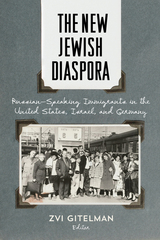

This study examines the history of Zionist academic Orientalism—referred to throughout as Oriental studies, the term contemporary English speakers would have used—in light of its German-Jewish background, as a history of knowledge transfer stretching along an axis from Germany to Palestine. The transfer, which took place primarily during the 1920s and 1930s, involved questions about the re-establishment, far from Germany, of a field of knowledge with deep German roots. Like other German-Jewish scholars arriving in Palestine at the time, some of the Orientalist agents of transfer did so out of Zionist conviction as olim (immigrants making aliyah, or literally “ascending” to the homeland), while others joined them later as refugees from Nazi Germany; both groups were integrated into the institutional apparatus of the Hebrew University. Unlike other fields of knowledge or professions, however, the transfer of Orientalist knowledge was unique in that the axis involved an essential change in the nature of its encounter with the Orient: from a textual-scientific encounter at German universities, largely disconnected from contemporary issues to a living, substantive, and unmediated encounter with an essentially Arab region—and the escalating Jewish-Arab conflict in the background. Within the new context, German-Jewish Orientalist expertise was charged with political and cultural significance it had not previously faced, fundamentally influencing the course of the discipline’s development in Palestine and Israel.

Published in 1894 as its subject languished in madness, Salomé's book rode the crest of a surge of interest in Nietzsche's iconoclastic philosophy. She discusses his writings and such biographical events as his break with Wagner, attempting to ferret out the man in the midst of his works.
Salomé's provocative conclusion -- that Nietzsche's madness was the inevitable result of his philosophical views -- generated considerable controversy. Nietzsche's sister, Elisabeth Förster-Nietzsche, dismissed the book as a work of fantasy. Yet the philosopher's longtime acquaintance Erwin Rohde wrote, "Nothing better or more deeply experienced or perceived has ever been written about Nietzsche."
Siegfried Mandel's extensive introduction examines the circumstances that brought Lou Salomé and Nietzsche together and the ideological conflicts that drove them apart.
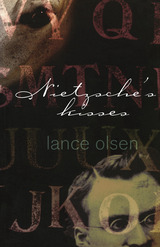

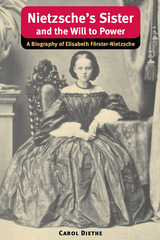
In 1901, a year after her brother Friedrich's death, Elisabeth Förster-Nietzsche published The Will to Power, a hasty compilation of writings he had never intended for print. In Nietzsche's Sister and the Will to Power, Carol Diethe contends that Förster-Nietzsche's own will to power and her desire to place herself--not her brother--at the center of cultural life in Germany are centrally responsible for Nietzsche's reputation as a belligerent and proto-Fascist thinker.
Offering a new look at Nietzsche's sister from a feminist perspective, this spirited and erudite biography examines why Elisabeth Förster-Nietzsche recklessly consorted with anti-Semites, from her own husband to Hitler himself, out of convenience and a desire for revenge against a brother whose love for her waned after she caused the collapse of his friendship with Lou Salomé. The book also examines their family dynamics, Nietzsche's dismissal of his sister's early writing career, and the effects of limited education on intelligent women. Diethe concludes by detailing Förster-Nietzsche's brief marriage and her subsequent colonial venture in Paraguay, maintaining that her sporadic anti-Semitism was, like most things in her life, an expedient tool for cultivating personal success and status.
A volume in the series International Nietzsche Studies, edited by Richard Schacht
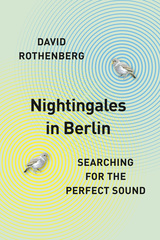
But have you ever listened closely to a nightingale’s song? It’s a strange and unsettling sort of composition—an eclectic assortment of chirps, whirs, trills, clicks, whistles, twitters, and gurgles. At times it is mellifluous, at others downright guttural. It is a rhythmic assault, always eluding capture. What happens if you decide to join in?
As philosopher and musician David Rothenberg shows in this searching and personal new book, the nightingale’s song is so peculiar in part because it reflects our own cacophony back at us. As vocal learners, nightingales acquire their music through the world around them, singing amidst the sounds of humanity in all its contradictions of noise and beauty, hard machinery and soft melody. Rather than try to capture a sound not made for us to understand, Rothenberg seeks these musical creatures out, clarinet in tow, and makes a new sound with them. He takes us to the urban landscape of Berlin—longtime home to nightingale colonies where the birds sing ever louder in order to be heard—and invites us to listen in on their remarkable collaboration as birds and instruments riff off of each other’s sounds. Through dialogue, travel records, sonograms, tours of Berlin’s city parks, and musings on the place animal music occupies in our collective imagination, Rothenberg takes us on a quest for a new sonic alchemy, a music impossible for any one species to make alone. In the tradition of The Hidden Life of Trees and The Invention of Nature, Rothenberg has written a provocative and accessible book to attune us ever closer to the natural environment around us.

Sunday evening, Tegel Airport, Berlin: A woman strikes up a conversation with a man, Robert Sturm, who is thirty-six years old and eighteen years her junior. He is on his way to Siberia and will return the following Saturday. She cannot wait . . .
In 1981 she came to West Berlin as an eighteen-year-old to study medicine and met Viktor, who was twice her age. Though he opened the world up to her, he remained closed himself. At the turn of the millennium and thirty-six, she meets Johann. He is thirty-six too. They try to make a life together, but their jobs aren’t the only things that are precarious. Saturday morning, Tegel Airport again: For six days, her everyday life and her memories have become entwined. Why are the men in her life always thirty-six? Is she still the person she remembers? Or, being someone who knows their way around the mind, is she in fact what she has forgotten?
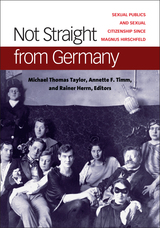
Two visual sourcebooks and catalog essays on an exhibition of contemporary artists’ responses to the Hirschfeld historical materials interrogate the modes of visual representation that Hirschfeld employed by re-imagining the public visibility of his institute from a contemporary perspective. The archival material includes stunning, never-before-published images from Hirschfeld’s institute that challenge many received ideas, while the scholarly and art catalog essays explore collaboration and dialogue as methods of research and activism that resonate beyond the academy to pressing issues of public concern.

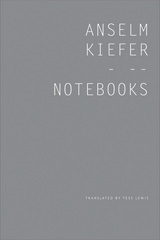
The first volume of Notebooks spans the years 1998-1999 and traces the origins and creative process of Kiefer’s visual works during this period. In this volume, Kiefer returns constantly to his touchstones: sixteenth-century alchemist Robert Fludd, German romantic poet Novalis, Martin Heidegger, Ingeborg Bachmann, Robert Musil, and many other writers and thinkers. The entries reveal the process by which his artworks are informed by his reading—and vice versa—and track the development of the works he created in the late 1990s. Translated into English for the first time by Tess Lewis, the diaries reveal Kiefer’s strong affinity for language and let readers witness the process of thoughts, experiences, and adventures slowly transcending the limits of art, achieving meaning in and beyond their medium.
Praise for Kiefer
“His works recall, in this sense, the grand tradition of history painting, with its notion about the elevated role of art in society, except that they do not presume moral certainty. What makes Kiefer’s work so convincing . . . is precisely its ambiguity and self-doubt, its rejection of easy solutions, historical amnesia, and transcendence.”—New York Times
“Wordiness for Kiefer is painterliness. The library and the gallery, the book and the frame inseparable, even interchangeable, in his monumental archive of human memory. Not since Picasso’s Guernica have pictures demanded so urgently that we studiously reflect and recollect in their presence.”—Simon Schama
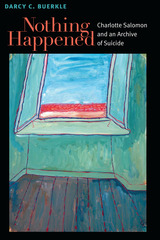
Charlotte Salomon's (1917-43) fantastical autobiography, Life? or Theater?, consists of 769 sequenced gouache paintings, through which the artist imagined the circumstances of the eight suicides in her family, all but one of them women. But Salomon's focus on suicide was not merely a familial idiosyncrasy. Nothing Happened argues that the social history of early-twentieth-century Germany has elided an important cultural and social phenomenon by not including the story of German Jewish women and suicide. This absence in social history mirrors an even larger gap in the intellectual history of deeply gendered suicide studies that have reproduced the notion of women's suicide as a rarity in history. Nothing Happened is a historiographic intervention that operates in conversation and in tension with contemporary theory about trauma and the reconstruction of emotion in history.

A member of the generation of the 1770s that included Hegel, Hölderlin, and Schelling, Hardenberg was an avid follower of the French Revolution, a semiotician avant la lettre, and a prescient critic of religion. Yet in 1802, only a year after his death, the writer who had scandalized the Prussian court was marketed to a nation at war as a reactionary patriot, a sweet versifier of Idealism, and a morbid mystic. Identifying the break between Hardenberg’s own early Romanticism and the late Romanticism that falsified it, Novalis shows us a writer fully engaged in revolutionary politics and examines his semiotic readings of philosophy and of the political, scientific, and religious institutions of the day. Drawing on the full range of Novalis’s writings, including his poetry, notebooks, novels, and journals, O’Brien situates his semiotics between those of the eighteenth century and those of the twentieth and demonstrates the manner in which a concern for signs and language permeated all aspects of his thought.
The most extensive study of Hardenberg available in English, Novalis makes this revolutionary theoretician visible for the first time. Mining a crucial chapter in the history of semiotics and social theory, it suggests fruitful, sometimes problematic connections between semiotic, historical, "deconstructive," and philological practices as it presents a portrait of one of the most complex figures in literary history. Indispensable for scholars of German Romanticism, Novalis will also be of interest to students of comparative literature and European intellectual history.
READERS
Browse our collection.
PUBLISHERS
See BiblioVault's publisher services.
STUDENT SERVICES
Files for college accessibility offices.
RECENTLY PUBLISHED

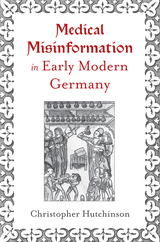





UChicago Accessibility Resources
home | accessibility | search | about | contact us
BiblioVault ® 2001 - 2026
The University of Chicago Press