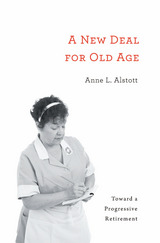
front cover of A New Deal for Old Age
A New Deal for Old Age
Toward a Progressive Retirement
Anne L. Alstott
Harvard University Press, 2016

As America’s haves and have-nots drift further apart, rising inequality has undermined one of the nation’s proudest social achievements: the Social Security retirement system. Unprecedented changes in longevity, marriage, and the workplace have made the experience of old age increasingly unequal. For educated Americans, the traditional retirement age of 65 now represents late middle age. These lucky ones typically do not face serious impediments to employment or health until their mid-70s or even later. By contrast, many poorly educated earners confront obstacles of early disability, limited job opportunities, and unemployment before they reach age 65.

America’s system for managing retirement is badly out of step with these realities. Enacted in the 1930s, Social Security reflects a time when most workers were men who held steady jobs until retirement at 65 and remained married for life. The program promised a dignified old age for rich and poor alike, but today that egalitarian promise is failing. Anne L. Alstott makes the case for a progressive program that would permit all Americans to retire between 62 and 76 but would provide more generous early retirement benefits for workers with low wages or physically demanding jobs. She also proposes a more equitable version of the outdated spousal benefit and a new phased retirement option to permit workers to transition out of the workforce gradually.

A New Deal for Old Age offers a pragmatic and principled agenda for renewing America’s most successful and popular social welfare program.

[more]

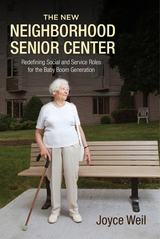
front cover of The New Neighborhood Senior Center
The New Neighborhood Senior Center
Redefining Social and Service Roles for the Baby Boom Generation
Weil, Joyce
Rutgers University Press, 2014
In 2011, seven thousand American “baby boomers” (those born between 1946 and 1964) turned sixty-five daily. As this largest U.S. generation ages, cities, municipalities, and governments at every level must grapple with the allocation of resources and funding for maintaining the quality of life, health, and standard of living for an aging population. 

In The New Neighborhood Senior Center, Joyce Weil uses in-depth ethnographic methods to examine a working-class senior center in Queens, New York. She explores the ways in which social structure directly affects the lives of older Americans and traces the role of political, social, and economic institutions and neighborhood processes in the decision to close such centers throughout the city of New York. 

Many policy makers and gerontologists advocate a concept of “aging in place,” whereby the communities in which these older residents live provide access to resources that foster and maintain their independence. But all “aging in place” is not equal and the success of such efforts depends heavily upon the social class and availability of resources in any given community. Senior centers, expanded in part by funding from federal programs in the 1970s, were designed as focal points in the provision of community-based services. However, for the first wave of “boomers,” the role of these centers has come to be questioned.  

Declining government support has led to the closings of many centers, even as the remaining centers are beginning to “rebrand” to attract the boomer generation. However, The New Neighborhood Senior Centerdemonstrates the need to balance what the boomers’ want from centers with the needs of frailer or more vulnerable elders who rely on the services of senior centers on a daily basis. Weil challenges readers to consider what changes in social policies are needed to support or supplement senior centers and the functions they serve. 
[more]

front cover of The Ninth Decade
The Ninth Decade
An Octogenarian’s Chronicle
Klaus, Carl H.
University of Iowa Press, 2021
The Ninth Decade is a path-breaking and timely book on aging: the first to focus explicitly and at length on eighty-somethings, the fastest-growing demographic in the industrialized world. Covering eight years in lively six-month installments, Klaus tells a vivid story not only of his own ninth decade and survival routines, but also of his loving companion, Jackie, who is strikingly different from him in her physical well-being, practical outlook, sociable temperament, and vigorous workouts. Cameos of their octogenarian friends and relatives near and far add to a wide-ranging and revelatory portrayal of advanced aging, as do bios of notable octogenarians.

The multi-year scope of his chronicle reveals the numerous physical and mental problems that arise during octogenarian life and how eighty-year-olds have dealt with those challenges. The Ninth Decade is a unique, first-hand source of information for anyone in their sixties, seventies, or eighties, as well as for persons devoted to care of the aged. Though the challenges of octogenarian life often require specialized care, The Ninth Decade also shows the pleasures of it to be so special as to have inspired Lillian Hellman’s paradoxical description of “longer life” as “the happy problem of our time.”

 
[more]

front cover of Normal Aging III
Normal Aging III
Reports from the Duke Longitudinal Studies, 1975–1984
Erdman Palmore, Ewald Busse, George Maddox, John Nowlin, and Ilene Siegler, eds.
Duke University Press, 1985
Since they began in 1955, the Duke Longitudinal Studies have aging have been regarded as landmark investigations, amassing invaluable data on the typical physical changes that accompany aging, typical patterns of mental health and mental illness, psychological aging, and the normal social roles, self-concepts, satisfactions, and adjustments to retirement of the aged. Comprising information on more than 750 aged and middle-aged persons, these studies have contributed enormously to our ability to distinguish normal and inevitable processes of aging from those that may accompany aging because of accident, stress, maladjustment, or disuse.
[more]


Send via email Share on Facebook Share on Twitter