
 A SCHOLARLY BOOK REPOSITORY
5 start with O start with O
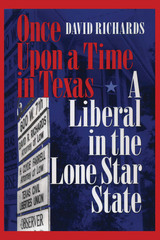
Once upon a time in Texas...there were liberal activists of various stripes who sought to make the state more tolerant and more tolerable. David Richards was one of them. In this fast-paced, often humorous memoir, he remembers the players, the strategy sessions, the legal and political battles, and the wins and losses that brought significant gains in civil rights, voter rights, labor law, and civil liberties to the people of Texas from the 1950s to the 1990s.
In his work as a lawyer, Richards was involved in cases covering voters' rights, school finance reform, and a myriad of civil liberties and free speech cases. In telling these stories, he vividly evokes the "glory days" of Austin liberalism, when a who's who of Texas activists plotted strategy at watering holes such as Scholz Garden and the Armadillo World Headquarters. Likewise, he offers vivid portraits of liberal politicians from Ralph Yarborough to Ann Richards (his former wife), progressive journalists such as Molly Ivins and the Texas Observer staff, and the hippies, hellraisers, and musicians who all challenged Texas's conservative status quo.
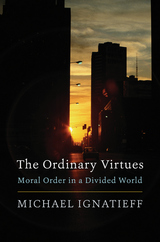
Winner of the Zócalo Book Prize
A New York Times Book Review Editors’ Choice
“Combines powerful moral arguments with superb storytelling.”
—New Statesman
What moral values do we hold in common? As globalization draws us together economically, are the things we value converging or diverging? These twin questions led Michael Ignatieff to embark on a three-year, eight-nation journey in search of an answer. What we share, he found, are what he calls “ordinary virtues”: tolerance, forgiveness, trust, and resilience. When conflicts break out, these virtues are easily exploited by the politics of fear and exclusion, reserved for one’s own group but denied to others. Yet these ordinary virtues are the key to healing and reconciliation on both a local and global scale.
“Makes for illuminating reading.”
—Simon Winchester, New York Review of Books
“Engaging, articulate and richly descriptive… Ignatieff’s deft histories, vivid sketches and fascinating interviews are the soul of this important book.”
—Times Literary Supplement
“Deserves praise for wrestling with the devolution of our moral worlds over recent decades.”
—Los Angeles Review of Books
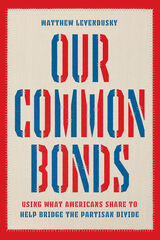
One of the defining features of twenty-first-century American politics is the rise of affective polarization: Americans increasingly not only disagree with those from the other party but distrust and dislike them as well. This has toxic downstream consequences for both politics and social relationships. Is there any solution?
Our Common Bonds shows that—although there is no silver bullet that will eradicate partisan animosity—there are concrete interventions that can reduce it. Matthew Levendusky argues that partisan animosity stems in part from partisans’ misperceptions of one another. Democrats and Republicans think they have nothing in common, but this is not true. Drawing on survey and experimental evidence, the book shows that it is possible to help partisans reframe the lens through which they evaluate the out-party by priming commonalities—specifically, shared identities outside of politics, cross-party friendships, and common issue positions and values identified through civil cross-party dialogue. Doing so lessons partisan animosity, and it can even reduce ideological polarization. The book discusses what these findings mean for real-world efforts to bridge the partisan divide.
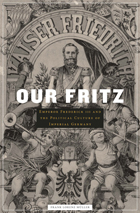
On June 15, 1888, a mere ninety-nine days after ascending the throne to become king of Prussia and German emperor, Frederick III succumbed to throat cancer. Europeans were spellbound by the cruel fate nobly borne by the voiceless Fritz, who for more than two decades had been celebrated as a military hero and loved as a kindly gentleman. A number of grief-stricken individuals reportedly offered to sacrifice their own healthy larynxes to save the ailing emperor.
Frank Lorenz Müller, in the first comprehensive life of Frederick III ever written, reconstructs how the hugely popular persona of “Our Fritz” was created and used for various political purposes before and after the emperor’s tragic death. Sandwiched between the reign of his ninety-year-old father and the calamitous rule of his own son, the future emperor William II, Frederick III served as a canvas onto which different political forces projected their hopes and fears for Germany's future. The book moves beyond the myth that Frederick’s humane liberalism would have built a lasting Anglo-German partnership, perhaps even preventing World War I, and beyond the castigations and exaggerations of parties with a different agenda. Surrounded by an unforgettable cast of characters that includes the emperor’s widely hated English wife, Vicky—daughter of Queen Victoria—and the scheming Otto von Bismarck, Frederick III offers in death as well as in life a revealing, poignant glimpse of Prussia, Germany, and the European world that his son would help to shatter.
READERS
Browse our collection.
PUBLISHERS
See BiblioVault's publisher services.
STUDENT SERVICES
Files for college accessibility offices.
RECENTLY PUBLISHED


UChicago Accessibility Resources
home | accessibility | search | about | contact us
BiblioVault ® 2001 - 2026
The University of Chicago Press