
 A SCHOLARLY BOOK REPOSITORY
7 start with O start with O

Spanning several decades, Ella Shohat's work has introduced conceptual frameworks that fundamentally challenged conventional understandings of Palestine, Zionism and the Middle East, focusing on the pivotal figure of the Arab-Jew. This book gathers together her most influential political essays, interviews, speeches, testimonies and memoirs, as well as previously unpublished material.
Defying the binarist and Eurocentric Arab-versus-Jew rendering of the Israeli/Palestinian conflict, Shohat's work has dared to engage with the deeper historical and cultural questions swirling around colonialism, Orientalism and nationalism. Shohat's paradigm-shifting work unpacks such fraught issues as the anomalies of the national/colonial in Zionist discourse; the narrating of Jewish pasts in Muslim spaces; the links and distinctions between the dispossession of the Nakba and the dislocation of Arab-Jews; the traumatic memories triggered by partition and border-crossing; the echoes within Islamophobia of the anti-Semitic figure of 'the Jew'; and the efforts to imagine a possible future inter-communal 'convivencia'.
Shohat's transdisciplinary perspective illuminates the cultural politics in and around the Middle East. Juxtaposing texts of various genres written in divergent contexts, the book offers a vivid sense of the author's intellectual journey.
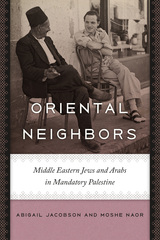
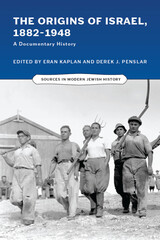
In 1880 the Jewish community in Palestine encompassed some 20,000 Orthodox Jews; within sixty-five years it was transformed into a secular proto-state with well-developed political, military, and economic institutions, a vigorous Hebrew-language culture, and some 600,000 inhabitants. The Origins of Israel, 1882–1948: A Documentary History chronicles the making of modern Israel before statehood, providing in English the texts of original sources (many translated from Hebrew and other languages) accompanied by extensive introductions and commentaries from the volume editors.
This sourcebook assembles a diverse array of 62 documents, many of them unabridged, to convey the ferment, dissent, energy, and anxiety that permeated the Zionist project from its inception to the creation of the modern nation of Israel. Focusing primarily on social, economic, and cultural history rather than Zionist thought and diplomacy, the texts are organized in themed chapters. They present the views of Zionists from many political and religious camps, factory workers, farm women, militants, intellectuals promoting the Hebrew language and arts—as well as views of ultra-Orthodox anti-Zionists. The volume includes important unabridged documents from the origins of the Arab-Israeli conflict that are often cited but are rarely read in full. The editors, Eran Kaplan and Derek J. Penslar, provide both primary texts and informative notes and commentary, giving readers the opportunity to encounter voices from history and make judgments for themselves about matters of world-historical significance.
Best Special Interest Books, selected by the Public Library Reviewers
Best Books for General Audiences, selected by the American Association of School Librarians
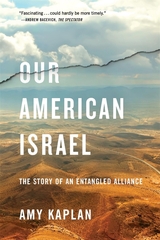
“Our American Israel is masterful and deserves a larger audience.” —Ta-Nehisi Coates
An essential account of America’s most controversial alliance, and how that strong and divisive partnership plays out in our own time.
In 1945, it was not inevitable that a global superpower emerging victorious from World War II would come to identify with a small state for Jewish refugees, refugees who at that time were still being turned away from the United States. How, then, did so many in America come to feel that the bond between it and Israel was historically inevitable, morally right, and a matter of common sense. Our American Israel reveals how Israel’s identity has long been entangled with America’s belief in its own exceptional nature. Beginning at the end of World War II with debates about the establishment of a Jewish state in Palestine and continuing through both the rise of evangelical Christian Zionism and the war on terror, Amy Kaplan challenges the associations underlying this special alliance.
Through popular narratives expressed in news media, fiction, and film, a shared sense of identity emerged from the two nations’ histories as settler societies. Americans projected their own origin myths onto Israel: the biblical promised land, the open frontier, the refuge for immigrants. Israel assumed a mantle of moral authority, based on its image as an “invincible victim,” a nation of intrepid warriors and concentration camp survivors. The image of the underdog shattered when Israel invaded Lebanon; its military was strongly censured around the world, including notes of dissent in the United States. Rather than a symbol of justice, Israel became a model of military strength and technological ingenuity.
In America today, Israel’s political realities pose profoundly difficult challenges. Turning a critical eye on the turbulent history that bound the two nations together, Kaplan unearths the roots of present controversies that threaten to divide them.
Michael Riordon takes us to thousand year-old olive groves, besieged villages, refugee camps, checkpoints and barracks. In the face of deepening conflict, Our Way to Fight offers courageous grassroots action on both sides of the wall, and points the way to a liveable future.
Even before he wrote his bestselling book The Ethnic Cleansing of Palestine, historian Ilan Pappe was a controversial figure in Israel. In Out of the Frame, he gives a full account of his break with mainstream Israeli scholarship and its consequences.
Here he traces his journey of discovery from the whispers of Palestinian classmates to his realisation that the 'enemy's' narrative of the events of 1948 was correct. After completing his thesis at Oxford University in the early 1980s, he returned to Palestine determined to protect the memory of the Nakbah. For the first time he gives the details of the formidable opposition he faced in Israel, including death threats fed by the media, denunciations by the Knesset and calls for him to be sacked from his post at Haifa university.
This revealing work, written with dignity and humour, highlights Israel's difficulty in facing up to its past and forging a peaceful, inclusive future in Palestine.
Joel Kovel argues that the inner contradictions of Zionism have led Israel to a ‘state-sponsored racism’ fully as incorrigible as that of apartheid South Africa and deserving of the same resolution. Only a path toward a single-state secular democracy can provide the justice essential to healing the wounds of the Middle East.
Kovel is well-known writer on the Middle East conflict. This book draws on his detailed knowledge to show that Zionism and democracy are essentially incompatible. He offers a thoughtful account of the emergence and disintegration of Zionism that integrates psychological, political, cultural, economic, and ideological levels.
Ultimately, Kovel argues, a two-state solution is essentially hopeless as it concedes too much to the regressive forces of nationalism, wherein lie the roots of continued conflict.
READERS
Browse our collection.
PUBLISHERS
See BiblioVault's publisher services.
STUDENT SERVICES
Files for college accessibility offices.
RECENTLY PUBLISHED



UChicago Accessibility Resources
home | accessibility | search | about | contact us
BiblioVault ® 2001 - 2025
The University of Chicago Press