
 A SCHOLARLY BOOK REPOSITORY
117 start with P start with P

In this concise analysis, written with elegant wit, the greatest living textual critic of Latin authors offers new insight into the poetry of Horace.
Horace is best known for his four books of Odes, cherished for their lyric grace. His amiable persona is displayed more intimately in the moralizing verses of the Satires and Epistles. In a reading of all the poetry, but focusing especially on problematic areas, Shackleton Bailey examines Horace's art of self-presentation. A variety of themes are elucidated, from the poet's relations with his patron to Roman sexual attitudes. Close scrutiny is given to about thirty passages which, he argues, have been misread. An appended essay on a notable predecessor, the textual scholar Richard Bentley, is especially revealing on the art of classical scholarship.
"The proper lady was a handy concept for a developing bourgeois patriarchy, since it deprived women of worldly power, relegating them to a sanctified domestic sphere that, in complex ways, nourished and sustained the harsh 'real' world of men. With care and subtle intelligence, Poovey examines this 'guardian and nemesis of the female self' through the ways it is implicated in the style and strategies of three very different writers."—Rachel M. Brownstein, The Nation
"The Proper Lady and the Woman Writer is a model of . . . creative discovery, providing a well-researched, illuminating history of women writers at the turn of the nineteenth century. [Poovey] creates sociologically and psychologically persuasive accounts of the writers: Wollstonecraft, who could never fully transcend the ideology of propriety she attacked; Shelley, who gradually assumed a mask of feminine propriety in her social and literary styles; and Austen, who was neither as critical of propriety as Wollstonecraft nor as accepting as Shelley ultimately became."—Deborah Kaplan, Novel
Through a close study of Cadalso, Saavedra, and Larra, Iarocci argues that Spanish writers were intensely concerned with the same issues taken up by more famous Romantics and that the ways in which they address these issues provides us with a richer notion, not only of Spain, but of all of Europe.
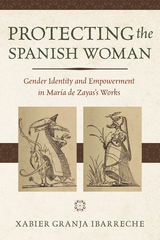
María de Zayas is unique in the seventeenth century as the only Spanish woman to write a collection of exemplary novels whose quality is often compared to Miguel de Cervantes’ masterful works. Her two main collections of short stories, Novelas amorosas y ejemplares and Desengaños amorosos, encompass a social critique based on literary fiction that exposes flaws in the idealized archetypes of masculine identity in early modern Spain. Zayas’s stories redefine women’s patriarchal disadvantage as a tool to expose the ways in which early modern Spanish women could be empowered to counteract men’s discursive and political authority, which they use to unfairly maintain their own social privilege.
Xabier Granja Ibarreche explores how Zayas defies Spanish hegemony by manipulating and transforming the ideals of courtly masculinity that had been popularized by conduct manuals and the traits they specified for appropriate noble comportment. In doing so, Zayas elaborates a nonofficial discourse throughout plots that subvert patriarchal hierarchies: she rearticulates the existing ideological order to empower women who are no longer willing to remain silent and oppressed by masculine domination after centuries of failing to attain a sufficiently self-sufficient political position to ascend in the social hierarchy. By inverting the male gaze that assumes masculinity as a preeminent identity, Zayas subverts the patriarchal subject/masculine, object/feminine order and destabilizes manly superiority as a basic universal reality, thereby empowering and unshackling Spanish women to liberate Iberian culture from the repressive and pernicious future she forebodes.
Known for her far-reaching examinations of psychoanalysis, literature, and politics, Jacqueline Rose has in recent years turned her attention to the Israel-Palestine conflict, one of the most enduring and apparently intractable conflicts of our time. In Proust among the Nations, she takes the development of her thought on this crisis a stage further, revealing it as a distinctly Western problem.
In nineteen original essays, a foreword by Jean–Yves Tadié, and an introduction by editors Armine Kotin Mortimer and Katherine Kolb, this volume guides readers through the dense weave of Proust's fiction and correspondence. The essays take us into the realm of Proustian language–-as quotation, metaphor, and memory–-and into art history and musical ideology, connecting the art of words with the words of art. They explore the interface of history and fiction, the mysteries of the text's evolution, and the dilemmas of its publication. They present the revelations of genetic criticism and the surprises of gender analysis.
Taken together, these essays conjure a multifaceted profile of Proust–-his work, life, character, and influence–-and of new directions in Proust scholarship today. With compelling rigor and infectious enthusiasm, Proust in Perspective conveys the magnitude of Proust's continuing appeal.
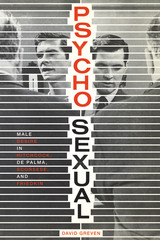
Bridging landmark territory in film studies, Psycho-Sexual is the first book to apply Alfred Hitchcock’s legacy to three key directors of 1970s Hollywood—Brian De Palma, Martin Scorsese, and William Friedkin—whose work suggests the pornographic male gaze that emerged in Hitchcock’s depiction of the voyeuristic, homoerotically inclined American man. Combining queer theory with a psychoanalytic perspective, David Greven begins with a reconsideration of Psycho and the 1956 remake of The Man Who Knew Too Much to introduce the filmmaker’s evolutionary development of American masculinity.
Psycho-Sexual probes De Palma’s early Vietnam War draft-dodger comedies as well as his film Dressed to Kill, along with Scorsese’s Taxi Driver and Friedkin’s Cruising as reactions to and inventive elaborations upon Hitchcock’s gendered themes and aesthetic approaches. Greven demonstrates how the significant political achievement of these films arises from a deeply disturbing, violent, even sorrowful psychological and social context. Engaging with contemporary theories of pornography while establishing pornography’s emergence during the classical Hollywood era, Greven argues that New Hollywood filmmakers seized upon Hitchcock’s radical decentering of heterosexual male dominance. The resulting images of heterosexual male ambivalence allowed for an investment in same-sex desire; an aura of homophobia became informed by a fascination with the homoerotic. Psycho-Sexual also explores the broader gender crisis and disorganization that permeated the Cold War and New Hollywood eras, reimagining the defining premises of Hitchcock criticism.
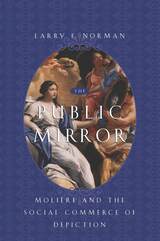
Pairing close readings of Molière's comedies with insightful accounts of French social history and aesthetics, Norman shows how Molière conceived of satire as a "public mirror" provoking dynamic exchange and conflict with audience members obsessed with their own images. Drawing on these tensions, Molière portrays characters satirizing one another on stage, with their reactions providing dramatic conflict and propelling comic dialogue. By laying bare his society's system of imagining itself, Molière's satires both enthralled and enraged his original audience and provide us with a crucial key to the classical culture of representation.
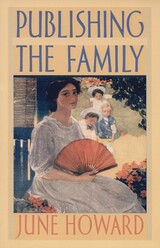
Publishing the Family describes the sources and controversial outcome of a fascinating literary experiment. Howard embeds the story of The Whole Family in the story of Harper & Brothers’ powerful and pervasive presence in American cultural life, treating the publisher, in effect, as an author.
Each chapter of Publishing the Family casts light on some aspect of life in the United States at a moment that arguably marked the beginning of our own era. Howard revises common views of the turn-of-the-century literary marketplace and discusses the perceived crisis in the family as well as the popular and expert discourses that emerged to remedy it. She also demonstrates how creative women like Bazar editor Elizabeth Jordan blended their own ideas about the “New Woman” with traditional values. Howard places these analyses in the framework of far-reaching historical changes, such as the transformation of the public meaning of emotion and “sentimentality.” Taken together, the chapters in Publishing the Family show how profoundly the modern mapping of social life relies on boundaries between family and business, culture and commerce, which The Whole Family and Publishing the Family constantly unsettle.
Publishing the Family will interest students and scholars of American history, literature, and culture, as well as those studying gender, sexuality, and the family.
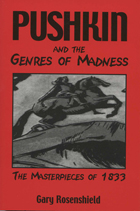
In 1833 Alexander Pushkin began to explore the topic of madness, a subject little explored in Russian literature before his time. The works he produced on the theme are three of his greatest masterpieces: the prose novella The Queen of Spades, the narrative poem The Bronze Horseman, and the lyric "God Grant That I Not Lose My Mind." Gary Rosenshield presents a new interpretation of Pushkin’s genius through an examination of his various representations of madness.
Pushkin brilliantly explored both the destructive and creative sides of madness, a strange fusion of violence and insight. In this study, Rosenshield illustrates the surprising valorization of madness in The Queen of Spades and "God Grant That I Not Lose My Mind" and analyzes The Bronze Horseman’s confrontation with the legacy of Peter the Great, a cornerstone figure of Russian history. Drawing on themes of madness in western literature, Rosenshield situates Pushkin in a greater framework with such luminaries as Shakespeare, Sophocles, Cervantes, and Dostoevsky providing an insightful and absorbing study of Russia’s greatest writer.
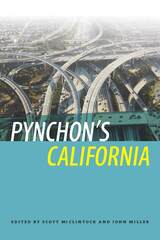
Contributors explore such topics as the relationship of the “California novels” to Pynchon’s more historical and encyclopedic works; the significance of California's beaches, deserts, forests, freeways, and “hieroglyphic” suburban sprawl; the California-inspired noir tradition; and the surprising connections to be uncovered between drug use and realism, melodrama and real estate, private detection and the sacred. The authors bring insights to bear from an array of critical, social, and historical discourses, offering new ways of looking not only at Pynchon’s California novels, but at his entire oeuvre. They explore both how the history, geography, and culture of California have informed Pynchon’s work and how Pynchon’s ever-skeptical critical eye has been turned on the state that has been, in many ways, the flagship for postmodern American culture.
CONTRIBUTORS: Hanjo Berressem, Christopher Coffman, Stephen Hock, Margaret Lynd, Scott MacLeod, Scott McClintock, Bill Millard, John Miller, Henry Veggian

is a provocative, intelligent analysis of V., The Crying of Lot 49, Gravity's
Rainbow, and Vineland. Hanjo Berrssem examines these works in the
light of post-structuralist thought and literary theory, investigating the notion
of subjectivity and the relations between the subject, culture, and language.
READERS
Browse our collection.
PUBLISHERS
See BiblioVault's publisher services.
STUDENT SERVICES
Files for college accessibility offices.
RECENTLY PUBLISHED




UChicago Accessibility Resources
home | accessibility | search | about | contact us
BiblioVault ® 2001 - 2025
The University of Chicago Press