
 A SCHOLARLY BOOK REPOSITORY
17 start with P start with P

Pataphysics and Surrealism in Alabama: A Cultural History by Steven Harris is the first book to explore the history of a series of interrelated artistic and cultural movements that originated in Tuscaloosa and Birmingham, Alabama. Harris interviewed twenty-six individuals involved in Raudelunas and its subgroups, and those interviews, along with existing primary sources like sound recordings and publications, have largely shaped the rich history that unfolds within. The book is divided into five chapters, beginning with situating the study within contexts of Alabama, Dada, pataphysics, surrealism, and improvised music. Subsequent chapters delve into the histories of Raudelunas, Transcendprovisation, and the Glass Veal, respectively, and the final chapter follows several key members into the present. It also includes a timeline of major events, biographies of key members, and an anthology of representative writings by the participants.
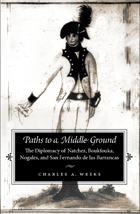
Weeks shows how diplomatic relations were established and maintained in the Gulf South between Choctaw, Chickasaw, Creek, and Cherokee chiefs and their Spanish counterparts aided by traders who had become integrated into Indian societies. He explains that despite the absence of a European state system, Indian groups had diplomatic skills that Europeans could understand: full-scale councils or congresses accompanied by elaborate protocol, interpreters, and eloquent metaphorical language.
Paths to a Middle Ground is both a narrative and primary documents. Key documents from Spanish archival sources serve as a basis for the examination of the political culture and imperial rivalry playing out in North America in the waning years of the 18th century.
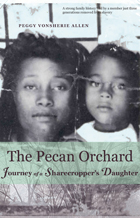
This is a true story of the struggle, survival, and ultimate success of a large black family in south Alabama who, in the middle decades of the 20th century, lifted themselves out of poverty to achieve the American dream of property ownership. Descended from slaves and sharecroppers in the Black Belt region, this family of hard-working parents and their thirteen children is mentored by its matriarch, Moa, the author’s beloved great grandmother, who passes on to the family, along with other cultural wealth, her recipe for moonshine.
Without rancor or blame, and even with occasional humor, The Pecan Orchard offers a window into the inequities between blacks and whites in a small southern town still emerging from Jim Crow attitudes.
Told in clean, straightforward prose, the story radiates the suffocating midday heat of summertime cotton fields and the biting winter wind sifting through porous shanty walls. It conveys the implicit shame in “Colored Only” restrooms, drinking fountains, and eating areas; the beaming satisfaction of a job well done recognized by others; the “yessum” manners required of southern society; and the joyful moments, shared memories, and loving bonds that sustain—and even raise—a proud family.
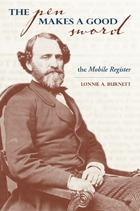
One editor. One era. A pen that cut through history.
This book is a biography of Alabama native John Forsyth Jr. and documents his career as a southern newspaper editor during the antebellum, Civil War, and Reconstruction periods. From 1837 to 1877 Forsyth wrote about many of the most important events of the 19th century. He used his various positions as an editor, Civil War field correspondent, and Reconstruction critic at the MobileRegister to advocate on behalf of both the South and the Democratic Party.
In addition, Forsyth played an active role in the events taking place around him through his political career, as United States Minister to Mexico, state legislator, Confederate Peace Commissioner to the Lincoln administration, staff officer to Braxton Bragg, and twice mayor of the city of Mobile.
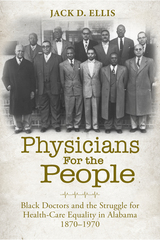
WINNER OF THE JAMES F. SULZBY AWARD
Healing against the odds—Black doctors, bold resistance, and the fight for medical justice in Alabama.
Physicians for the People chronicles the remarkable stories of 241 Black doctors who practiced medicine in Alabama during the Jim Crow era. Historian Jack D. Ellis reveals the ingenuity and resilience of these trailblazing doctors who defied segregation by establishing hospitals and clinics and providing vital healthcare to underserved Black communities.
This meticulously researched work draws on archival sources, oral histories, and an unparalleled database to dismantle the myth of a monolithic medical system in the Jim Crow South. Jack D. Ellis argues that the post–Civil War lives of Black physicians, dentists, pharmacists, nurses, and midwives hold special significance, illuminating both the causes of health care disparities among African Americans and the reasons for their continued underrepresentation in the medical professions.
Offering much of interest to students and scholars of Black history, medical history, and the civil rights movement, Physicians for the People exposes the deliberate exclusion faced by Black doctors within the white medical establishment and their ongoing fight for racial equality in medicine.
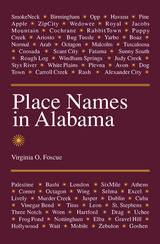
The first systematic attempt to account for all the names of the counties, cities, town, water courses, bodies of water, and mountains that appear on readily available maps of Alabama
“An invaluable resource for television news and talk shows…not to mention a treasure for trivia buffs!” —Tom York, WBRC-6
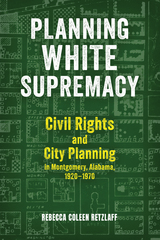
An unflinching account of how city planning was deployed to enforce white supremacy in Montgomery, Alabama—the birthplace of the Civil Rights Movement—and how Black activists fought back, block by neighborhood block.
At the heart of the Civil Rights Movement was a city meticulously designed to enforce inequality. In Planning White Supremacy: Civil Rights and City Planning in Montgomery, Alabama, 1920–1970, Rebecca Coleen Retzlaff traces how city officials used the tools of modern planning—zoning, infrastructure, housing codes, public investment, and highway construction—to suppress political power, economic opportunity, and spatial freedom for Black citizens.
As the birthplace of the Civil Rights Movement, Montgomery became a battleground where urban planning and direct-action protest collided, shaping the city’s culture in ways that still resonate today. Retzlaff’s analysis exposes the calculated use of municipal power to control land use, displace Black communities, keep schools and neighborhoods segregated, and preserve white political dominance. By placing urban planning at the center of Montgomery’s story, this groundbreaking work reframes the movement not only as a fight for voting rights and legal equality, but as a struggle for space, housing, mobility, education, and the right to live with dignity. Retzlaff also highlights the resilience and joy of the close-knit Black neighborhoods that nurtured the civil rights activists who changed history.
Retzlaff reveals how urban planning decisions systematically targeted Black neighborhoods, reinforcing racial inequality under the guise of modernization. With historical depth and critical insight, Planning White Supremacy situates Montgomery within the broader context of American urban history—offering a vital perspective on the intersection of race, space, and power. Essential for scholars of urban planning, history, and racial justice, this book also provides urgent insight into how these legacies continue to shape cities and Black socioeconomic opportunities today.

Wisteria, mistletoe, oleander, milkweed, narcissus, yellow Jessamine, wild hydrangea, trillium, all are plants easily recognized by most people. But these and more that 200 other plants in Alabama and the Southeast can cause systemic poisoning if ingested by human beings and livestock. This book describes these poisonous plants, including various mushrooms, and discusses the toxic properties, symptoms of poisoning, habitat occurrence, and geographic distribution. One chapter describes plants that cause dermatitis or other allergic reactions-plants including poison ivy, poison sumac, ragweed, clematis, and red maple.
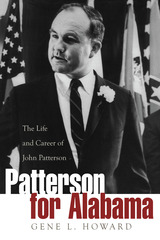
Exploring who benefits and who pays when different narratives are accepted as true, Pride offers a step-by-step account of how Mobile's culture changed each time a new and more forceful narrative was used to justify inequality. More than a retelling of Mobile's story of desegregation, The Political Use of Racial Narratives promotes the value of rhetorical and narrative analysis in the social sciences and history.
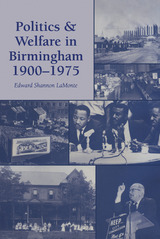
This well-written volume explores the relationships between politics and welfare programs for low-income residents in Birmingham during four periods in the twentieth century:
From the time of its founding in 1871, Birmingham has had a biracial population, so the theme of race relations runs naturally throughout the narrative. LaMonte pays particular attention to those efforts to achieve a more harmonious biracial community, including the failed effort to establish an Urban League in the 1940s, the progressive activities of the Community Chest’s Interracial Division in the 1950s, which were abruptly terminated, and the dramatic events of the Civil Rights Movement in the 1960s, when local events were elevated to international significance.
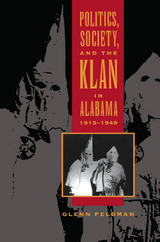
exhaustive research that challenges traditional interpretations.
The Ku Klux Klan has wielded considerable power both as
a terrorist group and as a political force. Usually viewed as appearing
in distinct incarnations, the Klans of the 20th century are now shown by
Glenn Feldman to have a greater degree of continuity than has been previously
suspected. Victims of Klan terrorism continued to be aliens, foreigners,
or outsiders in Alabama: the freed slave during Reconstruction, the 1920s
Catholic or Jew, the 1930s labor organizer or Communist, and the returning
black veteran of World War II were all considered a threat to the dominant
white culture.
Feldman offers new insights into this "qualified continuity"
among Klans of different eras, showing that the group remained active during
the 1930s and 1940s when it was presumed dormant, with elements of the
"Reconstruction syndrome" carrying over to the smaller Klan of the civil
rights era.
In addition, Feldman takes a critical look at opposition to
Klan activities by southern elites. He particularly shows how opponents
during the Great Depression and war years saw the Klan as an impediment
to attracting outside capital and federal relief or as a magnet for federal
action that would jeopardize traditional forms of racial and social control.
Other critics voiced concerns about negative national publicity, and others
deplored the violence and terrorism.
This in-depth examination of the Klan
in a single state, which features rare photographs, provides a means of
understanding the order's development throughout the South. Feldman's book
represents definitive research into the history of the Klan and makes a
major contribution to our understanding of both that organization and the
history of Alabama.
Library of Alabama Classics
Winner of the Albert J. Beveridge Award of the American Historical Association
“In this excellent study of Alabama politics, Hackney deftly analyzes the leadership, following, and essential character of Populism and Progressivism during the period from 1890 to 1910. The work is exceptionally well written; it deals with the personal, social, and political intricacies involved; and it combines traditional and quantitative techniques with a clarity and imagination that should serve as a spur and a model for many future studies.” – Annals of the American Academy of Political and Social Science
“Whatever the ultimate judgment on its conclusions may be, this is an important study and one that should stimulate additional research.
“Hackney has very skillfully integrated his quantitative findings and the results of more traditional research. In this respect the book should for some time be a prime exhibit of the utility of the ‘new political history’ [and] we should receive Hackney’s contribution with both gratitude and admiration.” – Journal of Interdisciplinary History
Sheldon Hackney is a native Alabamian, and -- perhaps aptly -- the son-in-law of courageous Alabama progressives Virginia and Clifford Durr. A student of C. Vann Woodward at Yale, Hackney taught at Princeton University, served as president of Tulane University (1975-80) and the University of Pennsylvania (1981-1993). In 1993 he was appointed by President Clinton as chairman of the National Endowment for the Humanities, where he served until 1997. After his NEH service he returned to the University of Pennsylvania as Boies Professor of United States History.

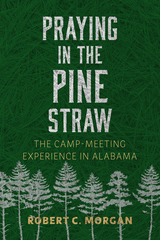
Step into the South’s brush arbors and piney woods where faith runs deep, stories run wild, and the old-time camp meeting was anything but quiet.
Praying in Pine Straw immerses readers in the raw, rollicking, and deeply human world of Alabama’s camp meetings—a Southern tradition where fire-and-brimstone preaching echoed through pine forests and where faith was often accompanied by contradiction. From “treeing the Devil” to “holy laughter,” these revivals blended heartfelt worship with all the complications of human nature. Mule-drawn wagons brought the faithful to rustic camps, where gospel fervor mingled with whiskey traders, local politicians, and opportunists of every kind. Preachers thundered against sin—even as they sometimes flirted with it themselves.
Robert C. Morgan offers a textured portrait of camp meetings as both spiritual experience and cultural spectacle, reviving a Southern tradition that flourished from the late nineteenth to mid-twentieth centuries. With a blend of humor and keen insight, Praying in the Pine Straw unveils the enduring contradictions of “old-time religion” and its significant influence on Southern culture and faith—a legacy that is both treasured and complex.
READERS
Browse our collection.
PUBLISHERS
See BiblioVault's publisher services.
STUDENT SERVICES
Files for college accessibility offices.
RECENTLY PUBLISHED





UChicago Accessibility Resources
home | accessibility | search | about | contact us
BiblioVault ® 2001 - 2026
The University of Chicago Press