
 A SCHOLARLY BOOK REPOSITORY
14 start with P start with P

Penumbra Theatre Company was founded in 1976 by Lou Bellamy as a venue for African American voices within the Twin Cities theatre scene and has stood for more than thirty-five years at the intersection of art, culture, politics, and local community engagement. It has helped launch the careers of many internationally respected theatre artists and has been repeatedly recognized for its artistic excellence as the nation’s foremost African American theatre.
Penumbra is the first-ever history of this barrier-breaking institution. Based on extensive interviews with actors, directors, playwrights, producers, funders, and critics, Macelle Mahala’s book offers a multifaceted view of the theatre and its evolution. Penumbra follows the company’s emergence from the influential Black Arts and settlement house movements; the pivotal role Penumbra played in the development of August Wilson’s career and, in turn, how Wilson became an avid supporter and advocate throughout his life; the annual production of Black Nativity as a community-building performance; and the difficult economics of African American theatre production and how Penumbra has faced these challenges for nearly four decades.
Penumbra is a testament to how a theatre can respond to and thrive within changing political and cultural realities while contributing on a national scale to the African American presence on the American stage. It is a celebration of theatre as a means of social and cultural involvement—both local and national—and ultimately, of Penumbra’s continuing legacy of theatre that is vibrant, diverse, and vital.
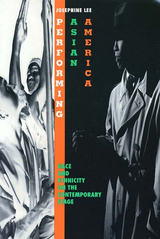
For instance, some Asian American playwrights critique the separation of issues of race and ethnicity from those of economics and class, or they see ethnic identity as a voluntary choice of lifestyle rather than an impetus for concerted political action. Others deal with the problem of cultural stereotypes and how to reappropriate their power. Lee is attuned to the complexities and contradictions of such performances, and her trenchant thinking about the criticisms lobbed at Asian American playwrights -- for their choices in form, perpetuation of stereotype, or apparent sexism or homophobia -- leads her to question how the presentation of Asian American identity in the theater parallels problems and possibilities of identity offstage as well.
Discussed are better-known plays such as Frank Chin's The Chickencoop Chinaman, David Henry Hwang's M. Butterfly, and Velina Hasu Houston's Tea, and new works like Jeannie Barroga's Walls and Wakako Yamauchi's 12-1-a.

Klaver applies post-structuralist theories of subjectivity to drama while ranging through Beckett’s plays, National Hockey League games, “The Tonight Show,” gay and lesbian drama, minority drama, avant-garde performance, and the topics of theatrical paranoia, the mediatized Imaginary, and the spectatorial gaze.

In Playhouse to Powerhouse, Kerry L. Goldmann explores the Black theatre movement through the lens of three significant women-led theatres that are still in operation today: Nora Vaughn’s Black Repertory Group in Berkeley, Barbara Ann Teer’s National Black Theatre in Harlem, and George Hawkins and Eileen Morris’s Ensemble Theatre in Houston. Goldmann concludes with a discussion of the current moment, examining contemporary obstacles such as gentrification, the co-opting of Black theatres, and the impact of COVID-19.
This remarkable work sheds light on the foundational role that Vaughn, Teer, and Morris played in the Black cultural revolution of the mid- to late twentieth century, securing theatre houses that thrived in multiple capacities as sites for revolution organizing, revenue generation for communal uplift, and unapologetic Black cultural representation.
-William Coco
"At last---a book documenting the beginnings of Off-Off Broadway theater. Playing Underground is an insightful, illuminating, and honest appraisal of this important period in American theater."
-Rosalyn Drexler, author of Art Does (Not!) Exist and Occupational Hazard
"An epic movie of an epic movement, Playing Underground is a book the world has waited for without knowing it. How precisely it captures the evolution of our revolution! I am amazed by the book's scope and scale, and I bless its author especially for giving two greats, Paul Foster and H. M. Koutoukas, their proper, polar places, and for memorializing such unjustly forgotten masterpieces as Irene Fornes's Molly's Dream and Jeff Weiss's A Funny Walk Home. Stephen Bottoms's vivid evocation of the grand adventure of Off-Off Broadway has woken and broken my heart. It is difficult to believe that he was not there alongside me to breathe the caffeine-nicotine-alkaloid-steeped air."
-Robert Patrick, author of Kennedy's Children and Temple Slave
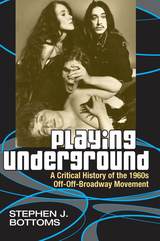
Few books address the legendary age of 1960s off-off Broadway theater. Fortunately, Stephen Bottoms fills that gap with Playing Underground---the first comprehensive history of the roots of off-off Broadway.
This is a theater whose legacy is still felt today: it was the launching pad for many leading contemporary theater artists, including Sam Shepard, Maria Irene Fornes, and others, and it was a pivotal influence on improv comedy and shows like Saturday Night Live.
Off-off Broadway groups such as the Living Theatre, La Mama, and Caffe Cino captured the spirit of nontraditional theater with their edgy, unscripted, boundary-crossing subjects. Yet, as Bottoms discovers, there is no one set of truths about off-off Broadway to uncover; the entire scene was always more a matter of competing perceptions than a singular, concrete reality.
No other author has managed to illuminate this shifting tableau as Bottoms does. Through interviews with dozens of the era's leading playwrights, performers, directors, and critics, he unearths a countercultural theater movement that was both influential and transforming-yet ephemeral and quintessentially of its moment.
Playing Underground will be a definitive work on the subject, offering a complete picture of an important but little-studied period in American theater.

Playwrights for Tomorrow was first published in 1971. Minnesota Archive Editions uses digital technology to make long-unavailable books once again accessible, and are published unaltered from the original University of Minnesota Press editions.
This is the seventh volume in the series Playwrights for Tomorrow,which makes available collections of plays by dramatists who have participated in the program of the Office for Advanced Drama Research (O.A.D.R.) at the University of Minnesota. Arthur H. Ballet, the series editor, is the director of the O.A.D.R. Under the program of the O.A.D.R., promising playwrights are awarded grants and given the opportunity of having their plays produced by college, community, or experimental theatre groups.
In his introduction to this volume Professor Ballet comments on the experience and progress of the O.A.D.R. program. He points out that the playwrights included here represent the first full year of O.A.D.R. work with the theatres in various parts of the country. Previously the productions of the plays under the O.A.D.R. program had been limited to theatrical groups in or near Minneapolis and St. Paul.
The plays in this volume are Grace and George and God by Alexander Hierholzer, Assassin! by David Ball, Freddie the Pigeon by Seymour Leichman, Rags by Nancy Walter, The Orientals by Stephen Grecco, and Drive-In by David Kranes. Six delightful sketches by Mr. Leichman illustrate his play. Details about the initial productions of the plays and sidelights about the authors and their work are given by Professor Ballet in his introduction.
The locales for the premieres of these plays included Cincinnati's Playhouse in the Part, where two of the plays were given; the Firehouse Theatre in Minneapolis; Yale University's Drama School; the Theatre in the Round, Minneapolis; and the theatre at Birmingham-Southern College in Alabama.
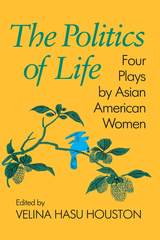
This anthology of work by three Asian American women playwrights—Wakako Yamauchi, Genny Lim, and Velina Hasu Houston—features pioneering contemporary writers who have made their mark in regional and ethnic theatres throughout the United States. In her introduction, Houston observes that the Asian American woman playwright is compelled "to mine her soul" and express the angst, fear, and rage that oppression has wrought while maintaining her relationship with America as a good citizen.
The plays are rich with cultural and political substance and have a feminist concern about women's spirit, intellect, and lives. They portray Asian and Asian American women who challenge the cultural and sexual stereotypes of the Asian female. Yamauchi's two plays deal with how easily a country can dishonor its citizens. In "12-1-A," a Japanese American family is incarcerated during World War II in an Arizona camp where Yamauchi herself was interned. "The Chairman's Wife" dramatizes the life of Madame Mao Tse Tung through the lens of events at Tien An Men Square in 1989. Lim's "Bitter Cane" is about the exploitation of Chinese laborers who were recruited to work the Hawaiian sugar cane plantations. In "Asa Ga Kimashita" ("Morning Has Broken"), Houston explores a Japanese woman's interracial romance in postwar Japan and the influence of traditional patriarchy on the lives of Japanese women.
These plays will entertain and enlighten, enrage and profoundly move audiences. With honesty, imagination and courage, each grapples with the politics of life.
In the series Asian American History and Culture, edited by Sucheng Chan, David Palumbo-Liu, Michael Omi, K. Scott Wong, and Linda Trinh Võ.
2025 ATHE Outstanding Book Award Finalist
- 2025 ATDS John W. Frick Book Award Finalist
- 2025 MLA Prize in U.S. Latina and Latino and Chicana and Chicano Literary and Cultural Studies Honorable Mention
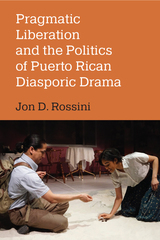
Pragmatic Liberation and the Politics of Puerto Rican Diasporic Drama explores the work of a unique group of playwrights—Puerto Rican dramatists writing in the United States—who offer a model of political engagement. As members of the Puerto Rican diaspora, they have a heightened awareness of the systematic discrimination and the colonial citizenship created by Puerto Rico’s territorial status. Pragmatic Liberation analyzes the work of established playwrights as well as work that has previously received little attention in the world of theater studies, including René Marqués’s Palm Sunday. The book demonstrates the strategies these playwrights use to model a nuanced way of moving toward liberation while being sensitive to the potential impact these actions might have on those closest to us. This is a crucially important model that needs more attention in our currently polarized political moment.
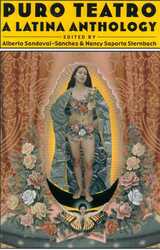
Puro Teatro, A Latina Anthology includes a variety of theatrical genres: plays, performance pieces, puppet shows, innovative collaborations, and testimonials. It features previously unpublished plays from a broad range of experiences within the Latino/a community, including families and home, friends and community building, coming of age and empowerment, and sexual and ethnic identities. The editors' introduction provides a comprehensive survey of contemporary Latina theater, placing it in its theatrical context and examining its divergent roots. Puro Teatro, A Latina Anthology is the first book of its kind to reflect in print a diversified body of writing that turns the spotlight on some of America's most talented and prolific artists. A subsequent volume will complement this anthology with a theoretical, critical reading of Latina theater and performance.
CONTENTS
Botánica by Dolores Prida
Heart of the Earth: A Popul Vuh Story by Cherríe Moraga
The Fat-Free Chicana and the Snow Cap Queen by Elaine Romero
One-act Plays
Las nuevas tamaleras by Alicia Mena
And Where Was Pancho Villa When You Really Needed Him? by Silviana Wood
Fuschia by Janis Astor del Valle
Performance Pieces
Nostalgia Maldita: 1-900-MEXICO : A StairMaster Piece by Yareli Arizmendi
Good Grief, Lolita by Wilma Bonet
A Roomful of Men by Amparo García Crow
Describe Your Work by Monica Palacios
Testimonials
"Battle Worn," by Laura Esparza
"Dancing with the Voice of Truth," by María Mar
"Searching for Sanctuaries: Cruising through Town in a Red Convertible," by Diane Rodríguez
"Home, Desire, Memory: There Are No Borders Here," by Caridad Svich
"Tales of a South-of-the-Border/North-of-the-Stereotype Theatre Director, by Susana Tubert
"Catching the Next Play: The Joys and Perils of Playwriting," by Edit Villarreal
Full-Length Plays, Collaborative Works
Frida: The Story of Frida Kahlo by Migdalia Cruz and Hilary Blecher
Memorias de la revolución by Carmelita Tropicana and Uzi Parnes
READERS
Browse our collection.
PUBLISHERS
See BiblioVault's publisher services.
STUDENT SERVICES
Files for college accessibility offices.
RECENTLY PUBLISHED




UChicago Accessibility Resources
home | accessibility | search | about | contact us
BiblioVault ® 2001 - 2026
The University of Chicago Press