
 A SCHOLARLY BOOK REPOSITORY
12 start with P start with P
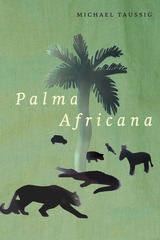
Palm oil. Saturating everything from potato chips to nail polish, palm oil has made its way into half of the packaged goods in our supermarkets. By 2020, world production will be double what it was in 2000. In Colombia, palm oil plantations are covering over one-time cornucopias of animal, bird, and plant life. Over time, they threaten indigenous livelihoods and give rise to abusive labor conditions and major human rights violations. The list of entwined horrors—climatic, biological, social—is long. But Taussig takes no comfort in our usual labels: “habitat loss,” “human rights abuses,” “climate change.” The shock of these words has passed; nowadays it is all a blur. Hence, Taussig’s keen attention to words and writing throughout this work. He takes cues from precursors’ ruminations: Roland Barthes’s suggestion that trees form an alphabet in which the palm tree is the loveliest; William Burroughs’s retort to critics that for him words are alive like animals and don’t like to be kept in pages—cut them and the words are let free.
Steeped in a lifetime of philosophical and ethnographic exploration, Palma Africana undercuts the banality of the destruction taking place all around us and offers a penetrating vision of the global condition. Richly illustrated and written with experimental verve, this book is Taussig’s Tristes Tropiques for the twenty-first century.
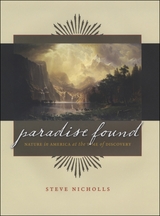
The first Europeans to set foot on North America stood in awe of the natural abundance before them. The skies were filled with birds, seas and rivers teemed with fish, and the forests and grasslands were a hunter’s dream, with populations of game too abundant and diverse to even fathom. It’s no wonder these first settlers thought they had discovered a paradise of sorts. Fortunately for us, they left a legacy of copious records documenting what they saw, and these observations make it possible to craft a far more detailed evocation of North America before its settlement than any other place on the planet.
Here Steve Nicholls brings this spectacular environment back to vivid life, demonstrating with both historical narrative and scientific inquiry just what an amazing place North America was and how it looked when the explorers first found it. The story of the continent’s colonization forms a backdrop to its natural history, which Nicholls explores in chapters on the North Atlantic, the East Coast, the Subtropical Caribbean, the West Coast, Baja California, and the Great Plains. Seamlessly blending firsthand accounts from centuries past with the findings of scientists today, Nicholls also introduces us to a myriad cast of characters who have chronicled the changing landscape, from pre–Revolutionary era settlers to researchers whom he has met in the field.
A director and writer of Emmy Award–winning wildlife documentaries for the Smithsonian Channel, Animal Planet, National Geographic, and PBS, Nicholls deploys a cinematic flair for capturing nature at its most mesmerizing throughout. But Paradise Found is much more than a celebration of what once was: it is also a reminder of how much we have lost along the way and an urgent call to action so future generations are more responsible stewards of the world around them. The result is popular science of the highest order: a book as remarkable as the landscape it recreates and as inspired as the men and women who discovered it.
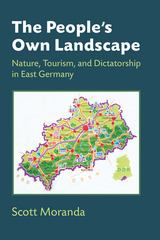
East Germany’s Socialist Unity Party aimed to placate a public well aware of the higher standards of living enjoyed elsewhere by encouraging them to participate in outdoor activities and take vacations in the countryside. Scott Moranda considers East Germany’s rural landscapes from the perspective of both technical experts (landscape architects, biologists, and physicians) who hoped to dictate how vacationers interacted with nature, and the vacationers themselves, whose outdoor experience shaped their understanding of environmental change. As authorities eliminated traditional tourist and nature conservation organizations, dissident conservationists demanded better protection of natural spaces. At the same time, many East Germans shared their government’s expectations for economic development that had real consequences for the land. By the 1980s, environmentalists saw themselves as outsiders struggling against the state and a public that had embraced mainstream ideas about limitless economic growth and material pleasures.
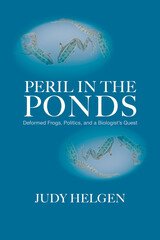
By the 1990s, wetlands across the United States were endangered from pollution and decades of drainage to convert them into farmland and urban developments. But when deformed frogs—many with missing legs or eyes, footless stumps, or misshapen jaws—began to emerge from Minnesota wetlands, alarm bells went off. What caused such deformities? Pollution? Ultraviolet rays? Biological agents? And could the mysterious cause also pose a threat to humans?
Judy Helgen writes with passionate concern about vulnerable frogs and wetlands as she navigates through a maze of inquisitive media and a reluctant government agency. She reports on the complexity of a growing catastrophe for frogs and broadens the issue as she researches and meets with scientists from around the world. She affirms the importance of examining aquatic life to understand pollution and the need to rescue our remaining wetlands. She also shares the fears expressed by the teachers, students, and other citizens who found these creatures, sensed a problem, and looked to her for answers. Ultimately, this is a story about the biological beauty of wetlands and our need to pay attention to the environment around us.
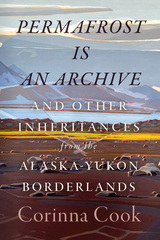
The Yukon Ice Patch Project reveals ancient lives. A road through the boreal forest reads like a map of climate upheaval. Those houses with broken doorknobs—a legacy of government regulation over Indigenous life. Corinna Cook, who was born white on Áak’w Kwáan Tlingit land in Juneau, Alaska, wrestles with the past and future into Canada’s Yukon Territory. With writing that blends research and reverie, her essays ask how we might come into right relations with our most difficult, shared histories. How can we carry the past together, in a good way, as the land melts? The answers—elusive as they are—carry global resonance, taking shape through a deeply personal lens combined with careful study of local arts, artifacts, maps, and the land we depend on.
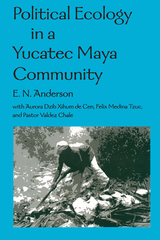
Unlike many small tropical towns, Chunhuhub in rural Quintana Roo, Mexico, has not been a helpless victim of international forces. Its people are descendants of heroic Mayans who stood off the Spanish invaders. People in Chunhuhub continue to live largely through subsistence farming of maize and vegetables, supplemented by commercial orchard, livestock, and field crop cultivation. They are, however, also self-consciously “modernizing” by seeking better educational and economic opportunities.
Political Ecology in a Yucatec Maya Community tells the story of Chunhuhub at the beginning of the twenty-first century, focusing on the resource management of plants and animals. E. N. Anderson and his Maya co-authors provide a detailed overview of Maya knowledge of and relationships with the environment, describing how these relationships have been maintained over the centuries and are being transformed by modernization. They show that the Quintana Roo Mayas have been working to find ways to continue ancient and sustainable methods of making a living while also introducing modern techniques that can improve that living. For instance, traditional subsistence agriculture is broadly sustainable at current population densities, but hunting is not, and modern mechanized agriculture has an uncertain future.
Bringing the voice of contemporary Mayas to every page, the authors offer an encyclopedic overview of the region: history, environment, agriculture, medicine, social relations, and economy. Whether discussing the fine points of beekeeping or addressing the problem of deforestation, they provide a remarkably detailed account that immerses readers in the landscape.
Maya of the Yucatán Peninsula have had more than their share of successes—and some failures as well—and as a study in political and cultural ecology, Political Ecology in a Yucatec Maya Community has much to tell us about tropical development and about the human condition. Their experience tells us that if we wish to have not only farms but also mahogany, wildlife, and ecotourism, then further efforts are needed.
As Anderson observes, traditional Maya management, with its immense knowledge base, remains the best—indeed, the only—effective system for making a living from the Yucatán’s harsh landscape. Political Ecology in a Yucatec Maya Community is a compelling testament to the daily life practices of modern peasant farmers that can provide us with clues about more efficient management techniques for the conservation of biodiversity worldwide.
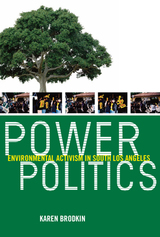
Power Politics is a rich and readable study of a grassroots campaign where longtime labor and environmental allies found themselves on opposite sides of a conflict that pitted good jobs against good air. Karen Brodkin analyzes how those issues came to be opposed and in doing so unpacks the racial and class dynamics that shape Americans' grasp of labor and environmental issues. Power Politics' activists stood at the forefront of a movement that is building broad-based environmental coalitions and placing social justice at the heart of a new and robust vision.
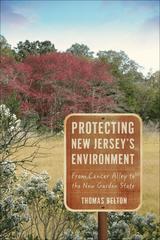
And you can add even more to the list-ozone depletion, nuclear power, toxic waste, sprawl, racial inequity, brownfields remediation versus environmental justice concerns. Through a series of gripping accounts organized by geographic area, Thomas Belton considers key environmental issues in New Jersey and champions the ways common citizens have sought justice when faced with unseen health threats. Often, as people search for remedies in their neighborhoods, the challenges they face result in what Belton calls bare-knuckles environmental protection, replete with back-room political deals, infighting, criminals, and hapless victims.
With people as its focus, Protecting New Jersey's Environment explores the science underpinning environmental issues and the public policy infighting that goes undocumented behind the scenes and beneath the controversies. Belton demonstrates the ways that scientists, regulators, lobbyists, and politicians interact and offers the public a go-to guide on how to seek environmental protection in practical ways.
READERS
Browse our collection.
PUBLISHERS
See BiblioVault's publisher services.
STUDENT SERVICES
Files for college accessibility offices.
RECENTLY PUBLISHED


UChicago Accessibility Resources
home | accessibility | search | about | contact us
BiblioVault ® 2001 - 2026
The University of Chicago Press