
 A SCHOLARLY BOOK REPOSITORY
35 start with P start with P

The 94th US Infantry Division was an organization formed late in the Second World War, made up largely of draft-deferred university students as enlisted men and an officer corps pulled together from various domestic postings with unfortunate consequences for mutual trust and respect.
Initially used as part of the force blockading the Brittany ports after D-Day, in December of 1944, the division was incorporated into General Patton’s Third Army south of the Moselle-Saar Triangle, the base of which was a portion of the Siegfried Line known as the Orscholz Switch. Its first combat experience came in battalion-sized attacks during that terrible winter while the Battle of the Bulge raged to the north, and the Division suffered heavy casualties, many due to the ferocity of the winter weather. Patton, with characteristic zeal, excoriated the division’s officers and senior NCOs for the rate of non-combat casualties. Thereafter, the division was ordered forward on an all-out assault to break through the Siegfried Line. After horrific fighting against entrenched defenders, with ice turning to mud as spring approached, on February 19, 1945, the 94th broke through to open the roads to Trier and the Rhine.
This book is the most comprehensive study to date of the fierce fighting between the 94th U.S. Infantry Division and their German counterparts during that spring of 1945. It sheds new light on the achievements of the outnumbered division in penetrating Germany’s Westwall. With characteristic verve and detail, Tony Le Tissier narrates the action and illuminates the tribulations and sacrifices of American soldiers who won their laurels at great cost.

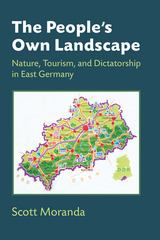
East Germany’s Socialist Unity Party aimed to placate a public well aware of the higher standards of living enjoyed elsewhere by encouraging them to participate in outdoor activities and take vacations in the countryside. Scott Moranda considers East Germany’s rural landscapes from the perspective of both technical experts (landscape architects, biologists, and physicians) who hoped to dictate how vacationers interacted with nature, and the vacationers themselves, whose outdoor experience shaped their understanding of environmental change. As authorities eliminated traditional tourist and nature conservation organizations, dissident conservationists demanded better protection of natural spaces. At the same time, many East Germans shared their government’s expectations for economic development that had real consequences for the land. By the 1980s, environmentalists saw themselves as outsiders struggling against the state and a public that had embraced mainstream ideas about limitless economic growth and material pleasures.
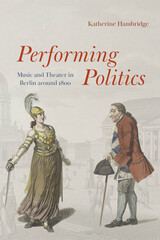
A new account of the emergence of modern cultural politics through a study of music and theater in Berlin around 1800.
Berlin around 1800 has been seen—at the time and since—as somewhat behind other major European cities in terms of its musical culture, peripheral to the momentous developments attributed to the period. By contrast, early nineteenth-century Berlin has been exhaustively studied as the site of a nascent German-national movement and the Prussian Reforms. In Performing Politics, Katherine Hambridge examines the confluence of music and politics in Berlin around 1800, engaging directly with the themes of being behind/ahead, central/peripheral, in order to tell new stories about nineteenth-century German history, musical and otherwise.
Performing Politics emphasizes events as much as repertoires, and non-canonical repertoires over the more familiar music of this period: dynastic birthday celebrations, the music of historical dramas, political song and communal singing, popular music theater. By focusing our attention on the unfamiliar specificity of Berlin Nationaltheater, Hambridge reenergizes our understanding of 1800–1815 as a key period in the development of musical and political modernity. Using sources largely unexploited by musicologists, and phenomena neglected by historians, she reveals the quotidian aesthetics, values, and practices that shaped both the sociopolitical narratives and musical developments of the time. Performing Politics is thus not only a history of music and theater in Berlin at a critical moment, but a music history of modern cultural politics.
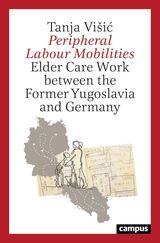
The precarious situation in the successor states of Yugoslavia created a specific dynamic in the field of labor mobility. Still, little research has been done in this region on how women, who are older care workers from Serbia or Bosnia commute—often via illegal border crossings—to German households to look after the elderly. In Peripheral Labor Mobilities, Tanja Višic explores this gender-specific migration pattern in the first expansive ethnography of contemporary cross-border elder care in this region. She takes up questions about how the mobility and work practices of women are integrated into the socio-economic networks of the informal care work sector while also looking at worker confrontations with labor laws and border regimes. Illustrative case studies clearly detail culturally specific patterns of perception of care work, family relationships, and the mobility demanded by these labor arrangements.
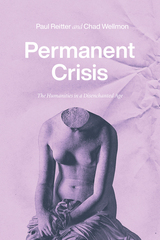
Leads scholars and anyone who cares about the humanities into more effectively analyzing the fate of the humanities and digging into the very idea of the humanities as a way to find meaning and coherence in the world.
The humanities, considered by many as irrelevant for modern careers and hopelessly devoid of funding, seem to be in a perpetual state of crisis, at the mercy of modernizing and technological forces that are driving universities towards academic pursuits that pull in grant money and direct students to lucrative careers. But as Paul Reitter and Chad Wellmon show, this crisis isn’t new—in fact, it’s as old as the humanities themselves.
Today’s humanities scholars experience and react to basic pressures in ways that are strikingly similar to their nineteenth-century German counterparts. The humanities came into their own as scholars framed their work as a unique resource for resolving crises of meaning and value that threatened other cultural or social goods. The self-understanding of the modern humanities didn’t merely take shape in response to a perceived crisis; it also made crisis a core part of its project. Through this critical, historical perspective, Permanent Crisis can take scholars and anyone who cares about the humanities beyond the usual scolding, exhorting, and hand-wringing into clearer, more effective thinking about the fate of the humanities. Building on ideas from Max Weber and Friedrich Nietzsche to Helen Small and Danielle Allen, Reitter and Wellmon dig into the very idea of the humanities as a way to find meaning and coherence in the world.
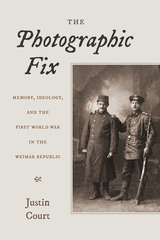

A cultural history of German radio broadcasting from the 1920s to today
Since the rise of film and television, radio has continued to evolve, with satellite radio and podcasts as its latest incarnations. Any understanding of the development of radio, like its visual counterparts, depends on closely examining the artistic ventures that preceded commercial acceptance.
In Pieces of Sound, Daniel Gilfillan offers a cultural history that explores these major aspects of the medium by focusing on German radio broadcasting, providing a context that sees beyond programming to consider regulations, cultural politics, and social standardization. Gilfillan showcases the work of radio pioneers and artists over the past century, including Brecht’s work with the form, and how radio was employed before and after World War II. He traces how German radio broadcasters experimented with networked media not only to expand the artistic and communicative possibilities of radio, but also to inform perceptions about the advantages and direction of newer telecommunications media like Internet broadcasting and pirate radio, which artists are using today to engage with a medium that is increasingly under corporate control. Gilfillan astutely observes how claims made for the Internet today echo those made for radio in its infancy and puts forth a broad and incisive historical analysis of German cultural broadcasting.

From the first, Enzensberger resisted the marginalization of literature–particularly poetry—by connecting it with ethical imperatives of the post-Holocaust era. Charlotte Ann Melin shows how Enzensberger has accomplished this by challenging prevailing aesthetic and social values. Departing from existing studies that focus on Enzensberger's political views or controversial texts, her book situates his full poetic program within contemporary discussions staged by various German writers, translators, and theorists, including Jürgen Habermas and Theodor Adorno. Melin proposes a framework for reading poetry by Enzensberger and his contemporaries—one that connects the radical evolution of poetic style with how questions about representation, identity, and ethical values developed under historical conditions unique to the second half of the twentieth century. Her account of postwar literary trends explores the fluidity of national literary boundaries and tastes after 1945, and reveals the relationship of such American poets as William Carlos Williams and Carolyn Forché to German verse. Essential to an understanding Enzensberger as an important literary figure, Poetic Maneuvers also offers invaluable insight into the status of recent postwar German literature and American-European literary relations.

Though the Vietnam War did not directly involve West Germany, it was nonetheless a decisive catalyst for the era’s wider protest movements in that country, and it gave rise to an ardent anti-war discourse. Poetry and poetic writing were key to anti-war work. Hundreds of poems and related writings about Vietnam circulated in West Germany, yet they are almost entirely forgotten today. Poetic Writing and the Vietnam War in West Germany uncovers and explores some of that rich artistic production in order to present a new history of engaged poetic writing in West Germany in the 1960s and 1970s and to draw out distinctive characteristics of wider protest culture. In doing so, it makes the case for attending to marginal, non-canonical, or neglected literary and cultural forms, and for critical thinking about why they might, over time, have been obscured. The book also offers a case study for reflection on the representation of war, on ways in which German oppositional culture could imagine its others, and on the relationship of poetry to the historical world.

What would it mean to make a work of art the focal point of one’s life practice? Poetry as a Way of Life goes back to the origins of aesthetics as a philosophical discipline in the early eighteenth century in order to uncover an understanding of the work of art as an exercise of the self. Engaging in close readings of works by both canonical and less well-known eighteenth-century German poets such as Friedrich Holderlin, Novalis, Friedrich von Hagedorn, and Johann Wilhelm Ludwig Gleim, Gabriel Trop illustrates the ways in which these authors tap into the potential of poetic form to redefine the limits of human perception and generate alternative ways of being in the world.

Policy Debates on Reprogenetics takes an in-depth look at recent public policy debates over stem cell research and therapeutic cloning in Great Britain and Germany in order to determine the effect of such debates on the progress of scientific knowledge. Svea Luise Herrmann argues that debates about government policy do not tend to lead to more societal and political control over scientific research; rather, the discussions, when framed as questions of ethics, allow societies to air anxieties without retarding or challenging scientific progress. As our understanding of genetics continues to grow, this volume will be a useful resource for scientists and policy makers alike.
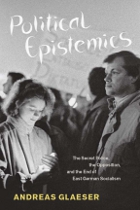
What does the durability of political institutions have to do with how actors form knowledge about them? Andreas Glaeser investigates this question in the context of a fascinating historical case: socialist East Germany’s unexpected self-dissolution in 1989. His analysis builds on extensive in-depth interviews with former secret police officers and the dissidents they tried to control as well as research into the documents both groups produced. In particular, Glaeser analyzes how these two opposing factions’ understanding of the socialist project came to change in response to countless everyday experiences. These investigations culminate in answers to two questions: why did the officers not defend socialism by force? And how was the formation of dissident understandings possible in a state that monopolized mass communication and group formation? He also explores why the Stasi, although always well informed about dissident activities, never developed a realistic understanding of the phenomenon of dissidence.
Out of this ambitious study, Glaeser extracts two distinct lines of thought. On the one hand he offers an epistemic account of socialism’s failure that differs markedly from existing explanations. On the other hand he develops a theory—a sociology of understanding—that shows us how knowledge can appear validated while it is at the same time completely misleading.
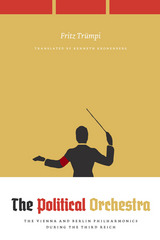
Trümpi looks first at the decades preceding National Socialist rule, when the competing orchestras, whose rivalry mirrored a larger rivalry between Berlin and Vienna, were called on to represent “superior” Austro-German music and were integrated into the administrative and social structures of their respective cities—becoming vulnerable to political manipulation in the process. He then turns to the Nazi period, when the orchestras came to play a major role in cultural policies. As he shows, the philharmonics, in their own unique ways, strengthened National Socialist dominance through their showcasing of Germanic culture in the mass media, performances for troops and the general public, and fictional representations in literature and film. Accompanying these propaganda efforts was an increasing politicization of the orchestras, which ranged from the dismissal of Jewish members to the programming of ideologically appropriate repertory—all in the name of racial and cultural purity.
Richly documented and refreshingly nuanced, The Political Orchestra is a bold exploration of the ties between music and politics under fascism.
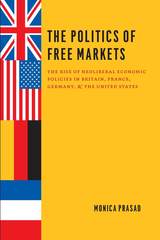
In The Politics of Free Markets, a comparative-historical analysis of the development of neoliberal policies in these four countries,Monica Prasad argues that neoliberalism was made possible in the United States and Britain not because the Left in these countries was too weak, but because it was in some respects too strong. At the time of the oil crisis in the 1970s, American and British tax policies were more punitive to business and the wealthy than the tax policies of France and West Germany; American and British industrial policies were more adversarial to business in key domains; and while the British welfare state was the most redistributive of the four, the French welfare state was the least redistributive. Prasad shows that these adversarial structures in the United States and Britain created opportunities for politicians to find and mobilize dissatisfaction with the status quo, while the more progrowth policies of France and West Germany prevented politicians of the Right from anchoring neoliberalism in electoral dissatisfaction.

An ambitious, original work, The Politics of Sociability is Stefan-Ludwig Hoffmann's exploration of the social and political significance of Freemasonry in German history. Drawing on de Tocqueville's theory that without civic virtue there is no civil society, and that civic virtue unfolds only through the social interaction between citizens, Hoffmann examines the critical link between Freemasonry and the evolution of German civil society in the late nineteenth century. The practice of Masonic sociability reflected an enlightened belief in the political significance of moral virtue for civil society, indeed, for humanity. Freemasons' self-image as civilizing agents, acting in good faith and with the unimpeachable idea of universal brotherhood, was contradicted not only by their heightened sense of exclusivity; Freemasons unintentionally exacerbated nineteenth-century political conflicts---for example, between liberals and Catholics, or Germans and French---by employing a universalist language.
Using a wealth of archival sources previously unavailable, Stefan-Ludwig Hoffmann shows how Freemasonry became a social refuge for elevated and liberal-minded bourgeois men who felt attracted to its secret rituals and moral teachings. German Freemasons sought to reform self and society but, Hoffmann argues, ultimately failed to balance modern politics with a cosmopolitan ethos. Hoffmann illuminates a capacious history of the political effects of Enlightenment concepts and practices in a century marked by nationalism, social discord, and religious conflict.
Stefan-Ludwig Hoffmann is Assistant Professor of Modern History at Ruhr-University Bochum. The German edition of this book, Die Politik der Geselligkeit: Freimaurerlogen in der deutschen Bürgergesellschaft, 1840-1918 (Vandenhoeck & Ruprecht, 2000), won the Association of German Historians' 2002 Hedwig Hintze Prize for Best First Book.
Tom Lampert was born in Boston in 1962 and grew up in northern California. He received a BA in political science from Stanford University (1986) and a PhD in government from Cornell (1998). His book, Ein einziges Leben (Hanser Verlag 2001) was published as One Life by Harcourt in 2004, which he translated himself. Lampert has worked as a freelance translator since 1998. He currently lives in Bad Kreuznach, Germany.
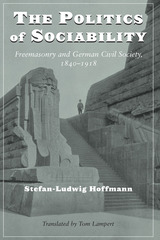
Cover Image: Monument of the Battle of the Nations in Leipzig, erected between 1898 and 1913 by German Freemasons, Barbarossa-Head by Christian Behrens, located next to the stairs leading to the monument. The German mythical figure of the Kaiser Barbarossa is depicted as a sphinx, which in Masonic symbolism protects the Masonic secret from profanation. Courtesy of the Deutsche Bücherei, Leipzig.
"This is an exemplary study of the role of Freemasonry in the German Bürgergesellschaft (civil society) of the nineteenth and early twentieth centuries, concise, comprehensive, and well written. It combines social profiling with a careful examination of contemporary concepts in a long-term diachronic study, based on an impressive amount of primary material. . . . Hoffmann's empirically and methodologically convincing study is not only a major contribution to our understanding of Freemasonry in the German Bürgergesellschaft. It also reflects the complex social and political transformation of German society in the nineteenth century and the difficulties contemporaries faced in responding to it."
---German History
"Hoffmann's arguments are theoretically informed, supported by a wealth of archival sources. . . . Indeed, in many ways this is the best combination of painstaking social history and well-argued Begriffsgeschichte (conceptual history). . . . One of the great virtues of this book is that Hoffmann does not shy away from the contradictions in the Freemasons' rhetoric and actions. Such contradictions, in fact, are key to the Mason's importance, because they force us to rethink some of our assumptions about Imperial Germany. . . . This is an important book that encourages us to rethink many of our characterizations of the German Kaiserreich and our assumptions about civil society."
---Central European History
"Based on a rich variety of sources. . . . Hoffmann explores the evolving relationship between Freemasonry and the monarchy, state, and church, and he also scrutinizes the internal practices and discourse of these notoriously secretive and cosmopolitan societies. . . . Hoffmann engages fruitfully with a wide historiography covering themes such as masculinity and racism, he dissects the complex attitude of Freemasonry to Jews and Catholics, and he scrutinizes the attacks of its conservative, clerical, and antisemitic critics."
---Journal of Modern History

In the United Kingdom, the question of women’s suffrage represented the most substantial challenge to the constitution since 1832, seeking not only to expand but to redefine definitions of citizenship and power. At the same time, it was inseparable from other urgent contemporary political debates—the Irish question, the decline of the British Empire, the Great War, and the increasing demand for workers’ rights.
This collection positions women’s suffrage as central to, rather than separate from, these broader political discussions, demonstrating how they intersected and were mutually constitutive. In particular, this collection pays close attention to the issues of class and Empire which shaped this era. It demonstrates how campaigns for women’s rights were consciously and unconsciously played out, impacting attitudes to motherhood, spurring the radical “birth-strike” movement, and burgeoning communist sympathies in working-class communities around Britain and beyond.


Too often dismissed as escapist entertainment or vilified as mass manipulation, popular cinema in the Third Reich was in fact sustained by well-established generic conventions, cultural traditions, aesthetic sensibilities, social practices, and a highly developed star system—not unlike its Hollywood counterpart in the 1930s. This pathfinding study contributes to the ongoing reassessment of Third Reich cinema by examining it as a social, cultural, economic, and political practice that often conflicted with, contradicted, and compromised the intentions of the Propaganda Ministry. Nevertheless, by providing the illusion of a public sphere presumably free of politics, popular cinema helped to sustain the Nazi regime, especially during the war years.
Rather than examining Third Reich cinema through overdetermined categories such as propaganda, ideology, or fascist aesthetics, Sabine Hake concentrates on the constituent elements shared by most popular cinemas: famous stars, directors, and studios; movie audiences and exhibition practices; popular genres and new trends in set design; the reception of foreign films; the role of film criticism; and the representation of women. She pays special attention to the forced coordination of the industry in 1933, the changing demands on cinema during the war years, and the various ways of coming to terms with these filmic legacies after the war. Throughout, Hake's findings underscore the continuities among Weimar, Third Reich, and post-1945 West German cinema. They also emphasize the codevelopment of German and other national cinemas, especially the dominant Hollywood model.

Caldwell makes accessible the rich literature in German constitutional thought of the Weimar period, most of which has been unavailable in English until now. On the liberal left, Hugo Preuss and Hans Kelsen defended a concept of democracy that made the constitution sovereign and, in a way, created the "Volk" through constitutional procedure. On the right, Carl Schmitt argued for a substantial notion of the "Volk" that could overrule constitutional procedure in a state of emergency. Rudolf Smend and Heinrich Triepel located in the constitution a set of inviolable values of the political community, while Hermann Heller saw in it a guarantee of substantial social equality. Drawing on the work of these major players from the 1920s, Caldwell reveals the various facets of the impassioned constitutional struggles that permeated German legal and political culture during the Weimar Republic.

This new collection of essays considers the demise of the GDR and its impact on the place of intellectuals in Germany today. Distinguished contributors from Germany, Austria, and the United States survey aspects of high and low culture, including the current nostalgia for East German film, the demise of the GDR rock scene, the pivotal role of East German poets, the consolidation and privatization of German media, and the frightening new resurgence of right-wing violence. The result is a timely volume that charts Germany's rocky transition from one world to another.
Contributors:
Mitchell G. Ash
Simone Barck
David Bathrick
John Borneman
Dorothea Dornhof
Michael Geyer
Andreas Graf
Dietrich Hohmann
Andreas Huyssen
Konrad Jarausch
Alexander Kluge
Loren Kruger
Martina Langermann
Siegfried Lokatis
Patricia Anne Simpson
Frank Trommler
Katie Trumpener
Lindenfeld argues that these sciences of state developed a technique of deliberation on practical issues such as tax policy and welfare, that serves as a model for contemporary administrations.
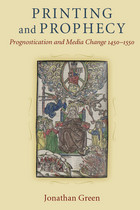
Printing and Prophecy: Prognostication and Media Change 1450-1550 examines prognostic traditions and late medieval prophetic texts in the first century of printing and their effect on the new medium of print. The many prophetic and prognostic works that followed Europe's earliest known printed book---not the Gutenberg Bible, but the Sibyl's Prophecy, printed by Gutenberg two years earlier and known today only from a single page---over the next century were perennial best sellers for many printers, and they provide the modern observer with a unique way to study the history and inner workings of the print medium. The very popularity of these works, often published as affordable booklets, raised fears of social unrest. Printers therefore had to meet customer demand while at the same time channeling readers' reactions along approved paths. Authors were packaged---and packaged themselves---in word and image to respond to the tension, while leading figures of early modern culture such as Paracelsus, Martin Luther, and Sebastian Brant used printed prophecies for their own purposes in a rapidly changing society.
Based on a wide reading of many sources, Printing and Prophecy contributes to the study of early modern literature, including how print changed the relationship among authors, readers, and texts. The prophetic and astrological texts the book examines document changes in early modern society that are particularly relevant to German studies and are key texts for understanding the development of science, religion, and popular culture in the early modern period. By combining the methods of cultural studies and book history, this volume brings a new perspective to the study of Gutenberg and later printers.

Between 1967 and 2000, film production in Germany underwent a number of significant transformations, including the birth and death of New German Cinema as well as the emergence of a new transnational cinematic practice. In Projecting History, Nora M. Alter explores the relationship between German cinematic practice and the student protests in both East and West Germany against the backdrop of the U.S. war in Vietnam in the sixties, the outbreak of terrorism in West Germany in the seventies, West Germany's rise as a significant global power in the eighties, and German reunification in the nineties.
Although a central tendency of New German Cinema in the 1970s was to reduce the nation's history to the product of individuals, the films addressed in Projecting History focus not on individual protagonists, but on complex socioeconomic structures. The films, by Rainer Werner Fassbinder, Harun Farocki, Alexander Kluge, Ulrike Ottinger, Wim Wenders and others, address basic problems of German history, including its overall "peculiarity" within the European context, and, in particular, the specific ways in which the National Socialist legacy continues to haunt Germans.
Nora M. Alter is Associate Professor of German, Film and Media Studies, and Women and Gender Studies at the University of Florida. A specialist in twentieth-century film, comparative literature, and cultural studies, Alter has been the recipient of a National Endowment for the Humanities Fellowship and a Howard Foundation Fellowship. She is also the author of Vietnam Protest Theatre: The Television War on Stage.
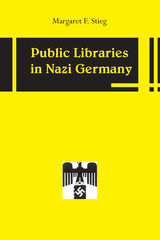
"Margaret F. Stieg's thoroughly researched study, the first comprehensive examination of public libraries in Nazi Germany, reveals that library policy in the Third Reich was far more complex than we might assume, with the positive and the negative hopelessly entangled. . . . A solid and welcome contribution."
—American Historical Review
READERS
Browse our collection.
PUBLISHERS
See BiblioVault's publisher services.
STUDENT SERVICES
Files for college accessibility offices.
RECENTLY PUBLISHED





UChicago Accessibility Resources
home | accessibility | search | about | contact us
BiblioVault ® 2001 - 2026
The University of Chicago Press