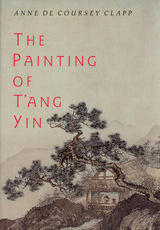
front cover of The Painting of T'ang Yin
The Painting of T'ang Yin
Anne De Coursey Clapp
University of Chicago Press, 1991
+This richly illustrated volume documents the art and fully examines the career of the sixteenth-century Chinese master T'ang Yin. One of the four great painters of the middle Ming period, the ambitious T'ang Yin rose above the merchant class into which he was born to become a member of the elite scholarly circle in the city of Suchou. Deprived by accident of his academic degrees and so forced to paint for a living, T'ang Yin became a social anomaly whose style of life cut across the conventions of his time. His experiences throw into sharp relief the realities faced by a Chinese painter who was both elite Confucian scholar and professional painter.

Anne De Coursey Clapp's work also explores larger issues of Ming painting raised by the artist's turbulent career. She describes the social and intellectual values exalted in Ming Suchou, its system of patronage, the contrast between the professional and amateur artist, and the formative influence of twelfth-century Sung dynasty styles on Suchou painters. Clapp shows how T'ang Yin's artistic inventions were made in the course of leading the revival of Sung dynasty styles in Suchou: tracing T'ang Yin's early studies of ancient and contemporary masters, she describes how he reworked an antique style, converting it into a vehicle of expression that reached fruition in a long series of fresh and powerful paintings of landscapes and birds-and-flowers. In the process, she revises the distorted version of middle Ming painting written by later Chinese art theorists to justify their own social and artistic values, noting especially the role of art patrons and their effect on artistic production.

Clapp analyzes the increasing currency of painting as a means of social exchange in ancient China. In particular, she identifies commemorative painting as a major genre of the later dynasties and explores the role it played in the oeuvres of professional masters with its humanistic implications for the Chinese view of the ideal scholarly man. Her broad view of T'ang Yin's career shows him divided between the professional and amateur camps of his time: in landscape and figural subjects he was aligned with the professionals; in flower subjects with the amateurs. Clap argues that the uneven distribution of styles and genres between this master who was subject to the market, and those who were independent of it, suggests that T'ang deliberately tried to expand the range of his paintings in order to appeal to buyers in the lower educational and social strata. Illustrated by some of T'ang Yin's most celebrated paintings and by some which are published for the first time, her work is of tremendous importance to art, literary, and cultural historians of Ming China.

"In this important work, Anne de Coursey Clapp has drawn a clear picture of T'ang Yin's life, patronage relationships, and contribution to the history of Chinese painting. In the person of T'ang Yin, she has chosen an ideal focus around which to examine some of the misleading stereotypes
which have distorted our understanding of Chinese painting since the seventeenth century. Marked by analytical clarity and scrupulous scholarship, her work is a welcome addition to the few works in English on individual Chinese artists."—Louise Yuhas, Occidental College
[more]

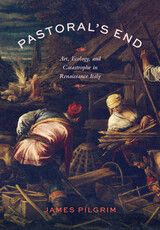
front cover of Pastoral’s End
Pastoral’s End
Art, Ecology, and Catastrophe in Renaissance Italy
James Pilgrim
University of Chicago Press, 2026
How early modern Italian painting addressed the ways humans shape and are shaped by their environments.
 
In the sixteenth century, Italian artist Jacopo Bassano painted pictures of herdsmen and animals moving through dark and muddy landscapes. But he also participated in the agricultural development of the region in which he lived, producing topographical maps of local mountains and forests, inventing new methods of drainage and irrigation, and studying the latest techniques of crop rotation and fertilization. The relationship between Bassano’s rustic art and his participation in environmental transformation has, however, never been explored.
 
One of the first studies of Italian Renaissance art to grapple with the connections between visual culture and the environment, Pastoral’s End explores this crucial, formative relationship. James Pilgrim looks at Bassano’s career holistically, demonstrating how his involvement in a world marked by agricultural expansion, industrialization, resource extraction, environmental degradation, social transformation, and radical philosophical development informed his paintings of country life. Introducing new archival and visual evidence of Bassano’s knowledge of hydrology, agronomy, husbandry, and architecture, Pastoral’s End argues that he transformed the more placid rustic imagery of previous Renaissance artists into visions of dangerous ecological instability.

 
[more]

logo for University of Chicago Press
Paul Klee
His Work and Thought
Marcel Franciscono
University of Chicago Press, 1991
Marcel Franciscono offers an exhaustive historical and critical study of Klee's artistic personality and thought. Drawing extensively on documentation published since 1940, Franciscono highlights the extraordinary range of artistic, literary, and philosophical speculation Klee brought to his work. The portrait that emerges is one of a great comic artist, an ironist whose most characteristic pictures pit beauty of form and color against the dubious nature of things, yet one whose satiric depictions of everyday life extend to the most rarified evocations of nature.
[more]

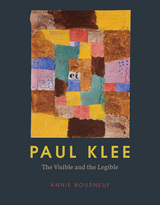
front cover of Paul Klee
Paul Klee
The Visible and the Legible
Annie Bourneuf
University of Chicago Press, 2015
The fact that Paul Klee (1879–1940) consistently intertwined the visual and the verbal in his art has long fascinated commentators from Walter Benjamin to Michel Foucault. However, the questions it prompts have never been satisfactorily answered—until now. In Paul Klee, Annie Bourneuf offers the first full account of the interplay between the visible and the legible in Klee’s works from the 1910s and 1920s.

Bourneuf argues that Klee joined these elements to invite a manner of viewing that would unfold in time, a process analogous to reading. From his elaborate titles to the small scale he favored to his metaphoric play with materials, Klee created forms that hover between the pictorial and the written. Through his unique approach, he subverted forms of modernist painting that were generally seen to threaten slow, contemplative viewing. Tracing the fraught relations among seeing, reading, and imagining in the early twentieth century, Bourneuf shows how Klee reconceptualized abstraction at a key moment in its development.
[more]

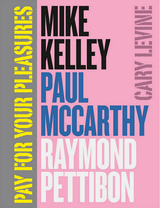
front cover of Pay for Your Pleasures
Pay for Your Pleasures
Mike Kelley, Paul McCarthy, Raymond Pettibon
Cary Levine
University of Chicago Press, 2013
Mike Kelley, Paul McCarthy, and Raymond Pettibon—these Southern California artists formed a “bad boy” trifecta. Early purveyors of abject art, the trio produced work ranging from sculptures of feces to copulating stuffed animals, and gained notoriety from being perverse. Showing how their work rethinks transgressive art practices in the wake of the 1960s, Pay for Your Pleasures argues that their collaborations as well as their individual enterprises make them among the most compelling artists in the Los Angeles area in recent years.
 
Cary Levine focuses on Kelley’s, McCarthy’s, and Pettibon’s work from the 1970s through the 1990s, plotting the circuitous routes they took in their artistic development. Drawing on extensive interviews with each artist, he identifies the diverse forces that had a crucial bearing on their development—such as McCarthy’s experiences at the University of Utah, Kelley’s interest in the Detroit-based White Panther movement, Pettibon’s study of economics, and how all three participated in burgeoning subcultural music scenes. Levine discovers a common political strategy underlying their art that critiques both nostalgia for the 1960s counterculture and Reagan-era conservatism. He shows how this strategy led each artist to create strange and unseemly images that test the limits of not only art but also gender roles, sex, acceptable behavior, poor taste, and even the gag reflex that separates pleasure from disgust. As a result, their work places viewers in uncomfortable situations that challenge them to reassess their own values.
 
The first substantial analysis of Kelley, McCarthy, and Pettibon, Pay for Your Pleasures shines new light on three artists whose work continues to resonate in the world of art and politics.
[more]

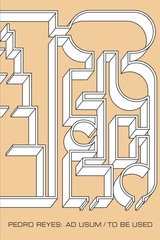
front cover of Pedro Reyes
Pedro Reyes
Ad Usum / To Be Used
José Luis Falconi
Harvard University Press

For more than a decade the Mexico City–based artist, architect, and cultural agent Pedro Reyes has been turning existing social problems into opportunities for effecting tangible change through collective imagination. By breaking open failed models and retooling them with space to project alternatives, Reyes’s art enables productive diversions of otherwise destructive forces. Ad Usum: To Be Used is the second volume in the series Focus on Latin American Art and Agency, which is dedicated to contemporary cultural agents, a term that is perhaps best understood through the words of Reyes himself: “changing our individual habits has no degree of effectiveness” as “progress is only significant if you start to multiply by 10, by 100, by 1,000.” Rather than merely illustrate his work, this collection of images, interviews, and critical essays is intended as an apparatus for multiplying the possibilities when art becomes a resource for the common good.

This full-color illustrated survey of Reyes’s projects includes critical essays by José Luis Falconi, Robin Greeley, Johan Hartle, Adam Kleinman, and Doris Sommer, as well as interviews between the artist and such seminal thinkers as Lauren Berlant, Michael Hardt, Alejandro Jodorowsky, and Antanas Mockus.

[more]

logo for University of Chicago Press
Performing Chance
The Art of Alison Knowles In/Out of Fluxus
Nicole L. Woods
University of Chicago Press, 2026
The first monographic study of American artist Alison Knowles, a significant yet overlooked cofounder of the Fluxus movement.
 
Alison Knowles stands out as the sole female artist among the founders of Fluxus, yet she has remained an enigmatic, underrecognized figure in the history of art. Performing Chance fills a gap in the record, bringing to light Knowles’s transformative body of work as it evolved from abstract painting in the late 1950s, to silkscreens, print media, and performance in the early 1960s, to groundbreaking works in digital poetry, acoustical art, and large-scale installations in the late 1960s-70s.
 
Through her access to previously unpublished archival materials and direct interviews with the artist, Nicole L. Woods provides close readings of pivotal works, disclosing the ways Knowles instituted formal tactics that moved beyond modernist painting, championed principles of indeterminacy and chance, and fostered sociopolitical consciousness. Situating Knowles’s innovations in various media within the distinct cultural contexts of Wiesbaden, London, Paris, New York City, and Los Angeles, Performing Chance brings this key artist back to her rightful place as a leader of the postwar avant-garde and provides a nuanced history of the role of women artists in Fluxus and beyond.
 
[more]

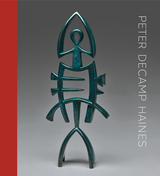
front cover of Peter DeCamp Haines
Peter DeCamp Haines
Sculpture, 1975–2024
Belinda Rathbone
The Artist Book Foundation, 2025
This book will be the first major monograph on the work of Haines’s oeuvre, which builds on the evolution of Modernism as much as it harkens back to the Bronze Age. The clearest expression of this is a series of 1,000 elemental bronze “artifacts” he has created over the course of nearly fifty years, to which he contributes yearly, ranging from palm-size to colossal outdoor works. He calls this output “a personal archaeology,” or “an archaeology of the subconscious,” referencing ancient tools, animal and human shapes, and the synchronicity of antique forms with the purely abstract. Haines’s interest in psychology and anthropology has deeply informed his art. Working in a Modernist tradition, his career has pursued a continuing exploration of the formal attributes of sculpture: form, scale, negative space, and composition. As Haines sees it, one of the satisfactions of sculpture is that ideas such as wholeness, beauty, and timelessness can be expressed without words and one of the critical elements of this wordless communication is negative space. Thus, the doorways, windows, and silhouettes of his sculptures can suggest an area larger than the sculpture itself. Born in 1942, Haines grew up in Ohio. He holds a Bachelor of Arts degree from the University of Colorado, Boulder, a Master of Business Administration from Harvard University, and he is a graduate of the School of the Museum of Fine Arts in Boston. He is a founding member of the Boston Sculptors Gallery and co-founder of the Vermont Gentlemen’s Foundry. His work has been shown in numerous solo and group exhibitions, and can be found in the DeCordova Museum and Sculpture Park in Concord, Massachusetts, and the Chen Yunxian Museum in Nanchang, China, among other collections in Boston, New York, and South Korea. Haines lives and works in Cambridge, Massachusetts.
[more]

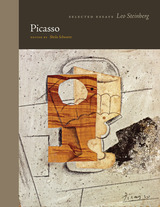
front cover of Picasso
Picasso
Selected Essays
Leo Steinberg
University of Chicago Press, 2022
The fourth volume in the Essays by Leo Steinberg series, focusing on the artist Pablo Picasso.
 
Leo Steinberg was one of the most original art historians of the twentieth century, known for taking interpretive risks that challenged the profession by overturning reigning orthodoxies. In essays and lectures ranging from old masters to modern art, he combined scholarly erudition with eloquent prose that illuminated his subject and a credo that privileged the visual evidence of the image over the literature written about it. His writings, sometimes provocative and controversial, remain vital and influential reading. Steinberg’s perceptions evolved from long, hard looking at his objects of study. Almost everything he wrote included passages of formal analysis but always put into the service of interpretation.
 
This volume brings together Steinberg’s essays on Pablo Picasso, many of which have been studied and debated for decades, such as “The Philosophical Brothel,” as well as unpublished lectures, including “The Intelligence of Picasso,” a wide-ranging look at Picasso’s enduring ambition to stretch the agenda of representation, from childhood drawings to his last self-portrait. An introduction by art historian Richard Shiff contextualizes these works and illuminates Steinberg’s lifelong dedication to refining the expository, interpretive, and rhetorical features of his writing.
 
Picasso is the fourth volume in a series that presents Steinberg’s writings, selected and edited by his longtime associate Sheila Schwartz.
 
[more]

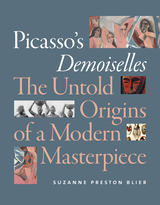
front cover of Picasso's Demoiselles
Picasso's Demoiselles
The Untold Origins of a Modern Masterpiece
Suzanne Preston Blier
Duke University Press, 2019
In Picasso's Demoiselles, eminent art historian Suzanne Preston Blier uncovers the previously unknown history of Pablo Picasso's Les Demoiselles d’Avignon, one of the twentieth century's most important, celebrated, and studied paintings. Drawing on her expertise in African art and newly discovered sources, Blier reads the painting not as a simple bordello scene but as Picasso's interpretation of the diversity of representations of women from around the world that he encountered in photographs and sculptures. These representations are central to understanding the painting's creation and help identify the demoiselles as global figures, mothers, grandmothers, lovers, and sisters, as well as part of the colonial world Picasso inhabited. Simply put, Blier fundamentally transforms what we know about this revolutionary and iconic work.
[more]

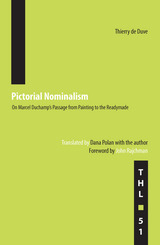
front cover of Pictorial Nominalism
Pictorial Nominalism
On Marcel Duchamp’s Passage from Painting to the Readymade
Thierry De Duve
University of Minnesota Press, 2005
Beginning with the instance in 1912 when Marcel Duchamp wrote in a note to himself, "No more painting, get a job," Thierry de Duve reviews in Pictorial Nominalism the implications of the readymade for art and representation. Arguing that the readymade belongs to that moment in the history of painting when both figuration and the practice of painting become "impossible," de Duve presents a psychoanalytically informed account of the birth of abstraction.Differing considerably from such thinkers as Clement Greenberg and Peter Burger, de Duve demonstrates that the readymade is the link between painting in particular and art at large.
[more]

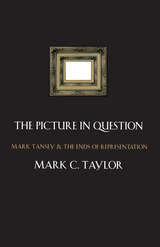
front cover of The Picture in Question
The Picture in Question
Mark Tansey and the Ends of Representation
Mark C. Taylor
University of Chicago Press, 1999
A rich exploration of the possibilities of representation after Modernism, Mark Taylor's new study charts the logic and continuity of Mark Tansey's painting by considering the philosophical ideas behind Tansey's art. Taylor examines how Tansey uses structuralist and poststructuralist thought as well as catastrophe, chaos, and complexity theory to create paintings that please the eye while provoking the mind. Taylor's clear accounts of thinkers ranging from Plato, Kant, and Hegel to Merleau-Ponty, Derrida, and de Man will be an invaluable contribution to students and teachers of art.

[more]

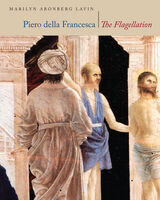
front cover of Piero Della Francesca
Piero Della Francesca
The Flagellation
Marilyn Aronberg Lavin
University of Chicago Press, 1990
"Lavin's study of the Pierro della Francesca "Flagellation" at Urbino, as befits this exquisite masterpiece, is a model of lucid and precise exposition as well as being an exciting exercise of scholarship. Informed with the intellectual rigour of Scholastic exegesis, it deserves to be placed with the classic readings of fifteenth and sixteenth century works by Erwin Panofsky and Edgar Wind."—Spectator

"[Lavin] leaves the picture more wondrous than before, a simultaneous triumph of the theological and biographical, as well as pictorial, imagination."—Rackstraw Downes, New York Times Book Review
[more]

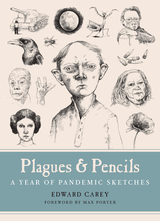
front cover of Plagues and Pencils
Plagues and Pencils
A Year of Pandemic Sketches
Edward Carey, with a foreword by Max Porter
University of Texas Press, 2022

Honorable Mention, 2022 Nonfiction Prize, Writers' League of Texas

A remarkable collection of words and illustrations documenting the first year of the pandemic.


In March 2020, as lockdowns were imposed around the world, author and illustrator Edward Carey raced home to Austin, Texas. The next day, he published on social media a sketch of “A Very Determined Young Man.” The day after, he posted another drawing. One year and one hundred and fifty Tombow B pencil stubs later, he was still drawing.

Carey’s pencil fills the page with the marvelous and intriguing, picturing people, characters, animals, monsters, and his favorite bird to draw, the grackle. He reaches into history and fiction to escape grim reality through flights of vivid imagination—until events demand the drawings “look straight on.”

Breonna Taylor, the Brontë sisters, John Lewis, King Lear, and even the portraits that mark the progress of the year for the Very Determined Young Man combine into a remarkable document of the pandemic and its politics. For Carey, though, trapped inside a home he loves, these portraits are something more, a way to chart time, an artist’s way of creating connection in isolation. With an introduction by Max Porter, this exceptional collection from the acclaimed author of Little marks a year of a man trapped with his pencil, determined to find solace amid uncertainty.
[more]

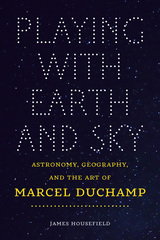
front cover of Playing with Earth and Sky
Playing with Earth and Sky
Astronomy, Geography, and the Art of Marcel Duchamp
James Housefield
Dartmouth College Press, 2016
Playing with Earth and Sky reveals the significance astronomy, geography, and aviation had for Marcel Duchamp—widely regarded as the most influential artist of the past fifty years. Duchamp transformed modern art by abandoning unique art objects in favor of experiences that could be both embodied and cerebral. This illuminating study offers new interpretations of Duchamp’s momentous works, from readymades to the early performance art of shaving a comet in his hair. It demonstrates how the immersive spaces and narrative environments of popular science, from museums to the modern planetarium, prepared paths for Duchamp’s nonretinal art. By situating Duchamp’s career within the transatlantic cultural contexts of Dadaism and Surrealism, this book enriches contemporary debates about the historical relationship between art and science. This truly original study will appeal to a broad readership in art history and cultural studies.
[more]

front cover of Pope.L
Pope.L
Showing Up to Withhold
The Renaissance Society at the University of Chicago
University of Chicago Press, 2014
Iconoclast and artist Pope.L uses the body, sex, and race as his materials the way other artists might use paint, clay, or bronze.  His work problematizes social categories by exploring how difference is marked economically, socially, and politically. Working in a range of media from ketchup to baloney to correction fluid, with a special emphasis on performativity and writing, Pope.L pokes fun at and interrogates American society’s pretenses, the bankruptcy of contemporary mores, and the resulting repercussions for a civil society. Other favorite Pope.L targets are squeamishness about the human body and the very possibility of making meaning through art and its display.

Published to accompany his wonderfully inscrutable exhibition Forlesen at the Renaissance Society at the University of Chicago, Pope.L: Showing Up to Withhold is simultaneously an artist’s book and a monograph. In addition to reproductions of a number of his most recent artworks, it includes images of significant works from the past decade, and presents a forum for reflection and analysis on art making today with contributions by renowned critics and scholars, including Lawrie Balfour, Nick Bastis, Lauren Berlant, and K. Silem Mohammad.
 
[more]

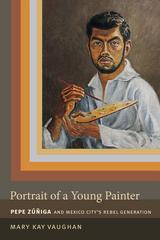
front cover of Portrait of a Young Painter
Portrait of a Young Painter
Pepe Zuniga and Mexico City's Rebel Generation
Mary Kay Vaughan
Duke University Press, 2015
In Portrait of a Young Painter, the distinguished historian Mary Kay Vaughan adopts a biographical approach to understanding the culture surrounding the Mexico City youth rebellion of the 1960s. Her chronicle of the life of painter Pepe Zúñiga counters a literature that portrays post-1940 Mexican history as a series of uprisings against state repression, injustice, and social neglect that culminated in the student protests of 1968. Rendering Zúñiga's coming of age on the margins of formal politics, Vaughan depicts midcentury Mexico City as a culture of growing prosperity, state largesse, and a vibrant, transnationally-informed public life that produced a multifaceted youth movement brimming with creativity and criticism of convention. In an analysis encompassing the mass media, schools, politics, family, sexuality, neighborhoods, and friendships, she subtly invokes theories of discourse, phenomenology, and affect to examine the formation of Zúñiga's persona in the decades leading up to 1968. By discussing the influences that shaped his worldview, she historicizes the process of subject formation and shows how doing so offers new perspectives on the events of 1968.
[more]

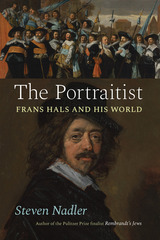
front cover of The Portraitist
The Portraitist
Frans Hals and His World
Steven Nadler
University of Chicago Press, 2022
A biography of the great portraitist Frans Hals that takes the reader into the turbulent world of the Dutch Golden Age. 
 
 
Frans Hals was one of the greatest portrait painters in history, and his style transformed ideas and expectations about what portraiture can do and what a painting should look like.
 
Hals was a member of the great trifecta of Dutch Baroque painters alongside Rembrandt and Vermeer, and he was the portraitist of choice for entrepreneurs, merchants, professionals, theologians, intellectuals, militiamen, and even his fellow artists in the Dutch Golden Age. His works, with their visible brush strokes and bold execution, lacked the fine detail and smooth finish common among his peers, and some dismissed his works as sloppy and unfinished. But for others, they were fresh and exciting, filled with a sense of the sitter’s animated presence captured with energy and immediacy.
 
Steven Nadler gives us the first full-length biography of Hals in many years and offers a view into seventeenth-century Haarlem and this culturally rich era of the Dutch Republic. He tells the story not only of Hals’s life, but also of the artistic, social, political, and religious worlds in which he lived and worked.
 
[more]

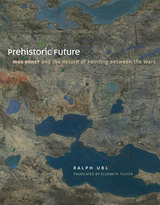
front cover of Prehistoric Future
Prehistoric Future
Max Ernst and the Return of Painting between the Wars
Ralph Ubl
University of Chicago Press, 2013
One of the most admired artists of the twentieth century, Max Ernst was a proponent of Dada and founder of surrealism, known for his strange, evocative paintings and drawings. In Prehistoric Future, Ralph Ubl approaches Ernst like no one else has, using theories of the unconscious—surrealist automatism, Freudian psychoanalysis, the concept of history as trauma—to examine how Ernst’s construction of collage departs from other modern artists.
 
Ubl shows that while Picasso, Braque, and Man Ray used scissors and glue to create collages, Ernst employed techniques he himself had forged—rubbing and scraping to bring images forth onto a sheet of paper or canvas to simulate how a screen image or memory comes into the mind’s view. In addition, Ernst scoured the past for obsolete scientific illustrations and odd advertisements to illustrate the rapidity with which time passes and to simulate the apprehension generated when rapid flows of knowledge turn living culture into artifact. Ultimately, Ubl reveals, Ernst was interested in the construction and phenomenology of both collective and individual modern history and memory. Shedding new light on Ernst’s working methods and the reasons that his pieces continue to imprint themselves in viewers’ memories, Prehistoric Future is an innovative work of critical writing on a key figure of surrealism.
[more]

front cover of Pre-Texts International
Pre-Texts International
José Luis Falconi and Doris Sommer
Harvard University Press
Pre-Texts is a methodology developed by Doris Sommer for education professionals to stimulate close reading and critical-thinking skills by making art based on challenging texts. This book is a manual of sorts. Presented in both English and Spanish, it gathers vivid descriptions and images of dozens of different Pre-Texts activities held across the globe, in person and in online forums, with groups diverse in age, background, and native language. Pre-Texts International features testimonials from both facilitators and participants, who describe in detail the planning, procedures, and activities they carried out and attest to the methodology’s efficacy and adaptability in a wide range of contexts.
[more]

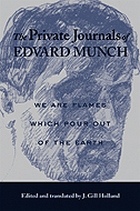
front cover of The Private Journals of Edvard Munch
The Private Journals of Edvard Munch
We Are Flames Which Pour Out of the Earth
Edvard Munch, edited and translated by J. Gill Holland
University of Wisconsin Press, 2005
Scandinavia's most famous painter, the Norwegian Edvard Munch (1863-1944), is probably best known for his painting The Scream, a universally recognized icon of terror and despair. (A version was stolen from the Munch Museum in Oslo, Norway, in August 2004, and has not yet been recovered.) But Munch considered himself a writer as well as a painter. Munch began painting as a teenager and, in his young adulthood, studied and worked in Paris and Berlin, where he evolved a highly personal style in paintings and works on paper. And in diaries that he kept for decades, he also experimented with reminiscence, fiction, prose portraits, philosophical speculations, and surrealism. Known as an artist who captured both the ecstasies and the hellish depths of the human condition, Munch conveys these emotions in his diaries but also reveals other facets of his personality in remarks and stories that are alternately droll, compassionate, romantic, and cerebral.
This English translation of Edvard Munch's private diaries, the most extensive edition to appear in any language, captures the eloquent lyricism of the original Norwegian text. The journal entries in this volume span the period from the 1880s, when Munch was in his twenties, until the 1930s, reflecting the changes in his life and his work. The book is illustrated with fifteen of Munch's drawings, many of them rarely seen before. While these diaries have been excerpted before, no translation has captured the real passion and poetry of Munch's voice. This is a translation that lets Munch speak for himself and evokes the primal passion of his diaries. J. Gill Holland's exceptional work adds a whole new level to our understanding of the artist and the depth of his scream.
[more]


Send via email Share on Facebook Share on Twitter