
 A SCHOLARLY BOOK REPOSITORY
9 start with P start with P
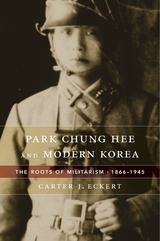
For South Koreans, the twenty years from the early 1960s to late 1970s were the best and worst of times—a period of unprecedented economic growth and of political oppression that deepened as prosperity spread. In this masterly account, Carter J. Eckert finds the roots of South Korea’s dramatic socioeconomic transformation in the country’s long history of militarization—a history personified in South Korea’s paramount leader, Park Chung Hee.
The first volume of a comprehensive two-part history, Park Chung Hee and Modern Korea: The Roots of Militarism, 1866–1945 reveals how the foundations of the dynamic but strongly authoritarian Korean state that emerged under Park were laid during the period of Japanese occupation. As a cadet in the Manchurian Military Academy, Park and his fellow officers absorbed the Imperial Japanese Army’s ethos of victory at all costs and absolute obedience to authority. Japanese military culture decisively shaped Korea’s postwar generation of military leaders. When Park seized power in an army coup in 1961, he brought this training and mentality to bear on the project of Korean modernization.
Korean society under Park exuded a distinctively martial character, Eckert shows. Its hallmarks included the belief that the army should intervene in politics in times of crisis; that a central authority should plan and monitor the country’s economic system; that the Korean people’s “can do” spirit would allow them to overcome any challenge; and that the state should maintain a strong disciplinary presence in society, reserving the right to use violence to maintain order.
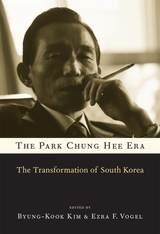
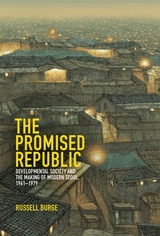
In 1961 South Korea was mired in poverty. By 1979 it had a powerful industrial economy and a vibrant civil society in the making, which would lead to a democratic breakthrough eight years later. The transformation took place during the years of Park Chung Hee's presidency. Park seized power in a coup in 1961 and ruled as a virtual dictator until his assassination in October 1979. He is credited with modernizing South Korea, but at a huge political and social cost.
South Korea's political landscape under Park defies easy categorization. The state was predatory yet technocratic, reform-minded yet quick to crack down on dissidents in the name of political order. The nation was balanced uneasily between opposition forces calling for democratic reforms and the Park government's obsession with economic growth. The chaebol (a powerful conglomerate of multinationals based in South Korea) received massive government support to pioneer new growth industries, even as a nationwide campaign of economic shock therapy-interest hikes, devaluation, and wage cuts-met strong public resistance and caused considerable hardship.
This landmark volume examines South Korea's era of development as a study in the complex politics of modernization. Drawing on an extraordinary range of sources in both English and Korean, these essays recover and contextualize many of the ambiguities in South Korea's trajectory from poverty to a sustainable high rate of economic growth.

James B. Palais theorizes in his important book on Korea that the remarkable longevity of the Yi dynasty (1392–1910) was related to the difficulties the country experienced in adapting to the modern world. He suggests that the aristocratic and hierarchical social system, which was the source of stability of the dynasty, was also the cause of its weakness.
The period from 1864 to 1873 was one in which the monarchy attempted to increase and expand central power at the expense of the powerful aristocracy. But the effort failed, and 1874 saw a rebirth of bureaucratic and aristocratic dominance. What this meant when Korea was “opened” two years later to the outside world was that the country was poorly suited to the attainment of modern national objectives—the aggrandizement of state wealth and power—in competition with other nations. Thus any sense of national purpose was subverted, and the leadership could not generate the unified support needed for either modernization or domestic harmony. The consequences for the twentieth-century world have been portentous.
James B. Palais theorizes in his important book on Korea that the remarkable longevity of the Yi dynasty (1392–1910) was related to the difficulties the country experienced in adapting to the modern world. He suggests that the aristocratic and hierarchical social system, which was the source of stability of the dynasty, was also the cause of its weakness.
The period from 1864 to 1873 was one in which the monarchy attempted to increase and expand central power at the expense of the powerful aristocracy. But the effort failed, and 1874 saw a rebirth of bureaucratic and aristocratic dominance. What this meant when Korea was “opened” two years later to the outside world was that the country was poorly suited to the attainment of modern national objectives—the aggrandizement of state wealth and power—in competition with other nations. Thus any sense of national purpose was subverted, and the leadership could not generate the unified support needed for either modernization or domestic harmony. The consequences for the twentieth-century world have been portentous.
The Postdevelopmental State radically reframes research into the South Korean economy by foregrounding the efforts of pro-democratic reformers and social movements in South Korea to create an alternative economic model—one that can address Korea’s legacy of authoritarian economic development during the Cold War and neoliberal restructuring since the Asian Financial Crisis of the late 1990s. Understanding these attempts offers insight into the types of economic reforms that have been enacted since the late 1990s as well as the continued legacy of dictatorship-era politics within the Korean political and legal system. By examining the dilemmas economic democracy has encountered over the past 25 years, from the IMF Crisis to the aftermath of the Candlelight Revolution, the book reveals the enormous and comprehensive challenges involved in addressing the legacy of authoritarian economic models and their neoliberal transformations.

Buddhism in medieval Korea is characterized as “State Protection Buddhism,” a religion whose primary purpose was to rally support (supernatural and popular) for and legitimate the state. In this view, the state used Buddhism to engender compliance with its goals. A closer look, however, reveals that Buddhism was a canvas on which people projected many religious and secular concerns and desires.
This study is an attempt to specify Buddhism’s place in Koryo and to ascertain to what extent and in what areas Buddhism functioned as a state religion. Was state support the main reason for Buddhism’s dominance in Koryo? How actively did the state seek to promote religious ideals? What was the strength of Buddhism as an institution and the nature of its relationship to the state? What role did Confucianism, the other state ideology, play in Koryo? This study argues that Buddhism provided most of the symbols and rituals, and some of the beliefs, that constructed an aura of legitimacy, but that there was no single ideological system underlying the Koryo dynasty’s legitimating strategies.
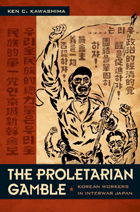
Kawashima draws on previously unseen archival materials from interwar Japan as he describes how Korean migrants struggled against various recruitment practices, unfair and discriminatory wages, sudden firings, racist housing practices, and excessive bureaucratic red tape. Demonstrating that there was no single Korean “minority,” he reveals how Koreans exploited fellow Koreans and how the stratification of their communities worked to the advantage of state and capital. However, Kawashima also describes how, when migrant workers did organize—as when they became involved in Rōsō (the largest Korean communist labor union in Japan) and in Zenkyō (the Japanese communist labor union)—their diverse struggles were united toward a common goal. In The Proletarian Gamble, his analysis of the Korean migrant workers' experiences opens into a much broader rethinking of the fundamental nature of capitalist commodity economies and the analytical categories of the proletariat, surplus populations, commodification, and state power.

Socialist doctrines had an important influence on Korean writers and intellectuals of the early twentieth century. From the 1910s through the 1940s, a veritable wave of anarchist, Marxist, nationalist, and feminist leftist groups swept the cultural scene with differing agendas as well as shared demands for equality and social justice. In The Proletarian Wave, Sunyoung Park reconstructs the complex mosaic of colonial leftist culture by focusing on literature as its most fertile and enduring expression. The book combines a general overview of the literary left with the intellectual portraits of four writers whose works exemplify the stylistic range and colonial inflection of socialist culture in a rapidly modernizing Korea. Bridging Marxist theory and postcolonial studies, Park confronts Western preconceptions about third-world socialist cultures while interrogating modern cultural history from a post–Cold War global perspective.
The Proletarian Wave provides the first historical account in English of the complex interrelations of literature and socialist ideology in colonial Korea. It details the origins, development, and influence of a movement that has shaped twentieth-century Korean politics and aesthetics alike through an analysis that simultaneously engages some of the most debated and pressing issues of literary historiography, Marxist criticism, and postcolonial cultural studies.
READERS
Browse our collection.
PUBLISHERS
See BiblioVault's publisher services.
STUDENT SERVICES
Files for college accessibility offices.
RECENTLY PUBLISHED




UChicago Accessibility Resources
home | accessibility | search | about | contact us
BiblioVault ® 2001 - 2026
The University of Chicago Press