front cover of Pattern of a Man and Other Stories
Pattern of a Man and Other Stories
James Still
Ohio University Press

Published in 2001 by Gnomon Press

This reissue of a 1976 collection, featuring a new afterword by Wendell Berry, showcases James Still’s enduring mastery of the short story form. Set in the Appalachian region, these twelve stories reflect the rhythms, dialects, and deep-rooted traditions of mountain life, rendered with quiet power and poetic precision.

Still’s characters—rural craftsmen, widows, children, and wanderers—navigate the complexities of isolation, kinship, and survival. Stories like “The Nest,” “The Scrape,” and “Maybird Upshaw” reveal a landscape both stark and tender, where the natural world and human spirit intertwine. With language shaped by the unique dialect of eastern Kentucky, Still’s prose honors the dignity of his subjects without sentimentality or condescension.

This collection affirms Still’s place among the great chroniclers of American regional life, offering readers a poignant and authentic portrait of a vanishing world.

[more]

logo for Harvard University Press
Plato's Theory of Man
An Introduction to the Realistic Philosophy of Culture
John Wild
Harvard University Press

front cover of Play Like a Man
Play Like a Man
My Life in Poster Children
Rose Marshack
University of Illinois Press, 2023
As a member of Poster Children, Rose Marshack took part in entwined revolutions. Marshack and other women seized a much-elevated profile in music during the indie rock breakthrough while the advent of new digital technologies transformed the recording and marketing of music. Touring in a van, meeting your idols, juggling a programming job with music, keeping control and credibility, the perils of an independent record label (and the greater perils of a major)—Marshack chronicles the band’s day-to-day life and punctuates her account with excerpts from her tour reports and hard-learned lessons on how to rock, program, and teach while female. She also details the ways Poster Children applied punk’s DIY ethos to digital tech as a way to connect with fans via then-new media like pkids listservs, internet radio, and enhanced CDs.

An inside look at a scene and a career, Play Like a Man is the evocative and humorous tale of one woman’s life in the trenches and online.

[more]

logo for University of Chicago Press
Political Philosophy 3
From the Rights of Man to the Republican Idea
Luc Ferry and Alain Renaut
University of Chicago Press, 1992
What is the common element linking the right to health care and the right of free speech, the right to leisure and the right of free association, the right to work and the right to be protected? Debates on the rights of man abound in the media today, but all too often they remain confused and fail to recognize the fundamental political conceptions on which they hinge.

Several French theorists have recently attempted a new account of rights, one that would replace the discredited Marxist view of rights as mere formalities concealing the realities of class domination. In this final volume of Political Philosophy, Luc Ferry and Alain Renaut summarize these efforts and put forward their own set of arguments.
[more]

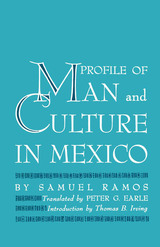
front cover of Profile of Man and Culture in Mexico
Profile of Man and Culture in Mexico
By Samuel Ramos
University of Texas Press, 1962

Profile of Man and Culture in Mexico, originally written in 1934, is addressed to the author’s compatriots, but it speaks to people, wherever they are, who are interested in enriching their own lives and in elevating the cultural level of their countries. And it speaks with a peculiar timeliness to citizens of the United States who would understand their neighbors to the south.

Samuel Ramos’s avowed purpose is to assist in the spiritual reform of Mexico by developing a theory that might explain the real character of Mexican culture. His approach is not flattering to his fellow citizens. After an analysis of the historical forces that have molded the national psychology, Ramos concludes that the Mexican sense of inferiority is the basis for most of the Mexican’s spiritual troubles and for the shortcomings of the Mexican culture.

Ramos subscribes to neither of the two major opposing schools of thought as to what norms should direct the development of Mexican culture. He agrees neither with the nationalists, who urge a deliberate search for originality and isolation from universal culture, nor with the “Europeanizers,” who advocate abandonment of the life around them and a withdrawal into the modes of foreign cultures. Ramos thinks that Mexico’s hope lies in a respect for the good in native elements and a careful selection of those foreign elements that are appropriate to Mexican life. Such a sensible choice of foreign elements will result not in imitation, but in assimilation. Combined with the nurturing of desirable native elements, it will result in an independent cultural unit, “a new branch grafted onto world culture.”

Ramos finds in Mexico no lack of intelligence or vitality: “It needs only to learn.” And he believes that the future is Mexico’s, that favorable destinies await a Mexico striving for the elevation of humanity, for the betterment of life, for the development of all the national capacities.


[more]


Send via email Share on Facebook Share on Twitter