
 A SCHOLARLY BOOK REPOSITORY
8 start with P start with P

Early modern digital studies is a thriving field that draws in strands from publishing, textual studies, digital humanities, and more. Yet it is also rapidly changing. This volume shows that early modern digital studies must be reconsidered from different perspectives as new projects and tools emerge, change, or disappear, and as we make advances into better understanding the past. The chapters in this volume explore how and what we publish (digitally and otherwise), how we value, evaluate, and sustain those publications and digital projects, and how these projects enable us to ask new research questions about early modern literature and culture. This collection does not seek to be a definitive or final state-of-the-field, but rather, a celebration of existing scholarship and an invitation to further scholarship about our ever-evolving practices.
A saying in Mexico City is “quien domina el centro, domina el país” (whoever dominates the center, dominates the country) as the Zócalo continues to act as the performative embodiment of Mexican society. This book highlights how particular performances build upon each other by recycling past architectures and performative practices for new purposes. Ana Martínez discusses the singular role of collective memory in creating meaning through space and landmarks, providing a new perspective and further insight into the problem of Mexico’s relationship with its own past. Rather than merely describe the commemorations, she traces the relationship between space and the invention of a Mexican imaginary. She also explores how indigenous communities, Mexico’s alienated subalterns, performed as exploited objects, exotic characters, and subjects with agency. The book’s dual purposes are to examine the Zócalo as Mexico’s central site of performance and to unmask, without homogenizing, the official discourse regarding Mexico’s natives. This book will be of interest for students and scholars in theater studies, Mexican Studies, Cultural Geography, Latinx and Latin American Studies.

Since the time of Blackstone's "Farewell," poetry has been seen as celestial, pastoral, solitary, and mellifluous; law as venerable, social, urban, and cacophonous. This perception has persisted even to the present, with the bourgeoning field of law and literature focusing almost exclusively on fiction and drama. Poetry of the Law, however, reveals the richness of poetry about the law.
Poetry of the Law is the first serious anthology of law-related poetry ever published in the United States. As the editors make clear, though, serious need not imply solemn. Instead, David Kader and Michael Stanford have assembled a surprisingly capacious collection of 100 poems from the 1300s to the present.
Set in courtrooms, lawyers’ offices, law-school classrooms, and judges’ chambers; peopled with attorneys, the imprisoned (both innocent and guilty), judges, jurors, witnesses, and law-enforcement officers; based on real events (think “Scottsboro”) or exploring the complexity of abstract legal ideas; the poems celebrate justice or decry the lack of it, ranging in tone from witty to wry, sad to celebratory, funny to infuriating. Poetry of the Law is destined to become an authoritative source for years to come.
Contributors Include:
W. H. Auden
Robert Burns
Lewis Carroll
John Ciardi
Daniel Defoe
Emily Dickinson
John Donne
Rita Dove
Ralph Waldo Emerson
Martín Espada
Thomas Hardy
Seamus Heaney
A. E. Housman
Langston Hughes
Ben Jonson
X. J. Kennedy
Yusef Komunyakaa
Ted Kooser
D. H. Lawrence
Edgar Lee Masters
W. S. Merwin
Edna St. Vincent Millay
Sir Walter Raleigh
Muriel Rukeyser
Carl Sandburg
William Shakespeare
Jonathan Swift
Mona Van Duyn
Oscar Wilde
William Carlos Williams
from “The Hanging Judge” by Eavan Boland
Come to the country where justice is seen to be done,
Done daily. Come to the country where
Sentence is passed by word of mouth and raw
Boys split like infinitives. Look, here
We hanged our son, our only son
And hang him still and still we call it law.
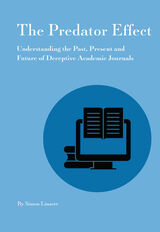
The Predator Effect concerns predatory publishing — it is the first to chart both the rise and impact of deceptive publishing. The author — a scientific communications expert with 20 years’ experience — looks at how predatory journals had become an accepted part of scholarly publishing, reviewing in turn the history, development and impact of predatory journals. The book also puts their rise in context of wider issues such as Open Access and publication ethics. Other issues it addresses include: defining predatory journals, the history of predatory publishing practices, Beall’s List, authors’ motivations and the future of predatory publishing practices.
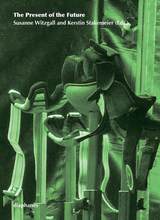
The result of a lecture series held at the cx centre for interdisciplinary studies at the Academy of Fine Arts, Munich, The Present of the Future explores our current relationship to the future and considers strategies for artists and scholars to establish effective action for shaping alternative futures. Contributors to the book approach this problem from the perspective of diverse disciplines, including art, design, architecture, and philosophy.
READERS
Browse our collection.
PUBLISHERS
See BiblioVault's publisher services.
STUDENT SERVICES
Files for college accessibility offices.
RECENTLY PUBLISHED

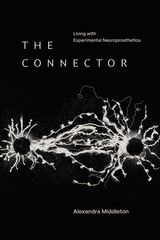





UChicago Accessibility Resources
home | accessibility | search | about | contact us
BiblioVault ® 2001 - 2026
The University of Chicago Press