logo for Pluto Press
Palestinians in Israel
Segregation, Discrimination and Democracy
Ben White
Pluto Press, 2012

Palestinians in Israel considers a key issue ignored by the official 'peace process' and most mainstream commentators: that of the growing Palestinian minority within Israel itself.

What the Israeli right-wing calls 'the demographic problem' Ben White identifies as 'the democratic problem' which goes to the heart of the conflict. Israel defines itself not as a state of its citizens, but as a Jewish state, despite the substantial and increasing Palestinian population. White demonstrates how the consistent emphasis on privileging one ethno-religious group over another cannot be seen as compatible with democratic values and that, unless addressed, will undermine any attempts to find a lasting peace.

Individual case studies are used to complement this deeply informed study into the great, unspoken contradiction of Israeli democracy. It is a pioneering contribution which will spark debate amongst all those concerned with a resolution to the Israel/Palestine conflict.
[more]

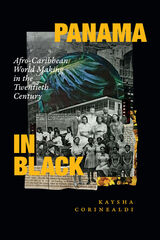
front cover of Panama in Black
Panama in Black
Afro-Caribbean World Making in the Twentieth Century
Kaysha Corinealdi
Duke University Press, 2022
In Panama in Black, Kaysha Corinealdi traces the multigenerational activism of Afro-Caribbean Panamanians as they forged diasporic communities in Panama and the United States throughout the twentieth century. Drawing on a rich array of sources including speeches, yearbooks, photographs, government reports, radio broadcasts, newspaper editorials, and oral histories, Corinealdi presents the Panamanian isthmus as a crucial site in the making of an Afro-diasporic world that linked cities and towns like Colón, Kingston, Panamá City, Brooklyn, Bridgetown, and La Boca. In Panama, Afro-Caribbean Panamanians created a diasporic worldview of the Caribbean that privileged the potential of Black innovation. Corinealdi maps this innovation by examining the longest-running Black newspaper in Central America, the rise of civic associations created to counter policies that stripped Afro-Caribbean Panamanians of citizenship, the creation of scholarship-granting organizations that supported the education of Black students, and the emergence of national conferences and organizations that linked anti-imperialism and Black liberation. By showing how Afro-Caribbean Panamanians used these methods to navigate anti-Blackness, xenophobia, and white supremacy, Corinealdi offers a new mode of understanding activism, community, and diaspora formation.
[more]

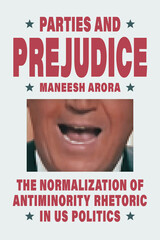
front cover of Parties and Prejudice
Parties and Prejudice
The Normalization of Antiminority Rhetoric in US Politics
Maneesh Arora
University of Chicago Press, 2025

An essential guide to how the interactions between social norms, party politics, and expressions of prejudice are driving contemporary politics.

Antiminority rhetoric in American politics has grown more overt. What were once fringe comments on Stormfront have now become typical campaign appeals from many mainstream politicians. If there was ever a doubt, this is a poignant reminder that the boundaries of what is “acceptable” and “unacceptable” to say and do are fluid and socially enforced.

In Parties and Prejudice, Maneesh Arora offers a broad framework for understanding this new political terrain. Arora argues that the interaction between social norms and party politics determines what the political consequence of prejudicial speech will be. He illuminates this nuanced relationship by showing that norms vary based on the targeted minority group and the intended audience.

Drawing on experiments, survey data, news coverage, and real-world examples, Parties and Prejudice examines the distinctive ways that egalitarian/inegalitarian norms have developed—within each party—for Black, Muslim, and LGBTQ+ Americans. It is essential reading for understanding Donald Trump’s rise to power, the modern conservative agenda (including opposition to critical race theory and transgender rights), and threats to the development of a multiracial democracy.
[more]

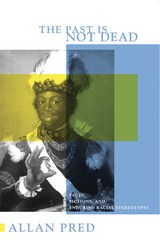
front cover of Past Is Not Dead
Past Is Not Dead
Facts, Fictions, and Enduring Racial Stereotypes
Allan Pred
University of Minnesota Press, 2004

A study of the genealogy and perpetuation of stereotyping

Through one figure—Badin, an eighteenth-century Afro-Caribbean slave given to the Swedish royal court—Allan Pred shows how stereotypes endure through the repeated confusion of facts and fiction, providing a highly original perspective on the perpetuation of racializing stereotypes in the West.

In the first of two interlocking montages inspired by Walter Benjamin, the book focuses on Badin, who died in Stockholm in 1822, and representations of his life that appeared from the 1840s through the 1990s. In the second montage, Pred brings the late nineteenth century and the present into play, shifting to urban sites where racialized stereotyping is on public display, including a museum that has exhibited the bodily remains of the African male.Intriguing for its insight into the workings of race and immigration on the national imagination of a European nation—but with implications and ramifications far beyond that specific example—The Past Is Not Dead is a bold inquiry into both the collective memory and the amnesia of those who stereotype versus the personal remembering and forgetting of the stereotyped.
[more]

front cover of Pervasive Prejudice?
Pervasive Prejudice?
Unconventional Evidence of Race and Gender Discrimination
Ian Ayres
University of Chicago Press, 2001
If you're a woman and you shop for a new car, will you really get the best deal? If you're a man, will you fare better? If you're a black man waiting to receive an organ transplant, will you have to wait longer than a white man?

In Pervasive Prejudice? Ian Ayres confronts these questions and more. In a series of important studies he finds overwhelming evidence that in a variety of markets—retail car sales, bail bonding, kidney transplantation, and FCC licensing—blacks and females are consistently at a disadvantage. For example, when Ayres sent out agents of different races and genders posing as potential buyers to more than 200 car dealerships in Chicago, he found that dealers regularly charged blacks and women more than they charged white men. Other tests revealed that it is commonly more difficult for blacks than whites to receive a kidney transplant because of federal regulations. Moreover, Ayres found that minority male defendants are frequently required to post higher bail bonds than their Caucasian counterparts.

Traditional economic theory predicts that free markets should drive out discrimination, but Ayres's startling findings challenge that position. Along with empirical research, Ayres offers game—theoretic and other economic methodologies to show how prejudice can enter the bargaining process even when participants are supposedly acting as rational economic agents. He also responds to critics of his previously published studies included here. These studies suggest that race and gender discrimination is neither a thing of the past nor merely limited to the handful of markets that have been the traditional focus of civil rights laws.
[more]

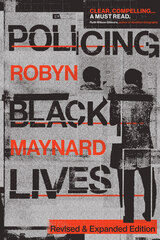
front cover of Policing Black Lives
Policing Black Lives
State Violence in Canada from Slavery to the Present
Robyn Maynard
Duke University Press, 2025
Robyn Maynard’s bestselling Policing Black Lives offers a comprehensive account of the state-sanctioned surveillance, criminalization, and punishment of Black lives in Canada. In this revised and expanded edition, Maynard exposes Canada’s veneer of multiculturalism and tolerance to document how half a century of police reforms have expanded the scope and scale of policing and undermined Black freedom struggles in the wake of global Black uprisings in 2020. She traces the afterlives of slavery across multiple institutions and illuminates the state’s role in perpetuating colonial dispossession, racial profiling, police killings, incarceration, immigration detention, deportation, exploitative migrant labor practices, and the school-to-prison pipeline. At the same time, Maynard foregrounds the ubiquity of Black resistance while offering new insights on how to build liveable futures without policing. Advancing a compelling vision for making policing obsolete and building new forms of safety, Policing Black Lives is an essential text that will guide and inspire activists, students, scholars, and all those working toward Black futures beyond surveillance and confinement.
[more]

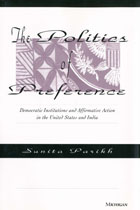
front cover of The Politics of Preference
The Politics of Preference
Democratic Institutions and Affirmative Action in the United States and India
Sunita Parikh
University of Michigan Press, 1997
Sunita Parikh examines the history and fate of affirmative action programs in two ethnically heterogeneous democracies, the United States and India. Affirmative action programs in the United States represent a controversial policy about which the American public feel at best ambivalence and at worst hostility, while in India the expansion of reservation policies in recent years has led to riots and contributed to the fall of governments. And yet these policies were not particularly controversial when they were introduced. How the policy traveled from these auspicious beginnings to its current predicament can best be understood, according to Parikh, by exploring the changing political conditions under which it was introduced, expanded, and then challenged.
Although they are in many respects very different countries, India and the United States are important countries in which to study the implementation of ascriptive policies like affirmative action, according to Parikh. They are both large, heterogeneous societies with democratic political systems in which previously excluded groups were granted benefits by the majorities that had historically oppressed them. Parikh argues that these policies were the product of democratic politics--which required political parties to mobilize existing groups as voters--and the ethnically heterogeneous nature of Indian and U.S. society--where ethnic markers are particularly salient sources of identification as groups. Affirmative action in both countries was introduced because it could be used to solidify and expand electoral coalitions by giving benefits to defined minority groups, according to Parikh. As the policy became better known, it became more disliked by non-targeted groups, and it was no longer an appeal which was cost free for politicians.
This book will be of interest to social scientists concerned with race and ethnic relations and with the comparative study of political and social systems.
Sunita Parikh is Assistant Professor of Political Science, Columbia University.
[more]

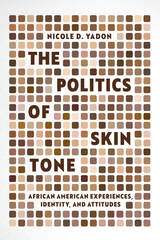
front cover of The Politics of Skin Tone
The Politics of Skin Tone
African American Experiences, Identity, and Attitudes
Nicole D. Yadon
University of Chicago Press, 2025

A nuanced examination of the salience of skin tone within African American politics.

Research shows that skin tone is associated with significant differences in life experiences. On average, African Americans with darker skin earn lower wages, suffer worse health outcomes, and endure more negative criminal justice experiences than lighter-skinned African Americans. Nicole D. Yadon conceptualizes skin tone as one facet of the multidimensional construct of race that powerfully influences racialized experiences which, in turn, can influence political identities and attitudes.

Drawing on evidence from one hundred in-depth interviews, multiple surveys, and a survey experiment, The Politics of Skin Tone investigates the political associations of skin tone. Yadon finds that skin tone correlates with political attitudes, particularly on issues where color-based disparities are especially pronounced such as criminal justice. Moreover, a sizable number of African Americans adopt a skin tone-based identity. In an era of shifting racial boundaries and growing color-based discrimination, The Politics of Skin Tone examines the implications for both scholars and policymakers.
[more]

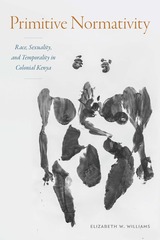
front cover of Primitive Normativity
Primitive Normativity
Race, Sexuality, and Temporality in Colonial Kenya
Elizabeth W. Williams
Duke University Press, 2024
In Primitive Normativity Elizabeth W. Williams traces the genealogy of a distinct narrative about African sexuality that British colonial authorities in Kenya used to justify their control over indigenous populations. She identifies a discourse of “primitive normativity” that suggested that Africans were too close to nature to develop sexual neuroses and practices such as hysteria, homosexuality, and prostitution which supposedly were common among Europeans. Primitive normativity framed Kenyan African sexuality as less polluted than that of the more deviant populations of their colonizers. Williams shows that colonial officials and settlers used this narrative to further the goals of white supremacy by arguing that Africans’ sexuality was proof that Kenyan Africans must be protected from the forces of urbanization, Western-style education, and political participation, lest they be exposed to forms of civilized sexual deviance. Challenging the more familiar notion that Europeans universally viewed Africans as hypersexualized, Williams demonstrates how narratives of African sexual normativity rather than deviance reinforced ideas about the evolutionary backwardness of African peoples and their inability to govern themselves.
[more]

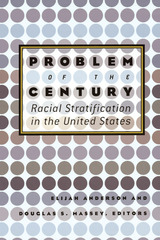
front cover of Problem of the Century
Problem of the Century
Racial Stratification in the United States
Elijah Anderson
Russell Sage Foundation, 2001
In 1899 the great African American scholar, W.E.B. DuBois, published The Philadelphia Negro, the first systematic case study of an African American community and one of the foundations of American sociology. DuBois prophesied that the color line would be the problem of the twentieth century. One hundred years later, Problem of the Century reflects upon his prophecy, exploring the ways in which the color line is still visible in the labor market, the housing market, education, family structure, and many other aspects of life at the turn of a new century. The book opens with a theoretical discussion of the way racial identity is constructed and institutionalized. When the government classifies races and confers group rights upon them, is it subtly reenforcing damaging racial divisions, or redressing the group privileges that whites monopolized for so long? The book also delineates the social dynamics that underpin racial inequality. The contributors explore the causes and consequences of high rates of mortality and low rates of marriage in black communities, as well as the way race affects a person's chances of economic success. African Americans may soon lose their historical position as America's majority minority, and the book also examines how race plays out in the sometimes fractious relations between blacks and immigrants. The final part of the book shows how the color line manifests itself at work and in schools. Contributors find racial issues at play on both ends of the occupational ladder—among absentee fathers paying child support from their meager earnings and among black executives prospering in the corporate world. In the schools, the book explores how race defines a student's peer group and how peer pressure affects a student's grades. Problem of the Century draws upon the distinguished faculty of sociologists at the University of Pennsylvania, where DuBois conducted his research for The Philadelphia Negro. The contributors combine a scrupulous commitment to empirical inquiry with an eclectic openness to different methods and approaches. Problem of the Century blends ethnographies and surveys, statistics and content analyses, census data and historical records, to provide a far-reaching examination of racial inequality in all its contemporary manifestations.
[more]

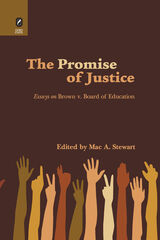
front cover of Promise of Justice
Promise of Justice
Essays on Brown v. Board of Education
Mac A. Stewart
The Ohio State University Press, 2008
Brown v. Board of Education of Topeka Kansas (1954) was a landmark decision of the United States Supreme Court in the twentieth century. It overturned the Court’s earlier ruling in Plessy v. Ferguson (1896), declaring the establishment of separate public schools for black and white students, as inherently unequal. This victory paved the way for integration in public schools and the civil rights movement of the 1960s. The Promise of Justice: Essays on Brown v. Board of Education assembles fourteen essays about Brown and its consequences in the fifty years following the decision.
 
Several of the essayists in this anthology provide personal recollections of the conditions before and immediately after the decision in Brown. One of the authors was a child plaintiff in a related case. Another was the federal district judge responsible for deciding in favor of, and then overseeing, integration in a major northern city. Contributors to this volume include legal specialists, sociologists, educators, and political scientists. A history of the legal milestones of integration is included, as well as judgments about the progress that has been made and the need for additional actions to assure racial equality under the law. Ten of these essays first appeared in a special issue of The Negro Educational Review published in January 2005, and four were written expressly for this volume.
 
 
[more]


Send via email Share on Facebook Share on Twitter