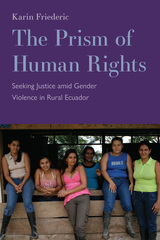
The Prism of Human Rights
Seeking Justice amid Gender Violence in Rural Ecuador
Karin Friederic
Rutgers University Press, 2023
Gender violence has been at the forefront of women’s human rights struggles for decades, shaping political movements and NGO and government programs related to women’s empowerment, community development, and public health. Drawing on over twenty years of research and activism in rural Ecuador, Karin Friederic provides a remarkably intimate view of what these rights-based programs actually achieve over the long term. The Prism of Human Rights brings us into the lives of women, men, and children who find themselves entangled in intimate partner violence, structural violence, political economic change, and a global cultural project in which “rights” are associated with modernity, development, and democratic states. She details the multiple forms of violence that rural women experience; shows the diverse ways they make sense of, endure, and combat this violence; and helps us understand how people are grappling with new ideas of gender, rights, and even of violence itself. Ultimately, Friederic demonstrates that rights-based interventions provide important openings for women seeking a life free of violence, but they also unwittingly expose “liberated” women to more extreme dynamics of structural violence. Thus, these interventions often reduce women’s room to maneuver and encourage communities to hide violence in order to appear “modern” and “developed.” This analysis of human rights in practice is essential for anyone seeking to promote justice in a culturally responsible manner, and for anyone who hopes to understand how the globalization of rights, legal institutions, and moral visions is transforming distant locales and often perpetuating violence in the process.
[more]