
 A SCHOLARLY BOOK REPOSITORY
437 books about International and 5
start with Q
437 books about International and 5
437 books about International
5 start with Q start with Q
5 start with Q start with Q
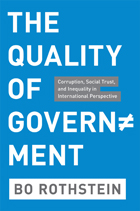
The Quality of Government
Corruption, Social Trust, and Inequality in International Perspective
Bo Rothstein
University of Chicago Press, 2011
The relationship between government, virtue, and wealth has held a special fascination since Aristotle, and the importance of each frames policy debates today in both developed and developing countries. While it’s clear that low-quality government institutions have tremendous negative effects on the health and wealth of societies, the criteria for good governance remain far from clear.
In this pathbreaking book, leading political scientist Bo Rothstein provides a theoretical foundation for empirical analysis on the connection between the quality of government and important economic, political, and social outcomes. Focusing on the effects of government policies, he argues that unpredictable actions constitute a severe impediment to economic growth and development—and that a basic characteristic of quality government is impartiality in the exercise of power. This is borne out by cross-sectional analyses, experimental studies, and in-depth historical investigations. Timely and topical, The Quality of Government tackles such issues as political legitimacy, social capital, and corruption.
[more]
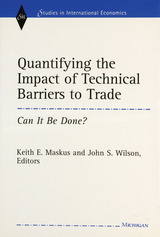
Quantifying the Impact of Technical Barriers to Trade
Can It Be Done?
Keith E. Maskus and John S. Wilson, Editors
University of Michigan Press, 2001
This book provides an up-to-date discussion of economic issues involved in analyzing regulations of product quality and performance in international trade. Among the issues addressed in this collection are restrictions on genetically modified foods and pesticide use and compatibility standards for computers. While such regulations may serve important goals, they may also interfere with international trade flow by raising the costs of compliance. This is of special concern to developing countries, which have found it difficult to meet the increasingly exacting regulations imposed by the United States and Europe. Keith E. Maskus and John S. Wilson gather prominent international trade specialists to ask whether the impacts of such regulations may be quantified systematically in order to inform the international policy debate. The essays included here cover all fronts of the debate over regulatory issues and trade conflicts. The discussion ranges from a review of how trade conflicts emerge and how they are managed by the international trading system to a technical analysis of the potential impact of European restraints on trade in genetically modified products to an examination of methods for estimating the costs of compliance with environmental regulations. Considerable attention is paid to whether the emergence and enforcement of stronger standards among developed economies could result in diminished trade opportunities for developing countries. At the same time, the possibility that standards could expand market access through resolving consumer information problems is analyzed. This book will appeal to international economists, international relations specialists, and individuals concerned about appropriate regulation of safety and health issues in the global economy. Keith E. Maskus is Professor of Economics, University of Colorado, Boulder. John S. Wilson is Lead Economist, Development Economics Research Group, The World Bank.
[more]

Questioning Secularism
Islam, Sovereignty, and the Rule of Law in Modern Egypt
Hussein Ali Agrama
University of Chicago Press, 2012
The central question of the Arab Spring—what democracies should look like in the deeply religious countries of the Middle East—has developed into a vigorous debate over these nations’ secular identities. But what, exactly, is secularism? What has the West’s long familiarity with it inevitably obscured? In Questioning Secularism, Hussein Ali Agrama tackles these questions. Focusing on the fatwa councils and family law courts of Egypt just prior to the revolution, he delves deeply into the meaning of secularism itself and the ambiguities that lie at its heart.
Drawing on a precedent-setting case arising from the family law courts —the last courts in Egypt to use Shari‘a law—Agrama shows that secularism is a historical phenomenon that works through a series of paradoxes that it creates. Digging beneath the perceived differences between the West and Middle East, he highlights secularism’s dependence on the law and the problems that arise from it: the necessary involvement of state sovereign power in managing the private spiritual lives of citizens and the irreducible set of legal ambiguities such a relationship creates. Navigating a complex landscape between private and public domains, Questioning Secularism lays important groundwork for understanding the real meaning of secularism as it affects the real freedoms of a citizenry, an understanding of the utmost importance for so many countries that are now urgently facing new political possibilities.
[more]
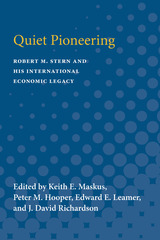
Quiet Pioneering
Robert M. Stern and His International Economic Legacy
Edited by Keith E. Maskus, Peter M. Hooper, Edward E. Leamer and J. David Richardson
University of Michigan Press, 1998
New scholarly research in important aspects of international economics is brought together in this volume. The unifying theme is that each chapter is devoted to a fresh analysis of a problem in international economics that had earlier received cogent and prescient attention by Professor Robert Stern of the University of Michigan, one of the major figures in international economic research in the second half of the twentieth century. Each chapter examines a significant issue in international trade or finance, including determinants of comparative advantage, the effects of trade restrictions and the importance of trade liberalization, aspects of international trade institutions, and monetary policy in integrated markets. Three broad areas of international economic analysis are explored. The first part of the volume is devoted to new and sophisticated empirical analyses of important policy questions, such as technical change in trade models, how nontariff barriers are established, and how patent protection affects trade flows. The second part analyzes key areas involving international trade negotiations, including the usefulness of binding tariff commitments, regionalism versus bilateralism in trade liberalization, and strategic competition among international firms in setting negotiating agendas. The final part considers important questions in labor costs, asset pricing, and monetary union in international markets. Professional international economists will find much worth reading in the volume. It also is relevant to those who study international relations and international organizations; political scientists; and government policy analysts. Keith E. Maskus is Professor of Economics, University of Colorado, Boulder. Peter M. Hooper is Assistant Director, Division of International Finance, Board of Governors of the Federal Reserve System. Edward E. Leamer is Professor of Economics and Management, University of California, Los Angeles. J. David Richardson is Professor of Economics, Syracuse University.
[more]
Quiet Pioneering
Robert M. Stern and His International Economic Legacy
Keith E. Maskus, Peter M. Hooper, Edward E. Leamer, and J. David Richardson, Editors
University of Michigan Press, 1997
New scholarly research in important aspects of international economics is brought together in this volume. The unifying theme is that each chapter is devoted to a fresh analysis of a problem in international economics that had earlier received cogent and prescient attention by Professor Robert Stern of the University of Michigan, one of the major figures in international economic research in the second half of the twentieth century. Each chapter examines a significant issue in international trade or finance, including determinants of comparative advantage, the effects of trade restrictions and the importance of trade liberalization, aspects of international trade institutions, and monetary policy in integrated markets. Three broad areas of international economic analysis are explored. The first part of the volume is devoted to new and sophisticated empirical analyses of important policy questions, such as technical change in trade models, how nontariff barriers are established, and how patent protection affects trade flows. The second part analyzes key areas involving international trade negotiations, including the usefulness of binding tariff commitments, regionalism versus bilateralism in trade liberalization, and strategic competition among international firms in setting negotiating agendas. The final part considers important questions in labor costs, asset pricing, and monetary union in international markets. Professional international economists will find much worth reading in the volume. It also is relevant to those who study international relations and international organizations; political scientists; and government policy analysts. Keith E. Maskus is Professor of Economics, University of Colorado, Boulder. Peter M. Hooper is Assistant Director, Division of International Finance, Board of Governors of the Federal Reserve System. Edward E. Leamer is Professor of Economics and Management, University of California, Los Angeles. J. David Richardson is Professor of Economics, Syracuse University.
[more]
READERS
Browse our collection.
PUBLISHERS
See BiblioVault's publisher services.
STUDENT SERVICES
Files for college accessibility offices.
RECENTLY PUBLISHED







UChicago Accessibility Resources
home | accessibility | search | about | contact us
BiblioVault ® 2001 - 2025
The University of Chicago Press