
 A SCHOLARLY BOOK REPOSITORY
24 start with R start with R
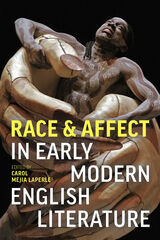
Race and Affect in Early Modern English Literature puts the fields of critical race studies and affect theory into dialogue. Doing so opens a new set of questions: What are the emotional experiences of racial formation and racist ideologies? How do feelings—through the physical senses, emotional passions, or sexual encounters—come to signify race? What is the affective register of anti-blackness that pervades canonical literature? How can these visceral forms of racism be resisted in discourse and in practice? By investigating how race feels, this book offers new ways of reading and interpreting literary traditions, religious differences, gendered experiences, class hierarchies, sexuality, and social identities. So far scholars have shaped the discussion of race in the early modern period by focusing on topics such as genealogy, language, economics, religion, skin color, and ethnicity. This book, however, offers something new: it considers racializing processes as visceral, affective experiences.

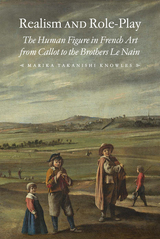
Published by University of Delaware Press. Distributed worldwide by Rutgers University Press.
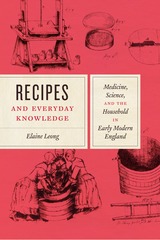
In Recipes and Everyday Knowledge, Elaine Leong situates recipe knowledge and practices among larger questions of gender and cultural history, the history of the printed word, and the history of science, medicine, and technology. The production of recipes and recipe books, she argues, were at the heart of quotidian investigations of the natural world or “household science”. She shows how English homes acted as vibrant spaces for knowledge making and transmission, and explores how recipe trials allowed householders to gain deeper understandings of sickness and health, of the human body, and of natural and human-built processes. By recovering this story, Leong extends the parameters of natural inquiry and productively widens the cast of historical characters participating in and contributing to early modern science.
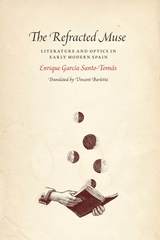
While Spain is often thought to have taken little notice of the Scientific Revolution, García Santo-Tomás tells a different story, one that reveals Golden Age Spanish literature to be in close dialogue with the New Science. Drawing on the work of writers such as Cervantes, Lope de Vega, Calderón de la Barca, and Quevedo, he helps us trace the influence of science and discovery on the rapidly developing and highly playful genre of the novel. Indeed, García Santo-Tomás makes a strong case that the rise of the novel cannot be fully understood without taking into account its relationship to the scientific discoveries of the period.
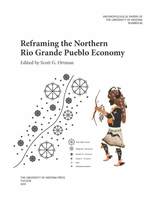
Economists recognize scale, agglomeration, the division of labor, international trade, and control over violence as important determinants of socioeconomic development in the modern world. But is a development framework appropriate for understanding Rio Grande archaeology? What do we learn about contemporary Pueblo culture and its resiliency when Pueblo history is viewed through this lens? What does the exercise teach us about the determinants of economic growth more generally?
The contributors in this volume argue that ideas from economics and complexity science, when suitably adapted, provide a compelling approach to the archaeological record. Contributors consider what we can learn about socioeconomic development through archaeology and explore how Pueblo culture and institutions supported improvements in the material conditions of life over time. They examine demographic patterns; the production and exchange of food, cotton textiles, pottery, and stone tools; and institutional structures reflected in village plans, rock art, and ritual artifacts that promoted peaceful exchange. They also document change through time in various economic measures and consider their implications for theories of socioeconomic development.
The archaeological record of the Northern Rio Grande exhibits the hallmarks of economic development, but Pueblo economies were organized in radically different ways than modern industrialized and capitalist economies. This volume explores the patterns and determinants of economic development in pre-Hispanic Rio Grande Pueblo society, building a platform for more broadly informed research on this critical process.
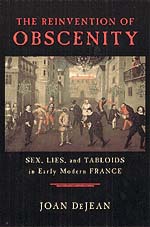
The Reinvention of Obscenity casts a fresh light on the mythical link between sexual impropriety and things French. Exploring the complicity between censorship, print culture, and obscenity, DeJean argues that mass market printing and the first modern censorial machinery came into being at the very moment that obscenity was being reinvented—that is, transformed from a minor literary phenomenon into a threat to society. DeJean's principal case in this study is the career of Moliére, who cannily exploited the new link between indecency and female genitalia to found his career as a print author; the enormous scandal which followed his play L'école des femmes made him the first modern writer to have his sex life dissected in the press.
Keenly alert to parallels with the currency of obscenity in contemporary America, The Reinvention of Obscenity will concern not only scholars of French history, but anyone interested in the intertwined histories of sex, publishing, and censorship.
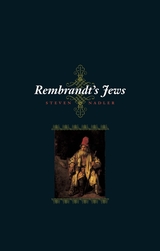
Rembrandt's Jews puts this myth to the test as it examines both the legend and the reality of Rembrandt's relationship to Jews and Judaism. In his elegantly written and engrossing tour of Jewish Amsterdam—which begins in 1653 as workers are repairing Rembrandt's Portuguese-Jewish neighbor's house and completely disrupting the artist's life and livelihood—Steven Nadler tells us the stories of the artist's portraits of Jewish sitters, of his mundane and often contentious dealings with his neighbors in the Jewish quarter of Amsterdam, and of the tolerant setting that city provided for Sephardic and Ashkenazic Jews fleeing persecution in other parts of Europe. As Nadler shows, Rembrandt was only one of a number of prominent seventeenth-century Dutch painters and draftsmen who found inspiration in Jewish subjects. Looking at other artists, such as the landscape painter Jacob van Ruisdael and Emmanuel de Witte, a celebrated painter of architectural interiors, Nadler is able to build a deep and complex account of the remarkable relationship between Dutch and Jewish cultures in the period, evidenced in the dispassionate, even ordinary ways in which Jews and their religion are represented—far from the demonization and grotesque caricatures, the iconography of the outsider, so often found in depictions of Jews during the Middle Ages and the Renaissance.
Through his close look at paintings, etchings, and drawings; in his discussion of intellectual and social life during the Dutch Golden Age; and even through his own travels in pursuit of his subject, Nadler takes the reader through Jewish Amsterdam then and now—a trip that, under ever-threatening Dutch skies, is full of colorful and eccentric personalities, fiery debates, and magnificent art.
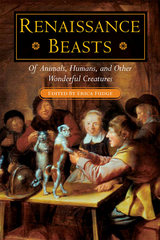
Taking as its starting point the popularity of speaking animals in sixteenth-century literature and ending with the decline of the imperial Ménagerie during the French Revolution, Renaissance Beasts uses the lens of human-animal relationships to view issues as diverse as human status and power, diet, civilization and the political life, religion and anthropocentrism, spectacle and entertainment, language, science and skepticism, and domestic and courtly cultures.
Within these pages scholars from a variety of disciplines discuss numerous kinds of texts--literary, dramatic, philosophical, religious, political--by writers including Calvin, Montaigne, Sidney, Shakespeare, Descartes, Boyle, and Locke. Through analysis of these and other writers, Renaissance Beasts uncovers new and arresting interpretations of Renaissance culture and the broader social assumptions glimpsed through views on matters such as pet ownership and meat consumption.
Renaissance Beasts is certainly about animals, but of the many species discussed, it is ultimately humankind that comes under the greatest scrutiny.

Today genre studies are flourishing, and nowhere more vigorously perhaps than in the field of Renaissance literature, given the importance to Renaissance writers of questions of genre. These studies have been nourished, as Barbara Lewalski points out, by the varied insights of contemporary literary theory. More sophisticated conceptions of genre have led to a fuller appreciation of the complex and flexible Renaissance uses of literary forms.
The eighteen essays in this volume are striking in their diversity of stance and approach. Three are addressed to genre theory explicitly, and all reveal a concern with theoretical issues. The contributors are James S. Baumlin, Francis C. Blessington, Morton W. Bloomfield, Barbara J. Bono, Mary Thomas Crane, Heather Dubrow, Alastair Fowler, Marjorie Garber, Claudio Guillén, Ann E. Imbrie, John N. King, John Klause, Harry Levin, Earl Miner, Janel M. Mueller, Annabel Patterson, Robert N. Watson, and Steven N. Zwicker.

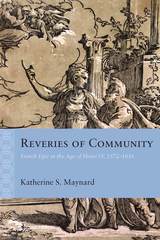
Traditionally united by une foi, une loi, un roi (one faith, one law, one king), France under Henri IV was cleaved into warring factions of Catholics and Huguenots. The country suffered episodes of bloodshed such as the St. Bartholomew’s Day Massacre, even as attempts were made to attenuate the violence through frequent edicts, including those of St. Germain (1570) and Nantes (1598). Maynard examines the rich and often dismissed body work written during these bloody decades: Pierre de Ronsard’s Franciade, Guillaume Salluste Du Bartas’s La Judit and La Sepmaine, Sébastian Garnier’s La Henriade, Agrippa d’Aubigné’s Les Tragiques, and others. She traces how French poets, taking classics such as Virgil’s Aeneid and Homer’s Iliad as their models, reimagined possibilities for French reconciliation and unity.

Milton’s Great Poems—Paradise Lost, Paradise Regained, and Samson Agonistes—are here examined in the light of his lifelong commitment to the English revolutionary cause. The poems, Joan Bennett shows, reflect the issues Milton had dealt with in theological and public policy debate, foreign diplomacy, and propaganda; moreover, they work innovatively with these issues, reaching in epic and tragedy answers that his pamphlets and tracts of the past twenty years had only partially achieved. The central issue is the nature and possibility of human freedom, or “Christian liberty.” Related questions are the nature of human rationality, the meaning of law, of history, of individuality, of society, and—everywhere—the problem of evil.
The book offers a revisionist position in the history of ideas, arguing that Renaissance Christian humanism in England descended not from Tudor to Stuart Anglicanism but from Tudor Anglicanism to revolutionary Puritanism. Close readings are offered of texts by Richard Hooker, Milton, and a range of writers before and during the revolutionary period. Not only theological and political positions but also political actions taken by the authors are compared. Milton's poems are studied in the light of these analyses.
The concept of “radical Christian humanism” moves current Milton criticism beyond the competing conceptions of Milton as the poet of democratic liberalism and the prophet of revolutionary absolutism. Milton's radical Christian humanism was built upon pre-modern conceptions and experiences of reason that are not alien to our time. It stemmed from, and resulted in, a religious commitment to political process which his poems embody and illuminate.

This volume is a systematic study of the politics of five crucial years of the Puritan Revolution, the period between John Pym's death in December 1643 and the execution of Charles I in January 1649. MacCormack provides a fresh and coherent interpretation of the events chronicled in the first volume of S. R. Gardiner's monumental History of the Great Civil War, a work long known to be inadequate.
Through an exhaustive compilation of the activities of individual members, MacCormack examines the Long Parliament and the structures of its parties. He investigates the degree to which the division between parties was religious or political, the character of the leadership of the two major groups (moderates and radicals), and the transformation of the parties during the five-year period.
The author focuses on the way in which the Parliamentary radical group led by Oliver St. John, Sir Henry Vane, Jr., and Oliver Cromwell gradually retreated from their revolutionary stance of 1644 in the face of the genuine populism of the Levellers. He contends that their failure to retain the moral leadership of the revolution led to the fragmentation of parties in 1648 and to the eventual dictatorship of Oliver Cromwell.
The book includes fresh interpretations of the role of Oliver Cromwell, especially in 1647 and 1648 when he emerged as the central figure. Significant material is also presented on John Lilburne. In analyzing the transformations of the radical party, the author places Lilburne's party, the Levellers, in the political context of the Revolution.
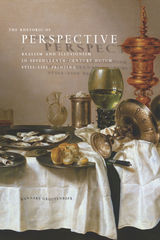
Aided by a stunning full-color gallery, Hanneke Grootenboer proposes a new theory of perspective based on the phenomenological aspects of non-narrative still-life, trompe l'oeil, and anamorphic imagery. Drawing on playful and mesmerizing baroque images, Grootenboer characterizes what she calls their "sophisticated deceit," asserting that painting is more about visual representation than about its supposed objects.
Offering an original theory of perspective's impact on pictorial representation, the act of looking, and the understanding of truth in painting, Grootenboer shows how these paintings both question the status of representation and explore the limits and credibility of perception.
-Jonathan Dollimore, York University
"Rogues and Early Modern English Culture is an up-to-date and suggestive collection on a subject that all scholars of the early modern period have encountered but few have studied in the range and depth represented here."
-Lawrence Manley, Yale University
"A model of cross-disciplinary exchange, Rogues and Early Modern English Culture foregrounds the figure of the rogue in a nexus of early modern cultural inscriptions that reveals the provocation a seemingly marginal figure offers to authorities and various forms of authoritative understanding, then and now. The new and recent work gathered here is an exciting contribution to early modern studies, for both scholars and students."
-Alexandra W. Halasz, Dartmouth College
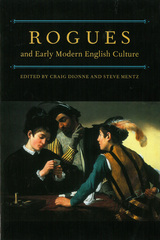
Rogues and Early Modern English Culture is a definitive collection of critical essays on the literary and cultural impact of the early modern rogue. Under various names-rogues, vagrants, molls, doxies, vagabonds, cony-catchers, masterless men, caterpillars of the commonwealth-this group of marginal figures, poor men and women with no clear social place or identity, exploded onto the scene in sixteenth-century English history and culture. Early modern representations of the rogue or moll in pamphlets, plays, poems, ballads, historical records, and the infamous Tudor Poor Laws treated these characters as harbingers of emerging social, economic, and cultural changes.
Images of the early modern rogue reflected historical developments but also created cultural icons for mobility, change, and social adaptation. The underclass rogue in many ways inverts the familiar image of the self-fashioned gentleman, traditionally seen as the literary focus and exemplar of the age, but the two characters have more in common than courtiers or humanists would have admitted. Both relied on linguistic prowess and social dexterity to manage their careers, whether exploiting the politics of privilege at court or surviving by their wits on urban streets.
Deftly edited by Craig Dionne and Steve Mentz, this anthology features essays from prominent and emerging critics in the field of Renaissance studies and promises to attract considerable attention from a broad range of readers and scholars in literary studies and social history.
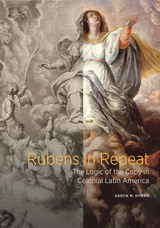
This book examines the reception in Latin America of prints designed by the Flemish artist Peter Paul Rubens, showing how colonial artists used such designs to create all manner of artworks and, in the process, forged new frameworks for artistic creativity.
Peter Paul Rubens (1577–1640) never crossed the Atlantic himself, but his impact in colonial Latin America was profound. Prints made after the Flemish artist’s designs were routinely sent from Europe to the Spanish Americas, where artists used them to make all manner of objects.
Rubens in Repeat is the first comprehensive study of this transatlantic phenomenon, despite broad recognition that it was one of the most important forces to shape the artistic landscapes of the region. Copying, particularly in colonial contexts, has traditionally held negative implications that have discouraged its serious exploration. Yet analyzing the interpretation of printed sources and recontextualizing the resulting works within period discourse and their original spaces of display allow a new critical reassessment of this broad category of art produced in colonial Latin America—art that has all too easily been dismissed as derivative and thus unworthy of sustained interest and investigation. This book takes a new approach to the paradigms of artistic authorship that emerged alongside these complex creative responses, focusing on the viceroyalties of New Spain and Peru in the seventeenth and eighteenth centuries. It argues that the use of European prints was an essential component of the very framework in which colonial artists forged ideas about what it meant to be a creator.
Martin shows how Paradise Lost, written at the threshold of the enormous imaginative shift that accompanied the Protestant, scientific, and political revolutions of the seventeenth century, conforms to a prophetic baroque model of allegory similar to that outlined by Walter Benjamin. As she demonstrates, Milton’s experimentation with baroque forms radically reformulates classical epic, medieval romance, and Spenserian allegory to allow for both a naturalistic, empirically responsible understanding of the universe and for an infinite and incomprehensible God. In this way, the resulting poetic world of Paradise Lost is like Milton’s God, an allegorical “ruin” in which the divine is preserved but at the price of a loss of certainty. Also, as Martin suggests, the poem affirmatively anticipates modernity by placing the chief hope of human progress in the fully self-authored subject.
Maintaining a dialogue with a critical tradition that extends from Johnson and Coleridge to the best contemporary Milton scholarship, Martin sets Paradise Lost in both the early modern and the postmodern worlds. Ruins of Allegory will greatly interest all Milton scholars, as well as students of literary criticism and early modern studies.
READERS
Browse our collection.
PUBLISHERS
See BiblioVault's publisher services.
STUDENT SERVICES
Files for college accessibility offices.
RECENTLY PUBLISHED




UChicago Accessibility Resources
home | accessibility | search | about | contact us
BiblioVault ® 2001 - 2025
The University of Chicago Press