
 A SCHOLARLY BOOK REPOSITORY
24 start with R start with R
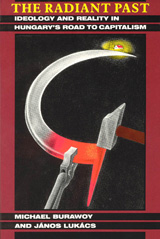
Michael Burawoy and Janos Lukacs consider this question from the standpoint of the Hungarian working class. Between 1983 and 1990 the authors carried out intensive studies in two core Hungarian industries, machine building and steel production, to produce the first extended participant-observation study of work and politics in state socialism.
"A fascinating and engagingly written eyewitness report on proletarian life in the waning years of goulash communism. . . . A richly rewarding book, one that should interest political scientists in a variety of subfields, from area specialists and comparativists to political economists, as well as those interested in Marxist and post-Marxist theory."—Elizabeth Kiss, American Political Science Review
"A very rich book. . . . It does not merely offer another theory of transition, but also presents a clear interpretive scheme, combined with sociological theory and vivid ethnographic description."—Ireneusz Bialecki, Contemporary Sociology
"Its informed skepticism of post-Communist liberal euphoria, its concern for workers, and its fine ethnographic details make this work valuable."—"àkos Róna-Tas, American Journal of Sociology
Back to the future: a heterodox economist rewrites Keynes’s General Theory of Employment, Interest, and Money to serve as the basis for a macroeconomics for the twenty-first century.
John Maynard Keynes’s General Theory of Employment, Interest, and Money was the most influential economic idea of the twentieth century. But, argues Stephen Marglin, its radical implications were obscured by Keynes’s lack of the mathematical tools necessary to argue convincingly that the problem was the market itself, as distinct from myriad sources of friction around its margins.
Marglin fills in the theoretical gaps, revealing the deeper meaning of the General Theory. Drawing on eight decades of discussion and debate since the General Theory was published, as well as on his own research, Marglin substantiates Keynes’s intuition that there is no mechanism within a capitalist economy that ensures full employment. Even if deregulating the economy could make it more like the textbook ideal of perfect competition, this would not address the problem that Keynes identified: the potential inadequacy of aggregate demand.
Ordinary citizens have paid a steep price for the distortion of Keynes’s message. Fiscal policy has been relegated to emergencies like the Great Recession. Monetary policy has focused unduly on inflation. In both cases the underlying rationale is the false premise that in the long run at least the economy is self-regulating so that fiscal policy is unnecessary and inflation beyond a modest 2 percent serves no useful purpose.
Fleshing out Keynes’s intuition that the problem is not the warts on the body of capitalism but capitalism itself, Raising Keynes provides the foundation for a twenty-first-century macroeconomics that can both respond to crises and guide long-run policy.
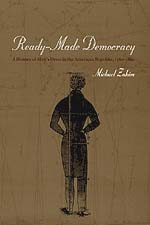
By the early nineteenth century, homespun began to disappear from the American material landscape. Exhortations of industry and modesty, however, remained a common fixture of public life. In fact, they found expression in the form of the business suit. Here, Zakim traces the evolution of homespun clothing into its ostensible opposite—the woolen coats, vests, and pantaloons that were "ready-made" for sale and wear across the country. In doing so, he demonstrates how traditional notions of work and property actually helped give birth to the modern industrial order. For Zakim, the history of men's dress in America mirrored this transformation of the nation's social and material landscape: profit-seeking in newly expanded markets, organizing a waged labor system in the city, shopping at "single-prices," and standardizing a business persona.
In illuminating the critical links between politics, economics, and fashion in antebellum America, Ready-Made Democracy will prove essential to anyone interested in the history of the United States and in the creation of modern culture in general.
Vail finds that these respective evolutions involve interrelated changes in social and economic policies and are characterized by political relationships that are continuously renegotiated—often in unpredictable ways. In the process, he presents a compelling reconceptualization of change in both the welfare state and the broader political economy during an age of globalization.

The wave of liberalization that swept world markets in the 1980s and 90s altered the ways that governments manage their economies. Reinventing State Capitalism analyzes the rise of new species of state capitalism in which governments interact with private investors either as majority or minority shareholders in publicly-traded corporations or as financial backers of purely private firms (the so-called “national champions”). Focusing on a detailed quantitative assessment of Brazil’s economic performance from 1976 to 2009, Aldo Musacchio and Sergio Lazzarini examine how these models of state capitalism influence corporate investment and performance.
According to one model, the state acts as a majority investor, granting the state-owned enterprise (SOE) financial autonomy and allowing professional management. This form, the authors argue, has reduced many agency problems commonly faced by state ownership. According to another hybrid model, the state uses sovereign wealth funds, holding companies, and development banks to acquire a small share of equity ownership in a corporation, thereby potentially alleviating capital constraints and leveraging latent capabilities.
Both models have benefits and costs. Yet neither model has entirely eliminated the temptation of governments to intervene in the operation of natural resource industries and other large strategic enterprises. Nevertheless, the longstanding debate over whether private ownership is superior or inferior to state capitalism has become irrelevant, Musacchio and Lazzarini conclude. Private ownership is now mingled with state capital on a global scale.
As Eastern European economies move to capitalism, many people there hope for a better life. But capitalism is no guarantee of prosperity. Economic deprivation, war, social marginalization, and powerlessness mark the lives of millions and spark social movements for economic justice aimed at correcting these conditions. Often these movements are based in religious communities, their activists motivated by religious commitment to human dignity and the need for personal empowerment. Although the new theology contains an economic critique, little dialogue has taken place between the religious and economic communities on matters of economic analysis. Religion and Economic Justice seeks to develop this exchange.
This book contains original essays by distinguished contributors from economics, religious ethics, and biblical studies. The authors provide a powerful critique of the individualism which underlies mainstream economic analysis and which fragments our communities, a critique that extends to the values implicit in the market system. The authors also show how social marginalization and economic deprivation are the consequences of economic organization, not simply the failings of individuals.


Karl Polanyi’s “substantivist” critique of market society has found new popularity in the era of neoliberal globalization. The author reclaims this polymath for contemporary anthropology, especially economic anthropology, in the context of Central Europe, where Polanyi (1886–1964) grew up. The Polanyian approach illuminates both the communist era, in particular the “market socialist” economy which evolved under János Kádár in Hungary, as well as the post-communist transformations of property relations, civil society and ethno-national identities throughout the region.
Hann’s analyses are based primarily on his own ethnographic investigations in Hungary and South-East Poland. They are pertinent to the rise of neo-nationalism in those countries, which is theorized as a malign countermovement to the domination of the market. At another level, Hann’s adaptation of Polanyi’s social philosophy points beyond current political turbulence to an original concept of “social Eurasia”.
Investigating a wide range of cases, the essays illuminate, for instance, the organizational and cultural means by which unmeasured surpluses—labor that occurs outside the formal workplace‚ such as domestic work—are distributed and put to use. Editors Resnick and Wolff, along with J. K. Gibson-Graham, bring theoretical essays together with those that apply their vision to topics ranging from the Iranian Revolution to sharecropping in the Mississippi Delta to the struggle over the ownership of teaching materials at a liberal arts college. Rather than understanding class as an element of an overarching capitalist social structure, the contributors—from radical and cultural economists to social scientists—define class in terms of diverse and ongoing processes of producing, appropriating, and distributing surplus labor and view class identities as multiple, changing, and interacting with other aspects of identity in contingent and unpredictable ways.
Re/presenting Class will appeal primarily to scholars of Marxism and political economy.
Contributors. Carole Biewener, Anjan Chakrabarti, Stephen Cullenberg, Fred Curtis, Satyananda Gabriel, J. K. Gibson-Graham, Serap Kayatekin, Bruce Norton, Phillip O’Neill, Stephen Resnick, David Ruccio, Dean Saitta, Andriana Vlachou, Richard Wolff

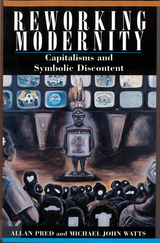
Using both grand conceptualizations and grounded case studies, Allan Pred and Michael Watts look at how people cope with and give meaning to capitalism and modernity in different times and places. As capital accumulation has grown and taken new forms, it has affected technology and labor relations which in turn have affected people's daily lives. These changes have not always been either welcome or easy. Pred and Watts focus on the symbolic discontent and cultural confrontations that accompany capitalism. They depict people struggling over the meaning of change in their lives and over new relations of power.
Modernity is experienced differently in different times and places. To illustrate this point, Pred and Watts offer four case studies that range across time and space. These studies remind us that there are multiple capitalisms and mutiple reactions to capitalisms. Watts begins with a study of a Muslim millenarian movement that arose alongside the Nigerian oil boom of the 1970s. When a Muslim prophet and disenfranchised followers tried to create a distinctive community and identity, they came into brutal conflict with state authorities. Thousands died in the resulting oppression. Watts's next case is less bloody, at least in the short run. He tell us what happened when technological change was introduced in rice production in West African peasant society. Peasants were drawn into the world economy as contract farmers. This changed work relations and affected everyday life in peasant households. Families began to fight over who would work and under what conditions. They struggled over gender indentity and property rights. We move back in time and across space for ther third case study. Pred discusses changes in the daily life of the Stockholm working class at the end of the nineteenth century. He writes of the various forms their discontent took as they struggled with economic restructuring. Even conflict over street names took on special meaning. For the last case Pred takes us to a steel mill in California. When a South Korean company became half owner of the mill, there was money for modernization and the threat of layoffs was reduced. But the workers remained unhappy. They protested low wages, unsafe conditions, and unfair recruitment practices. Their labor issues turned into issues of nationalism, morality and identity. All four case studies demonstrate the shock of modernity and how the resulting struggles affect daily life.
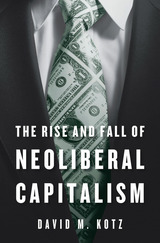
The financial and economic collapse that began in the United States in 2008 and spread to the rest of the world continues to burden the global economy. David Kotz, who was one of the few academic economists to predict it, argues that the ongoing economic crisis is not simply the aftermath of financial panic and an unusually severe recession but instead is a structural crisis of neoliberal, or free-market, capitalism. Consequently, continuing stagnation cannot be resolved by policy measures alone. It requires major institutional restructuring.
Kotz analyzes the reasons for the rise of free-market ideas, policies, and institutions beginning around 1980. He shows how the neoliberal capitalism that resulted was able to produce a series of long although tepid economic expansions, punctuated by relatively brief recessions, as well as a low rate of inflation. This created the impression of a “Great Moderation.” However, the very same factors that promoted long expansions and low inflation—growing inequality, an increasingly risk-seeking financial sector, and a series of large asset bubbles—were not only objectionable in themselves but also put the economy on an unsustainable trajectory. Kotz interprets the current push for austerity as an attempt to deepen and preserve neoliberal capitalism. However, both economic theory and history suggest that neither austerity measures nor other policy adjustments can bring another period of stable economic expansion. Kotz considers several possible directions of economic restructuring, concluding that significant economic change is likely in the years ahead.
A bold history of the rise of central banks, showing how institutions designed to steady the ship of global finance have instead become as destabilizing as they are dominant.
While central banks have gained remarkable influence over the past fifty years, promising more stability, global finance has gone from crisis to crisis. How do we explain this development? Drawing on original sources ignored in previous research, The Rise of Central Banks offers a groundbreaking account of the origins and consequences of central banks’ increasing clout over economic policy.
Many commentators argue that ideas drove change, indicating a shift in the 1970s from Keynesianism to monetarism, concerned with controlling inflation. Others point to the stagflation crises, which put capitalists and workers at loggerheads. Capitalists won, the story goes, then pushed deregulation and disinflation by redistributing power from elected governments to markets and central banks. Both approaches are helpful, but they share a weakness. Abstracting from the evolving practices of central banking, they provide inaccurate accounts of recent policy changes and fail to explain how we arrived at the current era of easy money and excessive finance.
By comparing developments in the United States, the United Kingdom, Germany, and Switzerland, Leon Wansleben finds that central bankers’ own policy innovations were an important ingredient of change. These innovations allowed central bankers to use privileged relationships with expanding financial markets to govern the economy. But by relying on markets, central banks fostered excessive credit growth and cultivated an unsustainable version of capitalism. Through extensive archival work and numerous interviews, Wansleben sheds new light on the agency of bureaucrats and calls upon society and elected leaders to direct these actors’ efforts to more progressive goals.

Climate change and other ecological ills are driving the creation of a grassroots global movement for change. From Latin America to Europe, Australia and China a militant movement merging red and green is taking shape.
Ecosocialists argue that capitalism threatens the future of humanity and the rest of nature. From indigenous protest in the Peruvian Amazon to the green transition in Cuba to the creation of red-green parties in Europe, ecosocialism is defining the future of left and green politics globally. Latin American leaders such as Morales and Chavez are increasingly calling for an ecosocialist transition.
Drawing on the work of key thinkers such as Joel Kovel and John Bellamy Foster, Derek Wall provides an unique insider view of how ecosocialism has developed and a practical guide to focused ecosocialist action. A great handbook for activists and engaged students of politics.
Winner of the SHEAR Book Prize
Honorable Mention, Avery O. Craven Award
“Few books have captured the lived experience of slavery as powerfully.”
—Ari Kelman, Times Literary Supplement
“[One] of the most impressive works of American history in many years.”
—The Nation
“An important, arguably seminal, book…Always trenchant and learned.”
—Wall Street Journal
A landmark history, by the author of National Book Critics Circle Award finalist The Broken Heart of America, that shows how slavery fueled Southern capitalism.
When Jefferson acquired the Louisiana Territory, he envisioned an “empire for liberty” populated by self-sufficient white farmers. Cleared of Native Americans and the remnants of European empires by Andrew Jackson, the Mississippi Valley was transformed instead into a booming capitalist economy commanded by wealthy planters, powered by steam engines, and dependent on the coerced labor of slaves. River of Dark Dreams places the Cotton Kingdom at the center of worldwide webs of exchange and exploitation that extended across oceans and drove an insatiable hunger for new lands. This bold reconsideration dramatically alters our understanding of American slavery and its role in U.S. expansionism, global capitalism, and the upcoming Civil War.
Walter Johnson deftly traces the connections between the planters’ pro-slavery ideology, Atlantic commodity markets, and Southern schemes for global ascendency. Using slave narratives, popular literature, legal records, and personal correspondence, he recreates the harrowing details of daily life under cotton’s dark dominion. We meet the confidence men and gamblers who made the Valley shimmer with promise, the slave dealers, steamboat captains, and merchants who supplied the markets, the planters who wrung their civilization out of the minds and bodies of their human property, and the true believers who threatened the Union by trying to expand the Cotton Kingdom on a global scale.
But at the center of the story are the enslaved people who pulled down the forests, planted the fields, picked the cotton—who labored, suffered, and resisted on the dark underside of the American dream.
“Shows how the Cotton Kingdom of the 19th-century Deep South, far from being a backward outpost of feudalism, was a dynamic engine of capitalist expansion built on enslaved labor.”
—A. O. Scott, New York Times
“River of Dark Dreams delivers spectacularly on the long-standing mission to write ‘history from the bottom up.’”
—Maya Jasanoff, New York Review of Books
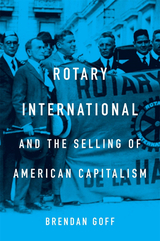
A new history of Rotary International shows how the organization reinforced capitalist values and cultural practices at home and tried to remake the world in the idealized image of Main Street America.
Rotary International was born in Chicago in 1905. By the time World War II was over, the organization had made good on its promise to “girdle the globe.” Rotary International and the Selling of American Capitalism explores the meteoric rise of a local service club that brought missionary zeal to the spread of American-style economics and civic ideals.
Brendan Goff traces Rotary’s ideological roots to the business progressivism and cultural internationalism of the United States in the early twentieth century. The key idea was that community service was intrinsic to a capitalist way of life. The tone of “service above self” was often religious, but, as Rotary looked abroad, it embraced Woodrow Wilson’s secular message of collective security and international cooperation: civic internationalism was the businessman’s version of the Christian imperial civilizing mission, performed outside the state apparatus. The target of this mission was both domestic and global. The Rotarian, the organization’s publication, encouraged Americans to see the world as friendly to Main Street values, and Rotary worked with US corporations to export those values. Case studies of Rotary activities in Tokyo and Havana show the group paving the way for encroachments of US power—economic, political, and cultural—during the interwar years.
Rotary’s evangelism on behalf of market-friendly philanthropy and volunteerism reflected a genuine belief in peacemaking through the world’s “parliament of businessmen.” But, as Goff makes clear, Rotary also reinforced American power and interests, demonstrating the tension at the core of US-led internationalism.
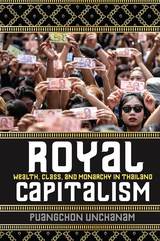
The kingdom positioned itself to connect business elites, patronize local industries, and form strategic partnerships with global corporations. Instead of restraining or regulating royal power, white-collar workers joined with the crown to form a dynamic, symbiotic force that has left the lower classes to struggle in their wake. Unchanam presents a surprising case study that kings and queens live long and large in cooperation with the bourgeoisie's interests and ideology.
READERS
Browse our collection.
PUBLISHERS
See BiblioVault's publisher services.
STUDENT SERVICES
Files for college accessibility offices.
RECENTLY PUBLISHED




UChicago Accessibility Resources
home | accessibility | search | about | contact us
BiblioVault ® 2001 - 2026
The University of Chicago Press