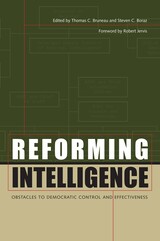
front cover of Reforming Intelligence
Reforming Intelligence
Obstacles to Democratic Control and Effectiveness
Edited by Thomas C. Bruneau and Steven C. Boraz
University of Texas Press, 2007

These days, it's rare to pick up a newspaper and not see a story related to intelligence. From the investigations of the 9/11 commission, to accusations of illegal wiretapping, to debates on whether it's acceptable to torture prisoners for information, intelligence—both accurate and not—is driving domestic and foreign policy. And yet, in part because of its inherently secretive nature, intelligence has received very little scholarly study. Into this void comes Reforming Intelligence, a timely collection of case studies written by intelligence experts, and sponsored by the Center for Civil-Military Relations (CCMR) at the Naval Postgraduate School, that collectively outline the best practices for intelligence services in the United States and other democratic states.

Reforming Intelligence suggests that intelligence is best conceptualized as a subfield of civil-military relations, and is best compared through institutions. The authors examine intelligence practices in the United States, United Kingdom, and France, as well as such developing democracies as Brazil, Taiwan, Argentina, and Russia. While there is much more data related to established democracies, there are lessons to be learned from states that have created (or re-created) intelligence institutions in the contemporary political climate. In the end, reading about the successes of Brazil and Taiwan, the failures of Argentina and Russia, and the ongoing reforms in the United States yields a handful of hard truths. In the murky world of intelligence, that's an unqualified achievement.


[more]

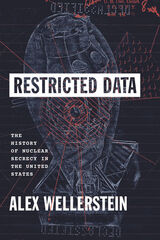
front cover of Restricted Data
Restricted Data
The History of Nuclear Secrecy in the United States
Alex Wellerstein
University of Chicago Press, 2021
The first full history of US nuclear secrecy, from its origins in the late 1930s to our post–Cold War present.

The American atomic bomb was born in secrecy. From the moment scientists first conceived of its possibility to the bombings of Hiroshima and Nagasaki and beyond, there were efforts to control the spread of nuclear information and the newly discovered scientific facts that made such powerful weapons possible. The totalizing scientific secrecy that the atomic bomb appeared to demand was new, unusual, and very nearly unprecedented. It was foreign to American science and American democracy—and potentially incompatible with both. From the beginning, this secrecy was controversial, and it was always contested. The atomic bomb was not merely the application of science to war, but the result of decades of investment in scientific education, infrastructure, and global collaboration. If secrecy became the norm, how would science survive? 

Drawing on troves of declassified files, including records released by the government for the first time through the author’s efforts, Restricted Data traces the complex evolution of the US nuclear secrecy regime from the first whisper of the atomic bomb through the mounting tensions of the Cold War and into the early twenty-first century. A compelling history of powerful ideas at war, it tells a story that feels distinctly American: rich, sprawling, and built on the conflict between high-minded idealism and ugly, fearful power. 
[more]


Send via email Share on Facebook Share on Twitter