logo for National University of Singapore Press
Signs and Signals from Vietnam
Essays on Contemporary Art
Edited by Pamela N. Corey, Nora A. Taylor, and Ðo Tuong Linh
National University of Singapore Press, 2026

The first English-language volume on Vietnamese contemporary art.

Contemporary art in Vietnam is a dynamic field shaped by memory, history, and experimentation. Over the last thirty years, Vietnamese artists have come to command international recognition, even as a growing domestic market for contemporary art fosters alternative infrastructures of collection and exhibition. Signs and Signals from Vietnam brings together artists, curators, and academics to examine artistic practice and contemporary art histories in Vietnam today.

Moving beyond familiar North-South or diasporic-national divides, the essays represent the perspectives of Vietnamese, Vietnamese diasporic, and non-Vietnamese writers of different generations, affiliations, and positionalities. Contributors trace the inventive ways artists work with language, narrative, performance, and archival practice to communicate through their art. Key themes running through the volume represent the predominant concerns of Vietnamese artists over the past three decades, including the enduring impact of socialist paradigms in contemporary art, gender, diaspora, memory, and the environment. Together, these essays demonstrate how contemporary art can convey lesser-known histories, contested narratives, and personal perspectives. 

[more]

logo for Rutgers University Press
The Silent Film Companion
A Recovered and Expanded History
Liz Clarke
Rutgers University Press, 2027

Silent film is more than just a cinema of firsts, greats, or classics. It is a cinema of experimentation, ambition, and connection. To watch a silent film is to be transported into another world.  A Silent Film Companion seeks to broaden the silent film canon by focusing on compelling non-canonical films from around the globe to provide a fresh perspective and new view of silent cinema. With over 50 films discussed, this volume captures just a sliver of the many delights silent cinema has to offer. The book encourages discovery, and rediscovery, of the world of silent cinema: one where the movies were still young, full of possibility, eager to entice others to take part in a wonderful adventure. Films covered are from fourteen countries, including Brazil, Mexico, China, Cuba, India, Italy, and Russia, and representing a diversity of subjects. Chapters provide historical and cultural context to each film, the filmmakers, and a concise analysis of each film. A Silent Film Companion is a guidebook to the many pleasures of silent cinema, allowing you to see and understand diverse perspectives. It is a must read for students and fans of silent cinema interested in seeing a side of silent cinema that is rarely explored.

[more]

front cover of Silver
Silver
Philippa Merriman
Harvard University Press, 2009

The curious course of silver through human history unfolds in this rich and engaging book, accompanied by striking illustrations from the British Museum.

Philippa Merriman takes the reader back to the earliest uses of silver: in ingots and coins, dowries, hoards, and college plate. She shows us how silver demonstrated status—whether for an individual, as ornament, furnishings, and a store of wealth; or for a society, as grave decor, civic regalia, and ritual goods. And she traces the long and fascinating history of silver’s service as personal adornment—on heads, hands, wrists, ears, legs, and feet, and as accessories ranging from swords and baldrics to snuffboxes, walking sticks, fans, and chatelaines.

From the practical aspects of working silver to its role in magic, myth, and ritual in cultures as disparate as the Vikings and the Bedouins of North Africa, this exquisite book offers a full and fitting reflection of this precious metal’s power to move us.
[more]

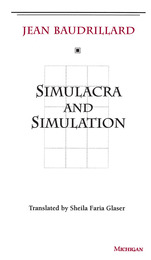
front cover of Simulacra and Simulation
Simulacra and Simulation
Jean Baudrillard
University of Michigan Press, 1994
This foundational work in postmodern philosophy and cultural theory explores how contemporary society has replaced reality and meaning with symbols and signs, leading to a condition Baudrillard calls “hyperreality.” In his provocative treatise, Baudrillard examines the implications of a world where simulations (copies without originals) precede and shape what we consider real, blurring the boundary between reality and representation. Through analysis of mass media, consumer culture, and technological influence, he argues that modern life is dominated by "simulacra," images and concepts that no longer refer to any authentic reality but instead reference each other, creating an endless cycle of signification detached from truth. With references ranging from Disneyland to the news media, this book offers a challenging critique of how people in the late twentieth century and beyond perceive, construct, and interact with the world, underlining the instability of meaning in a media-saturated culture.
[more]

front cover of Single Lives
Single Lives
Modern Women in Literature, Culture, and Film
Katherine Fama
Rutgers University Press, 2022
Single Lives is a collection of singleness studies essays from the interdisciplinary humanities that explores the last two hundred years of literature and popular media by, about, and for single women in the US and the UK. Independent women have always been a center around which social anxieties and excitement coalesced. Moving between the family home and domestic independence, between household and public labor, and between celibacy and a range of sexual relations, the single woman remains a literary and cultural focus, as she has been from the 19th to the 21st centuries. This collection offers readers the opportunity to uncover the social, political, economic, and cultural connections between the "singly blessed" women and "bachelor girls" of the 19th and early 20th century and "all the single ladies" of the 21st century. Essays read singleness across genre and field, offering new approaches to studying modern and contemporary single women in literature, film, and history. Authors engage scholarship from wide ranging fields of social history, women's studies, queer theory, and Black feminism. The collection reads familiar texts against the grain, rethinking archival resources, revisiting familiar figures, and exploring new sources: cookbooks, ephemera, personal documents, recovered film histories, and forms of domestic space and labor.This is a book for scholars of gender and sexuality, social history, feminist film and media scholars, and literary historians, and reflects the urgent contemporary interest in single women as a political, economic, and cultural force. 
 
[more]

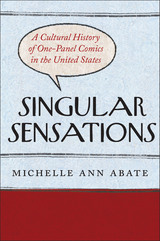
front cover of Singular Sensations
Singular Sensations
A Cultural History of One-Panel Comics in the United States
Michelle Ann Abate
Rutgers University Press, 2024

Shortlisted for the 2024 Eisner Award for Best Academic/Scholarly Book

What do The Family Circus, Ziggy, and The Far Side have in common? They are all single-panel comics, a seemingly simple form that cartoonists have used in vastly different ways. 
 
Singular Sensations is the first book-length critical study to examine this important but long-neglected mode of cartoon art. Michelle Ann Abate provides an overview of how the American single-panel comic evolved, starting with Thomas Nast’s political cartoons and R.F. Outcault’s groundbreaking Yellow Kid series in the nineteenth century. In subsequent chapters, she explores everything from wry New Yorker cartoons to zany twenty-first-century comics like Bizarro. Offering an important corrective to the canonical definition of comics as “sequential art,” Abate reveals the complexity, artistry, and influence of the single-panel art form. 
 
Engaging with a wide range of historical time periods, sociopolitical subjects, and aesthetic styles, Singular Sensations demonstrates how comics as we know and love them would not be the same without single-panel titles. Abate’s book brings the single-panel comic out of the margins and into the foreground.  

[more]

logo for Harvard University Press
Sir Joshua Reynolds
The Painter in Society
Richard Wendorf
Harvard University Press, 1996

That Sir Joshua Reynolds (1723–1792) became the most fashionable painter of his time was not simply due to his artistic gifts or good fortune. The art of pleasing, Richard Wendorf contends, was as much a part of Reynolds’s success—in his life and in his work—as the art of painting. The author’s examination of Reynolds’s life and career illuminates the nature of eighteenth-century English society in relation to the enterprise of portrait-painting. Conceived as an experiment in cultural criticism, written along the fault lines that separate (but also link) art history and literary studies, Sir Joshua Reynolds: The Painter in Society explores the ways in which portrait-painting is embedded in the social fabric of a given culture as well as in the social and professional transaction between the artist and his or her subject. In addition to providing a new view of Reynolds, Wendorf’s book develops a thoroughly new way of interpreting portraiture.

Wendorf takes us into Reynolds’s studio to show us the artist deploying his considerable social and theatrical skills in staging his sittings as carefully orchestrated performances. The painter’s difficult relationship with his sister Frances (also an artist and writer), his complicated maneuvering with patrons, the manner in which he set himself up as an artist and businessman, his highly politicized career as the first president of the Royal Academy of Arts: as each of these aspects of Reynolds’s practice comes under Wendorf’s scrutiny, a new picture of the painter emerges—more sharply defined and fully fleshed than the Reynolds of past portraits, and clearly delineating his capacity for provoking ambivalence among friends and colleagues, and among viewers and readers today.

[more]

logo for Diaphanes
The SIRENIC
Follow the Water Follow the Sound. Essays and Studies Across Film and the Arts
Edited by Fabienne Liptay and Giuseppe di Salvatore
Diaphanes, 2026

An original perspective on the mythologies and ecologies of water, the poetics and politics of voice, and the invocation of a communal spirit through film and other arts.

“Follow the Water Follow the Sound” is a call and response. Far removed from the associations of seduction and fear that the siren—both as mythological figure and alarm device—has inspired, it is an invitation to another perceptual attunement to our environment. Offering an original perspective, this bookengages with notions of singing, voicing, and listening that reach into a sonic pluriverse and imagine the "sirenic" as a practice oriented towards emergent futures, fabulations of becoming, and pedagogies of transformation. Through these notions, it provides the grounds for an expanded conception of cinema emerging through sound, music, and performance. Bringing together scholars, curators, and artists from across disciplines, Sirenic unfolds as a polyphonic publication. 

With contributions by Ruth Baettig, Dalida María Benfield, Elena Biserna, Mattia Capelletti, Caroline Courrioux, Alice Jasmine Crippa, Giuseppe Di Salvatore, Magali Dougoud, Burcu Dogramaci, Lidia Gasperoni, Alexandra Gelis, Tobias Gerber, Ute Holl, Roberta Ioli, Pauline Julier, Fabienne Liptay, Niccolò Moronato, Gabriel Paiuk, Dorota Sajewska, Alice Sartori, Alexandra Tsiamparta, and Matthias Wittmann.
[more]

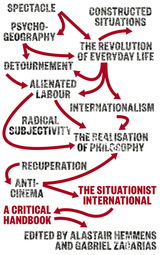
front cover of The Situationist International
The Situationist International
A Critical Handbook
Alastair Hemmens
Pluto Press, 2020
Formed amidst the incendiary violence and political turmoil of the 1960s, beyond the barricades, the Situationist International (SI) remains to this day influential in anti-capitalist cultural, political and philosophical debates. 

Looking at philosophy, sociology, critical theory, art, architecture and literature, The Situationist International is an up-to-date and comprehensive survey of the SI and its thought. Leading thinkers analyze the SI's interdisciplinary challenges, its roots in the artistic avant-garde and the traditional workers' movements, its engagement with the problems of postcolonialism and issues of gender and sexuality.

Including contributions from key thinkers, including Anselm Jappe and Michael Lowy, as well as new and upcoming scholars, The Situationist International unpacks the complexity of a group that has come to define radical politics and culture in the postwar period. 
[more]

front cover of Six Drawing Lessons
Six Drawing Lessons
William Kentridge
Harvard University Press, 2014

“A beautiful and necessary book...as brisk as it is insightful.”—Choice

South Africa’s most celebrated artist on art, colonialism, and studio practice.

Over the last three decades, the visual artist William Kentridge has garnered international acclaim for his work across media including drawing, film, sculpture, printmaking, and theater. Rendered in stark contrasts of black and white, his images reflect his native South Africa and, like endlessly suggestive shadows, point to something more elemental as well. Based on the 2012 Charles Eliot Norton Lectures, Six Drawing Lessons is the most comprehensive collection available of Kentridge’s thoughts on art, art-making, and the studio.

Art, Kentridge says, is its own form of knowledge. It does not simply supplement the real world, and it cannot be purely understood in the rational terms of traditional academic disciplines. The studio is the crucial location for the creation of meaning: the place where linear thinking is abandoned and the material processes of the eye, the hand, the charcoal and paper become themselves the guides of creativity. Drawing has the potential to educate us about the most complex issues of our time. This is the real meaning of “drawing lessons.”

Incorporating elements of graphic design and ranging freely from discussions of Plato’s cave to the Enlightenment’s role in colonial oppression to the depiction of animals in art, Six Drawing Lessons is an illustration in print of its own thesis of how art creates knowledge. Foregrounding the very processes by which we see, Kentridge makes us more aware of the mechanisms—and deceptions—through which we construct meaning in the world.
[more]

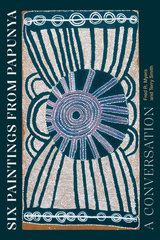
front cover of Six Paintings from Papunya
Six Paintings from Papunya
A Conversation
Fred R. Myers and Terry Smith
Duke University Press, 2024
In the early 1970s at Papunya, a remote settlement in the Central Australian desert, a group of Indigenous artists decided to communicate the sacred power of their traditional knowledge to the wider worlds beyond their own. Their exceptional, innovative efforts led to an outburst of creative energy across the continent that gave rise to the contemporary Aboriginal art movement that continues to this day. In their new book, anthropologist Fred Myers and art critic Terry Smith discuss six Papunya paintings featured in a 2022 exhibition in New York. They draw on several discourses that have developed around First Nations art—notably anthropology, art history, and curating as practiced by Indigenous and non-Indigenous interpreters. Their focus on six key paintings enables unusually close and intense insight into the works’ content and extraordinary innovation. Six Paintings from Papunya also includes a reflection by Indigenous curator and scholar Stephen Gilchrist, who considers the nature and significance of this rare transcultural conversation.
[more]

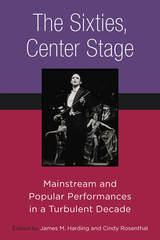
front cover of The Sixties, Center Stage
The Sixties, Center Stage
Mainstream and Popular Performances in a Turbulent Decade
Edited by James M. Harding and Cindy Rosenthal
University of Michigan Press, 2017
The Sixties, Center Stage offers rich insights into the innovative and provocative political underpinnings of mainstream and popular performances in the 1960s. While much critical attention has been focused on experimental and radical theater of the period, the essays confirm that mainstream performances not only merit more scholarly attention than they have received, but through serious examination provide an important key to understanding the 1960s as a period.
 
The introduction provides a broad overview of the social, political, and cultural contexts of artistic practices in mainstream theater from the mid-fifties to mid-seventies. Readers will find detailed examinations of the mainstream’s surprising attention to craft and innovation; to the rich exchange between European and American theatres; to the rise of regional theaters; and finally, to popular cultural performances that pushed the conceptual boundaries of mainstream institutions. The book looks afresh at productions of Hair, Cabaret, Raisin in the Sun, and Fiddler on the Roof, as well as German theater, and performances outside the Democratic National Convention of 1968.
 

[more]

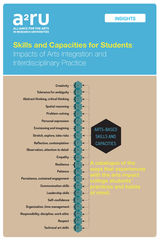
front cover of Skills and Capacities for Students
Skills and Capacities for Students
Impacts of Arts Integration and Interdisciplinary Practice
Gabriel Harp
A2RU Intervals, 2020

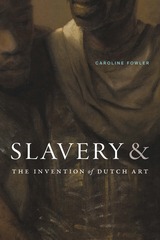
front cover of Slavery and the Invention of Dutch Art
Slavery and the Invention of Dutch Art
Caroline Fowler
Duke University Press, 2025
In Slavery and the Invention of Dutch Art, Caroline Fowler examines the fundamental role of the transatlantic slave trade in the production and evolution of seventeenth-century Dutch art. Whereas the sixteenth-century image debates in Europe engaged with crises around the representation of divinity, Fowler argues that the rise of the transatlantic slave trade created a visual field of uncertainty around picturing the transformation of life into property. Fowler demonstrates how the emergence of landscape, maritime, and botanical painting were deeply intertwined with slavery’s economic expansion. Moreover, she considers how the development of one of the first art markets was inextricable from the trade in human lives as chattel property. Reading seventeenth-century legal theory, natural history, inventories, and political pamphlets alongside contemporary poetry, theory, and philosophy from Black feminism and the African diaspora, Fowler demonstrates that ideas about property, personhood, and citizenship were central to the oeuvres of artists such as Rembrandt van Rijn, Hercules Segers, Frans Post, Johannes Vermeer, and Maria Sibylla Merian and therefore inescapably within slavery’s grasp.
[more]

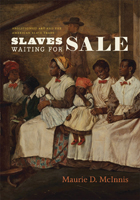
front cover of Slaves Waiting for Sale
Slaves Waiting for Sale
Abolitionist Art and the American Slave Trade
Maurie D. McInnis
University of Chicago Press, 2011

In 1853, Eyre Crowe, a young British artist, visited a slave auction in Richmond, Virginia. Harrowed by what he witnessed, he captured the scene in sketches that he would later develop into a series of illustrations and paintings, including the culminating painting, Slaves Waiting for Sale, Richmond, Virginia.
This innovative book uses Crowe’s paintings to explore the texture of the slave trade in Richmond, Charleston, and New Orleans, the evolving iconography of abolitionist art, and the role of visual culture in the transatlantic world of abolitionism. Tracing Crowe’s trajectory from Richmond across the American South and back to London—where his paintings were exhibited just a few weeks after the start of the Civil War—Maurie D. McInnis illuminates not only how his abolitionist art was inspired and made, but also how it influenced the international public’s grasp of slavery in America. With almost 140 illustrations, Slaves Waiting for Sale brings a fresh perspective to the American slave trade and abolitionism as we enter the sesquicentennial of the Civil War.
[more]

front cover of Sleeping Beauty
Sleeping Beauty
A One-Artist Dictionary
John Sparagana and Mieke Bal
University of Chicago Press, 2008
The dictionary. The ubiquitous high-gloss fashion ad. The fraught relationship between artist and critic. Sleeping Beauty ties these disparate strands of our everyday lives together only to strip away everything we thought we knew about each of them. A collaborative work by the artist John Sparagana and the critic Mieke Bal, this truly cutting-edge work takes the shape of a conversation between his creations—distressed, or “fatigued,” magazine pages—and her words, imagining anew the relationships of image to text and of art to those who write about it.
            Bal contributes twenty-six essays, one for each letter of the alphabet, which borrow their organizing principle from the dictionary but reach far beyond the utilitarian purpose of a reference volume. Each one enters deeply into Sparagana’s work, illuminating concepts from Abstract to Zestful that inform, underlie, and lend meaning to the exquisitely ruined images he creates by crinkling glossy images from fashion magazines until their sheen disappears and they become soft and elastic. Unmooring the magazine page from its familiar context, these beautiful rags are rendered poetic by Sparagana’s unique art of subtraction, which physically rubs away not only ink and material, but also transience and commercial usefulness.
            Just as Sparagana’s work intervenes in existing images, so, too, do Bal’s explorations qualify existing concepts. But together, in this inaugural volume in the new series Project Tango: Artists and Writers Together, they have given rise to something wholly new: a prophetic one-artist dictionary that simultaneously reenvisions the untapped interactions of images with words and the potential forms of the book itself. 

[more]

front cover of Smoothing the Jew
Smoothing the Jew
"Abie the Agent" and Ethnic Caricature in the Progressive Era
Jeffrey A. Marx
Rutgers University Press, 2024
The turn of the nineteenth century in the United States saw the substantial influx of immigrants and a corresponding increase in anti-immigration and nativist tendencies among longer-settled Americans. Jewish immigrants were often the object of such animosity, being at once the object of admiration and anxiety for their perceived economic and social successes. One result was their frequent depiction in derogatory caricatures on the stage and in print.
 
Smoothing the Jew investigates how Jewish artists of the time attempted to “smooth over” these demeaning portrayals by focusing on the first Jewish comic strip published in English, Harry Hershfield’s Abie the Agent. Jeffrey Marx demonstrates how Hershfield created a Jewish protagonist who in part reassured nativists of the Jews’ ability to assimilate into American society while also encouraging immigrants and their children that, over time, they would be able to adopt American customs without losing their distinctly Jewish identity.

 
[more]

front cover of Snow Fleas and Chickadees
Snow Fleas and Chickadees
Everyday Observations in the Sierra
Eve Quesnel
University of Nevada Press, 2025
In Snow Fleas and Chickadees, Eve Quesnel invites readers to join her on strolls through the forest surrounding her neighborhood in the Sierra Nevada mountains near Lake Tahoe. The book serves as an extended field guide and natural history reference for residents of the region and those visiting and exploring the Sierra. Through her writing, the author shares personal narratives and information gleaned from experts in the field, including biologists, ornithologists, and foresters. Each of the book’s twenty-one essays begins with a detailed black-and-white drawing by illustrator Anne Chadwick that provides a backdrop for the vignettes that follow.

Quesnel embraces the notion that to simply walk in one’s neighborhood is to familiarize oneself with the local flora and fauna, drawing attention to everyday things too often neglected. She argues that we can be complacent with what surrounds us, but with careful observation and research, we become acutely aware—and in awe of—nature’s everyday activities. The black bear’s hibernation techniques and mountain chickadee’s caching methods reveal just two of nature’s wily ways. Quesnel chases other curiosities as well, asking, “How does a spider create an orb web?” or, “How does a boulder the size of a small car end up alone in the woods?” In the introduction, she writes, “It is this ‘un-peeling’ of layers in nature that opens up our world.” 

For anyone interested in nature writing, whether an armchair explorer, outdoor enthusiast, or science aficionado, Snow Fleas and Chickadees provides an entertaining and engaging discovery of the picturesque Sierra Nevada.
[more]

front cover of Social Choreography
Social Choreography
Ideology as Performance in Dance and Everyday Movement
Andrew Hewitt
Duke University Press, 2005
Through the concept of “social choreography” Andrew Hewitt demonstrates how choreography has served not only as metaphor for modernity but also as a structuring blueprint for thinking about and shaping modern social organization. Bringing dance history and critical theory together, he shows that ideology needs to be understood as something embodied and practiced, not just as an abstract form of consciousness. Linking dance and the aesthetics of everyday movement—such as walking, stumbling, and laughter—to historical ideals of social order, he provides a powerful exposition of Marxist debates about the relation of ideology and aesthetics.

Hewitt focuses on the period between the mid-nineteenth century and the early twentieth and considers dancers and social theorists in Germany, Britain, France, and the United States. Analyzing the arguments of writers including Friedrich Schiller, Theodor Adorno, Hans Brandenburg, Ernst Bloch, and Siegfried Kracauer, he reveals in their thinking about the movement of bodies a shift from an understanding of play as the condition of human freedom to one prioritizing labor as either the realization or alienation of embodied human potential. Whether considering understandings of the Charleston, Isadora Duncan, Nijinsky, or the famous British chorus line the Tiller Girls, Hewitt foregrounds gender as he uses dance and everyday movement to rethink the relationship of aesthetics and social order.
[more]

front cover of Social Fabric
Social Fabric
Art and Activism in Contemporary Brazil
Edited by Maria Emilia Fernandez, Adele Nelson, and MacKenzie Stevens
University of Texas Press, 2023

Social Fabric: Art and Activism in Contemporary Brazil brings together the work of ten artists who reflect upon the long-standing histories of oppressive power structures in the territory now known as Brazil. Blurring the line between art and activism and spanning installation, painting, performance, photography, sculpture, and video, these artists contribute to local and global conversations about the state of democracy, racial injustice, and the violence inflicted by the nation-state. This first English-language, book-length study of contemporary Brazilian art in relationship to activism assembles artist-authored texts, interviews, essays, and a conceptual mapping of Brazilian history to illuminate the function of art as a platform for critical engagement with the historical, political, and cultural configurations of a particular place. By refusing to remain neutral, these artists create spaces of vibrant and vital community and self-construction to explore how healing and justice may be possible, especially in the Black, LGBTQIA+, and Indigenous communities to which many of them belong.
[more]

front cover of Social Formation and Symbolic Landscape
Social Formation and Symbolic Landscape
Denis E. Cosgrove
University of Wisconsin Press, 1998

Hailed as a landmark in its field since its first publication in 1984, Denis E. Cosgrove’s Social Formation and Symbolic Landscape has been influential well beyond geography. It has continued to spark lively debate among historians, geographers, art historians, social theorists, landscape architects, and others interested in the social and cultural politics of landscape.
[more]

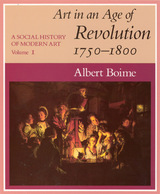
front cover of A Social History of Modern Art, Volume 1
A Social History of Modern Art, Volume 1
Art in an Age of Revolution, 1750-1800
Albert Boime
University of Chicago Press, 1990
In A Social History of Modern Art, a sweeping multivolume social history of Western art from the French Revolution to World War I, Albert Boime moves beyond the concern with style and form that has traditionally characterized the study of art history and, in the tradition of Arnold Hauser, examines art in a broad historical context. Into his wide-ranging cultural inquiry Boime incorporates not only frequently studied mainstream artists and sculptors but also neglected and lesser known artists and unattributed popular imagery. He examines popular as well as official culture, the family as well as the state, and the conditions of the poor as well as of the affluent that affected cultural practice.

This inaugural volume explores the artistic repercussions of the major political and economic events of the latter half of the eighteenth century: the Seven Years' War, the French Revolution, and the English industrial revolution. Boime examines the prerevolutionary popularity of the rococo style and the emergence of the cult of antiquity that followed the Seven Years' War. He shows how the continual experiments of Jacques-Louis David and others with neoclassical symbols and themes in the latter part of the century actively contributed to the transformation of French and English politics. Boime's analyses reveal the complex relationship of art with a wide range of contemporary attitudes and conditions—technological innovation, social and political tensions, commercial expansion, and the growth of capitalism.

"Provocative and endlessly revealing."—Christopher Knight, Los Angeles Herald Examiner
[more]

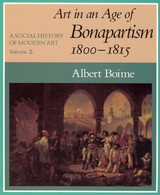
front cover of A Social History of Modern Art, Volume 2
A Social History of Modern Art, Volume 2
Art in an Age of Bonapartism, 1800-1815
Albert Boime
University of Chicago Press, 1990
In this second volume, Albert Boime continues his work on the social history of Western art in the Modern epoch. This volume offers a major critique and revisionist interpretation of Western European culture, history, and society from Napoleon's seizure of power to 1815. Boime argues that Napoleon manipulated the production of images, as well as information generally, in order to maintain his political hegemony. He examines the works of French painters such as Jacques-Louis David and Jean Auguste Dominique Ingres, to illustrate how the art of the time helped to further the emperor's propagandistic goals. He also explores the work of contemporaneous English genre painters, Spain's Francisco de Goya, the German Romantics Philipp Otto Runge and Caspar David Friedrich, and the emergence of a national Italian art.

Heavily illustrated, this volume is an invaluable social history of modern art during the Napoleonic era.

Stimulating and informative, this volume will become a valuable resource for faculty and undergraduates.—R. W. Liscombe, Choice
[more]

front cover of The Social Lives of Medieval Rings
The Social Lives of Medieval Rings
Jitske Jasperse
Arc Humanities Press, 2025

The essays in this volume focus on rings as small objects that have touched upon people, places, and events; rings have also featured in scholastic debates and form our modern museum collections. Contributors collectively argue that a closer look at these diminutive artifacts—both precious and mundane—alongside an assessment of their place within the visual, archaeological, and written record, and in museum contexts tells us more nuanced stories about how and why these small and sensory items were crafted and created connections between people and institutions. Their focus on the social aspects of medieval finger rings unites the contributions of nine scholars with backgrounds in art history, history, archaeology, museum studies, and collecting. Together their essays cover material roughly ranging from 1100 to 1500 in Iberia, France, England, Germany, Rus, and Byzantium.

[more]

front cover of Socialist Realism without Shores
Socialist Realism without Shores
Thomas Lahusen and Evgeny Dobrenko, eds.
Duke University Press, 1997
Socialist Realism without Shores offers an international perspective on the aesthetics of socialist realism—an aesthetic that, contrary to expectations, survived the death of its originators and the demise of its original domain. This expanded edition of a special issue of the South Atlantic Quarterly brings together scholars from various parts of the globe to discuss socialist realism as it appears across genres in art, architecture, film, and literature and across geographic divides—from the "center," Russia, to various points at the "periphery"—China, Germany, France, Poland, remote republics of the former USSR, and the United States.
The contributors here argue that socialist realism has never been a monolithic art form. Essays demonstrate, among other things, that its literature could accommodate psychoanalytic criticism; that its art and architecture could affect the aesthetic dictates of Moscow that made "Soviet" art paradoxically heterogeneous; and that its aesthetics could accommodate both high art and crafted kitsch. Socialist Realism without Shores also addresses the critical discourse provoked by socialist realism—Stalinist aesthetics, "anthropological" readings; ideology critique and censorship; and the sublimely ironic approaches adapted from sots art, the Soviet version of postmodernism.

Contributors. Antoine Baudin, Svetlana Boym, Greg Castillo, Katerina Clark, Evgeny Dobrenko, Boris Groys, Hans Günther, Julia Hell, Leonid Heller, Mikhail Iampolski, Thomas Lahusen, Régine Robin, Yuri Slezkine, Lily Wiatrowski Phillips, Xudong Zhang, Sergei Zimovets

[more]

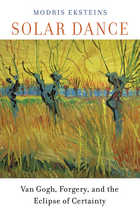
front cover of Solar Dance
Solar Dance
Van Gogh, Forgery, and the Eclipse of Certainty
Modris Eksteins
Harvard University Press, 2012

In Modris Eksteins’s hands, the interlocking stories of Vincent van Gogh and art dealer Otto Wacker reveal the origins of the fundamental uncertainty that is the hallmark of the modern era. Through the lens of Wacker’s sensational 1932 trial in Berlin for selling fake Van Goghs, Eksteins offers a unique narrative of Weimar Germany, the rise of Hitler, and the replacement of nineteenth-century certitude with twentieth-century doubt.

Berlin after the Great War was a magnet for art and transgression. Among those it attracted was Otto Wacker, a young gay dancer turned art impresario. His sale of thirty-three forged Van Goghs and the ensuing scandal gave Van Gogh’s work unprecedented commercial value. It also called into question a world of defined values and standards that had already begun to erode during the war. Van Gogh emerged posthumously as a hero who rejected organized religion and other suspect sources of authority in favor of art. Self-pitying Germans saw in his biography a series of triumphs—over defeat, poverty, and meaninglessness—that spoke to them directly. Eksteins shows how the collapsing Weimar Republic that made Van Gogh famous and gave Wacker an opportunity for reinvention propelled a third misfit into the spotlight. Taking advantage of the void left by a gutted belief system, Hitler gained power by fashioning myths of mastery.

Filled with characters who delight and frighten, Solar Dance merges cultural and political history to show how upheavals of the early twentieth century gave rise to a search for authenticity and purpose.
[more]

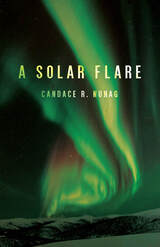
front cover of A Solar Flare
A Solar Flare
Candace R. Nunag
University of Alabama Press, 2025

A hybrid of short works exploring the 1859 Carrington solar flare

A flood of illumination, a cosmic cataclysm frozen in time—the Carrington Event of 1859 was the most disruptive solar flare in recorded history, an electromagnetic storm that wiped out telegraph systems across the world and which, if it were to occur today, might well destroy anything on the planet with an electrical circuit.

Candace Nunag’s A Solar Flare is a hybrid of short essays, research notes, poems, graphite rubbings, and instant photographs, as well as bits of flash fiction, all simultaneously contemplating technology and memory, while preoccupied with the 1859 solar flare. The ghost of the Carrington Event haunts A Solar Flare with the promise of definitive answers about the narrator’s many severed connections: her digital, supernatural, eastern, western, and analog past. It is an attempt to illuminate the path of thought, wending its way through the tangles of rumination and irreconcilable spaces of wonder.
[more]

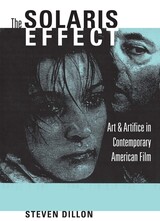
front cover of The Solaris Effect
The Solaris Effect
Art and Artifice in Contemporary American Film
By Steven Dillon
University of Texas Press, 2006

What do contemporary American movies and directors have to say about the relationship between nature and art? How do science fiction films like Steven Spielberg's A.I. and Darren Aronofsky's π represent the apparent oppositions between nature and culture, wild and tame?

Steven Dillon's intriguing new volume surveys American cinema from 1990 to 2002 with substantial descriptions of sixty films, emphasizing small-budget independent American film. Directors studied include Steven Soderbergh, Darren Aronofsky, Todd Haynes, Harmony Korine, and Gus Van Sant, as well as more canonical figures like Martin Scorcese, Robert Altman, David Lynch, and Steven Spielberg. The book takes its title and inspiration from Andrei Tarkovsky's 1972 film Solaris, a science fiction ghost story that relentlessly explores the relationship between the powers of nature and art. The author argues that American film has the best chance of aesthetic success when it acknowledges that a film is actually a film. The best American movies tell an endless ghost story, as they perform the agonizing nearness and distance of the cinematic image.

This groundbreaking commentary examines the rarely seen bridge between select American film directors and their typically more adventurous European counterparts. Filmmakers such as Lynch and Soderbergh are cross-cut together with Tarkovsky and the great French director, Jean-Luc Godard, in order to test the limits and possibilities of American film. Both enthusiastically cinephilic and fiercely critical, this book puts a decade of U.S. film in its global place, as part of an ongoing conversation on nature and art.
[more]

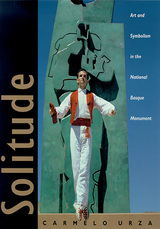
front cover of Solitude
Solitude
Art And Symbolism In The National Basque Monument
Carmelo Urza
University of Nevada Press, 1993

Urza discusses the genesis of the National Basque Monument to the Basque Sheepherder that is located in Reno, Nevada. He also describes the competition held to determine the monument's design and the debates arising from the modern sculpture created by renowned Basque artist Nestor Basterrextea. Urza examines the arguments of those who favored the selection of a figurative, traditional symbol and those who preferred a modern, forward-looking symbol. He utilizes this discussion to explore the evolution of Basque ethnicity and its relationship to society.
[more]

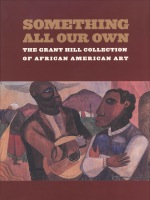
front cover of Something All Our Own
Something All Our Own
The Grant Hill Collection of African American Art
Grant Hill
Duke University Press, 2003
Since 1990, Grant Hill has thrilled sports fans with his artistry on the basketball court, first as an All-American player at Duke University and then as a six-time NBA All-Star for the Detroit Pistons and the Orlando Magic. During these years, Hill has amassed a collection of art by African Americans that he now shares with the public through this book, which accompanies a traveling exhibition.
The forty-six pieces documented here include thirteen works that span the career of the great Romare Bearden, from his 1941 gouache painting Serenade to the important collages of the 1980s. Hill’s fascination with artists’ depiction of women is represented in Elizabeth Catlett’s lithographs, many of them from the 1992 series “For My People,” and her sculptures in stone, bronze, and onyx. In addition to these two giants of twentieth-century art, the Hill Collection features pieces by Phoebe Beasley, Arthello Beck Jr., John Biggers, Malcolm Brown, John Coleman, Edward Jackson, and Hughie Lee Smith.
Hill began collecting art in the early 1990s after learning from his parents to appreciate artworks not only as objects of beauty but as expressions of heritage and culture. According to the internationally known curator Alvia J. Wardlaw, he is part of an emerging group of young African American collectors who have “raised the bar for others.” Hill writes, “Getting to know yourself means understanding your background and appreciating those who have come before you. My father has a saying he uses in speeches: ‘To be ignorant of your past is to remain a boy. ‘The interest in my heritage as an African American is reflected in this collection.”
Something All Our Own features Wardlaw’s essay on the history of African American collecting. It also features articles about Bearden and Catlett by the scholars Elizabeth Alexander and Beverly Guy-Sheftall and reflections about Hill by the historian John Hope Franklin, Duke’s basketball coach Mike Krzyzewski, and the sportswriter William C. Rhoden. Hill and his father, the NFL great Calvin Hill, contribute a dialogue that explores their motivations for collecting art.
At the heart of the book are the exquisite color photographs of the forty-six artworks included in the exhibition, with commentary by Wardlaw and by Hill himself.
As a star athlete, Grant Hill is well aware that African Americans who excel in sports and entertainment are more broadly recognized than their counterparts in artistic fields. He strives to inspire young people to explore their heritage and broaden their concept of excellence by learning more about African American art. By sharing his artworks with collectors and fans, Hill reminds us that while the jump shot is ephemeral, art is enduring.
[more]

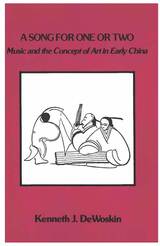
front cover of A Song for One or Two
A Song for One or Two
Music and the Concept of Art in Early China
Kenneth J. DeWoskin
University of Michigan Press, 1982
This study of theories of music and art in China from the classical period to the Six Dynasties is based on analysis and interpretation of textual and archaeological evidence. Its wide-ranging sources include mythology, aesthetic philosophy, musical lore, and notation systems. The evolution of theories of music and art is considered in the context of cosmological and moral philosophy.
[more]

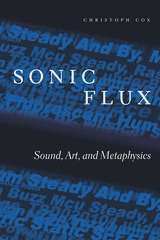
front cover of Sonic Flux
Sonic Flux
Sound, Art, and Metaphysics
Christoph Cox
University of Chicago Press, 2018
From Edison’s invention of the phonograph through contemporary field recording and sound installation, artists have become attracted to those domains against which music has always defined itself: noise, silence, and environmental sound. Christoph Cox argues that these developments in the sonic arts are not only aesthetically but also philosophically significant, revealing sound to be a continuous material flow to which human expressions contribute but which precedes and exceeds those expressions. Cox shows how, over the course of the twentieth and twenty-first centuries, philosophers and sonic artists have explored this “sonic flux.”

Through the philosophical analysis of works by John Cage, Maryanne Amacher, Max Neuhaus, Christian Marclay, and many others, Sonic Flux contributes to the development of a materialist metaphysics and poses a challenge to the prevailing positions in cultural theory, proposing a realist and materialist aesthetics able to account not only for sonic art but for artistic production in general.
[more]

front cover of Sons And Daughters Of Los
Sons And Daughters Of Los
Culture And Community In L.A.
David James
Temple University Press, 2003
Los Angeles. A city that is synonymous with celebrity and mass-market culture, is also, according to David James, synonymous with social alienation and dispersal. In the communities of Los Angeles, artists, cultural institutions and activities exist in ways that are often concealed from sight, obscured by the powerful presence of Hollywood and its machinations. In this significant collection of original essays, The Sons and Daughters of Los reconstructs the city of Los Angeles with new cultural connections. Explored here are the communities that offer alternatives to the picture of L..A. as a conglomeration of studios and mass media. Each essay examines a particular piece of, or place in, Los Angeles cultural life: from the Beyond Baroque Poetry Foundation, the Woman's Building, to Highways, and LACE, as well as the achievements of these grassroots initiatives. Also included is critical commentary on important artists, including Harry Gamboa, Jr., and others whose work have done much to shape popular culture in L.A. The cumulative effect of reading this book is to see a very different city take shape, one whose cultural landscape is far more innovative and reflective of the diversity of the city's people than mainstream notions of it suggest. The Sons and Daughters of Los offers a substantive and complicated picture of the way culture plays itself it out on the smallest scale—in one of the largest metropolises on earth—contributing to a richer, more textured understanding of the vibrancy of urban life and art.
[more]

front cover of Sophie Taeuber-Arp and the Avant-Garde
Sophie Taeuber-Arp and the Avant-Garde
A Biography
Roswitha Mair
University of Chicago Press, 2018
Sophie Taeuber-Arp was a quiet innovator whose fame has too often been yoked to that of her husband, Jean Arp. Over time, however, she has slowly come to be seen as one of the foremost abstract artists and designers of the twentieth century. The Swiss-born Taeuber-Arp had a front row seat to the first wave of Dadaism and was, along with Mondrian and Malevich, a pioneer of Constructivism. Her singular artwork incorporated painting, sculpture, dance, fiber arts, and architecture, as hers was one of the first oeuvres to successfully bridge the divide between fine and functional art.
 
Now Roswitha Mair has brought us the first biography of this unique polymath, illuminating not just Tauber-Arp’s own life and work, but also the various milieux and movements in which she traveled.  No fan of the Dadaists and their legacy will want to miss this first English-language translation.
 
[more]

front cover of The Sorcerer's Apprentice
The Sorcerer's Apprentice
Picasso, Provence, and Douglas Cooper
John Richardson
University of Chicago Press, 2001
The Sorcerer's Apprentice is John Richardson's vivid memoir of the time he spent living with and learning from the deeply knowledgeable and temperamental art collector, Douglas Cooper. For ten years the two entertained a circle of friends that included Jean Cocteau, W. H. Auden, Tennessee Williams, and, most intriguingly, Pablo Picasso. Compulsively readable and beautifully illustrated, this book is both a triple portrait of the author, Cooper, and Picasso, and a revealing look at a crucial artistic period.
 
[more]

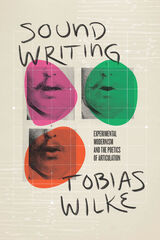
front cover of Sound Writing
Sound Writing
Experimental Modernism and the Poetics of Articulation
Tobias Wilke
University of Chicago Press, 2022
Considers the avant-garde rethinking of poetic language in terms of physical speech production.
 
Avant-garde writers and artists of the twentieth century radically reconceived poetic language, appropriating scientific theories and techniques as they turned their attention to the physical process of spoken language. This modernist “sound writing” focused on the bodily production of speech, which it rendered in poetic, legible, graphic form.
 
Modernist sound writing aims to capture the acoustic phenomenon of vocal articulation by graphic means. Tobias Wilke considers sound writing from its inception in nineteenth-century disciplines like physiology and experimental phonetics, following its role in the aesthetic practices of the interwar avant-garde and through to its reemergence in the postwar period. These projects work with the possibility of crossing over from the audible to the visible, from speech to notation, from body to trace. Employing various techniques and concepts, this search for new possibilities played a central role in the transformation of poetry into a site of radical linguistic experimentation. Considering the works of writers and artists—including Raoul Hausmann, Kurt Schwitters, Viktor Shklovsky, Hugo Ball, Charles Olson, and Marshall McLuhan—Wilke offers a fresh look at the history of the twentieth-century avant-garde.
 
[more]

logo for University of Chicago Press Journals
Source
Notes in the History of Art, volume 40 number 3 (Spring 2021)
The University of Chicago Press
University of Chicago Press Journals, 2021

front cover of Source
Source
Notes in the History of Art, volume 40 number 4 (Summer 2021)
The University of Chicago Press
University of Chicago Press Journals, 2021
This is volume 40 issue 4 of Source: Notes in the History of Art. Source was founded in 1981 as a scholarly journal in art history. Its mission is to publish articles of 2,500 words or less, accompanied by a maximum of three illustrations. The range of articles spans antiquity to the present and includes western and non-western art. The original premise has been borne out: there is an audience for scholarly articles in art history that are clearly written, adequately illustrated and above all, succinct. Furthermore, scholars welcome having a forum to present ideas and speculations that don’t warrant a major treatise, but might nevertheless make interesting “notes” for specialists and non-specialists alike.
[more]

front cover of Source
Source
Notes in the History of Art, volume 41 number 1 (Fall 2021)
The University of Chicago Press
University of Chicago Press Journals, 2021
This is volume 41 issue 1 of Source: Notes in the History of Art. Source was founded in 1981 as a scholarly journal in art history. Its mission is to publish articles of 2,500 words or less, accompanied by a maximum of three illustrations. The range of articles spans antiquity to the present and includes western and non-western art. The original premise has been borne out: there is an audience for scholarly articles in art history that are clearly written, adequately illustrated and above all, succinct. Furthermore, scholars welcome having a forum to present ideas and speculations that don’t warrant a major treatise, but might nevertheless make interesting “notes” for specialists and non-specialists alike.
[more]

front cover of Source
Source
Notes in the History of Art, volume 41 number 2 (Winter 2022)
The University of Chicago Press
University of Chicago Press Journals, 2022
This is volume 41 issue 2 of Source: Notes in the History of Art. Source was founded in 1981 as a scholarly journal in art history. Its mission is to publish articles of 2,500 words or less, accompanied by a maximum of three illustrations. The range of articles spans antiquity to the present and includes western and non-western art. The original premise has been borne out: there is an audience for scholarly articles in art history that are clearly written, adequately illustrated and above all, succinct. Furthermore, scholars welcome having a forum to present ideas and speculations that don’t warrant a major treatise, but might nevertheless make interesting “notes” for specialists and non-specialists alike.
[more]

front cover of Source
Source
Notes in the History of Art, volume 41 number 3 (Spring 2022)
The University of Chicago Press
University of Chicago Press Journals, 2022
This is volume 41 issue 3 of Source: Notes in the History of Art. Source was founded in 1981 as a scholarly journal in art history. Its mission is to publish articles of 2,500 words or less, accompanied by a maximum of three illustrations. The range of articles spans antiquity to the present and includes western and non-western art. The original premise has been borne out: there is an audience for scholarly articles in art history that are clearly written, adequately illustrated and above all, succinct. Furthermore, scholars welcome having a forum to present ideas and speculations that don’t warrant a major treatise, but might nevertheless make interesting “notes” for specialists and non-specialists alike.
[more]

front cover of Source
Source
Notes in the History of Art, volume 41 number 4 (Summer 2022)
The University of Chicago Press
University of Chicago Press Journals, 2022
This is volume 41 issue 4 of Source: Notes in the History of Art. Source was founded in 1981 as a scholarly journal in art history. Its mission is to publish articles of 2,500 words or less, accompanied by a maximum of three illustrations. The range of articles spans antiquity to the present and includes western and non-western art. The original premise has been borne out: there is an audience for scholarly articles in art history that are clearly written, adequately illustrated and above all, succinct. Furthermore, scholars welcome having a forum to present ideas and speculations that don’t warrant a major treatise, but might nevertheless make interesting “notes” for specialists and non-specialists alike.
[more]

front cover of Source
Source
Notes in the History of Art, volume 42 number 1 (Fall 2022)
The University of Chicago Press
University of Chicago Press Journals, 2022
This is volume 42 issue 1 of Source: Notes in the History of Art. Source was founded in 1981 as a scholarly journal in art history. Its mission is to publish articles of 2,500 words or less, accompanied by a maximum of three illustrations. The range of articles spans antiquity to the present and includes western and non-western art. The original premise has been borne out: there is an audience for scholarly articles in art history that are clearly written, adequately illustrated and above all, succinct. Furthermore, scholars welcome having a forum to present ideas and speculations that don’t warrant a major treatise, but might nevertheless make interesting “notes” for specialists and non-specialists alike.
[more]

front cover of Source
Source
Notes in the History of Art, volume 42 number 2 (Winter 2023)
The University of Chicago Press
University of Chicago Press Journals, 2023
This is volume 42 issue 2 of Source: Notes in the History of Art. Source was founded in 1981 as a scholarly journal in art history. Its mission is to publish articles of 2,500 words or less, accompanied by a maximum of three illustrations. The range of articles spans antiquity to the present and includes western and non-western art. The original premise has been borne out: there is an audience for scholarly articles in art history that are clearly written, adequately illustrated and above all, succinct. Furthermore, scholars welcome having a forum to present ideas and speculations that don’t warrant a major treatise, but might nevertheless make interesting “notes” for specialists and non-specialists alike.
[more]

front cover of Source
Source
Notes in the History of Art, volume 42 number 4 (Summer 2023)
The University of Chicago Press
University of Chicago Press Journals, 2023
This is volume 42 issue 4 of Source: Notes in the History of Art. Source was founded in 1981 as a scholarly journal in art history. Its mission is to publish articles of 2,500 words or less, accompanied by a maximum of three illustrations. The range of articles spans antiquity to the present and includes western and non-western art. The original premise has been borne out: there is an audience for scholarly articles in art history that are clearly written, adequately illustrated and above all, succinct. Furthermore, scholars welcome having a forum to present ideas and speculations that don’t warrant a major treatise, but might nevertheless make interesting “notes” for specialists and non-specialists alike.
[more]

front cover of Source
Source
Notes in the History of Art, volume 43 number 1 (Fall 2023)
The University of Chicago Press
University of Chicago Press Journals, 2023
This is volume 43 issue 1 of Source: Notes in the History of Art. Source was founded in 1981 as a scholarly journal in art history. Its mission is to publish articles of 2,500 words or less, accompanied by a maximum of three illustrations. The range of articles spans antiquity to the present and includes western and non-western art. The original premise has been borne out: there is an audience for scholarly articles in art history that are clearly written, adequately illustrated and above all, succinct. Furthermore, scholars welcome having a forum to present ideas and speculations that don’t warrant a major treatise, but might nevertheless make interesting “notes” for specialists and non-specialists alike.
[more]

front cover of Source
Source
Notes in the History of Art, volume 43 number 2 (Winter 2024)
The University of Chicago Press
University of Chicago Press Journals, 2024
This is volume 43 issue 2 of Source: Notes in the History of Art. Source was founded in 1981 as a scholarly journal in art history. Its mission is to publish articles of 2,500 words or less, accompanied by a maximum of three illustrations. The range of articles spans antiquity to the present and includes western and non-western art. The original premise has been borne out: there is an audience for scholarly articles in art history that are clearly written, adequately illustrated and above all, succinct. Furthermore, scholars welcome having a forum to present ideas and speculations that don’t warrant a major treatise, but might nevertheless make interesting “notes” for specialists and non-specialists alike.
[more]

front cover of Source
Source
Notes in the History of Art, volume 43 number 3 (Spring 2024)
The University of Chicago Press
University of Chicago Press Journals, 2024
This is volume 43 issue 3 of Source: Notes in the History of Art. Source was founded in 1981 as a scholarly journal in art history. Its mission is to publish articles of 2,500 words or less, accompanied by a maximum of three illustrations. The range of articles spans antiquity to the present and includes western and non-western art. The original premise has been borne out: there is an audience for scholarly articles in art history that are clearly written, adequately illustrated and above all, succinct. Furthermore, scholars welcome having a forum to present ideas and speculations that don’t warrant a major treatise, but might nevertheless make interesting “notes” for specialists and non-specialists alike.
[more]

front cover of Source
Source
Notes in the History of Art, volume 43 number 4 (Summer 2024)
The University of Chicago Press
University of Chicago Press Journals, 2024
This is volume 43 issue 4 of Source: Notes in the History of Art. Source was founded in 1981 as a scholarly journal in art history. Its mission is to publish articles of 2,500 words or less, accompanied by a maximum of three illustrations. The range of articles spans antiquity to the present and includes western and non-western art. The original premise has been borne out: there is an audience for scholarly articles in art history that are clearly written, adequately illustrated and above all, succinct. Furthermore, scholars welcome having a forum to present ideas and speculations that don’t warrant a major treatise, but might nevertheless make interesting “notes” for specialists and non-specialists alike.
[more]

front cover of Source
Source
Notes in the History of Art, volume 44 number 1 (Fall 2024)
The University of Chicago Press
University of Chicago Press Journals, 2024
This is volume 44 issue 1 of Source: Notes in the History of Art. Source was founded in 1981 as a scholarly journal in art history. Its mission is to publish articles of 2,500 words or less, accompanied by a maximum of three illustrations. The range of articles spans antiquity to the present and includes western and non-western art. The original premise has been borne out: there is an audience for scholarly articles in art history that are clearly written, adequately illustrated and above all, succinct. Furthermore, scholars welcome having a forum to present ideas and speculations that don’t warrant a major treatise, but might nevertheless make interesting “notes” for specialists and non-specialists alike.
[more]

front cover of Source
Source
Notes in the History of Art, volume 44 number 2 (Winter 2025)
The University of Chicago Press
University of Chicago Press Journals, 2025
This is volume 44 issue 2 of Source: Notes in the History of Art. Source was founded in 1981 as a scholarly journal in art history. Its mission is to publish articles of 2,500 words or less, accompanied by a maximum of three illustrations. The range of articles spans antiquity to the present and includes western and non-western art. The original premise has been borne out: there is an audience for scholarly articles in art history that are clearly written, adequately illustrated and above all, succinct. Furthermore, scholars welcome having a forum to present ideas and speculations that don’t warrant a major treatise, but might nevertheless make interesting “notes” for specialists and non-specialists alike.
[more]

front cover of Source
Source
Notes in the History of Art, volume 44 number 3 (Spring 2025)
The University of Chicago Press
University of Chicago Press Journals, 2025
This is volume 44 issue 3 of Source: Notes in the History of Art. Source was founded in 1981 as a scholarly journal in art history. Its mission is to publish articles of 2,500 words or less, accompanied by a maximum of three illustrations. The range of articles spans antiquity to the present and includes western and non-western art. The original premise has been borne out: there is an audience for scholarly articles in art history that are clearly written, adequately illustrated and above all, succinct. Furthermore, scholars welcome having a forum to present ideas and speculations that don’t warrant a major treatise, but might nevertheless make interesting “notes” for specialists and non-specialists alike.
[more]

front cover of Source
Source
Notes in the History of Art, volume 44 number 4 (Summer 2025)
The University of Chicago Press
University of Chicago Press Journals, 2025
This is volume 44 issue 4 of Source: Notes in the History of Art. Source was founded in 1981 as a scholarly journal in art history. Its mission is to publish articles of 2,500 words or less, accompanied by a maximum of three illustrations. The range of articles spans antiquity to the present and includes western and non-western art. The original premise has been borne out: there is an audience for scholarly articles in art history that are clearly written, adequately illustrated and above all, succinct. Furthermore, scholars welcome having a forum to present ideas and speculations that don’t warrant a major treatise, but might nevertheless make interesting “notes” for specialists and non-specialists alike.
[more]

front cover of Source
Source
Notes in the History of Art, volume 45 number 1 (Fall 2025)
The University of Chicago Press
University of Chicago Press Journals, 2025
This is volume 45 issue 1 of Source: Notes in the History of Art. Source was founded in 1981 as a scholarly journal in art history. Its mission is to publish articles of 2,500 words or less, accompanied by a maximum of three illustrations. The range of articles spans antiquity to the present and includes western and non-western art. The original premise has been borne out: there is an audience for scholarly articles in art history that are clearly written, adequately illustrated and above all, succinct. Furthermore, scholars welcome having a forum to present ideas and speculations that don’t warrant a major treatise, but might nevertheless make interesting “notes” for specialists and non-specialists alike.
[more]

front cover of The South Korean Film Industry
The South Korean Film Industry
Sangjoon Lee, Dal Yong Jin, And Junhyoung Cho, Editors
University of Michigan Press, 2024
As shown by the success of Squid Game and Parasite, South Korea’s film industry is producing films and original series for streaming services, film studios, and television stations worldwide. South Korea is now arguably considered one of the few countries outside the United States to have captivated the world’s hearts and minds through pop music, TV dramas, and film. Similarly, the exponential growth in the South Korean film industry has been mirrored by a growing body of industry and film policy forums and academic conferences in both the East and the West. 

The South Korean Film Industry is the first detailed scholarly overview of the South Korean film industry. The thirteen chapters discuss topics from short films to popular television series that have engaged global audiences. Contributors explore the major changes in South Korean film making, marketing, and in the international growth and popularity of South Korean films. By bringing together a wide range of academic specialists, The South Korean Film Industry situates the current scholarship on South Korean cinema within the ongoing theoretical debates in contemporary global film studies. This volume will be widely read in undergraduate and graduate classes related to Korean and East Asian studies, cinema and media studies, cultural studies, and communication studies. Moreover, many institutions offer dedicated modules on South Korean cinema, media, and popular culture, for which The South Korean Film Industry will be ideal.
[more]

front cover of South of Pico
South of Pico
African American Artists in Los Angeles in the 1960s and 1970s
Kellie Jones
Duke University Press, 2017
Named a Best Art Book of 2017 by the New York Times and Artforum

In South of Pico Kellie Jones explores how the artists in Los Angeles's black communities during the 1960s and 1970s created a vibrant, productive, and engaged activist arts scene in the face of structural racism. Emphasizing the importance of African American migration, as well as L.A.'s housing and employment politics, Jones shows how the work of black Angeleno artists such as Betye Saar, Charles White, Noah Purifoy, and Senga Nengudi spoke to the dislocation of migration, L.A.'s urban renewal, and restrictions on black mobility. Jones characterizes their works as modern migration narratives that look to the past to consider real and imagined futures. She also attends to these artists' relationships with gallery and museum culture and the establishment of black-owned arts spaces. With South of Pico, Jones expands the understanding of the histories of black arts and creativity in Los Angeles and beyond. 
[more]

front cover of The Southwest in American Literature and Art
The Southwest in American Literature and Art
The Rise of a Desert Aesthetic
David W. Teague
University of Arizona Press, 1997
Is there a way to appreciate the desert without destroying it, a way to enjoy it without consuming it and to love it without killing it? Moreover, how can literature about the southwestern landscape affect ways in which it is either exploited or preserved? When and how did the desert change dramatically in the eyes of Anglo Americans from barren wilderness to national treasure?

By focusing on cultures that lived in the Southwest and by analyzing ways in which they described the land, David Teague persuasively argues against the destructive approach that Americans currently take to the region. Included are Native American legends and Spanish and Hispanic literature. However, the bulk of the study concentrates on Anglo American views of the Southwest, which have been generally at odds with the ecology of the deserts.

Ranging from oral traditions of the Navajo, Zuñi, and Hopi Indians to travel journals, fiction, and visual art, Teague examines the work of nearly thirty writers, artists, and explorers, including Alvar Núñez Cabeza de Vaca, Mary Austin, John Wesley Powell, and Frederic Remington. As he traces ideas about the desert over time, the author shows how American literature and art have come to represent the Southwest as a landscape to be sustained rather than transformed.

Bound to gain a prominent place in ecological criticism and in literature of the Southwest, this book offers important insights for scholars and students of literature, environmental studies, history, anthropology, and Native American studies. Its originality and vigor will also appeal to general readers with an interest in the landscape—and the future—of the American Southwest.
[more]

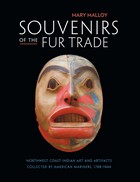
front cover of Souvenirs of the Fur Trade
Souvenirs of the Fur Trade
Northwest Coast Indian Art and Artifacts Collected by American Mariners, 1788–1844
Mary Malloy
Harvard University Press, 2000

American mariners made more than 175 voyages to the Northwest Coast during the half-century after the ships Columbia and Washington pioneered the route from Boston in 1787. Although obtaining sea otter pelts for the China trade was the original purpose of the voyages, the art and culture of Northwest Coast Indians so intrigued and fascinated American sailors that the collecting of ethnographic artifacts became an important secondary trade. The Indians traded masks, hats, paddles, pipes, fishhooks, spoons, clothing, and canoe models from their canoes to the decks of Yankee vessels.

In this act of exchange, the artifacts moved from one world to another—first to shipboard, and later to the “cabinets of curiosities” of learned societies in Massachusetts, where many of them found homes. The objects were the first examples of Northwest Coast Indian material culture to enter American museums, and they influenced perceptions of Northwest Coast Indian people and their complex cultures.

By carefully researching the records of ten institutions and the shipboard journals of more than a dozen mariners, Mary Malloy has brought details about these early collections together for the first time. From utilitarian objects to artistic masterpieces, these souvenirs tell a story of commerce and cultural exchange that reached across the continent during the period when Americans were first beginning to look westward.
[more]

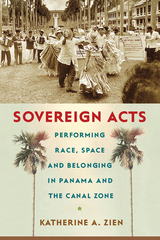
front cover of Sovereign Acts
Sovereign Acts
Performing Race, Space, and Belonging in Panama and the Canal Zone
Zien, Katherine A.
Rutgers University Press, 2017
Winner of the 2018 Gordon K. and Sybil Farrell Lewis Book Prize from the Caribbean Studies Association
Winner of the 2017 Annual Book Prize from the Canadian Association of Latin American and Caribbean Studies (CALACS)​


Sovereign Acts explores how artists, activists, and audiences performed and interpreted sovereignty struggles in the Panama Canal Zone, from the Canal Zone’s inception in 1903 to its dissolution in 1999. In popular entertainments and patriotic pageants, opera concerts and national theatre, white U.S. citizens, West Indian laborers, and Panamanian artists and activists used performance as a way to assert their right to the Canal Zone and challenge the Zone’s sovereignty, laying claim to the Zone’s physical space and imagined terrain. 

By demonstrating the place of performance in the U.S. Empire’s legal landscape, Katherine A. Zien transforms our understanding of U.S. imperialism and its aftermath in the Panama Canal Zone and the larger U.S.-Caribbean world. 
[more]

front cover of The Sovereign Self
The Sovereign Self
Aesthetic Autonomy from the Enlightenment to the Avant-Garde
Grant H. Kester
Duke University Press, 2023
In The Sovereign Self, Grant H. Kester examines the evolving discourse of aesthetic autonomy from its origins in the Enlightenment through avant-garde projects and movements in the nineteenth and twentieth centuries. Kester traces the idea of aesthetic autonomy—the sense that art should be autonomous from social forces while retaining the ability to reflect back critically on society—through Kant, Schiller, Hegel, Marx, and Adorno. Kester critiques the use of aesthetic autonomy as the basis for understanding the nature of art and the shifting relationship between art and revolutionary praxis. He shows that dominant discourses of aesthetic autonomy reproduce the very forms of bourgeois liberalism that autonomy discourse itself claims to challenge. Analyzing avant-garde art and political movements in Russia, India, Latin America, and elsewhere, Kester retheorizes the aesthetic beyond autonomy. Ultimately, Kester demonstrates that the question of aesthetic autonomy has ramifications that extend beyond art to encompass the nature of political transformation and forms of anticolonial resistance that challenge the Eurocentric concept of “Man,” upon which the aesthetic itself often depends.
[more]

front cover of Soviet Factography
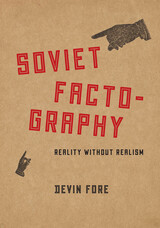
Soviet Factography
Reality without Realism
Devin Fore
University of Chicago Press, 2024
A study of Soviet factography, an avant-garde movement that employed photography, film, journalism, and mass media technologies.
 
This is the first major English-language study of factography, an avant-garde movement of 1920s modernism. Devin Fore charts this style through the work of its key figures, illuminating factography’s position in the material culture of the early Soviet period and situating it as a precursor to the genre of documentary that arose in the 1930s. Factographers employed photography and film practices in their campaign to inscribe facts and to chronicle modernization as it transformed human experience and society. Fore considers factography in light of the period’s explosion of new media technologies—including radio broadcasting, sound in film, and photo-media innovations—that allowed the press to transform culture on a massive scale.
 
This theoretically driven study uses material from Moscow archives and little-known sources to highlight factography as distinct from documentary and Socialist Realism and to establish it as one of the major twentieth-century avant-garde forms. Fore covers works of photography, film, literature, and journalism together in his considerations of Soviet culture, the interwar avant-gardes, aesthetics, and the theory of documentary.
 
[more]

front cover of Soviet Rock on Screen
Soviet Rock on Screen
The Life, Death, and Resurrection of a Film Genre
Rita Safariants
University of Wisconsin Press, 2026
As the Iron Curtain fell and Cold War suspicions thickened in the second half of the twentieth century, the quintessentially American genre of rock and roll, seen as a potent symbol and product of an enemy ideology, quickly became a clandestine import in the USSR. The Soviet underground embraced the forbidden sounds, despite official propaganda that called rock stars social parasites and corrupting sluggards. Contrary to the regime’s desires, the genre grew in popularity until it could no longer be ignored. In the Soviet Union’s last decade, a flailing film industry, controlled by and dependent on an increasingly unstable central government, seized on the rock star as a central figure—and the Soviet rock film was born.

In Soviet Rock on Screen, Rita Safariants chronicles the birth, life, death, and resurrection of a genre that rapidly became one of the most readily recognized cultural signifiers of the perestroika era and which continues to reflect and codify Russian culture. During their initial heyday in the 1980s, rock films were influenced by and encouraged the cultural shifts of perestroika and the incipient political storm. Today, Safariants argues, the reemergence and reconfiguration of the genre indicates the extent to which Soviet-era cultural emblems inform Russian national identity and obliquely support the current political repression under Putin.
[more]

front cover of Sowing Empire
Sowing Empire
Landscape And Colonization
Jill H. Casid
University of Minnesota Press, 2005
Planting and transplanting, seeding and reshaping—landscaping practices that emerged in the eighteenth century—are inextricable from the contested terrain of empire within which they operated. From the plantations of the “nabobs” to the island gardens of narrative fiction, from William Beckford’s estate at Fonthill to Marie Antoinette’s ornamented farm, Sowing Empire considers imperial relandscaping—its patriarchal organization, heterosexual reproduction, and slavery—and how it contributed to the construction of imperial power. At the same time, the book shows how these picturesque landscapes and sugar plantations contained within them the seeds of resistance—how, for instance, slave gardens and the Afro-Caribbean practice of Vodou threatened authority and created new possibilities for once again transforming the landscape.In an ambitious work of wide-ranging literary, visual, and historical allusion, Jill H. Casid examines how landscaping functioned in an imperial mode that defined and remade the “heartlands” of nations as well as the contact zones and colonial peripheries in the West and East Indies. Revealing the colonial landscape as far more than an agricultural system—as a means of regulating national, sexual, and gender identities—Casid also traces how the circulation of plants and hybridity influenced agriculture and landscaping on European soil and how colonial contacts materially shaped what we take as “European.”Utilizing a wide range of both visual and written sources—maps, literature, and travel writing—this book is interdisciplinary in its methodology and in its scope. Sowing Empire explores how postcolonial and queer studies can alter art history and visual studies and, in turn, what close attention to the visual may offer to both postcolonial theorizing and historically and materially based colonial cultural studies.Jill H. Casid is assistant professor of art history and part of the developing transdisciplinary program in visual culture studies at the University of Wisconsin, Madison.
[more]

front cover of Space, Site, Intervention
Space, Site, Intervention
Situating Installation Art
Erika Suderburg
University of Minnesota Press, 2000

In Space, Site, Intervention, some of today's most prominent art critics, curators, and artists view installation art as a diverse, multifaceted, and international art form that challenges institutional assumptions and narrow conceptual frameworks. Together, the essays in Space, Site, Intervention investigate how installation resonates within modern culture and society, as well as its ongoing influence on contemporary visual culture. 

Contributors: C. Ondine Chavoya, John Coleman, Sean Cubitt, Colin Gardner, Chrissie Iles, Miwon Kwon, Ernest Larsen, Tiffany Ana López, Catherine Lord, Kevin McMahon, James Meyer, Alessandra Moctezuma, Leda Ramos, Laurence A. Rickels, Barbara Maria Stafford, Susan Stewart, Marita Sturken, and John C. Welchman. 

[more]

front cover of Spaces of Creative Resistance
Spaces of Creative Resistance
Social Change Projects in Twenty-First-Century East Asia
Andrea Gevurtz Arai
Rutgers University Press, 2025
Spaces of Creative Resistance: Social Change Projects in Twenty-First-Century East Asia brings together an exciting cross-regional interdisciplinary group of scholars, scholar activists, artists, and others for a collection that addresses the last two decades' hollowing out of social connections, socioeconomic income gaps, and general precarity of life in East Asian societies. Written by authors from China, Japan, South Korea, Taiwan, and Hong Kong, each chapter is focused on people making a difference together in socially sustainable ways, particularly in the areas of gender, labor, and environments—both built and natural. These projects all constitute acts of creative resistance to neoliberal development, and each act of creative resistance demonstrates how individuals and communities across East Asia are making new worlds and lifeways in the small and everyday. Taking on larger political and economic forces that affect their lives and communities, each project and group of individuals featured here is focused on making more liveable presents and more possible futures.
[more]

logo for Intellect Books
Spanish Cinema of the New Millennium
And the Winner Is...
Thomas G. Deveny
Intellect Books, 2019
Spanish Cinema of the New Millennium provides a new approach to the study of contemporary Spanish cinema between 2000 and 2015 through the analysis of films that represent both "high" culture and "popular" culture. The two film cultures are represented by Goya Award–winning films and box-office successes. Thomas G. Deveny's examination of the country's most important films in this 16-year period provides a rigorous academic analysis of contemporary Spain's film industry, identity, and culture.
[more]

logo for Harvard University Press
Spanish Painting and the French Romantics
Ilse Hempel Lipschutz
Harvard University Press, 1972

logo for Intellect Books
Spatialities
The Geographies of Art and Architecture
Edited by Judith Rugg and Craig Martin
Intellect Books, 2012

Spatialities: The Geographies of Art and Architecture draws on a distinguished panel of artists, cultural theorists, architects, and geographers to offer a nuanced conceptual framework for understanding the ever-evolving spatial orderings that materially constitute our world. With chapters covering a wide range of topics, including the interstitial, the liminal and the relational processes of networks, accumulations, and assemblage as possibilities for spatial reflection, this volume shows space to be less a defining category and more an abstract terrain whose boundaries may be continually probed and contested.

[more]

front cover of Speaking of Furniture
Speaking of Furniture
Conversations with 14 American Masters
Warren Eames Johnson
The Artist Book Foundation, 2013
Speaking of Furniture: Conversations with 14 American Masters is a fresh, stimulating, and in-depth examination of the modus operandi of 14 accomplished—and diverse—furniture makers. An engaging history of studio furniture, this colorful, informative study includes engaging conversations with James Krenov, Wendell Castle, Jere Osgood, Judy Kensley McKie, David Ebner, Richard Scott Newman, Hank Gilpin, Alphonse Mattia, John Dunnigan, Wendy Maruyama, James Schriber, Timothy S. Philbrick, Michael Hurwitz, and Thomas Hucker. The insightful interviews illuminate how these creative and gifted craftspeople arrived professionally and what their craft means to them individually. In his enlightening foreword, Edward S. Cooke, Jr. maps out the background of the studio furniture movement. Author and furnituremaker Roger Holmes offers an insider’s perspective on the art and craft of producing exquisite contemporary furniture in his conversational introduction and maintains, “Art or craft, this is very personal work.” This elegant presentation skillfully sheds light on the thought processes and techniques of a celebrated and exceptional gathering of studio furniture makers who are as unique as they are stellar. As sculptor and furniture designer Wendell Castle remarks, “What I admired was that . . . fine art and craft were the same thing.”
[more]

front cover of Speaking Truths
Speaking Truths
Young Adults, Identity, and Spoken Word Activism
Valerie Chepp
Rutgers University Press, 2022
The twenty-first century is already riddled with protests demanding social justice, and in every instance, young people are leading the charge. But in addition to protesters who take to the streets with handmade placards are young adults who engage in less obvious change-making tactics. In Speaking Truths, sociologist Valerie Chepp goes behind-the-scenes to uncover how spoken word poetry—and young people’s participation in it—contributes to a broader understanding of contemporary social justice activism, including this generation’s attention to the political importance of identity, well-being, and love.
 
Drawing upon detailed observations and in-depth interviews, Chepp tells the story of a diverse group of young adults from Washington, D.C. who use spoken word to create a more just and equitable world. Outlining the contours of this approach, she interrogates spoken word activism’s emphasis on personal storytelling and “truth,” the strategic uses of aesthetics and emotions to politically engage across difference, and the significance of healing in sustainable movements for change. Weaving together their poetry and personally told stories, Chepp shows how poets tap into the beautiful, emotional, personal, and therapeutic features of spoken word to empathically connect with others, advance intersectional and systemic analyses of inequality, and make social justice messages relatable across a diverse public. By creating allies and forging connections based on friendship, professional commitments, lived experiences, emotions, artistic kinship, and political views, this activist approach is highly integrated into the everyday lives of its practitioners, online and face-to-face.
 
Chepp argues that spoken word activism is a product of, and a call to action against, the neoliberal era in which poets have come of age, characterized by widening structural inequalities and increasing economic and social vulnerability. She illustrates how this deeply personal and intimate activist approach borrows from, builds upon, and diverges from previous social movement paradigms. Spotlighting the complexity and mutual influence of modern-day activism and the world in which it unfolds, Speaking Truths contributes to our understanding of contemporary social change-making and how neoliberalism has shaped this political generation’s experiences with social injustice.
[more]

front cover of SpecLab
SpecLab
Digital Aesthetics and Projects in Speculative Computing
Johanna Drucker
University of Chicago Press, 2009

Nearly a decade ago, Johanna Drucker cofounded the University of Virginia’s SpecLab, a digital humanities laboratory dedicated to risky projects with serious aims. In SpecLab she explores the implications of these radical efforts to use critical practices and aesthetic principles against the authority of technology based on analytic models of knowledge.

            Inspired by the imaginative frontiers of graphic arts and experimental literature and the technical possibilities of computation and information management, the projects Drucker engages range from Subjective Meteorology to Artists’ Books Online to the as yet unrealized ’Patacritical Demon, an interactive tool for exposing the structures that underlie our interpretations of text. Illuminating the kind of future such experiments could enable, SpecLab functions as more than a set of case studies at the intersection of computers and humanistic inquiry. It also exemplifies Drucker’s contention that humanists must play a role in designing models of knowledge for the digital age—models that will determine how our culture will function in years to come.

[more]

logo for University of Chicago Press
The Spectacle of Women
Imagery of the Suffrage Campaign 1907-14
Lisa Tickner
University of Chicago Press, 1988
Too "artistic" for political history, too political for the history of art, the visual history of the campaign for women's suffrage in Britain has long been neglected. In this comprehensive and pathbreaking study, Lisa Tickner discusses and illustrates the suffragist use of spectacle—the design of banners, posters and postcards, the orchestration of mass demonstrations—in an unprecedented propaganda campaign.
[more]

front cover of Spectacular Wealth
Spectacular Wealth
The Festivals of Colonial South American Mining Towns
By Lisa Voigt
University of Texas Press, 2016

Bridging print culture and performance, Spectacular Wealth draws on eighteenth-century festival accounts to explore how colonial residents of the silver-mining town of Potosí, in the viceroyalty of Peru, and the gold-mining region of Minas Gerais, in Brazil, created rich festive cultures that refuted European allegations of barbarism and greed. In her examination of the festive participation of the towns’ diverse inhabitants, including those whose forced or slave labor produced the colonies’ mineral wealth, Lisa Voigt shows how Amerindians, Afro-descendants, Europeans, and creoles displayed their social capital and cultural practices in spectacular performances.

Tracing the multiple meanings and messages of civic festivals and religious feast days alike, Spectacular Wealth highlights the conflicting agendas at work in the organization, performance, and publication of festivals. Celebrants and writers in mining boomtowns presented themselves as far more than tributaries yielding mineral wealth to the Spanish and Portuguese empires, using festivals to redefine their reputations and to celebrate their cultural, spiritual, and intellectual wealth.
[more]

front cover of The Specter and the Speculative
The Specter and the Speculative
Afterlives and Archives in the African Diaspora
Mae G. Henderson
Rutgers University Press, 2024
The Specter and the Speculative: Afterlives and Archives in the African Diaspora engages in a critical conversation about how historical subjects and historical texts within the African Diaspora are re-fashioned, re-animated, and re-articulated, as well as parodied, nostalgized, and defamiliarized, to establish an “afterlife” for African Atlantic identities and narratives. These essays focus on transnational, transdisciplinary, and transhistorical sites of memory and haunting—textual, visual, and embodied performances—in order to examine how these “living” archives circulate and imagine anew the meanings of prior narratives liberated from their original context. Individual essays examine how historical and literary performances—in addition to film, drama, music, dance, and material culture—thus revitalized, transcend and speak across temporal and spatial boundaries not only to reinstate traditional meanings, but also to motivate fresh commentary and critique. Emergent and established scholars representing diverse disciplines and fields of interest specifically engage under explored themes related to afterlives, archives, and haunting.
[more]

front cover of Spectral Characters
Spectral Characters
Genre and Materiality on the Modern Stage
Sarah Balkin
University of Michigan Press, 2019

Theater’s materiality and reliance on human actors has traditionally put it at odds with modernist principles of aesthetic autonomy and depersonalization. Spectral Characters argues that modern dramatists in fact emphasized the extent to which humans are fictional, made and changed by costumes, settings, props, and spoken dialogue. Examining work by Ibsen, Wilde, Strindberg, Genet, Kopit, and Beckett, the book takes up the apparent deadness of characters whose selves are made of other people, whose thoughts become exteriorized communication technologies, and whose bodies merge with walls and furniture. The ghostly, vampiric, and telepathic qualities of these characters, Sarah Balkin argues, mark a new relationship between the material and the imaginary in modern theater. By considering characters whose bodies respond to language, whose attempts to realize their individuality collapse into inanimacy, and who sometimes don’t appear at all, the book posits a new genealogy of modernist drama that emphasizes its continuities with nineteenth-century melodrama and realism.
[more]

front cover of Speculating Daguerre
Speculating Daguerre
Art and Enterprise in the Work of L. J. M. Daguerre
Stephen C. Pinson
University of Chicago Press, 2012
 

Louis Jacques Mandé Daguerre (1787–1851) was a true nineteenth-century visionary—a painter, printmaker, set designer, entrepreneur, inventor, and pioneer of photography. Though he was widely celebrated beyond his own lifetime for his invention of the daguerreotype, it was his origins as a theatrical designer and purveyor of visual entertainment that paved the way for Daguerre’s emergence as one of the world’s most iconic imagemakers.

In Speculating Daguerre, Stephen C. Pinson reinterprets the story of the man and his time, painting a vivid picture of Daguerre as an innovative artist and savvy impresario whose eventual fame as a photographer eclipsed everything that had come before. Drawing upon previously unpublished correspondence and unplumbed archival sources, Pinson mixes biography with an incisive study of Daguerre’s wide-ranging involvement in visual culture. From his work as a commercial lithographer to his coinvention of the Paris Diorama—a theater in the round in which Daguerre employed natural light and special effects to simulate time and movement in large-scale paintings—here we are given access to Daguerre the artist, whose tireless experimentation, entrepreneurial spirit, and exceptional talent for popular spectacle helped to usher in a new visual age.

Filled with more than one hundred illustrations and including the first complete catalogue of Daguerre’s paintings, works on paper, and daguerreotypes to appear in print, the publication of Speculating Daguerre will be a much-heralded event for anyone with even a passing interest in one of the most fascinating characters in the history of photography.
[more]

front cover of Speculation, Now
Speculation, Now
Essays and Artwork
Vyjayanthi Venuturupalli Rao, with Prem Krishnamurty and Carin Kuoni, eds.
Duke University Press, 2014
Interdisciplinary in design and concept, Speculation, Now illuminates unexpected convergences between images, concepts, and language. Artwork is interspersed among essays that approach speculation and progressive change from surprising perspectives. A radical cartographer asks whether "the speculative" can be represented on a map. An ethnographer investigates religious possession in Islam to contemplate states between the divine and the seemingly human. A financial technologist queries understandings of speculation in financial markets. A multimedia artist and activist considers the relation between social change and assumptions about the conditions to be changed, and an architect posits purposeful neglect as political strategy. The book includes an extensive glossary with more than twenty short entries in which scholars contemplate such speculation-related notions as insurance, hallucination, prophecy, the paradox of beginnings, and states of half-knowledge. The book's artful, nonlinear design mirrors and reinforces the notion of contingency that animates it. By embracing speculation substantively, stylistically, seriously, and playfully, Speculation, Now reveals its subversive and critical potential.

Artists and essayists include William Darity Jr., Filip De Boeck, Boris Groys, Hans Haacke, Darrick Hamilton, Laura Kurgan, Lin + Lam, Gary Lincoff, Lize Mogel, Christina Moon, Stefania Pandolfo, Satya Pemmaraju, Mary Poovey, Walid Raad, Sherene Schostak, Robert Sember, and Srdjan Jovanović Weiss.

Published by Duke University Press and the Vera List Center for Art and Politics at The New School

 
[more]

front cover of Speculative Blackness
Speculative Blackness
The Future of Race in Science Fiction
André M. Carrington
University of Minnesota Press, 2016

In Speculative Blackness, André M. Carrington analyzes the highly racialized genre of speculative fiction—including science fiction, fantasy, and utopian works, along with their fan cultures—to illustrate the relationship between genre conventions in media and the meanings ascribed to blackness in the popular imagination.

Carrington’s argument about authorship, fandom, and race in a genre that has been both marginalized and celebrated offers a black perspective on iconic works of science fiction. He examines the career of actor Nichelle Nichols, who portrayed the character Uhura in the original Star Trek television series and later became a recruiter for NASA, and the spin-off series Star Trek: Deep Space Nine, set on a space station commanded by a black captain. He recovers a pivotal but overlooked moment in 1950s science fiction fandom in which readers and writers of fanzines confronted issues of race by dealing with a fictitious black fan writer and questioning the relevance of race to his ostensible contributions to the 'zines. Carrington mines the productions of Marvel comics and the black-owned comics publisher Milestone Media, particularly the representations of black sexuality in its flagship title, Icon. He also interrogates online fan fiction about black British women in Buffy the Vampire Slayer and the Harry Potter series.

Throughout this nuanced analysis, Carrington theorizes the relationship between race and genre in cultural production, revealing new understandings of the significance of blackness in twentieth-century American literature and culture.


[more]

front cover of Speculative Light
Speculative Light
The Arts of Beauford Delaney and James Baldwin
Amy J. Elias, editor
Duke University Press, 2025
Over the course of a thirty-eight-year friendship, painter Beauford Delaney and writer James Baldwin shared their private lives and shaped one another’s artistic values. Speculative Light brings together scholars, critics, and artists who analyze the stylistic and historical import of Delaney's and Baldwin’s works and examine how this friendship fundamentally shaped the pair's ideas about art and life. The book’s contributors explore how the two men, sharing identities as queer Black American artists, first in New York and then as expatriates in France, created a speculative space in their work to think about more just and creative Black futures. Essay topics and issues range from masculinity, queerness, Blackness, and Americanness to the relationship between jazz, painting, and writing. Throughout, the contributors establish a positive history for Delaney's and Baldwin’s arts that refuses a subordinate role to white artists of the modernist avant-garde. Ultimately, Speculative Light demonstrates that Delaney and Baldwin's bond provides revolutionary grounds for theorizing contemporary Black art and life.

Contributors. Hilton Als, Nicholas Boggs, Indie A. Choudhury, Shawn Anthony Christian, Rachel Cohen, Amy J. Elias, Monika Gehlawat, David Leeming, D. Quentin Miller, Fred Moten, Walton M. Muyumba, Robert O’Meally, Ed Pavlić, Levi Prombaum, Robert Reid-Pharr, Tyler T. Schmidt, Abbe Schriber, Jered Sprecher, Stephen C. Wicks, Magdalena Zaborowska

[more]

front cover of Spiral Jetta
Spiral Jetta
A Road Trip through the Land Art of the American West
Erin Hogan
University of Chicago Press, 2008

Erin Hogan hit the road in her Volkswagen Jetta and headed west from Chicago in search of the monuments of American land art: a salty coil of rocks, four hundred stainless steel poles, a gash in a mesa, four concrete tubes, and military sheds filled with cubes. Her journey took her through the states of Utah, Nevada, New Mexico, Arizona, and Texas. It also took her through the states of anxiety, drunkenness, disorientation, and heat exhaustion. Spiral Jetta is a chronicle of this journey.

A lapsed art historian and devoted urbanite, Hogan initially sought firsthand experience of the monumental earthworks of the 1970s and the 1980s—Robert Smithson’s Spiral Jetty, Nancy Holt’s Sun Tunnels, Walter De Maria’s Lightning Field, James Turrell’s Roden Crater, Michael Heizer’s Double Negative, and the contemporary art mecca of Marfa, Texas. Armed with spotty directions, no compass, and less-than-desert-appropriate clothing, she found most of what she was looking for and then some.

“I was never quite sure what Hogan was looking for when she set out . . . or indeed whether she found it. But I loved the ride. In Spiral Jetta, an unashamedly honest, slyly uproarious, ever-probing book, art doesn’t magically have the power to change lives, but it can, perhaps no less powerfully, change ways of seeing.”—Tom Vanderbilt, New York Times Book Review

“The reader emerges enlightened and even delighted. . . . Casually scrutinizing the artistic works . . . while gamely playing up her fish-out-of-water status, Hogan delivers an ingeniously engaging travelogue-cum-art history.”—Atlantic

“Smart and unexpectedly hilarious.”—Kevin Nance, Chicago Sun-Times

“One of the funniest and most entertaining road trips to be published in quite some time.”—June Sawyers, Chicago Tribune

“Hogan ruminates on how the work affects our sense of time, space, size, and scale. She is at her best when she reexamines the precepts of modernism in the changing light of New Mexico, and shows how the human body is meant to be a participant in these grand constructions.”—New Yorker

[more]

front cover of Spiral Jetta
Spiral Jetta
A Road Trip through the Land Art of the American West
Erin Hogan
University of Chicago Press, 2008

Erin Hogan hit the road in her Volkswagen Jetta and headed west from Chicago in search of the monuments of American land art: a salty coil of rocks, four hundred stainless steel poles, a gash in a mesa, four concrete tubes, and military sheds filled with cubes. Her journey took her through the states of Utah, Nevada, New Mexico, Arizona, and Texas. It also took her through the states of anxiety, drunkenness, disorientation, and heat exhaustion. Spiral Jetta is a chronicle of this journey.

A lapsed art historian and devoted urbanite, Hogan initially sought firsthand experience of the monumental earthworks of the 1970s and the 1980s—Robert Smithson’s Spiral Jetty, Nancy Holt’s Sun Tunnels, Walter De Maria’s Lightning Field, James Turrell’s Roden Crater, Michael Heizer’s Double Negative, and the contemporary art mecca of Marfa, Texas. Armed with spotty directions, no compass, and less-than-desert-appropriate clothing, she found most of what she was looking for and then some.

“I was never quite sure what Hogan was looking for when she set out . . . or indeed whether she found it. But I loved the ride. In Spiral Jetta, an unashamedly honest, slyly uproarious, ever-probing book, art doesn’t magically have the power to change lives, but it can, perhaps no less powerfully, change ways of seeing.”—Tom Vanderbilt, New York Times Book Review

“The reader emerges enlightened and even delighted. . . . Casually scrutinizing the artistic works . . . while gamely playing up her fish-out-of-water status, Hogan delivers an ingeniously engaging travelogue-cum-art history.”—Atlantic

“Smart and unexpectedly hilarious.”—Kevin Nance, Chicago Sun-Times

“One of the funniest and most entertaining road trips to be published in quite some time.”—June Sawyers, Chicago Tribune

“Hogan ruminates on how the work affects our sense of time, space, size, and scale. She is at her best when she reexamines the precepts of modernism in the changing light of New Mexico, and shows how the human body is meant to be a participant in these grand constructions.”—New Yorker
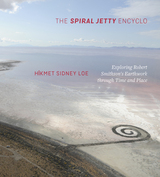
[more]

front cover of Spiral Jetta Summer
Spiral Jetta Summer
Swimming in the Great Salt Lake
Erin Hogan
University of Chicago Press, 2008
Erin Hogan hit the road in her Volkswagen Jetta and headed west from Chicago in search of the monuments of American land art: a salty coil of rocks, four hundred stainless steel poles, a gash in a mesa, four concrete tubes, and military sheds filled with cubes. Her completed journey took her through the states of Utah, Nevada, New Mexico, Arizona, and Texas. It also took her through the states of anxiety, drunkenness, disorientation, and heat exhaustion. Spiral Jetta Summer is a chronicle of this adventure, and it reveals Hogan’s unpretentious and boisterous narrative flair on the roads of middle-of-nowhere Utah in pursuit of Robert Smithson’s classic work Spiral Jetty. Along the way, Hogan writes about venturing outside of her urban comfort zone; who she encounters; and most importantly, how she found most of what she was looking for and then some.

[more]

front cover of The Spiral Jetty Encyclo
The Spiral Jetty Encyclo
Exploring Robert Smithson's Earthwork through Time and Place
Hikmet Sidney Loe
University of Utah Press, 2017

Copublished with the Tanner Trust Fund, J. Willard Marriott Library.

Robert Smithson’s earthwork, Spiral Jetty (1970), an icon of the Land Art movement of the 1960s and 1970s, is located on the northern shores of Utah’s Great Salt Lake. Smithson built a masterpiece from local materials, one that spirals counterclockwise into the lake and appears or is submerged with fluctuations in the lake’s locally red, saline water.

The Spiral Jetty Encyclo draws on Smithson’s writings for encyclopedic entries that bring to light the context of the earthwork and Smithson’s many points of reference in creating it. Visitors and armchair travelers, too, will discover how much significance Smithson placed on regional considerations, his immersion in natural history, his passion for travel, and his ability to use diverse mediums to create a cohesive and lasting work of art. Containing some 220 images, most of them in color, with some historical black and whites, The  Spiral Jetty Encyclo lets readers explore the construction, connections, and significance of Smithson’s 1,500-foot-long curl into Great Salt Lake, created, in Smithson’s words, of “mud, salt crystals, rocks, water.” 

Winner of 15 Bytes Book Award for Art Book.
Finalist for the Utah State Historical Society Best Book Award.
[more]

front cover of The Spirit of Colonial Williamsburg
The Spirit of Colonial Williamsburg
Ghosts and Interpreting the Recreated Past
Alena Pirok
University of Massachusetts Press, 2022

On any given night, hundreds of guests walk the darkened streets of Colonial Williamsburg looking for ghosts. Since the early 2000s, both the museum and private companies have facilitated these hunts, offering year-round ghost tours. Critics have called these excursions a cash grab, but in truth, ghosts and hauntings have long been at the center of the Colonial Williamsburg project.

The Spirit of Colonial Williamsburg examines how the long-dead past comes alive at this living-history museum. In the early twentieth century, local stories about the ghosts of former residents—among them Revolutionary War soldiers and nurses, tavern owners and prominent attorneys, and enslaved African Americans—helped to turn Williamsburg into a desirable site for historical restoration. But, for much of the twentieth century, the museum tried diligently to avoid any discussion of ghosts, considering them frivolous and lowbrow. Alena Pirok explores why historic sites have begun to embrace their spectral residents in recent decades, arguing that through them, patrons experience an emotional connection to place and a palpable understanding of the past through its people.
[more]

logo for Harvard University Press
The Spirit of Man in Asian Art
Lawrence Binyon
Harvard University Press

front cover of The Spirit of the City
The Spirit of the City
Marshall Fredericks Sculptures in Detroit
Janna Jones
Michigan State University Press, 2023
Marshall Fredericks’s Detroit sculptures capture the spirit of the Motor City and its dramatic transformation from the 1950s to the present day. In this book, Janna Jones analyzes eight of these enormous works of public art, situating them and their structures in metro Detroit’s distinctive midcentury milieu and bringing much-needed critical attention to this sculptor’s oeuvre. Sadly, some of these artworks have suffered along with the city as it shrank from its postwar zenith. Both the buildings and the sculptures erected for them deserve to be rescued from neglect, and then maintained and preserved for the future.
 
[more]

front cover of Spirit of the Place
Spirit of the Place
From Mauthausen to Moma
Péter György
Central European University Press, 2008
These essays are case-studies, the cases unraveling our cultural roots, memory itself. If a museum is the subject, then for instance the way the museum changes face, function, its manner of speech; how, a repository of collections and the cultural memory of humankind itself turns into one of the objects, memories, a custodian and exponent of its own history, or the opposite: how it connects with its modernized environs and changing audience: us. How has, or might the sanctum be transformed into a public venue, go from an inward looking, reverential enclosure to a space full of life. In other studies included here the author speaks of spatial and incarnate remembrance: the radical difference between a monument and a memorial. The duality of “always remembering” and “never forgetting”: a past depersonalized and dehistoricized as it was seized and processed. Of the layers of meaning attached to concentration camps, transmuting essence of artworks, and the difficult, the contradictory but inescapable processing of history and the past, of self-identical existence in history. So that we know we are alive. And how that is so.
[more]

front cover of Spiritual Moderns
Spiritual Moderns
Twentieth-Century American Artists and Religion
Erika Doss
University of Chicago Press, 2022
Examines how and why religion matters in the history of modern American art.
 
Andy Warhol is one of the best-known American artists of the twentieth century. He was also an observant Catholic who carried a rosary, went to mass regularly, kept a Bible by his bedside, and depicted religious subjects throughout his career. Warhol was a spiritual modern: a modern artist who appropriated religious images, beliefs, and practices to create a distinctive style of American art.
 
Spiritual Moderns centers on four American artists who were both modern and religious. Joseph Cornell, who showed with the Surrealists, was a member of the Church of Christ, Scientist. Mark Tobey created pioneering works of Abstract Expressionism and was a follower of the Bahá’í Faith. Agnes Pelton was a Symbolist painter who embraced metaphysical movements including New Thought, Theosophy, and Agni Yoga. And Warhol, a leading figure in Pop art, was a lifelong Catholic. Working with biographical materials, social history, affect theory, and the tools of art history, Doss traces the linked subjects of art and religion and proposes a revised interpretation of American modernism.
 
[more]

front cover of Spoiled
Spoiled
Asian American Hostility and the Damage of Repair
Summer Kim Lee
Duke University Press, 2025
In Spoiled, Summer Kim Lee examines how contemporary Asian American artists challenge expectations that their work should repair the wounds of racial trauma. Kim Lee turns to the “spoiled”—the racialized, gendered body and all that it consumes, wrecks, and inflicts in its desire and excess—in visual culture, performance, music, and literature. Reading works by Cato Ouyang, Patty Chang, Wu Tsang, TJ Shin, Jes Fan, and others, Kim Lee highlights moments of hostility and deformation that spoil idealizations of Asian Americanness and incite modes of feeling and relating that relinquish fantasies of wholeness, power, and control. She observes the latent aggressive behaviors and negative affects in Asian American aesthetic practice: the embarrassment of asociality, the imposition of speaking as someone else, and the indulgence of ravenous appetites. In so doing, Kim Lee questions the political desires for repair expressed in “feeling Asian” and stays with the damage that spoilage creates as integral to the kinds of repair that Asian Americans seek.
[more]

logo for St. Augustine's Press
St. Austin Review, Truth in Fiction
The Art of the Novel, Vol. 10 No. 3
Joseph Pearce and Robert Asch
St. Augustine's Press, 2010

front cover of Staging Asia
Staging Asia
The Dutch East India Company and the Amsterdam Theatre
Manjusha Kuruppath
Leiden University Press, 2017
How is it possible that three playwrights in the early modern Dutch Republic wrote dramas based on contemporary political events in Asia? Reflecting on this remarkable phenomenon, Staging Asia traces the passage of the stories surrounding three political revolutions from seventeenth-century Asia through to the Dutch Republic and their ultimate manifestation as dramas. This book explores the nature of the representation of the Orient in these plays and evaluates how this characterization was influenced by the channels that these dramatists relied on to gather information for their works. As these dramas exhibit strong connections to the Dutch East India Company, this work additionally examines the role of that enterprise in disseminating information on Asia and producing imagery about the Orient.
[more]

front cover of Standing on the Walls of Time
Standing on the Walls of Time
Ancient Art of Utah's Cliffs and Canyons
Kevin T. Jones and Layne Miller
University of Utah Press, 2019
In western culture, rock art has traditionally been viewed as “primitive” and properly belonging in the purview of anthropologists rather than art scholars and critics. This volume, featuring previously unpublished photographs of Utah’s magnificent rock art by long-time rock art researcher Layne Miller and essays by former Utah state archaeologist Kevin Jones, views rock art through a different lens.

Miller’s photographs include many rare and relatively unknown panels and represent a lifetime of work by someone intimately familiar with the Colorado Plateau. The photos highlight the astonishing variety of rock art as well as the variability within traditions and time periods. Jones’s essays furnish general information about previous Colorado Plateau cultures and shine a light on rock art as art. The book emphasizes the exqui­site artistry of these ancient works and their capacity to reach through the ages to envelop and inspire viewers.
[more]

front cover of Star Gods of the Maya
Star Gods of the Maya
Astronomy in Art, Folklore, and Calendars
By Susan Milbrath
University of Texas Press, 2000

Observations of the sun, moon, planets, and stars played a central role in ancient Maya lifeways, as they do today among contemporary Maya who maintain the traditional ways. This pathfinding book reconstructs ancient Maya astronomy and cosmology through the astronomical information encoded in Precolumbian Maya art and confirmed by the current practices of living Maya peoples.

Susan Milbrath opens the book with a discussion of modern Maya beliefs about astronomy, along with essential information on naked-eye observation. She devotes subsequent chapters to Precolumbian astronomical imagery, which she traces back through time, starting from the Colonial and Postclassic eras. She delves into many aspects of the Maya astronomical images, including the major astronomical gods and their associated glyphs, astronomical almanacs in the Maya codices [painted books], and changes in the imagery of the heavens over time. This investigation yields new data and a new synthesis of information about the specific astronomical events and cycles recorded in Maya art and architecture. Indeed, it constitutes the first major study of the relationship between art and astronomy in ancient Maya culture.
[more]

front cover of Stars in My Eyes
Stars in My Eyes
Don Bachardy
University of Wisconsin Press, 2011

Stars in My Eyes is a revealing and entertaining collection of celebrity portraits, rendered both in acute drawings and in finely observed prose. In the 1970s and 1980s, internationally known artist Don Bachardy made portraits from life, depicting the actors, writers, artists, composers, directors, and Hollywood elite that he and his partner Christopher Isherwood knew. He then made detailed notes about these portrait sittings in the journal he has kept for more than forty years. The result is a unique document: we enter the mind of the artist as he records the images and behavior of his celebrity subjects—from Ruby Keeler and Barbara Stanwyck to Jack Nicholson and Linda Ronstadt—during their often intense collaboration with him.

Finalist, Lambda Literary Foundation Book Award
 

[more]

front cover of State and Cosmos in the Art of Tenochtitlan
State and Cosmos in the Art of Tenochtitlan
Richard Fraser Townsend
Harvard University Press
Richard Fraser Townsend offers an interpretation of major examples of Mexica monumental art by identifying three interrelated iconographic themes: the conception of the universe as a sacred structure, the correspondence of the social order and the territory of the nation with the cosmic structure, and the representation of Tenochtitlan as the historically legitimate successor to the civilization of the past.
[more]

front cover of The State as a Work of Art
The State as a Work of Art
The Cultural Origins of the Constitution
Eric Slauter
University of Chicago Press, 2009

The founding of the United States after the American Revolution was so deliberate, so inspired, and so monumental in scope that the key actors considered this new government to be a work of art framed from natural rights. Recognizing the artificial nature of the state, these early politicians believed the culture of a people should inform the development of their governing rules and bodies. Eric Slauter explores these central ideas in this extensive and novel account of the origins and meanings of the Constitution of the United States. Slauter uncovers the hidden cultural histories upon which the document rests, highlights the voices of ordinary people, and considers how the artifice of the state was challenged in its effort to sustain inalienable natural rights alongside slavery and to achieve political secularization at a moment of growing religious expression.

A complement to classic studies of the Constitution’s economic, ideological, and political origins, The State as a Work of Art sheds new light on the origins of the Constitution and on ongoing debates over its interpretation.

[more]

front cover of Stay by Me, Roses
Stay by Me, Roses
The Life of American Artist Alice Archer Sewall James, 1870-1955
ALICE B. SKINNER
Swedenborg Foundation Publishers, 2011

Alice Archer Sewall James—known affectionately as “Archie”—lived a life that most women of her time could only dream about. Educated from a young age and encouraged by her family to express herself in all forms of art, she grew into an irrepressible woman who never stopped looking for ways to pass her experience on to others.

This biography traces her life from her childhood in Urbana, Ohio, to teenage years spent traveling in Europe, to her challenging marriage to John H. James, heir to a family fortune built by his entrepreneurial grandfather of the same name. Her father, Swedenborgian minister and educator Frank Sewall, was her greatest fan, supporting her in good times, as she started to build a reputation as a painter and illustrator, and in bad, as poor health forced her to abandon her art and put a strain on her personal relationships. In later years, however—like the roses in the title poem—she reemerged as an artist and as a teacher, inspiring a new generation of painters at Urbana University.

While Archie’s Swedenborgian heritage gave structure and meaning to her life, it was her inner creative drive that truly touched others. Stay by Me, Roses opens a window on the life and times of a unique nineteenth-century woman.

[more]

logo for Intellect Books
Stephen King on the Small Screen
Mark Browning
Intellect Books, 2011
 

In this follow up to Stephen King on the Big Screen, Mark Browning turns his critical eye to the much-neglected subject of the best-selling author’s work in television, examining what it is about King’s fiction that makes it particularly suitable for the small screen.

By focusing on this body of work, from the highly successful The Stand and The Night Flier to the lesser-known TV films Storm of the Century, Rose Red, Kingdom Hospital, and the 2004 remake of Salem’s Lot, Browning is able to articulate how these adaptations work and, in turn, suggest new ways of viewing them. This book is the first written by a film specialist to consider King’s television work in its own right, and it rejects previous attempts to make the films and books fit rigid thematic categories. Browning examines what makes a written or visual text successful at evoking fear on a case-by-case basis, in a highly readable and engaging way. He also considers the relationship between the big and small screen. Why, for instance, are some TV versions more effective than movie adaptations and vice versa? In the process, Stephen King on the Small Screen is able to shed new light on what it is that makes King’s novels so successful and reveal the elements of style and approach that have helped make King one of the world’s best-selling authors.

[more]

logo for Duke University Press
Still Dangerous!
The Harmony Hammond Reader
Harmony Hammond. Edited by Tirza True Latimer.
Duke University Press, 2026
Still Dangerous! brings together over five decades worth of writings in a range of genres by the artist, feminist activist, curator, educator, and author Harmony Hammond.

Harmony Hammond, a leading figure in New York’s feminist and lesbian art movements, is primarily known for her abstract painting and sculpture. As a co-founder of A.I.R., the first major women’s cooperative art gallery, and Heresies, a groundbreaking feminist journal, Hammond played a critical role in the emergence of lesbian and feminist art through her curation and writing. Still Dangerous!, with an introduction by the volume editor Tirza True Latimer and a foreword by Julia Bryan-Wilson, brings together five decades of Hammond’s writings addressing the historical invisibility of women and lesbian artists, the politics of gender and sexuality in contemporary creative practice, materiality, feminism’s expanding purview, resisting censorship, and strategies of feminist and queer abstraction. Compiling essays, reviews, artist’s statements, presentations, letters, and interviews, Still Dangerous! fleshes out Hammond’s career while providing a valuable resource for scholars and students of contemporary culture.
[more]

front cover of Still Life
Still Life
Ecologies of the Modern Imagination at the Art Museum
Fernando Domínguez Rubio
University of Chicago Press, 2020
How do you keep the cracks in Starry Night from spreading? How do you prevent artworks made of hugs or candies from disappearing? How do you render a fading photograph eternal—or should you attempt it at all? These are some of the questions that conservators, curators, registrars, and exhibition designers dealing with contemporary art face on a daily basis. In Still Life, Fernando Domínguez Rubio delves into one of the most important museums of the world, the Museum of Modern Art (MoMA) in New York, to explore the day-to-day dilemmas that museum workers face when the immortal artworks that we see in the exhibition room reveal themselves to be slowly unfolding disasters.

Still Life offers a fascinating and detailed ethnographic account of what it takes to prevent these disasters from happening. Going behind the scenes at MoMA, Domínguez Rubio provides a rare view of the vast technological apparatus—from climatic infrastructures and storage facilities, to conservation labs and machine rooms—and teams of workers—from conservators and engineers to guards and couriers—who fight to hold artworks still.

As MoMA reopens after a massive expansion and rearranging of its space and collections, Still Life not only offers a much-needed account of the spaces, actors, and forms of labor traditionally left out of the main narratives of art, but it also offers a timely meditation on how far we, as a society, are willing to go to keep the things we value from disappearing into oblivion.
[more]


Send via email Share on Facebook Share on Twitter