
 A SCHOLARLY BOOK REPOSITORY
6 start with S start with S
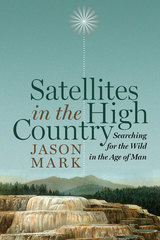
In Satellites in the High Country, journalist and adventurer Jason Mark travels beyond the bright lights and certainties of our cities to seek wildness wherever it survives. In California's Point Reyes National Seashore, a battle over oyster farming and designated wilderness pits former allies against one another, as locals wonder whether wilderness should be untouched, farmed, or something in between. In Washington's Cascade Mountains, a modern-day wild woman and her students learn to tan hides and start fires without matches, attempting to connect with a primal past out of reach for the rest of society. And in Colorado's High Country, dark skies and clear air reveal a breathtaking expanse of stars, flawed only by the arc of a satellite passing—beauty interrupted by the traffic of a million conversations. These expeditions to the edges of civilization's grid show us that, although our notions of pristine nature may be shattering, the mystery of the wild still exists — and in fact, it is more crucial than ever.
But wildness is wily as a coyote: you have to be willing to track it to understand the least thing about it. Satellites in the High Country is an epic journey on the trail of the wild, a poetic and incisive exploration of its meaning and enduring power in our Human Age.
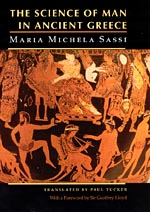
Maria Michela Sassi reconstructs Greek attempts to answer such questions from Homer's day to late antiquity, ranging across physiognomy, ethnography, geography, medicine, and astrology. Sassi demonstrates that in the Greek science of man, empirical observations were inextricably bound up with a prejudiced view of the free Greek male as superior to all others. Thus, because women were assumed to have pale skin from staying indoors too much, Greek biology and medicine sought to explain this feature as an indication of the "cold" nature of women, as opposed to the "hot" constitution of men.
For this English translation, Sassi has rewritten the introduction and updated the text and references throughout, and Sir Geoffrey Lloyd has provided a new foreword.

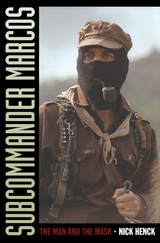
In this, the first English-language biography of Subcommander Marcos, Nick Henck describes the thought, leadership, and personality of this charismatic rebel spokesperson. He traces Marcos’s development from his provincial middle-class upbringing, through his academic career and immersion in the clandestine world of armed guerrillas, to his emergence as the iconic Subcommander. Henck reflects on what motivated an urbane university professor to reject a life of comfort in Mexico City in favor of one of hardship as a guerrilla in the mountainous jungles of Chiapas, and he examines how Marcos became a conduit through which impoverished indigenous Mexicans could communicate with the world.
Henck fully explores both the rebel leader’s renowned media savvy and his equally important flexibility of mind. He shows how Marcos’s speeches and extensive writings demonstrate not only the Subcommander’s erudition but also his rejection of Marxist dogmatism. Finally, Henck contextualizes Marcos, locating him firmly within the Latin American guerrilla tradition.
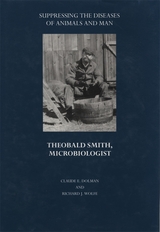
Theobald Smith (1859–1934) is widely considered to be America’s first significant medical scientist and the world’s leading comparative pathologist. Entering the new field of infectious diseases as a young medical graduate, his research in bacteriology, immunology, and parasitology produced many important and basic discoveries. His most significant accomplishment was proving for the first time that an infectious disease could be transmitted by an arthropod agent. He also made significant discoveries on anaphylaxis, vaccine production, bacterial variation, and a host of other methods and diseases. His work on hog cholera led to the selection of the paratyphoid species causing enteric fever as the prototype of the eponymous Salmonella genus, mistakenly named for his chief at the U.S. Department of Agriculture, Daniel Salmon, who first reported the discovery in 1886, although the work was undertaken by Smith alone.
In 1895, Smith began a twenty-year career as teacher and researcher at the Harvard Medical School and director of the biological laboratory at the Massachusetts State Board of Health. In 1902, when the Rockefeller Institute for Medical Research was founded, he was offered but declined its directorship; however, in 1914, when the Institute established a division of animal pathology, he became director of its research division. Suppressing the Diseases of Animals and Man, the first book-length biography of Smith to appear in print, is based primarily on personal papers and correspondence that have remained in the possession of his family until now.
READERS
Browse our collection.
PUBLISHERS
See BiblioVault's publisher services.
STUDENT SERVICES
Files for college accessibility offices.
RECENTLY PUBLISHED




UChicago Accessibility Resources
home | accessibility | search | about | contact us
BiblioVault ® 2001 - 2026
The University of Chicago Press