
 A SCHOLARLY BOOK REPOSITORY
16 start with T start with T

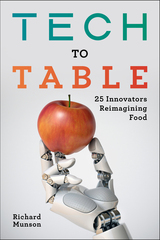
Tech to Table introduces readers to twenty-five of the most creative entrepreneurs advancing these solutions. They come from various places and professions, identities and backgrounds. But they share an outsider’s perspective and an idealistic, sometimes aggressive, ambition to rethink the food system.
Reinvention is desperately needed. Under Big Ag, pollution, climate change, animal cruelty, hunger, and obesity have festered, and despite decades of effort, organic farming accounts for less than one percent of US croplands. Entrepreneurs represent a new path, one where disruptive technology helps people and the environment. These innovations include supplements to lower the methane in cattle belches, drones that monitor irrigation levels in crops, urban warehouses that grow produce year-round, and more.
The pace and breadth of change is astonishing, as investors pump billions of dollars into ag-innovation. Startups are attracting capital and building markets, with the potential to upend conventional agribusiness’s stranglehold on the food system. Not every invention will prosper long-term, but each marks a fundamental change in our approach to feeding a growing population—sustainably.
A revolution in how we grow and eat food is brewing. Munson’s deftly crafted profiles offer a fascinating preview of the coming future of food.
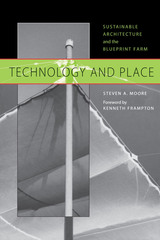
Developing "sustainable" architectural and agricultural technologies was the intent behind Blueprint Farm, an experimental agricultural project designed to benefit farm workers displaced by the industrialization of agriculture in the Rio Grande Valley of Texas. Yet, despite its promise, the very institutions that created Blueprint Farm terminated the project after just four years (1987-1991).
In this book, Steven Moore demonstrates how the various stakeholders' competing definitions of "sustainability," "technology," and "place" ultimately doomed Blueprint Farm. He reconstructs the conflicting interests and goals of the founders, including Jim Hightower and the Texas Department of Agriculture, Laredo Junior College, and the Center for Maximum Potential Building Systems, and shows how, ironically, they unwittingly suppressed the self-determination of the very farm workers the project sought to benefit. From the instructive failure of Blueprint Farm, Moore extracts eight principles for a regenerative architecture, which he calls his "nonmodern manifesto."
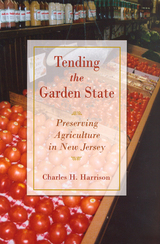
Early in the nineteenth century, an army colonel stood before a crowd at the Salem County Courthouse and ate buckets of tomatoes to prove that they were not poisonous. Ever since, the red vegetable of summer has played a starring role in New Jersey’s history. Although today visitors to the state are more likely to see smoke-spewing factories than acres of farmland or grazing cattle, the state’s legacy of agriculture and farming continues, and extends far beyond the popular Jersey tomato.
In Tending the Garden State, Charles Harrison tells the story of the state’s rich agricultural history from the time when Leni-Lenape Indians scratched the earth with primitive tools up through today. He recalls New Jersey’s rural past, traces the evolution of farming over the course of the twentieth century, and explains innovative approaches to protecting the industry.
Drawing on interviews with farmers, as well as researchers, professional planners, designers, and architects, Harrison discovers that despite the discouraging spread of suburban sprawl, the Garden State’s farming legacy is not as endangered as it may seem. Many residents care deeply about preserving New Jersey’s agricultural industry and are making great strides to keep the tradition alive for future generations. Some of these protective measures include new laws that encourage the conservation of land and research devoted to helping farmers make the most of their limited acreage. Innovative techniques such as high-tunnel farming, together with the growth of some very profitable farm specializations, such as turf grass, aquaculture, horticulture, and wine making, will enable farmers to remain active and successful in the state’s oldest industry.
Anyone interested in New Jersey’s history or, more broadly, in the history of American agriculture, will be delighted by Harrison’s engaging and readable account of farming in the Garden State.
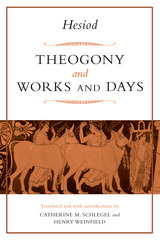
"This Schlegel-Weinfield translation of Hesiod is superbly crafted: compelling, unforgettable poetry to be read aloud with delight and gratitude."
—Allen Mandelbaum, Endowed Kenan Professor of Humanities, Wake Forest University
"This exciting and unique collaboration between a classical philologist and a poet will not just provide insight into archaic Greek society, but also offer something new: the opportunity to experience the richness of Hesiod's style, language, and modes of thought with remarkable fidelity to the ancient Greek. Weinfield and Schlegel make Hesiod sing."
—Carole Newlands, Classics Department, University of Wisconsin
"Schlegel and Weinfield have produced one of the most remarkable of a current resurgence of translations from the classics, allowing the modern world to hear a poet who may have known Homer. Hesiod’s song makes us understand why the Greeks thought a poet could draw dolphins through the seas or raise the walls of Thebes. Weinfield translates by ear and transfers what he hears to the page, resonant fourteeners, a worthy echo of the past."
Catherine Schlegel is Associate Professor of Classics, University of Notre Dame. Henry Weinfield is Professor and Chair of Liberal Studies, University of Notre Dame, and translator of The Collected Poems of Stephane Mallarme.
The work of A. V. Chayanov is today drawing more attention among Western scholars than ever before. Largely ignored in his native Russia because they differed from Marxist-Leninist theory, and neglected in the West for more than forty years, Chayanov’s sophisticated theories were at last published in English in 1966. That trenchant is reprinted in this Wisconsin paperback edition, which includes a new introduction by the sociologist Teodor Shanin, of the University of Manchester, one of the world’s leading Chayanov scholars. The Wisconsin edition will be essential reading for political scientists, anthropologists, and all whose interests include peasant studies, Third World development, and women’s studies.
"The past two decades have seen the emergence of a whole new field called 'peasant studies' and, along with those of Karl Marx, Chayanov's ideas have been central to its development. . . . The publishers are to be commended for re-issuing the book with both old and new introductions and making it available as an affordable paperback for students. The work is a classic."—Times Higher Education Supplement

To think through soil is to engage with some of the most critical issues of our time. In addition to its agricultural role in feeding eight billion people, soil has become the primary agent of carbon storage in global climate models, and it is crucial for biodiversity, flood control, and freshwater resources. Perhaps no other material is asked to do so much for the human environment, and yet our basic conceptual model of what soil is and how it works remains surprisingly vague.
In cities, soil occupies a blurry category whose boundaries are both empirically uncertain and politically contested. Soil functions as a nexus for environmental processes through which the planet’s most fundamental material transformations occur, but conjuring what it actually is serves as a useful exercise in reframing environmental thought, design thinking, and city and regional planning toward a healthier, more ethical, and more sustainable future.
Through a sustained analysis of the world’s largest wastewater agricultural system, located in the Mexico City–Mezquital hydrological region, Thinking Through Soil imagines what a better environmental future might look like in central Mexico. More broadly, this case study offers a new image of soil that captures its shifting identity, explains its profound importance to rural and urban life, and argues for its capacity to save our planet.

The world's montane forests are vitally important for conservation and water catchment. Because logging regimes have significant impacts on biodiversity as well as water quality and water quantity, the management of these forests has often been a major source of conflict amongst rural communities, government agencies, and conservationists. Although much information on ecologically sustainable managment practices is now available, further organizational change and policy tranformation is needed to see a transition to sustainable practices inplemented on the ground.
Towards Forest Sustainability contains practical essays by some of the world's leading forests ecologists and managers from the United States, Canada, Finland, Sweden, Australia, and New Zealand. The authors describe the changes that have taken place in forest management- highlighting what worked, what didn't, and the lessons that have been learned.
This unique collection of essays documents the drivers of the change in the logging industry and the resulting outcomes, both the good and the bad. The book provides real-world insights from an international perspective into government policy, industrial concerns, and conservation and biodiversity issues.
"The premise of mainstreaming gender is to bring equality concerns into every aspect of policy-making, and this brave book offers a close look at how feminists have taken up the challenge to transform the hidden dynamics of male domination in agricultural policy in Europe. In contrast to the automatic assumption that (neo)liberal policy always works against women’s interests, Prügl demonstrates the potential for feminist ju-jitsu to take advantage of multiple levels of governance to empower women in some circumstances. Although feminists were not always successful, the story of their efforts to remake agricultural policy should encourage activists to look for points of leverage in this and other contested and changing multilevel power systems."
---Myra Marx Ferree, University of Wisconsin
"Information on policy development, conflicts about improving the status of farm women, and using rural development policies to foster gender equality is hard to access in English and extremely useful for researchers concerned with the specifics of gender equality policy in the EU."
---Alison Woodward, Institute for European Studies, Vrije Universiteit Brussel
"This book is a must-read for scholars interested in the gendered process of global restructuring. Elisabeth Prügl succeeds superbly in teasing out the power politics involved in European agricultural policy. Through the lens of a feminist-constructivist approach, she makes visible the multiple mechanisms of gendered power within the state. This very lucid narrative is a milestone in a new generation of feminist theoretical scholarship."
---Brigitte Young, University of Muenster, Germany
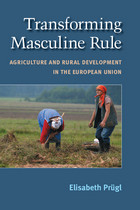
Taking West and East Germany as case studies, Elisabeth Prügl shows how European agricultural policy has cemented long-standing gender-based inequalities and how feminists have used liberalization as an opportunity to challenge such inequalities. Through a comparison of the EU’s rural development program known as LEADER as it played out in the Altmark region in the German East and in the Danube/Bavarian Forest region in the West, Prügl provides a close-up view of the power politics involved in government policies and programs.
In identifying mechanisms of power (refusal, co-optation, compromise, normalization, and silencing of difference), Prügl illustrates how these mechanisms operate in arguments over gender relations within the state. Her feminist-constructivist approach to global restructuring as a gendered process brings into view multiple levels of governance and the variety of gender constructions operating in different societies. Ultimately, Prügl offers a new understanding of patriarchy as diverse, contested, and in flux.
Jacket photograph: © iStockphoto.com/Wojtek Kryczka


With genetically modified crops we have entered uncharted territory—where visions of the triumph of biotechnology in agriculture vie with dire views of medical and environmental disaster. For two years Mark L. Winston traveled this fraught territory at home and abroad, listening to farmers, industry spokespeople, regulators, and researchers, canvassing high-security laboratories, environmentalist enclaves, and cyberspace, making a thorough survey of the facts, opinions, and practices deployed by opponents and proponents of transgenic crops.
Through his sympathetic portrayal of the passions on all sides, Winston brings a clear, unbiased perspective to this bewildering landscape. Traveling with Winston, we see the excitement and curiosity that pervade laboratories developing genetically modified crops, as well as the panic and outrage among dedicated opponents of agricultural biotechnology; the desperation of conventional farmers as they look to science for solutions to the problems driving them from their farms, as well as the deeply held values of organic farmers who dread the incursion of genetically modified crops into their expanding enterprise. And, Winston shows us, these contrasting attitudes transcend national borders, with troubling counterparts and consequences in the developing world.
As he seeks a middle ground where concerns about genetic engineering can be rationally discussed and resolved, Winston gives us, at long last, a full and balanced view of the forces at play in the chaotic debate over agricultural biotechnology.
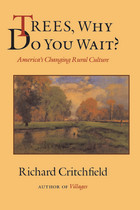
Richard Critchfield, author of the best-selling books Villages and An American Looks at Britain, examines the inescapable link between the decline of America's rural roots and the decay of our cities. Trees, Why Do You Wait? is a moving oral history chronicling the changes taking place in rural America. Through it, we meet real people of the heartland and feel the suffering and the strength in their relationship to the land.
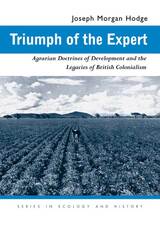
The most striking feature of British colonialism in the twentieth century was the confidence it expressed in the use of science and expertise, especially when joined with the new bureaucratic capacities of the state, to develop natural and human resources of the empire.
Triumph of the Expert is a history of British colonial doctrine and its contribution to the emergence of rural development and environmental policies in the late colonial and postcolonial period. Joseph Morgan Hodge examines the way that development as a framework of ideas and institutional practices emerged out of the strategic engagement between science and the state at the climax of the British Empire. Hodge looks intently at the structural constraints, bureaucratic fissures, and contradictory imperatives that beset and ultimately overwhelmed the late colonial development mission in sub-Saharan Africa, south and southeast Asia, and the Caribbean.
Triumph of the Expert seeks to understand the quandaries that led up to the important transformation in British imperial thought and practice and the intellectual and administrative legacies it left behind.
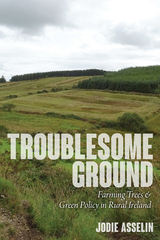
Through ethnographic description, Asselin illuminates how ephemeral worlds of green discourse and development plans manifest in rural areas, demonstrating the lived consequences of today’s competing demands on marginal regions. Troublesome Ground is a significant contribution to the anthropology of rural Ireland while offering insights into the wider realities of conflicting development and conservation strategies in global contemporary rural landscapes.
READERS
Browse our collection.
PUBLISHERS
See BiblioVault's publisher services.
STUDENT SERVICES
Files for college accessibility offices.
RECENTLY PUBLISHED






UChicago Accessibility Resources
home | accessibility | search | about | contact us
BiblioVault ® 2001 - 2026
The University of Chicago Press