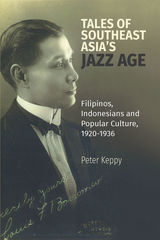
front cover of Tales of Southeast Asia’s Jazz Age
Tales of Southeast Asia’s Jazz Age
Filipinos, Indonesians and Popular Culture, 1920-1936
Peter Keppy
National University of Singapore Press, 2019
Luis Borromeo was the Philippines’s “King of Jazz,” who at the height of his popularity created a Filipino answer to the Ziegfeld Follies. Miss Riboet was a world-famous Javanese opera singer who ruled the theater world. While each represented a unique corner of the entertainment world, the rise and fall of these two superstar figures tell an important story of Southeast Asia’s 1920s Jazz Age.
This artistic era was marked by experimentation and adaption, and this was reflected in both Borromeo’s and Riboet’s styles. They were pioneering cultural brokers who dealt in hybrids. They were adept at combining high art and banal entertainment, tradition and modernity, and the foreign and the local.
Leaning on cultural studies and the work on cosmopolitanism and modernity by Henry Jenkins and Joel Kahn, Peter Keppy examines pop culture at this time as a contradictory social phenomenon. He challenges notions of Southeast Asia’s popular culture as lowbrow entertainment created by elites and commerce to manipulate the masses, arguing instead that audiences seized on this popular culture to channel emancipatory activities, to articulate social critique, and to propagate an inclusive nationalism without being radically anticolonial.
[more]

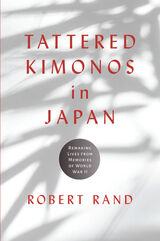
front cover of Tattered Kimonos in Japan
Tattered Kimonos in Japan
Remaking Lives from Memories of World War II
Robert Rand
University of Alabama Press, 2024
Examines Japan’s war generation—Japanese men and women who survived World War Two and rebuilt their lives, into the 21st century, from memories of that conflict
 
Since John Hersey’s Hiroshima—the classic account, published in 1946, of the aftermath of the atomic bombing of that city—very few books have examined the meaning and impact of World War II through the eyes of Japanese men and women who survived that conflict. Tattered Kimonos in Japan does just that: It is an intimate journey into contemporary Japan from the perspective of the generation of Japanese soldiers and civilians who survived World War II, by a writer whose American father and Japanese father-in-law fought on opposite sides of the conflict.

The author, a former NPR senior editor, is Jewish, and he approaches the subject with the sensibilities of having grown up in a community of Holocaust survivors. Mindful of the power of victimhood, memory, and shared suffering, he travels across Japan, including Hiroshima and Nagasaki, meeting a compelling group of men and women whose lives, even now, are defined by the trauma of war, and by lingering questions of responsibility and repentance for Japan’s wartime aggression.

The image of a tattered kimono from Hiroshima is the thread that drives the narrative arc of this emotional story about a writer’s encounter with history, inside the Japan of his father’s generation, on the other side of his father’s war. This is a book about history with elements of family memoir. It offers a fresh and truly unique perspective for readers interested in World War II, Japan, or Judaica; readers seeking cross-cultural journeys; and readers intrigued by Japanese culture, particularly the kimono.
 
[more]

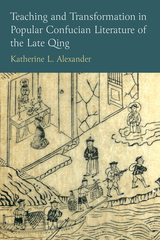
front cover of Teaching and Transformation in Popular Confucian Literature of the Late Qing
Teaching and Transformation in Popular Confucian Literature of the Late Qing
Katherine L. Alexander
University of Michigan Press, 2025
The Taiping Civil War (1851–1864) was one of the most destructive wars in Chinese history, with the death toll estimated between twenty and thirty million. What visions did survivors have for restoring their fractured society once the war ended? Katherine L. Alexander’s Teaching and Transformation in Popular Confucian Literature of the Late Qing approaches these questions through literature by examining the works of evangelical Confucian teacher Yu Zhi (1809-1874), who gave a voice to the zealous side of conservative Confucian reform efforts before, during, and after the Taiping War. His works offer radical visions of a world that could be restored through collective effort and goodness, while also revealing the shifting nature of power and the cracks in Qing society.

Yu’s works complicate the picture of socio-moral reform, particularly the Confucian mission of jiaohua (teaching and transformation). Though he viewed the disasters of the late Qing as the natural consequence of jiaohua’s failure to compete against socially disruptive media, such as vernacular fiction and theatrical productions, he also wanted reformers to engage closely with these genres. Yu became a vocal advocate of teaching with moral vernacular literature that he believed met commoners at their level. He emphasized the hope that by writing, printing, and performing such texts, every member of his audience could be transformed into teachers themselves, restoring society from the bottom up.
[more]

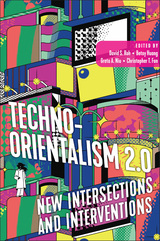
front cover of Techno-Orientalism 2.0
Techno-Orientalism 2.0
New Intersections and Interventions
David S. Roh
Rutgers University Press, 2025
Building on the groundbreaking Techno-Orientalism: Imagining Asia in Speculative Fiction, History, and Media, published by Rutgers University Press in 2015, Techno-Orientalism 2.0: New Intersections and Interventions addresses the impact of a volatile post-pandemic present on speculative futures by and about Asians. The backdrop of this highly anticipated follow-up is a world that is radically different than in 2015: COVID-19, threats of a “new cold war” with China, Russia’s invasion of Ukraine, and the reemergence of “strong man” politics around the world. An essential volume for this new critical juncture in Asian American history, Techno-Orientalism 2.0 catalogs intersectional dialogue with discourses such as Afrofuturism, Indigenous futurities, environmentalism, and disability studies. It also engages with recent high-profile and lesser-known works of Asian and Asian American speculative fiction, film, television, anime, art, music, journalism, architecture, state-sponsored policies and infrastructural projects, and the now-dominant China Panic.
 
[more]

front cover of Televising Chineseness
Televising Chineseness
Gender, Nation, and Subjectivity
Geng Song
University of Michigan Press, 2022
The serial narrative is one of the most robust and popular forms of storytelling in contemporary China. With a domestic audience of one billion-plus and growing transnational influence and accessibility, this form of storytelling is becoming the centerpiece of a fast-growing digital entertainment industry and a new symbol and carrier of China’s soft power. Televising Chineseness: Gender, Nation, and Subjectivity explores how television and online dramas imagine the Chinese nation and form postsocialist Chinese gendered subjects. The book addresses a conspicuous paradox in Chinese popular culture today: the coexistence of increasingly diverse gender presentations and conservative gender policing by the government, viewers, and society. Using first-hand data collected through interviews and focus group discussions with audiences comprising viewers of different ages, genders, and educational backgrounds, Televising Chineseness sheds light on how television culture relates to the power mechanisms and truth regimes that shape the understanding of gender and the construction of gendered subjects in postsocialist China.
[more]

logo for Duke University Press
Tension
Mental Distress and Embodied Inequality in the Western Himalayas
Nikita Kaur Simpson
Duke University Press, 2026
In Tension, Nikita Kaur Simpson examines the effects of rapid development in the Himalayas on the minds and bodies of the Gaddi people who inhabit them through attention to the multifaceted state of distress they call “tension.” This “tension” takes many forms: Kamzori, or weakness, in the bodies of elderly women; “Future tension” accumulating in the minds of young girls; or Opara, or black magic, afflicting whole families. Through her long-term ethnographic fieldwork, Simpson follows the ways in which Gaddi people tie this distress to broader structural changes, such as land dispossession and caste, class, tribal and gender inequality, which are growing alongside modernity and prosperity. In doing so, she shows how “tension” acts as an everyday diagnostic of the problems of cultural, economic and environmental change as they shape intimate life. At once a lived historical account, a cartography of care relations, and a multi-sensory exploration of the intimate experiences of atmosphere and body, Tension puts forth a novel theory of distress, that inequality is often determined by who is made to feel, hold, and absorb distress.
[more]

front cover of Territorial Natures
Territorial Natures
Imperial Japan and the Mongolian Question
Sakura Christmas
University of Chicago Press
A critical account of the Japanese occupation in Inner Mongolia.
 
Early in the twentieth century, the steppe borderlands between China and Mongolia erupted in violence. As imperial Japan expanded into this area, this crisis between nomadic and settler communities posed fundamental problems in governance. In response, Japanese and Mongol leaders together proposed a radical solution: Demarcating an autonomous region in Manchukuo for minority peoples, a new kind of political space that would later define the territorial structure of Communist China. 
 
In Territorial Natures, Sakura Christmas explores how the fraught partition of this autonomous region warped the ethnic and environmental boundaries of Manchukuo. She challenges its origin story as a socialist invention by the Chinese state, instead seeing it as also a fascist extension from the Japanese occupation. By reading Chinese and Mongolian sources against Japanese archives, Christmas reveals how this contested history seeded the volatile landscape of autonomous regions in the People’s Republic of China today.
 
[more]

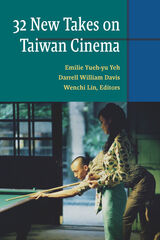
front cover of Thirty-two New Takes on Taiwan Cinema
Thirty-two New Takes on Taiwan Cinema
Emilie Yueh-yu Yeh, Darrell William Davis, Wenchi Lin, Editors
University of Michigan Press, 2022
Thirty-two New Takes on Taiwan Cinema covers thirty-two films from Taiwan, addressing a flowering of new talent, moving from art film to genre pictures, and nonfiction. Beyond the conventional framework of privileging “New and Post-New Cinema,” or prominence of auteurs or single films, this volume is a comprehensive, judicious take on Taiwan cinema that fills gaps in the literature, offers a renewed historiography, and introduces new creative force and voices of Taiwan’s moving image culture to produce a leading and accessible work on Taiwan film and culture.

Film-by-film is conceived as the main carrier of moving picture imagery for a majority of viewers, across the world. The curation offers an array of formal, historical, genre, sexual, social, and political frames, which provide a rich brew of contexts. This surfeit of meanings is carried by individual films, one by one, which breaks down abstractions into narrative bites and outsized emotions.
[more]

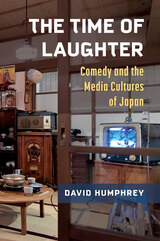
front cover of The Time of Laughter
The Time of Laughter
Comedy and the Media Cultures of Japan
David Humphrey
University of Michigan Press, 2023
From broadcast to social media, comedy plays a prominent role in Japan’s cultural landscape and political landscape. The Time of Laughter explores how comedy grew out of the early days of television to become a central force in shaping Japanese media over the past half-century. Comedy and its impact, David Humphrey argues, established a “time of laughter” in the media of the late twentieth and early twenty-first centuries in Japan. Through masterful interrogation of Japanese televisual archives and media discourse, Humphrey demonstrates that the unique temporality of laughter has had a profound role in the cultural atmosphere of Japan’s recent past. Laughter both complemented and absorbed the profound tensions and contradictions that emerged in Japanese television. Joyous and cacophonous, reaffirming and subverting, laughter simultaneously alienated and unified viewers. Through its exploration of the influence of comedy and the culture of laughter, The Time of Laughter presents a vibrant new take on Japan’s recent media history.
[more]

front cover of Touching the Unreachable
Touching the Unreachable
Writing, Skinship, Modern Japan
Fusako Innami
University of Michigan Press, 2021
Fusako Innami offers the first comprehensive study of touch and skinship—relationality with the other through the skin—in modern Japanese writing. The concept of the unreachable—that is, the lack of characters’ complete ability to touch what they try to reach for—provides a critical intervention on the issue of intimacy. Touch has been philosophically addressed in France, but literature is an effective—or possibly the most productive—venue for exploring touch in Japan, as literary texts depict what the characters may be concerned with but may not necessarily say out loud. Such a moment of capturing the gap between the felt and the said—the interaction between the body and language—can be effectively analyzed by paying attention to layers of verbalization, or indeed translation, by characters’ utterances, authors’ depictions, and readers’ interpretations. Each of the writers discussed in this book—starting with Nobel prize winner Kawabata Yasunari, Tanizaki Jun’ichirō, Yoshiyuki Junnosuke, and Matsuura Rieko—presents a particular obsession with objects or relationality to the other constructed via the desire for touch.

In Touching the Unreachable, phenomenological and psychoanalytical approaches are cross-culturally interrogated in engaging with literary touch to constantly challenge what may seem like the limit of transferability regarding concepts, words, and practices. The book thereby not only bridges cultural gaps beyond geographic and linguistic constraints, but also aims to decentralize a Eurocentric hegemony in its production and use of theories and brings Japanese cultural and literary analyses into further productive and stimulating intellectual dialogues. Through close readings of the authors’ treatment of touch, Innami develops a theoretical framework with which to examine intersensorial bodies interacting with objects and the environment through touch.
[more]

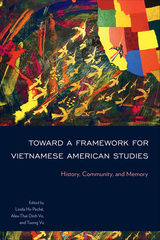
front cover of Toward a Framework for Vietnamese American Studies
Toward a Framework for Vietnamese American Studies
History, Community, and Memory
Edited by Linda Ho Peché, Alex-Thai Dinh Vo, and Tuong Vu
Temple University Press, 2023

The large number of Vietnamese refugees that resettled in the United States since the fall of Saigon have become America’s fastest growing immigrant group. Toward a Framework for Vietnamese American Studies traces the ideologies, networks, and cultural sensibilities that have long influenced and continue to transform social, political, and economic developments in Vietnam and the U.S.

Moving beyond existing approaches, the editors and contributors to this volume—the first to craft a working framework for researching, teaching, and learning about this dynamic community—present a new Vietnamese American historiography that began in South Vietnam. They provide deep-dive explorations into community development, political activism, civic participation and engagement, as well as entrepreneurial endeavors. Chapters offer new concepts and epistemological approaches to how legacy and memory is nurtured, produced and circulated in the Vietnamese diaspora.

Toward a Framework for Vietnamese American Studies seeks to better understand the rapidly changing landscape of Vietnamese American diaspora.

Contributors: Duyen Bui, Christian Collet, Wynn Gadkar-Wilcox, Elwing Suong Gonzalez, Tuan Hoang, Jennifer A. Huynh, Y Thien Nguyen, Nguyen Vu Hoang, Van Nguyen-Marshall, Thien-Huong Ninh, Hai-Dang Phan, Ivan V. Small, Quan Tue Tran, Thuy Vo Dang, and the editors
[more]

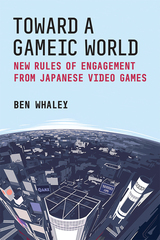
front cover of Toward a Gameic World
Toward a Gameic World
New Rules of Engagement from Japanese Video Games
Ben Whaley
University of Michigan Press, 2023
Toward a Gameic World bridges the gap between Japanese popular culture studies and game studies by encouraging a dialogue centered around Japanese-designed video games and social issues. It examines four contemporary Japanese video games in terms of how they engage with some of Japan’s biggest social and personal issues, including traumas: natural disasters (Disaster Report), a declining birthrate and aging population (Catherine), nuclear proliferation (Metal Gear Solid V); and youth social withdrawal (The World Ends with You). This book asks what some of the positive benefits are of working through a site of trauma from within a video game, and how games might teach us about Japanese culture and society through new kinds of interactive narratives, different from literature and film. The book proposes four new strategies of engagement with video games to explore the productive tensions that emerge at the boundaries of virtual reality, augmented reality, and gamification in contemporary Japan.
[more]

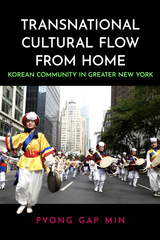
front cover of Transnational Cultural Flow from Home
Transnational Cultural Flow from Home
Korean Community in Greater New York
Pyong Gap Min
Rutgers University Press, 2023
When the first wave of post-1965 Korean immigrants arrived in the New York-New Jersey area in the early 1970s, they were reliant on retail and service businesses in the minority neighborhoods where they were. This caused ongoing conflicts with customers in black neighborhoods of New York City, with white suppliers at Hunts Point Produce Market, and with city government agencies that regulated small business activities. In addition, because of the times, Korean immigrants had very little contact with their homeland. Korean immigrants in the area were highly segregated from both the mainstream New York society and South Korea. However, after the 1990 Immigration Act, Korean immigrants with professional and managerial backgrounds have found occupations in the mainstream economy. Korean community leaders also engaged in active political campaigns to get Korean candidates elected as city council members and higher levels of legislative positions in the area. The Korean community's integration into mainstream society also increasingly developed stronger transnational ties to their homeland and spurred the inclusion of "everyday Korean life" in the NY-NJ area.

Transnational Cultural Flow from Home examines New York Korean immigrants’ collective efforts to preserve their cultural traditions and cultural practices and their efforts to transmit and promote them to New Yorkers by focusing on the Korean cultural elements such as language, foods, cultural festivals, and traditional and contemporary performing arts.

This publication was supported by the 2022 Korean Studies Grant Program of the Academy of Korean Studies (AKS-2022-P-009).

 
[more]

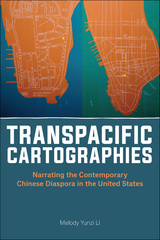
front cover of Transpacific Cartographies
Transpacific Cartographies
Narrating the Contemporary Chinese Diaspora in the United States
Melody Yunzi Li
Rutgers University Press, 2024
Transpacific Cartographies examines how contemporary Chinese diasporic narratives address the existential loss of home for immigrant communities at a time of global precarity and amid rising Sino-US tensions. Focusing on cultural productions of the Chinese diaspora from the 1990s to the present -- including novels by the Sinophone writers Yan Geling (The Criminal Lu Yanshi), Shi Yu (New York Lover), Chen Qian (Listen to the Caged Bird Sing), and Rong Rong (Notes of a Couple), as well as by the Anglophone writer Ha Jin (A Free LifeA Map of Betrayal), selected TV shows (Beijinger in New York; The Way We Were), and online literature -- Melody Yunzi Li argues that the characters in these stories create multilayered maps that transcend the territorial boundaries that make finding a home in a foreign land a seemingly impossible task. In doing so, these “maps” outline a transpacific landscape that reflects the psycho-geography of homemaking for diasporic communities. Intersecting with and bridging Sinophone studies, Chinese American studies, and diaspora studies and drawing on theories of literary cartography, Transpacific Cartographies demonstrates how these “maps” offer their readers different paths for finding a sense of home no matter where they are.
 
[more]

logo for University of Michigan Press
Transpacific Experiments
Intermedia Art and Music in 1960s Japan
Miki Kaneda
University of Michigan Press, 2026

Intermedia art—an avant-garde multimedia practice that combines sound and moving images–took root in Japan alongside other places in the 1960s. In Transpacific Experiments, Miki Kaneda analyzes intermedia as a practice that gives form to errant possibilities, unfolding in spaces of the everyday, to offer nuanced insights into the global flow of ideas, influence, and discourses of appropriation. The stories of intermedia art throughout the study offer feminist and transnational perspectives on experimental music and art that disorient existing narratives about the experimental and political in unexpected ways.

Transpacific Experiments contends that social, cultural, and political arrangements local to Japan had a greater influence on the transnational experimental music scene than previously acknowledged. Kaneda's perspective extends, exceeds, and at times unsettles frameworks for experimental practices, revealing the limitations of any single political or aesthetic lens.
[more]

logo for Duke University Press
Transpacific Nonencounters
Racial Disconnects Across Twentieth-Century Japan and Mexico
Andrea Mendoza
Duke University Press, 2026
In Transpacific Nonencounters, Andrea Mendoza works across the seemingly unconnected histories of race and nation in modern Mexico and Japan, showing the commonalities in the way race figures in their state and social formations through a method Mendoza calls the theory of nonencounter. Intellectual and cultural productions of racial knowledge were important for the formation of the modernizing Mexican and Japanese states at the beginning of the twentieth century and helped conceive the project of national modernity through ideologies that promoted multiracial and multiethnic belonging—mestizaje and Pan-Asian co-prosperity. Despite the diasporic, economic, and political points of contact that connected these states throughout the twentieth century, however, traditional Eurocentric comparative and area-based studies treat the formations and legacies of Mexican mestizo nationalism and Japanese imperialism as wholly unrelated phenomena. Transpacific Nonencounters proposes a theory of nonencounter to formulate the logic of disciplinary disconnection, offering a framework and hermeneutic for a transpacific account of how Japanese imperialism and Mexican mestizo settler nationalism structured and reinforced one another through the modern formations of race and racism.
[more]

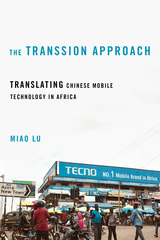
front cover of The Transsion Approach
The Transsion Approach
Translating Chinese Mobile Technology in Africa
Miao Lu
University of Illinois Press, 2025
How do we explain China’s tech rise in Africa? As Africa’s top phone seller, the Shenzhen-based company Transsion has profoundly shaped the continent’s digital transformation by providing affordable yet feature-rich mobile phones for the economically disadvantaged. Miao Lu draws on rich fieldwork in China and Ghana to delve into the company’s operations and growing influence. Critiquing technology transfer, Lu focuses on design, marketing, and repair to illustrate the multi-layered technology translations between China and Ghana. Borrowing the metaphor of deep ploughing, Lu examines the rural-centric and lower-class–oriented approach of translating mobile technology. Transsion challenges the cultural imagination of big tech. But the company is also evolving into a regional power that’s adept at marginalizing small players and increasing local dependence. Lu’s analysis explores the complexity that Shenzhen can act as Silicon Valley’s “South” and Africa’s “North” simultaneously. The middle space created by Transsion bridges globalization from above and below, which opens the door to new possibilities and inequalities.
[more]


Send via email Share on Facebook Share on Twitter