front cover of Campus Whisper Networks
Campus Whisper Networks
Knowing with Sexual Assault Survivors
Janet Hinson Shope
Rutgers University Press, 2026

Campus Whisper Networks examines how personal knowledge about student sexual assault circulates within college campus communities. Based upon both qualitative and quantitative survey data, Janet Hinson Shope and Richard Pringle's research demonstrates that students who have been sexually assaulted tell someone—almost always a friend. Most college students know someone who has been assaulted. Simply knowing, by means of relationships, that one or more peers have been assaulted affects the knowers, and the effects reverberate unevenly across campuses.  

Shope and Pringle highlight the structural properties that prohibit relational knowledge from becoming official institutional knowledge, confining it to whispers and secrecy within informal spheres of knowledge. The rules governing the circulation of such knowledge create an uneven epistemic field of sexual assault. This uneven field is consequential for the communities, affecting survivors and their confidants and shaping student views of the college community. Campus Whisper Networks demonstrates how personal and institutional avoidance, both the “need to not know” and “no need to know,” creates knowledge gaps that hide the community’s wounds and prevent personal knowledge from becoming social knowledge. 

[more]

logo for Intellect Books
Dancing across the Page
Narrative and Embodied Ways of Knowing
Karen Barbour
Intellect Books, 2011

An innovative exploration of understanding through dance, Dancing across the Page draws on the frameworks of phenomenology, feminism, and postmodernism to offer readers an understanding of performance studies that is grounded in personal narrative and lived experience. Through accounts of contemporary dance making, improvisation, and dance education, Karen Barbour explores a diversity of themes, including power; activism; and cultural, gendered, and personal identity. An intimate yet rigorous investigation of creativity in dance, Dancing across the Page emphasizes embodied knowledge and imagination as a basis for creative action in the world.
[more]

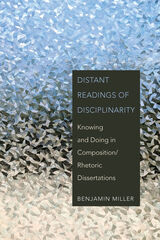
front cover of Distant Readings of Disciplinarity
Distant Readings of Disciplinarity
Knowing and Doing in Composition/Rhetoric Dissertations
by Benjamin Miller
Utah State University Press, 2022
In Distant Readings of Disciplinarity, Benjamin Miller brings a big data approach to the study of disciplinarity in rhetoric, composition, and writing studies (RCWS) by developing scalable maps of the methods and topics of several thousand RCWS dissertations from 2001 to 2015. Combining charts and figures with engaging and even playful prose, Miller offers an accessible model of how large-scale data-driven research can advance disciplinary understanding—both answering and amplifying the call to add replicable data analysis and visualization to the mix of methods regularly employed in the field.

Writing studies has long been marked by a multitude of methods and interlocking purposes, partaking of not just humanities approaches but also social scientific ones, with data drawn from interviews and surveys alongside historical and philosophical arguments and with corpus analytics in large-scale collections jostling against small-scale case studies of individuals. These areas of study aren’t always cleanly separable; shifting modes mark the discipline as open and welcoming to many different angles of research. The field needs to embrace that vantage point and generate new degrees of familiarity with methods beyond those of any individual scholar.
 
Not only a training genre and not only a knowledge-making genre, the dissertation is also a discipline-producing genre. Illustrating what the field has been studying, and how, Distant Readings of Disciplinarity supports more fruitful collaborations within and across research areas and methods.
 
[more]

logo for Intellect Books
Drawing as a Way of Knowing in Art and Science
Gemma Anderson
Intellect Books, 2017
In recent history, the arts and sciences have often been considered opposing fields of study, but a growing trend in drawing research is beginning to bridge this divide. Gemma Anderson’s Drawing as a Way of Knowing in Art and Science introduces tested ways in which drawing as a research practice can enhance morphological insight, specifically within the natural sciences, mathematics, and art.
 
Inspired and informed by collaboration with contemporary scientists and Goethe’s studies of morphology, as well as the work of artist Paul Klee, this book presents drawing as a means of developing and disseminating knowledge, and of understanding and engaging with the diversity of natural and theoretical forms, such as animal, vegetable, mineral, and four dimensional shapes. Anderson shows that drawing can offer a means of scientific discovery and can be integral to the creation of new knowledge in science as well as in the arts.
 
[more]

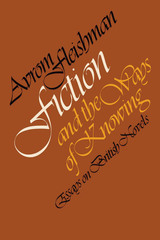
front cover of Fiction and the Ways of Knowing
Fiction and the Ways of Knowing
Essays on British Novels
By Avrom Fleishman
University of Texas Press, 1978

In this highly individual study, Avrom Fleishman explores a wide range of literary references to human culture—the culture of ideas, facts, and images. Each critical essay in Fiction and the Ways of Knowing takes up for sustained analysis a major British novel of the nineteenth or the twentieth century. The novels are analyzed in the light of social, historical, philosophical, and other perspectives that can be grouped under the human sciences.

The diversity of critical contexts in these thirteen essays is organized by Avrom Fleishman's governing belief in the interrelations of literature and other ways of interpreting the world. The underlying assumptions of this approach—as explained in his introductory essay—are that fiction is capable of encompassing even the most recondite facts and recalcitrant ideas; that fiction, though never a mirror of reality, is linked to realities and takes part in the real; and that a critical reading may be informed by scientific knowledge without reducing the literary work to a schematic formula.

Fleishman investigates the matters of fact and belief that make up the designated meanings, the intellectual contexts, and the speculative parallels in three types of novel. Some of the novels discussed make it clear that their authors are informed on matters beyond the nonspecialist's range; these essays help bridge this information gap. Other fictional works are only to be grasped in an awareness of the cultural lore tacitly distributed in their own time; a modern reader must make the effort to fathom their anachronisms. And other novels can be found to open passageways that their authors can only have glimpsed intuitively; these must be pursued with great caution but equal diligence.

The novels discussed include Little Dorrit, The Way We Live Now, Daniel Deronda, he Return of the Native, and The Magus. Also examined are Wuthering Heights, Vanity Fair, Northanger Abbey, To the Lighthouse, Under Western Eyes, Ulysses, and A Passage to India.
[more]

front cover of The Foundations of Knowing
The Foundations of Knowing
Roderick M. Chisholm
University of Minnesota Press, 1982

The Foundations of Knowing was first published in 1982. Minnesota Archive Editions uses digital technology to make long-unavailable books once again accessible, and are published unaltered from the original University of Minnesota Press editions.

This collection of essays on the foundations of empirical knowledge brings together ten of Roderick M. Chisholm's most important papers in epistemology, three of them published for the first time, the others significantly revised and expanded for this edition. The essays in Part I constitute a thoroughgoing defense of foundationalism—the doctrine that our justification for believing always rests upon a self-evident basis. In Part II, Chisholm applies foundationalist principles to various areas within the theory of knowledge, and in part III he presents a history of twentieth-century American epistemology.

"Roderick M. Chisholm's work has been most influential both in the development of epistemology and in the widespread application of his analytic method. I am sure this publication featuring the unification of his views will be of great value to those working on the central issues of philosophy." Hector-Neri Castañeda, Indiana University

Roderick Chisholm is Andrew W. Mellon Professor of the Humanities in the department of philosophy at Brown University. Among his books are Perceiving: A Philosophical Study, Theory of Knowledge, Person and Object,and The First Person (Minnesota, 1981).

[more]

front cover of Gender/Body/Knowledge
Gender/Body/Knowledge
Feminist Reconstructions of Being and Knowing
Jaggar, Alison M
Rutgers University Press, 1989
The essays in this interdisciplinary collection share the conviction that modern western paradigms of knowledge and reality are gender-biased. Some contributors challenge and revise western conceptions of the body as the domain of the biological and 'natural,' the enemy of reason, typically associated with women.
[more]

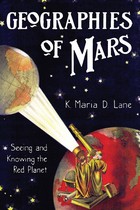
front cover of Geographies of Mars
Geographies of Mars
Seeing and Knowing the Red Planet
K. Maria D. Lane
University of Chicago Press, 2011

A highly original exploration of geography’s spatial dimensions at the beginning of the twentieth century, offering a new view of the mapping of far-off worlds.
One of the first maps of Mars, published by an Italian astronomer in 1877, with its pattern of canals, fueled belief in intelligent life forms on the distant red planet—a hope that continued into the 1960s. Although the Martian canals have long since been dismissed as a famous error in the history of science, K. Maria D. Lane argues that there was nothing accidental about these early interpretations. Indeed, she argues, the construction of Mars as an incomprehensibly complex and engineered world both reflected and challenged dominant geopolitical themes during a time of major cultural, intellectual, political, and economic transition in the Western world.

Geographies of Mars telescopes in on a critical period in the development of the geographical imagination, when European imperialism was at its zenith and American expansionism had begun in earnest. Astronomers working in the new observatories of the American Southwest or in the remote heights of the South American Andes were inspired, Lane finds, by their own physical surroundings and used representations of the Earth’s arid landscapes to establish credibility for their observations of Mars. With this simple shift to the geographer’s point of view, Lane deftly explains some of the most perplexing stances on Mars taken by familiar protagonists such as Percival Lowell, Alfred Russel Wallace, and Lester Frank Ward.

[more]

front cover of Intoxicated Ways of Knowing
Intoxicated Ways of Knowing
The Untold Story of Intoxicants and the Biological Subject in Nineteenth-Century Germany
Matthew Perkins-McVey
University of Chicago Press, 2026
Argues that intoxication was fundamental to German physiological, psychological, and psychiatric research during the nineteenth century.
 
Intoxicating substances can be found lurking in every corner of modern life, and Matthew Perkins-McVey’s pathbreaking book offers the untold story of how they were implicated in shifting perceptions of embodiment found in the emerging sciences of the body and mind in late-nineteenth-century Germany. Their use in this experimental context gave rise to a dynamic conception of the subject within the scientific, psychological, philosophical, and sociological milieu of the era. The history of the modern biological subject, Perkins-McVey argues, turns on “intoxicated ways of knowing.”
 
Intoxicated Ways of Knowing identifies the state of intoxication as a tacit form of thinking and knowing with the body. Intoxicants force us to feel, intervening directly in our perceptional awareness, and, Perkins-McVey contends, they bring latent conceptual associations into the foreground of conscious thought, engendering new ways of knowing the world. The book unfurls how intoxicants affected nineteenth-century German science and how, ultimately, the connection between mental life and intoxication is taken up in the works of Friedrich Nietzsche, Max Weber, and Sigmund Freud, bringing the biological subject out of the lab and into the worlds of philosophy, psychoanalysis, sociology, and politics.
[more]

front cover of Knowing an Empire
Knowing an Empire
Early Modern Chinese and Spanish Worlds in Dialogue
Edited by Mackenzie Cooley and Huiyi Wu
Lever Press, 2025
Knowing an Empire: Early Modern Chinese and Spanish Worlds in Dialogue unveils how these two vast empires, separated by thousands of miles, developed comparable systems to gather, order, and wield knowledge about their local worlds in the process of empire-building. From the sixteenth to the eighteenth centuries, officials in both empires compiled large quantities of structured data on the climate, topography, natural products, languages, religions, and more of their locales, creating a vision of their empires as diverse yet unified. Through a new methodology of “juxtapositional comparison,” the book reads the difangzhi 地方志 (local gazetteers) of China and the relaciones geográficas of the Spanish world in parallel. 

Knowing an Empire does not see the conveyance of information across an empire as a top-down process with an active center as a knowledge-maker. Instead, it amplifies a blend of voices that speak as much to imperial bureaucracy as to the rich local and Indigenous cultures, revealing these two early modern empires as diverse polities whose equilibria were constantly rebalanced among local powers. Comprised of 18 chapters, this edited collection reflects on the historical evolution and inner structures of the imperial epistemologies, as well as the many ways historians today read difangzhi and relaciones geográficas to understand the spatial, natural, and social order in both the Chinese and the Spanish empires. At once a comparative and a connected history, it places Chinese and Spanish imperial knowledge in the globalizing early modern world, highlighting the migration of people, goods, and ideas and revealing how these wide-ranging influences are reflected—or not—in the difangzhi and the relaciones. The book concludes by broadening our scope beyond China and Spain to reflect how other early modern empires, such as the Portuguese, failed to develop such systematized imperial genres. 

With contributions from leading scholars across Latin American and Asian Studies, this book synthesizes political, environmental, and socio-economic history with historical anthropology to highlight parallel governance and knowledge structures. The contributors challenge conventional binaries of Western versus Eastern, and colonial versus non-colonial, presenting a nuanced perspective of early modern empires as dynamic, interconnected entities through the shared challenges of scale, diversity, and increasing globalization. Through these dialogues, Knowing an Empire illuminates the complex entanglement of ruling and understanding. This groundbreaking collection offers a highly innovative and dialogic approach to comparative studies of empires, with major implications for Asian, European, Latin American, transnational, and global history.
 
[more]

front cover of Knowing and Being
Knowing and Being
Michael Polanyi
University of Chicago Press, 1973
Because of the difficulty posed by the contrast between the search for truth and truth itself, Michael Polanyi believes that we must alter the foundation of epistemology to include as essential to the very nature of mind, the kind of groping that constitutes the recognition of a problem.

This collection of essays, assembled by Marjorie Grene, exemplifies the development of Polanyi's theory of knowledge which was first presented in Science, Faith, and Society and later systematized in Personal Knowledge.
 
Polanyi believes that the dilemma of the modern mind arises from the peculiar relation between the positivist claim for total objectivity in scientific knowledge and the unprecedented moral dynamism characterizing the social and political aspirations of the last century. The first part of Knowing and Being deals with this theme. Part two develops Polanyi's idea that centralization is incompatible with the life of science as well as his views on the role of tradition and authority in science. The essays on tacit knowing in Part Three proceed directly from his preoccupation with the nature of scientific discovery and reveal a pervasive substructure of all intelligent behavior. Polanyi believes that all knowing involves movement from internal clues to external evidence. Therefore, to explain the process of knowing, we must develop a theory of the nature of living things in general, including an account of that aspect of living things we call "mind." Part Four elaborates upon this theme.

[more]

front cover of Knowing as Moving
Knowing as Moving
Perception, Memory, and Place
Susan Leigh Foster
Duke University Press, 2025
In Knowing as Moving, Susan Leigh Foster theorizes how the act of moving in and through the world creates the potential for individual and collective bodies to connect. Starting from the assertion that knowing takes place through bodily movement, Foster moves away from the Western philosophical traditions of dance, critiquing the Cartesian mind-body duality and its colonizing politics. She draws on Native and Indigenous studies, ecological cognitive science, disability studies, phenomenology, and new materialism to explore how knowledge is neither static nor storable. Thinking is a physical action and the product of an entire neuromuscular system with its mobile postural and gestural configurations, perceptual systems, and brain activity. Foster outlines how reading, examining, talking, and remembering are all forms of moving and contends that any process of knowing establishes one’s identity and relationality. By focusing on the centrality of bodily movement to thought and self, she contributes a decolonial critique of the study of knowledge and being. In so doing, Foster replaces the Cartesian-colonial “I think, therefore I am” with a decolonial “I move, and therefore I know.”
[more]

front cover of Knowing
Knowing
New and Selected Poems
Jonathan Holden
University of Arkansas Press, 2000
These poems are the best poems from Jonathan Holden's first seven books, four of which have won significant national competitions: Design for a House (The Devins Award, 1972), Leverage (The AWP Award Series, 1982), The Names of the Rapids (The Juniper Prize, 1985), and The Sublime (The Vassar Miller Prize, 1995). Holden's command of language is staggering, and his range of subjects is extensive. He writes about sex, mathematics, nationalism, propaganda, baseball, and blackmail with an emotional honesty that pushes his observations in surprising directions that the reader can never anticipate. These poems have a sustained leanness and concentrated power. Holden is a craftsman whose poems carry one along with the vigor and the inevitability of rapids and the illumination of chain lightning. His dramatic lyrics, like those of the late Richard Hugo, evoke a quality of light in the studied landscapes whose common denominator is solitude but where, through art, beauty and the heartening sense of human community can coexist.
[more]

front cover of Knowing, Seeing, Being
Knowing, Seeing, Being
Jonathan Edwards, Emily Dickinson, Marianne Moore, and the American Typological Tradition
Jennifer L. Leader
University of Massachusetts Press, 2016

Scholars no longer see Jonathan Edwards as the fire-and-brimstone preacher who deemed his parishioners “sinners in the hands of an angry god.” Edwards now figures as caring and socially conscious and exerts increased influence as a philosopher of the American school of Protestantism. In this study, he becomes the progenitor of an alternative tradition in American letters.

In Knowing, Seeing, Being, Jennifer L. Leader argues that Edwards, the nineteenth-century poet Emily Dickinson, and the twentieth-century poet Marianne Moore share a heretofore underrecognized set of religious and philosophical preoccupations. She contends that they represent an alternative tradition within American literature, one that differs from Transcendentalism and is grounded in Reformed Protestantism and its ways of reading and interpreting the King James Bible and the natural world. According to Leader, these three writers' most significant commonality is the Protestant tradition of typology, a rigorous mode of interpreting scripture and nature through which certain figures or phenomena are read as the fulfillment of prophecy and of God's work. Following from their similar ways of reading, they also share philosophical and spiritual questions about language, epistemology (knowing), perception (seeing), and physical and spiritual ontology (being). In connecting Edwards to these two poets, in exploring each writer's typological imagination, and through a series of insightful readings, this innovative book reevaluates three major figures in American intellectual and literary history and compels a reconsideration of these writers and their legacies.

[more]

front cover of Knowing the Day, Knowing the World
Knowing the Day, Knowing the World
Engaging Amerindian Thought in Public Archaeology
Lesley Green and David R. Green
University of Arizona Press, 2013
Based on more than a decade of research in Palikur lands known as Arukwa in the state of Amapá, Brazil, Knowing the Day, Knowing the World reconsiders the dialogue between formal scholarship and Amerindian ways of knowing. Beginning and ending with a public archaeology project in the region, the book engages head-on with Amerindian ways of thinking about space, time, and personhood. Demonstrating that Palikur knowledges are based on movement and a careful theorization of what it means to be present in a place, the book makes a sustained case for engaging with different ways of knowing. It shows how this kind of research can generate rich dialogues about nature, reality, and the ethical production of knowledge.
 
The structure of the book reflects a gradual comprehension of Palikur ways of knowing during the course of field research. The text enters into the ethnographic material from the perspective of familiar disciplines—history, geography, astronomy, geometry, and philosophy—and explores the junctures in which conventional disciplinary frameworks cannot adequately convey Palikur understandings. Beginning with reflections on questions of personhood, ethics, and ethnicity, the authors rethink assumptions about history and geography. They learn and recount an alternative way of thinking about astronomy from the Palikur astronomical narratives, and they show how topological concepts embedded in everyday Palikur speech extend to different ways of conceptualizing landscape. In conclusion, they reflect on the challenges of comprehending alternative cosmologies and consider the insights that come from allowing ethnographic material to pose questions of modernist frameworks.
[more]

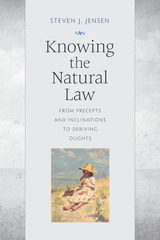
front cover of Knowing the Natural Law
Knowing the Natural Law
Steven Jensen
Catholic University of America Press, 2015
Knowing the Natural Law traces the thought of Aquinas from an understanding of human nature to a knowledge of the human good, from there to an account of ought-statements, and finally to choice, which issues in human actions. The much discussed article on the precepts of the natural law (I-II, 94, 2) provides the framework for a natural law rooted in human nature and in speculative knowledge. Practical knowledge is itself threefold: potentially practical knowledge, virtually practical knowledge, and fully practical knowledge.
[more]

front cover of Knowing the Suffering of Others
Knowing the Suffering of Others
Legal Perspectives on Pain and Its Meanings
Austin Sarat
University of Alabama Press, 2014
In Knowing the Suffering of Others, legal scholar Austin Sarat brings together essays that address suffering as it relates to the law, highlighting the ways law imagines suffering and how pain and suffering become jurisprudential facts.

From fetal imaging to end-of-life decisions, torts to international human rights, domestic violence to torture, and the law of war to victim impact statements, the law is awash in epistemological and ethical problems associated with knowing and imagining suffering. In each of these domains we might ask: How well do legal actors perceive and understand suffering in such varied domains of legal life? What problems of representation and interpretation bedevil efforts to grasp the suffering of others? What historical, political, literary, cultural, and/or theological resources can legal actors and citizens draw on to understand the suffering of others?

In Knowing the Suffering of Others, Austin Sarat presents legal scholarship that explores these questions and puts the problem of suffering at the center of thinking about law. The contributors to this volume do not regard pain and suffering as objective facts of a universe remote from law; rather they examine how both are discursively constructed in and by law. They examine how pain and suffering help construct and give meaning to the law as we know it. The authors attend to the various ways suffering appears in law as well as the different forms of suffering that require the law’s attention.

Throughout this book law is regarded as a domain in which the meanings of pain and suffering are contested, and constituted, as well as an instrument for inflicting suffering or for providing or refusing its relief. It challenges scholars, lawyers, students, and policymakers to ask how various legal actors and audiences understand the suffering of others.

Contributors
Montré D. Carodine / Cathy Caruth / Alan L. Durham / Bryan K.Fair / Steven H. Hobbs / Gregory C. Keating
/ Linda Ross Meyer / Meredith M. Render / Jeannie Suk / John Fabian Witt
[more]

front cover of Knowledge and Knowing in Media and Film Studies
Knowledge and Knowing in Media and Film Studies
Steve Connolly
University College London, 2025
Are media and film studies truly new subjects? Steve Connolly uncovers their deep disciplinary roots and evaluates how knowledge is constructed and taught in the classroom.

The nature of knowledge in the curriculum is well-defined for traditional subjects like History and Science, but for newer disciplines like Media and Film Studies, the boundaries are far less clear. Knowledge and Knowing in Media and Film Studies is the first book to explore this question in depth, tracing the epistemological foundations of these subjects and their place in the English school curriculum.

Steve Connolly argues that while both Media and Film Studies have distinct intellectual traditions, their inclusion of craft skills alongside theoretical and factual knowledge has shaped a different set of criteria for what counts as valuable knowledge. Consisting of historical sources and interviews with teachers, this work goes against the assumption that these are novel subjects and shows their deep parallels with more established fields. Essential reading for educators and researchers, the book provides a necessary framework for understanding how knowledge in these disciplines is taught and legitimized in schools today.
 
[more]

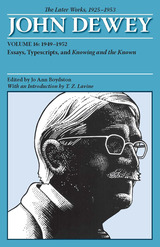
front cover of The Later Works of John Dewey, Volume 16, 1925 - 1953
The Later Works of John Dewey, Volume 16, 1925 - 1953
1949 - 1952, Essays, Typescripts, and Knowing and the Known
John Dewey. Edited by Jo Ann Boydston
Southern Illinois University Press, 2008

Typescripts, essays, and an authoritative edition of Knowing and the Known, Dewey’s collaborative work with Arthur F. Bentley.

In an illuminating Introduction T. Z. Lavine defines the collaboration's three goals—the "construction of a new language for behavioral inquiry," "a critique of formal logicians, in defense of Dewey’s Logic," and "a critique of logical positivism." In Dewey’s words: "Largely due to Bentley, I’ve finally got the nerve inside of me to do what I should have done years ago."

"What Is It to Be a Linguistic Sign or Name?" and "Values, Valuations, and Social Facts,’ both written in 1945, are published here for the first time.

[more]

logo for University of Chicago Press
Learning and Teaching the Ways of Knowing
Edited by Elliot Eisner
University of Chicago Press, 1985

front cover of Modelwork
Modelwork
The Material Culture of Making and Knowing
Martin Brückner
University of Minnesota Press, 2021

How making models allows us to recall what was and to discover what still might be 

Whether looking inward to the intricacies of human anatomy or outward to the furthest recesses of the universe, expanding the boundaries of human inquiry depends to a surprisingly large degree on the making of models. In this wide-ranging volume, scholars from diverse fields examine the interrelationships between a model’s material foundations and the otherwise invisible things it gestures toward, underscoring the pivotal role of models in understanding and shaping the world around us. Whether in the form of reproductions, interpretive processes, or constitutive tools, models may bridge the gap between the tangible and the abstract.

By focusing on the material aspects of models, including the digital ones that would seem to displace their analogue forebears, these insightful essays ground modeling as a tactile and emphatically humanistic endeavor. With contributions from scholars in the history of science and technology, visual studies, musicology, literary studies, and material culture, this book demonstrates that models serve as invaluable tools across every field of cultural development, both historically and in the present day.

Modelwork is unique in calling attention to modeling’s duality, a dynamic exchange between imagination and matter. This singular publication shows us how models shape our ability to ascertain the surrounding world and to find new ways to transform it. 

Contributors: Hilary Bryon, Virginia Tech; Johanna Drucker, UCLA; Seher Erdoğan Ford, Temple U; Peter Galison, Harvard U; Lisa Gitelman, New York U; Reed Gochberg, Harvard U; Catherine Newman Howe, Williams College; Christopher J. Lukasik, Purdue U; Martin Scherzinger, New York U; Juliet S. Sperling, U of Washington; Annabel Jane Wharton, Duke U.

[more]

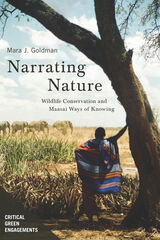
front cover of Narrating Nature
Narrating Nature
Wildlife Conservation and Maasai Ways of Knowing
Mara J. Goldman
University of Arizona Press, 2020
The current environmental crises demand that we revisit dominant approaches for understanding nature-society relations. Narrating Nature brings together various ways of knowing nature from differently situated Maasai and conservation practitioners and scientists into lively debate. It speaks to the growing movement within the academy and beyond on decolonizing knowledge about and relationships with nature, and debates within the social sciences on how to work across epistemologies and ontologies. It also speaks to a growing need within conservation studies to find ways to manage nature with people.

This book employs different storytelling practices, including a traditional Maasai oral meeting—the enkiguena—to decenter conventional scientific ways of communicating about, knowing, and managing nature. Author Mara J. Goldman draws on more than two decades of deep ethnographic and ecological engagements in the semi-arid rangelands of East Africa—in landscapes inhabited by pastoral and agropastoral Maasai people and heavily utilized by wildlife. These iconic landscapes have continuously been subjected to boundary drawing practices by outsiders, separating out places for people (villages) from places for nature (protected areas). Narrating Nature follows the resulting boundary crossings that regularly occur—of people, wildlife, and knowledge—to expose them not as transgressions but as opportunities to complicate the categories themselves and create ontological openings for knowing and being with nature otherwise.

Narrating Nature opens up dialogue that counters traditional conservation narratives by providing space for local Maasai inhabitants to share their ways of knowing and being with nature. It moves beyond standard community conservation narratives that see local people as beneficiaries or contributors to conservation, to demonstrate how they are essential knowledgeable members of the conservation landscape itself.

[more]

front cover of Now through a Glass Darkly
Now through a Glass Darkly
Specular Images of Being and Knowing from Virgil to Chaucer
Edward Peter Nolan
University of Michigan Press, 1991
In this series of interrelated essays, treating Ovil, Virgil, St. Augustine, Henrich von Morungen, Chretien de Troyes, Dante, Langland, and Chaucer, the author explores the ways in which medieval authors and their Roman predecessors used the image of the mirror both as instrument and metaphor. The essays individually provide fresh insights into the texts and issues discussed and, taken together, provide new perspectives on medieval culture and the ways it anticipated problems that plague our own.
 
Now through a Glass Darkly brings both traditional medievalist and postmodernist approaches to bear in its attempt to understand both the powers and the limits of verbal art. Nolan explores the ways medieval writers and their Roman predecessors used formal and thematic mirrors to examine the implications of alterity in the face of similarity, arguing that these preoccupations were as central to the medieval sensibility as they are to our own. Now through a Glass Darkly frames several of the key issues in the current debate over the continued viability (or not) of the inherited canon of Western culture, such as the question whether there is any meaning at all to be rescued from such notions as “coherence” or “tradition” in Western literature.
 
Now through a Glass Darkly will appeal to the educated generalist interested in the relationships between literature and its surrounding intellectual and cultural contexts as well as to those more specifically interested in medieval poetry and poetics. For medievalists and those who work at the intersection of critical theory and medieval literature, Now through a Glass Darkly will be of critical importance.
 
[more]

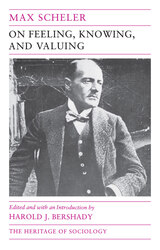
front cover of On Feeling, Knowing, and Valuing
On Feeling, Knowing, and Valuing
Selected Writings
Max Scheler
University of Chicago Press, 1992
One of the pioneers of modern sociology, Max Scheler (1874-
1928) ranks with Max Weber, Edmund Husserl, and Ernst
Troeltsch as being among the most brilliant minds of his
generation. Yet Scheler is now known chiefly for his
philosophy of religion, despite his groundbreaking work in
the sociology of knowledge, the sociology of emotions, and
phenomenological sociology. This volume comprises some of
Scheler's most interesting work—including an analysis of the
role of sentiments in social interaction, a sociology of
knowledge rooted in global social and cultural comparisons,
and a cross-cultural theory of values—and identifies some of
his important contributions to the discussion of issues at
the forefront of the social sciences today.

Editor Harold J. Bershady provides a richly detailed
biographical portrait of Scheler, as well as an incisive
analysis of how his work extends and integrates problems of
theory and method addressed by Durkheim, Weber, and Parsons,
among others.

Harold J. Bershady, professor of sociology at the University
of Pennsylvania, is the author of Ideology and Social
Knowledge and the editor of Social Class and
Democratic Leadership.

Heritage of Sociology series
[more]

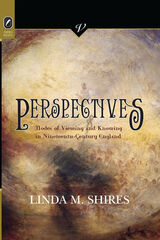
front cover of Perspectives
Perspectives
Modes of Viewing and Knowing in Nineteenth-Century England
Linda M. Shires
The Ohio State University Press, 2009
Perspectives: Modes of Viewing and Knowing in Nineteenth-Century England reopens the question of classical perspective and its vicissitudes in aesthetic practice with a focus on texts of the 1830s to the end of the 1870s. Linda M. Shires demonstrates why and how artists and writers across media experimented with techniques of dissolution, combination, and multiple viewpoints much earlier in the century than intellectual historians generally assume.
 
Arguing for a relationship between what she calls the disappearing “I” in poetry, a compromised omniscience, and the testing of a mastering eye in painting and photography, Shires argues that art forms themselves, rather than new technologies alone, reshaped the period by educating readers and viewers into new ways of knowing. In chapters on visual and verbal art and a waning theocentrism; D.G. Rossetti; Henry Peach Robinson and Lady Clementina Hawarden; and Robert Browning, Wilkie Collins, and George Eliot, Shires revitalizes the currently available scholarship on connections among nineteenth-century art forms.
 
This interdisciplinary study offers nuanced, close readings in order to rebut assertions of delayed artistic responses to the decreasing influence of traditional perspective. It shows how vision is bound up with all the senses of a viewer and it supports current concepts of modernism as transitional, rather than radical.
 
 
[more]

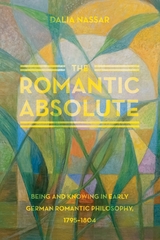
front cover of The Romantic Absolute
The Romantic Absolute
Being and Knowing in Early German Romantic Philosophy, 1795-1804
Dalia Nassar
University of Chicago Press, 2013
The absolute was one of the most significant philosophical concepts in the early nineteenth century, particularly for the German romantics. Its exact meaning and its role within philosophical romanticism remain, however, a highly contested topic among contemporary scholars.  In The Romantic Absolute, Dalia Nassar offers an illuminating new assessment of the romantics and their understanding of the absolute. In doing so, she fills an important gap in the history of philosophy, especially with respect to the crucial period between Kant and Hegel.
            
Scholars today interpret philosophical romanticism along two competing lines: one emphasizes the romantics’ concern with epistemology, the other their concern with metaphysics. Through careful textual analysis and systematic reconstruction of the work of three major romantics—Novalis, Friedrich Schlegel, and Friedrich Schelling—Nassar shows that neither interpretation is fully satisfying. Rather, she argues, one needs to approach the absolute from both perspectives. Rescuing these philosophers from frequent misunderstanding, and even dismissal, she articulates not only a new angle on the philosophical foundations of romanticism but on the meaning and significance of the notion of the absolute itself.
[more]

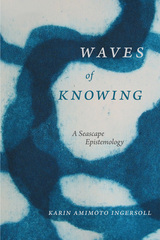
front cover of Waves of Knowing
Waves of Knowing
A Seascape Epistemology
Karin Amimoto Ingersoll
Duke University Press, 2016
In Waves of Knowing Karin Amimoto Ingersoll marks a critical turn away from land-based geographies to center the ocean as place. Developing the concept of seascape epistemology, she articulates an indigenous Hawaiian way of knowing founded on a sensorial, intellectual, and embodied literacy of the ocean. As the source from which Kānaka Maoli (Native Hawaiians) draw their essence and identity, the sea is foundational to Kanaka epistemology and ontology. Analyzing oral histories, chants, artwork, poetry, and her experience as a surfer, Ingersoll shows how this connection to the sea has been crucial to resisting two centuries of colonialism, militarism, and tourism. In today's neocolonial context—where continued occupation and surf tourism marginalize indigenous Hawaiians—seascape epistemology as expressed by traditional cultural practices such as surfing, fishing, and navigating provides the tools for generating an alternative indigenous politics and ethics. In relocating Hawaiian identity back to the waves, currents, winds, and clouds, Ingersoll presents a theoretical alternative to land-centric viewpoints that still dominate studies of place-making and indigenous epistemology.
[more]

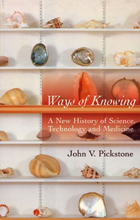
front cover of Ways of Knowing
Ways of Knowing
A New History of Science, Technology, and Medicine
John V. Pickstone
University of Chicago Press, 2001
In Ways of Knowing, John V. Pickstone provides a new and accessible framework for understanding science, technology, and medicine (STM) in the West from the Renaissance to the present. Pickstone's approach has four key features. First, he synthesizes the long-term histories and philosophies of disciplines that are normally studied separately. Second, he dissects STM into specific ways of knowing—natural history, analysis, and experimentalism—with separate but interlinked elements. Third, he explores these ways of knowing as forms of work related to our various technologies for making, mending, and destroying. And finally, he relates scientific and technical knowledges to popular understandings and to politics.

Covering an incredibly wide range of subjects, from minerals and machines to patients and pharmaceuticals, and from experimental physics to genetic engineering, Pickstone's Ways of Knowing challenges the reader to reexamine traditional conceptualizations of the history, philosophy, and social studies of science, technology, and medicine.
[more]

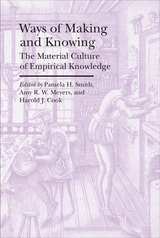
front cover of Ways of Making and Knowing
Ways of Making and Knowing
The Material Culture of Empirical Knowledge
Edited by Pamela H. Smith, Amy R. W. Meyers, and Harold J. Cook
Bard Graduate Center, 2017
Although craftspeople and artists often work with natural materials, the notion that making art can constitute a means of knowing nature is a novel one. This book, with contributions from historians of science, medicine, art, and material culture, shows that the histories of science and art are not simply histories of concepts or styles, but histories of the making and using of objects to understand the world. An examination of material practices makes it clear that the methods of the artisan represent a process of knowledge making that involves extensive experimentation and observation that parallel similar processes in the sciences. Ways of Making and Knowing offers a comprehensive and interdisciplinary history of the ways in which human beings have sought out, discovered, and preserved their own knowledge of the world around them; it has only been through material and human interaction with (and manipulation of) nature that we have come to understand it.
[more]

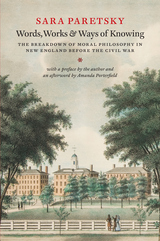
front cover of Words, Works, and Ways of Knowing
Words, Works, and Ways of Knowing
The Breakdown of Moral Philosophy in New England before the Civil War
Sara Paretsky
University of Chicago Press, 2016
Crime writer Sara Paretsky is known the world over for her acclaimed series of mysteries starring Chicago private investigator V. I. Warshawski, now in its seventeenth installment. Paretsky’s work has long been inflected with history—for her characters the past looms large in the present—and in her decades-long career, she has been recognized for transforming the role of women in contemporary crime fiction.
What’s less well-known is that before Paretsky began her writing career, she earned a PhD in history from the University of Chicago with a dissertation on moral philosophy and religion in New England in the early and mid-nineteenth century. Now, for the first time, fans of Paretsky can read that earliest work, Words, Works, and Ways of Knowing.

Paretsky here analyzes attempts by theologians at Andover Seminary, near Boston, to square and secure Calvinist religious beliefs with emerging knowledge from history and the sciences. She carefully shows how the open-minded scholasticism of these theologians paradoxically led to the weakening of their intellectual credibility as conventional religious belief structures became discredited, and how this failure then incited reactionary forces within Calvinism. That conflict between science and religion in the American past is of interest on its face, but it also sheds light on contemporary intellectual battles.

Rounding out the book, leading religious scholar Amanda Porterfield provides an afterword discussing where Paretsky’s work fits into the contemporary study of religion. And in a sobering—sometimes shocking—preface, Paretsky paints a picture of what it was like to be a female graduate student at the University of Chicago in the 1970s. A treat for Paretsky’s many fans, this book offers a glimpse of the development of the mind behind the mysteries.
[more]


Send via email Share on Facebook Share on Twitter