
 A SCHOLARLY BOOK REPOSITORY
5 start with T start with T
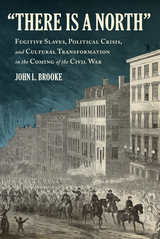
How does political change take hold? In the 1850s, politicians and abolitionists despaired, complaining that the "North, the poor timid, mercenary, driveling North" offered no forceful opposition to the power of the slaveholding South. And yet, as John L. Brooke proves, the North did change. Inspired by brave fugitives who escaped slavery and the cultural craze that was Uncle Tom's Cabin, the North rose up to battle slavery, ultimately waging the bloody Civil War.
While Lincoln's alleged quip about the little woman who started the big war has been oft-repeated, scholars have not fully explained the dynamics between politics and culture in the decades leading up to 1861. Rather than simply viewing the events of the 1850s through the lens of party politics, “There Is a North” is the first book to explore how cultural action—including minstrelsy, theater, and popular literature—transformed public opinion and political structures. Taking the North's rallying cry as his title, Brooke shows how the course of history was forever changed.
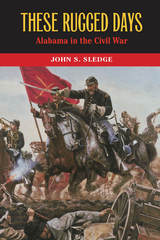
Alabama’s Civil War story—told with grit, grace, and truth.
In These Rugged Days: Alabama in the Civil War, John S. Sledge offers a riveting and readable account of Alabama’s Civil War saga. Focused on the conflict’s turning points within the state’s borders, Sledge recounts residents’ experiences from secession’s early days to its tumultuous collapse, when 75,000 blue-coated soldiers were on the move statewide. Sledge brings these tumultuous years to life in an impressive array of primary and secondary sources, including official records, diaries, newspapers, memoirs, correspondence, sketches, and photographs. He also highlights such colorful personalities as John Pelham, the youthful Jacksonville artillerist who was shipped home in an iron casket with a glass faceplate; Gus Askew, a nine-year-old Barbour County slave who vividly recalled the day the Yankees marched in; Augusta Jane Evans, the Mobile novelist who was given a gold pen by a daring blockade runner; and Emma Sansom, a plucky Gadsden teenager who acted as a scout and guide to Nathan Bedford Forrest.
These Rugged Days is an enthralling tale of action, courage, pride, and tragedy. The Civil War has left indelible marks on Alabama’s land, culture, economy, and people, and Sledge offers a refreshing take on the state's role in the conflict. His narrative is a dramatic account that will be enjoyed by lay readers as well as students and scholars of Alabama and the Civil War.
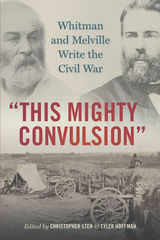
This is the first book exclusively devoted to the Civil War writings of Walt Whitman and Herman Melville, arguably the most important poets of the war. The essays brought together in this volume add significantly to recent critical appreciation of the skill and sophistication of these poets; growing recognition of the complexity of their views of the war; and heightened appreciation for the anxieties they harbored about its aftermath. Both in the ways they come together and seem mutually influenced, and in the ways they disagree, Whitman and Melville grapple with the casualties, complications, and anxieties of the war while highlighting its irresolution. This collection makes clear that rather than simply and straightforwardly memorializing the events of the war, the poetry of Whitman and Melville weighs carefully all sorts of vexing questions and considerations, even as it engages a cultural politics that is never pat.
Contributors: Kyle Barton, Peter Bellis, Adam Bradford, Jonathan A. Cook, Ian Faith, Ed Folsom, Timothy Marr, Cody Marrs, Christopher Ohge, Vanessa Steinroetter, Sarah L. Thwaites, Brian Yothers
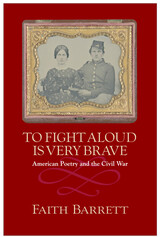
Focusing on literary and popular poets, as well as work by women, African Americans, and soldiers, this book considers how writers used poetry to articulate their relationships to family, community, and nation during the Civil War. Faith Barrett suggests that the nationalist “we” and the personal “I” are not opposed in this era; rather they are related positions on a continuous spectrum of potential stances. For example, while Julia Ward Howe became famous for her “Battle Hymn of the Republic,” in an earlier poem titled “The Lyric I” she struggles to negotiate her relationship to domestic, aesthetic, and political stances.
Barrett makes the case that Americans on both sides of the struggle believed that poetry had an important role to play in defining national identity. She considers how poets created a platform from which they could speak both to their own families and local communities and to the nations of the Confederacy, the Union, and the United States. She argues that the Civil War changed the way American poets addressed their audiences and that Civil War poetry changed the way Americans understood their relationship to the nation.
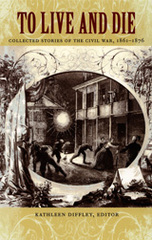
The authors, who include Louisa May Alcott and Mark Twain, depict the horrors of the battlefield, the suffering in prison camps and field hospitals, and the privations of the home front. In these pages, bushwhackers carry the war to out-of-the-way homesteads, spies work households from the inside, journeying paymasters rely on the kindness of border women, and soldiers turn out to be girls. The stories are populated with nurses, officers, speculators, preachers, slaves, and black troops, and they take place in cities, along the frontier, and on battlefields from Shiloh to Gettysburg.
The book opens with a prewar vigilante attack on the Underground Railroad and a Kansas parson in Henry King’s “The Cabin at Pharoah’s Ford” and concludes with an ex-slave recalling the loss of her remaining son in Twain’s “A True Story.” In between are stories written by both women and men that were published in magazines from the South and West as well as the culturally dominant Northeast. Wartime wood engravings highlight the text. Kathleen Diffley’s introduction provides literary and historical background, and her commentary introduces readers to magazine authors as well as the deepening disruptions of a country at war.
Just as they did for nineteenth-century readers, these stories will bring the war home to contemporary readers, giving shape to a crisis that rocked the nation then and continues to haunt it now.
READERS
Browse our collection.
PUBLISHERS
See BiblioVault's publisher services.
STUDENT SERVICES
Files for college accessibility offices.
RECENTLY PUBLISHED


UChicago Accessibility Resources
home | accessibility | search | about | contact us
BiblioVault ® 2001 - 2026
The University of Chicago Press