
 A SCHOLARLY BOOK REPOSITORY
13 start with T start with T

Winner of the Anisfield-Wolf Book Award
Winner of the Frederick Douglass Book Prize
Winner of the Elsa Goveia Book Prize
Winner of the James A. Rawley Prize in the History of Race Relations
Winner of the P. Sterling Stuckey Book Prize
Winner of the Harriet Tubman Prize
Winner of the Phillis Wheatley Book Award
Finalist for the Cundill Prize
“Brilliant…groundbreaking…Brown’s profound analysis and revolutionary vision of the Age of Slave War—from the too-often overlooked Tacky’s Revolt to the better-known Haitian Revolution—gives us an original view of the birth of modern freedom in the New World.”
—Cornel West
“Not only a story of the insurrection, but ‘a martial geography of Atlantic slavery,’ vividly demonstrating how warfare shaped every aspect of bondage…Forty years after Tacky’s defeat, new arrivals from Africa were still hearing about the daring rebels who upended the island.”
—Harper’s
“A sobering read for contemporary audiences in countries engaged in forever wars…It is also a useful reminder that the distinction between victory and defeat, when it comes to insurgencies, is often fleeting: Tacky may have lost his battle, but the enslaved did eventually win the war.”
—New Yorker
In the second half of the eighteenth century, as European imperial conflicts extended their domain, warring African factions fed their captives to the transatlantic slave trade while masters struggled to keep their restive slaves under the yoke. In this contentious atmosphere, a movement of enslaved West Africans in Jamaica organized to throw off that yoke by violence. Their uprising—which became known as Tacky’s Revolt—featured a style of fighting increasingly familiar today: scattered militias opposing great powers, with fighters hard to distinguish from noncombatants. Even after it was put down, the insurgency rumbled throughout the British Empire at a time when slavery seemed the dependable bedrock of its dominion. That certitude would never be the same, nor would the views of black lives, which came to inspire both more fear and more sympathy than before.
Tracing the roots, routes, and reverberations of this event, Tacky’s Revolt expands our understanding of the relationship between European, African, and American history as it speaks to our understanding of wars of terror today.
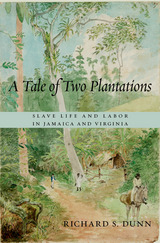
Forty years ago, after publication of his pathbreaking book Sugar and Slaves, Richard Dunn began an intensive investigation of two thousand slaves living on two plantations, one in North America and one in the Caribbean. Digging deeply into the archives, he has reconstructed the individual lives and collective experiences of three generations of slaves on the Mesopotamia sugar estate in Jamaica and the Mount Airy plantation in tidewater Virginia, to understand the starkly different forms slavery could take. Dunn’s stunning achievement is a rich and compelling history of bondage in two very different Atlantic world settings.
From the mid-eighteenth century to emancipation in 1834, life in Mesopotamia was shaped and stunted by deadly work regimens, rampant disease, and dependence on the slave trade for new laborers. At Mount Airy, where the population continually expanded until emancipation in 1865, the “surplus” slaves were sold or moved to distant work sites, and families were routinely broken up. Over two hundred of these Virginia slaves were sent eight hundred miles to the Cotton South.
In the genealogies that Dunn has painstakingly assembled, we can trace a Mesopotamia fieldhand through every stage of her bondage, and contrast her harsh treatment with the fortunes of her rebellious mulatto son and clever quadroon granddaughter. We track a Mount Airy craftworker through a stormy life of interracial sex, escape, and family breakup. The details of individuals’ lives enable us to grasp the full experience of both slave communities as they labored and loved, and ultimately became free.
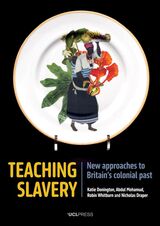
This groundbreaking book combines the latest academic research on Britain’s involvement in colonial slavery with innovative thinking on teaching “difficult histories” in the classroom. It addresses three main shortcomings in how slavery is taught in British secondary schools: insufficient teacher training in both historical content and pedagogy; a shortage of high-quality, research-informed teaching resources; and a lack of published guidance to support ethical and effective classroom engagement. Offering educators both historical and pedagogical approaches to discussing slavery, it examines key themes of race, gender, resistance, and abolition through illuminating historical examples.

Winner of the John H. Dunning Prize, American Historical Association
Winner of the Stuart L. Bernath Book Prize, Society for Historians of American Foreign Relations
Winner of the James H. Broussard Best First Book Prize, Society for Historians of the Early American Republic
Winner of the North Jersey Civil War Round Table Book Award
Finalist for the Harriet Tubman Prize, Lapidus Center for the Historical Analysis of Transatlantic Slavery
When the United States emerged as a world power in the years before the Civil War, the men who presided over the nation’s triumphant territorial and economic expansion were largely southern slaveholders. As presidents, cabinet officers, and diplomats, slaveholding leaders controlled the main levers of foreign policy inside an increasingly powerful American state. This Vast Southern Empire explores the international vision and strategic operations of these southerners at the commanding heights of American politics.
“At the close of the Civil War, more than Southern independence and the bones of the dead lay amid the smoking ruins of the Confederacy. Also lost was the memory of the prewar decades, when Southern politicians and pro-slavery ambitions shaped the foreign policy of the United States in order to protect slavery at home and advance its interests abroad. With This Vast Southern Empire, Matthew Karp recovers that forgotten history and presents it in fascinating and often surprising detail.”
—Fergus Bordewich, Wall Street Journal
“Matthew Karp’s illuminating book This Vast Southern Empire shows that the South was interested not only in gaining new slave territory but also in promoting slavery throughout the Western Hemisphere.”
—David S. Reynolds, New York Review of Books
Establishing himself as a fresh and important voice in the history of African American emancipation,William S. King provides a critical introduction to the lead-up to the Civil War. A skilled and judicious chronicler, King seamlessly weaves multiple and seemingly disparate threads, including early nineteenth-century Revivalism, the emergence of the Republic of Texas, the fugitive slave laws—and even the explosion of a cannon aboard the U.S.S. Princeton in 1844—to explain how the opposition to slavery in America changed from producing speeches and pamphlets to embracing the reality that slavery could be eradicated only through armed conflict. By tracing this transformation through the life of John Brown, King provides an entirely new assessment of this enigmatic figure who was characterized as a “mad man” in the wake of his butchering of proslavery settlers in Kansas and the inept raid on Harpers Ferry, Virginia. King puts these actions in context to explain the paradox of Brown’s legacy. On one hand he was vilified as an unstable threat to American democracy or a fanatical sideshow to the history of the Civil War, while on the other he was an inspiration to the oppressed, a man who garnered the indomitable Harriet Tubman’s commitment to the righteousness of his endeavor.
Elegantly written with a command of period sources, Till the Dark Angel Comes: Abolitionism and the Road to the Second American Revolution is the story of interracial opposition to slavery, the important debates among free blacks as to their future in America, and the arguments and compromises at the highest levels of government. Here we encounter many personalities of the time, some well known, such as Frederick Douglass,William Lloyd Garrison, and John C. Calhoun, and others less so, but no less important—Martin Delany, Henry Highland Garnet, and Elijah Lovejoy.
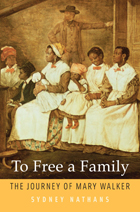
What was it like for a mother to flee slavery, leaving her children behind? To Free a Family tells the remarkable story of Mary Walker, who in August 1848 fled her owner for refuge in the North and spent the next seventeen years trying to recover her family. Her freedom, like that of thousands who escaped from bondage, came at a great price—remorse at parting without a word, fear for her family’s fate.
This story is anchored in two extraordinary collections of letters and diaries, that of her former North Carolina slaveholders and that of the northern family—Susan and Peter Lesley—who protected and employed her. Sydney Nathans’s sensitive and penetrating narrative reveals Mary Walker’s remarkable persistence as well as the sustained collaboration of black and white abolitionists who assisted her. Mary Walker and the Lesleys ventured half a dozen attempts at liberation, from ransom to ruse to rescue, until the end of the Civil War reunited Mary Walker with her son and daughter.
Unlike her more famous counterparts—Harriet Tubman, Harriet Jacobs, and Sojourner Truth—who wrote their own narratives and whose public defiance made them heroines, Mary Walker’s efforts were protracted, wrenching, and private. Her odyssey was more representative of women refugees from bondage who labored secretly and behind the scenes to reclaim their families from the South. In recreating Mary Walker’s journey, To Free a Family gives voice to their hidden epic of emancipation and to an untold story of the Civil War era.

Drawing on decades of research, and demonstrating remarkable command of a great range of primary sources, William S. King has written an important history of African Americans’ own contributions and points of crossracial cooperation to end slavery in America. Beginning with the civil war along the border of Kansas and Missouri, the author traces the life of John Brown and the personal support for his ideas from elite New England businessmen, intellectuals such as Emerson and Thoreau, and African Americans, including his confidant, Frederick Douglass, and Harriet Tubman. Throughout, King links events that contributed to the growing antipathy in the North toward slavery and the South’s concerns for its future, including Nat Turner’s insurrection, the Amistad affair, the Fugitive Slave law, the Kansas-Nebraska Act, and the Dred Scott decision. The author also effectively describes the debate within the African American community as to whether the U.S. Constitution was colorblind or if emigration was the right course for the future of blacks in America.
Following Brown’s execution after the failed raid on Harper’s Ferry in 1859, King shows how Brown’s vision that only a clash of arms would eradicate slavery was set into motion after the election of Abraham Lincoln. Once the Civil War erupted on the heels of Brown’s raid, the author relates how black leaders, white legislators, and military officers vigorously discussed the use of black manpower for the Union effort as well as plans for the liberation of the “veritable Africa” within the southern United States. Following the Emancipation Proclamation of January 1863, recruitment of black soldiers increased and by war’s end they made up nearly ten percent of the Union army, and contributed to many important victories.
To Raise Up a Nation: John Brown, Frederick Douglass, and the Making of a Free Country is a sweeping history that explains how the destruction of American slavery was not directed primarily from the counsels of local and national government and military men, but rather through the grassroots efforts of extraordinary men and women. As King notes, the Lincoln administration ultimately armed black Americans, as John Brown had attempted to do, and their role was a vital part in the defeat of slavery.
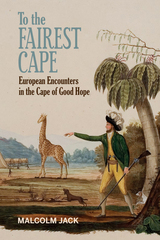
Published by Bucknell University Press. Distributed worldwide by Rutgers University Press.
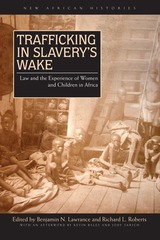
Women and children have been bartered, pawned, bought, and sold within and beyond Africa for longer than records have existed. This important collection examines the ways trafficking in women and children has changed from the aftermath of the “end of slavery” in Africa from the late nineteenth century to the present.
The formal abolition of the slave trade and slavery did not end the demand for servile women and children. Contemporary forms of human trafficking are deeply interwoven with their historical precursors, and scholars and activists need to be informed about the long history of trafficking in order to better assess and confront its contemporary forms. This book brings together the perspectives of leading scholars, activists, and other experts, creating a conversation that is essential for understanding the complexity of human trafficking in Africa.
Human trafficking is rapidly emerging as a core human rights issue for the twenty-first century. Trafficking in Slavery’s Wake is excellent reading for the researching, combating, and prosecuting of trafficking in women and children.
Contributors: Margaret Akullo, Jean Allain, Kevin Bales, Liza Stuart Buchbinder, Bernard K. Freamon, Susan Kreston, Benjamin N. Lawrance, Elisabeth McMahon, Carina Ray, Richard L. Roberts, Marie Rodet, Jody Sarich, and Jelmer Vos.
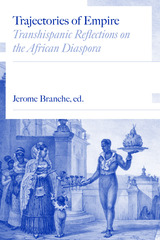
The book’s chapters explore what Blackness means in the so-called racial democracies of Brazil and Cuba today. Among the historical narratives and themes it covers are the role of medical science in the objectification and nullification of Black female personhood during slavery in nineteenth-century Brazil; the protocols of portraiture in the colonial period that, in including enslaved individuals, pictorially highlight and freeze their supposed inferiority vis-à-vis their owners; and those aspects of discourse that promote colonial capture and oppression in terms of evangelization and the saving of souls, or simply create the discursive template as early as the fifteenth century, for their continued alienation and marginalization across generations.
Trajectories of Empire’s contributions come from the fields of literary criticism, visual culture, history, anthropology, popular culture (rap), and cultural studies. As the product of an interdisciplinary collective, this book will be of interest to scholars in Iberian or Hispanic studies, Africana studies, postcolonial studies, and transatlantic studies, as well as the general public.

Before 1854, most Northerners managed to ignore the distant unpleasantness of slavery. But that year an escaped Virginia slave, Anthony Burns, was captured and brought to trial in Boston--and never again could Northerners look the other way. This is the story of Burns's trial and of how, arising in abolitionist Boston just as the incendiary Kansas-Nebraska Act took effect, it revolutionized the moral and political climate in Massachusetts and sent shock waves through the nation.
In a searching cultural analysis, Albert J. von Frank draws us into the drama and the consequences of the case. He introduces the individuals who contended over the fate of the barely literate twenty-year-old runaway slave--figures as famous as Richard Henry Dana Jr., the defense attorney, as colorful as Thomas Wentworth Higginson and Bronson Alcott, who led a mob against the courthouse where Burns was held, and as intriguing as Moncure Conway, the Virginia-born abolitionist who spied on Burns's master.
The story is one of desperate acts, even murder--a special deputy slain at the courthouse door--but it is also steeped in ideas. Von Frank links the deeds and rhetoric surrounding the Burns case to New England Transcendentalism, principally that of Ralph Waldo Emerson. His book is thus also a study of how ideas relate to social change, exemplified in the art and expression of Emerson, Henry Thoreau, Theodore Parker, Bronson Alcott, Walt Whitman, and others.
Situated at a politically critical moment--with the Whig party collapsing and the Republican arising, with provocations and ever hotter rhetoric intensifying regional tensions--the case of Anthony Burns appears here as the most important fugitive slave case in American history. A stirring work of intellectual and cultural history, this book shows how the Burns affair brought slavery home to the people of Boston and brought the nation that much closer to the Civil War.
READERS
Browse our collection.
PUBLISHERS
See BiblioVault's publisher services.
STUDENT SERVICES
Files for college accessibility offices.
RECENTLY PUBLISHED



UChicago Accessibility Resources
home | accessibility | search | about | contact us
BiblioVault ® 2001 - 2026
The University of Chicago Press