
 A SCHOLARLY BOOK REPOSITORY
4 start with U start with U
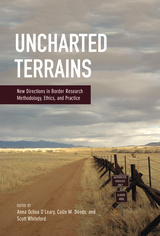
Each chapter raises methodological and ethical questions relevant to conducting research in transnational contexts, which can frequently be unpredictable or even volatile. The volume addresses the central question of how can scholars work with vulnerable migrant populations along the perilous US–Mexico border and maintain ethical and methodological standards, while also providing useful knowledge to stakeholders? Not only may immigrants be afraid to provide information that could be incriminating, but researchers may also be reluctant to allow their findings to become the basis of harsher law enforcement, unjustly penalize the subjects of their research, and inhibit the formulation of humane and effective immigration policy based on scholarly research.
All of these concerns, which are perfectly legitimate from the social scientists’ point of view, can put researchers into conflict with legal authorities. Contributors acknowledge their quandaries and explain how they have dealt with them. They use specific topics—reproductive health issues and sexually transmitted diseases among immigrant women, a study of undocumented business owners, and the administration of the Mexican Household Survey in Phoenix, among others—to outline research methodology that will be useful for generations of border researchers.
Assisted suicide remains one of the most emotionally charged and controversial topics—and the issue isn’t going away any time soon. As the baby boomer generation ages, many of us will watch as our parents—and ourselves—grow older, and wonder at the decisions that lie ahead.
Understanding Assisted Suicide provides both a fresh take on this important topic and the framework for intelligent participation in the discussion. Uniquely, the author frames the issue using his own experience watching both his parents die, which led him to ask fundamental questions about death, dying, religion, and the role of medicine and technology in alleviating human suffering.
In concerns about assisted suicide, each person’s “big picture” has largely been created out of picking and choosing from nine separate snapshot albums.
Understanding this offers a perspective for quickly determining the sources of another’s opinion on assisted suicide, as well as the issues they are not considering. Most importantly, Understanding Assisted Suicide offers a clear, easy-to-traverse landscape over which those who are sincerely looking for their own answers can navigate. The “nine-issue structure” allows both careful exploration of separate issues and a view of the full spectrum of ideas involved.


Utility and Rights was first published in 1984. Minnesota Archive Editions uses digital technology to make long-unavailable books once again accessible, and are published unaltered from the original University of Minnesota Press editions.
At issue in the clash between utilitarianism and the theory of rights is a fundamental question about the theoretical underpinnings of moral and political philosophy. Is this structure to be utility-based—grounded in the general welfare—or is it to be based on individual moral and political rights, as critics of utilitarianism increasingly insist? The argument centers, in part, upon the fact that utilitarianism, with its emphasis upon outcomes and total utility in the world, seems to employ a value theory that offers no protection to persons and their vital interests.
The essays in this volume grapple with the main issues in this controversy. They share a common concern with the nature of rights and the ways in which various moral theories can accommodate them; some measure the degree to which utilitarianism can or cannot be modified to include rights. Eight of the eleven essays were written expressly for this book; all of the authors are deeply engaged in the debate over utility and rights, and their essays build upon and extend current thinking on the subject. R. G. Frey's lucid introduction will make the book appropriate for advanced students as well as for scholars in moral, political, and legal theory.
"One ubiquitous criticism of utilitarianism is that it cannot make sense of moral rights at all. This collection is the first that explicitly addresses these issues, and it marks a major step in the debate."–Dale Jamieson, University of Colorado
R. G. Frey is senior lecturer in philosophy at the University of Liverpool. He is the author of Interests and Rights and Rights, Killing, and Suffering.
READERS
Browse our collection.
PUBLISHERS
See BiblioVault's publisher services.
STUDENT SERVICES
Files for college accessibility offices.
RECENTLY PUBLISHED



UChicago Accessibility Resources
home | accessibility | search | about | contact us
BiblioVault ® 2001 - 2025
The University of Chicago Press